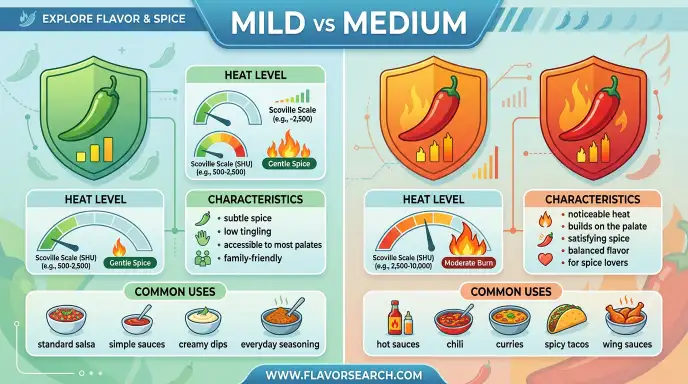
Mild and medium both describe something that is not extreme, but mild usually means less intense, while medium describes a middle level between lower and higher degrees. The exact difference depends on the context, such as food, weather, pain, flavor, or strength.
These two words are common in everyday English, but they can sometimes be confusing. A person may describe food as mild or medium, ask for a mild or medium sauce, or use these words to describe the severity of something. Although they can overlap, they do not always mean exactly the same thing.
“Mild” usually suggests a low level of intensity. “Medium” usually suggests a middle or moderate level. For example, mild food has little heat, while medium food has more heat but is not necessarily very hot.
Understanding the difference can help you choose the right word in conversations, writing, menus, product descriptions, and everyday situations.
Mild or Medium : Quick Answer
Mild usually means gentle, low in intensity, or not strong. Medium usually means a middle level between low and high.
For example:
- Mild sauce: Low heat or intensity.
- Medium sauce: More heat than mild, but less than hot.
- Mild weather: Not very cold, hot, or severe.
- Medium difficulty: Neither very easy nor very difficult.
Definition and Meaning of Mild
Mild means gentle, moderate, or not severe.
It can describe:
- Flavor
- Weather
- Pain
- Symptoms
- Behavior
- Temperatures
- Reactions
Example:
“The curry has a mild flavor.”
This suggests that the curry is not very spicy or strong.
Definition and Meaning of Medium
Medium means being in the middle of a range, size, degree, or level.
It can describe:
- Size
- Temperature
- Strength
- Difficulty
- Flavor
- Amount
- Intensity
Example:
“I ordered a medium pizza.”
Here, medium refers to size.
In “medium spicy,” it describes a level of heat between milder and hotter options.
The Origin of Mild and Medium
Origin of Mild
The word mild has Old English and Germanic roots. It has long been associated with meanings such as gentle, soft, pleasant, or not severe.
Over time, its meaning expanded into many areas of English.
Today, people can describe weather, food, pain, personality, and other conditions as mild.
Origin of Medium
Medium comes from Latin medius, meaning “middle.”
The word entered English through French and Latin based usage.
Its central idea has remained consistent: something positioned between two extremes or at an intermediate level.
That is why “medium” can describe both physical size and degrees of intensity.
Mild vs Medium: The Main Difference
The easiest way to understand the difference is to imagine a scale:
Low → Mild → Medium → Strong/High
However, this is only a general guide because different industries and situations use their own scales.
| Feature | Mild | Medium |
| Basic idea | Low intensity | Middle level |
| Strength | Usually lower | Moderate |
| Heat | Low | Moderate |
| Severity | Not severe | Moderate |
| Position on a scale | Toward the lower end | Around the middle |
| Common use | Food, weather, pain, symptoms | Size, strength, heat, difficulty |
| Example | Mild pain | Medium pain |
Mild or Medium for Food
Food is one of the most common situations where these words appear together.
What Does Mild Mean in Food?
When food is described as mild, it usually has a low level of spice, heat, or strong flavor.
Example:
“I prefer mild curry.”
This usually means the person does not want much chili or heat.
What Does Medium Mean in Food?
Medium usually indicates a middle level.
For spicy food, a typical scale might be:
Mild → Medium → Hot
Medium therefore generally has more heat than mild.
However, restaurants do not all use exactly the same scale. One restaurant’s medium may taste hotter than another restaurant’s medium.
Is mild less spicy than medium?
Usually, yes.
When talking about spicy food, mild normally means less spicy than medium.
Mild or Medium for Weather
Both words can describe weather.
Mild Weather
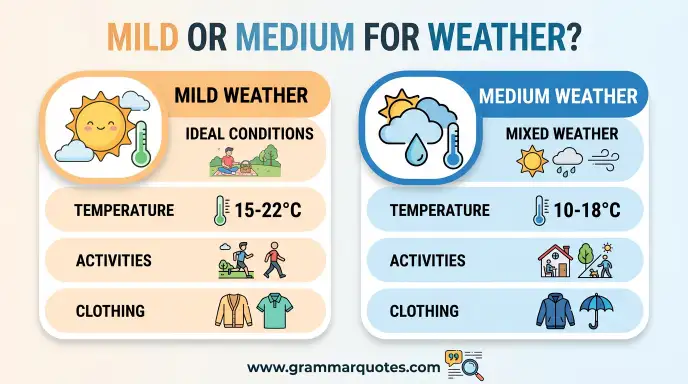
Mild weather is generally comfortable and not extreme.
Example:
“We had mild weather throughout the weekend.”
This can mean temperatures are neither extremely hot nor extremely cold.
Medium Weather?
“Medium weather” is not a common natural expression in standard English.
Native speakers are more likely to say:
- Mild weather
- Moderate weather
- Warm weather
- Cool weather
- Severe weather
So although “medium” means a middle level in many contexts, it does not work naturally with every noun.
Mild or Medium for Pain
Pain can also be described using levels.
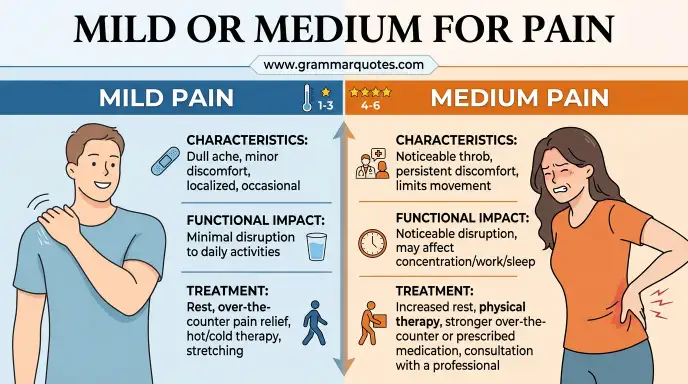
Mild pain usually means pain that is relatively low in intensity.
Moderate pain is a more common medical phrase than “medium pain.”
For example:
- Mild pain
- Moderate pain
- Severe pain
Therefore, if you are writing about pain in a medical context, mild and moderate are generally more natural than “mild and medium.”
Mild or Medium for Difficulty
Both words can describe difficulty, but they have slightly different natural uses.
You might say:
- Mild difficulty
- Moderate difficulty
- Medium difficulty
“Medium difficulty” is common in games, quizzes, courses, and rating systems.
Example:
“This level has medium difficulty.”
In more formal writing, moderate difficulty may sound more natural.
Mild or Medium for Strength
Both words can describe strength.
For example:
- Mild coffee
- Medium coffee
- Mild flavor
- Medium flavor
- Mild detergent
- Medium strength solution
The exact meaning depends on the product or scale being used.
If a product has several strength levels, “medium” usually means a middle option.
Medium or Mild for Temperature
“Mild” and “medium” are not always interchangeable when discussing temperature.
For weather, mild is natural:
“The winter has been mild.”
For cooking or food, medium can describe heat:
“Cook the steak over medium heat.”
For temperature settings, the word medium may simply mean a middle setting.
British English vs American English
There is no major spelling difference between mild and medium in British and American English.
| Word | British English | American English |
| Mild | Mild | Mild |
| Medium | Medium | Medium |
| Mildly | Mildly | Mildly |
| Moderately | Moderately | Moderately |
The main difference is not spelling but context and natural usage.
Which Word Should You Use?
Use mild when you want to emphasize that something is gentle, low in intensity, or not severe.
Medium when you want to describe a middle level, size, or setting.
Use “mild” for:
- Mild weather
- Mild pain
- Mild symptoms
- Mild flavor
- Mild spice
- Mild reaction
- Mild behavior
Use “medium” for:
- Medium size
- Medium heat
- Medium difficulty
- Medium strength
- Medium level
- Medium roast
- Medium setting
Remember that moderate can sometimes be a better formal alternative to both words.
Mild vs Medium: Comparison Table
| Context | Mild | Medium |
| Spicy food | Low heat | Moderate heat |
| Pain | Low intensity | Less natural than “moderate” |
| Weather | Common | Unnatural in many cases |
| Size | Not normally used | Very common |
| Difficulty | Possible | Very common |
| Strength | Low | Middle |
| Flavor | Gentle/light | Middle intensity |
| Cooking heat | Lower | Middle setting |
| Symptoms | Less severe | Usually “moderate” is preferred |
Common Mistakes With Mild and Medium
Mistake 1: Thinking they always mean the same thing
They overlap in some contexts, but they are not interchangeable everywhere.
Mistake 2: Saying “medium weather”
This is usually unnatural.
Better:
“We had mild weather.”
Or:
“We had moderate temperatures.”
Mistake 3: Using “medium pain” in formal medical writing
“Moderate pain” is generally more natural and precise.
Mistake 4: Assuming medium always means mild
Medium normally indicates a middle level, so it can be stronger than mild.
Mistake 5: Using mild to mean small
“Mild” refers mainly to intensity or severity.
For physical size, use:
- Small
- Medium
- Large
You would not normally say “mild size.”
Mild or Medium in Everyday Examples
Example 1: Food
“I ordered the mild curry because I don’t like very spicy food.”
Example 2: Restaurant Choice
“The medium salsa was hotter than the mild salsa.”
Example 3: Weather
“The city experienced mild temperatures in early spring.”
Example 4: Pain
“She reported mild pain after the activity.”
Example 5: Difficulty
“This is a medium difficulty puzzle.”
Example 6: Clothing
“I need a medium shirt.”
Here, “mild” would be incorrect because size is being described.
Medium or Mild: Which Is Stronger?
In many rating systems, medium is stronger than mild.
For example:
Mild → Medium → Hot
But this is not a universal rule.
When describing weather, “mild” does not mean a low setting on a simple strength scale. It usually means pleasant or not extreme.
This is why context matters when choosing between the two words.
Can Mild Mean Moderate?
Sometimes, yes.
“Mild” can mean relatively low or not severe, while moderate usually means somewhere in the middle.
For example:
- Mild pain = relatively low pain
- Moderate pain = middle level pain
- Severe pain = high level pain
Therefore, mild is generally weaker than moderate when describing intensity.
Is Medium the Same as Moderate?
Not always, but they are related.
Medium usually means a middle position, size, or level.
Moderate usually means reasonable, limited, or not extreme.
For example:
- Medium sized box
- Moderate difficulty
- Medium heat
- Moderate pain
Both words can describe an intermediate level, but one may sound more natural than the other depending on the context.
People Also Ask Questions
1. Is mild less than medium?
Usually, yes. Mild generally indicates a lower intensity, while medium indicates a middle level.
2. Is medium or mild more spicy?
Medium is usually spicier than mild.
3. What is the difference between mild and medium?
Mild means gentle or low in intensity, while medium usually means a middle level.
4. Is mild the same as moderate?
Not exactly. Mild generally suggests a lower level, while moderate usually suggests a middle level.
5. What does mild mean in food?
It usually means the food has relatively little spice or heat.
6. What does medium mean in food?
It usually means a middle level of spice, heat, flavor, or another characteristic.
7. Can you say medium weather?
“Medium weather” is not usually natural English. “Mild” or “moderate” is normally better.
8. Is mild pain better than medium pain?
“Mild pain” generally indicates less intensity. In formal medical language, “moderate pain” is more common than “medium pain.”
9. What comes after mild?
It depends on the scale, but a common sequence is mild, medium, and hot or strong.
10. Is medium a synonym for mild?
Not exactly. They can overlap when describing intensity, but medium usually means a middle level, whereas mild suggests lower intensity.
FAQs
What is the simplest difference between mild and medium?
Mild means low or gentle; medium means middle or moderate.
Which is hotter, mild or medium?
When talking about spicy food, medium is usually hotter than mild.
Is mild a positive word?
Usually, yes. It often suggests that something is gentle, comfortable, or not severe.
Is medium always stronger than mild?
Not necessarily. It depends on the context and the scale being used.
What is a formal alternative to medium?
Depending on the sentence, moderate can be a useful alternative.
What is the opposite of mild?
Possible opposites include severe, strong, intense, harsh, or extreme, depending on context.
What is the opposite of medium?
In a size scale, the opposite might be small or large. In an intensity scale, it might be low or high.
Final Guide: Mild or Medium
Mild and medium are both useful words for describing levels, but they do not mean exactly the same thing. Mild generally means gentle, low in intensity, or not severe. Medium usually means a middle level between lower and higher degrees.
The difference is especially easy to see with spicy food. Mild food usually contains less heat, while medium food has a higher level of heat. However, the meaning changes with context.
For weather, “mild” is natural, while “medium weather” usually is not. In size, “medium” is the normal word. For pain, “mild” and “moderate” are more natural than “mild and medium” in formal contexts.
The key is to think about what you are measuring. If you are describing something gentle or not severe, mild is often the better choice. If you are describing a middle position, size, or setting, medium is usually more appropriate.
Conclusion
Mild and medium are related words, but they have different uses. Mild usually describes something gentle, low in intensity, or not severe, while medium usually describes a middle level, size, or setting.
In food, medium is generally hotter or stronger than mild. In weather, mild is a natural choice, while medium is rarely used. Medical descriptions, mild and moderate are more common terms for levels of severity.
The best word depends on the noun and the context. You can say “mild pain,” “mild weather,” and “mild flavor,” while “medium size,” “medium heat,” and “medium difficulty” are natural choices.
Understanding this small difference can make your English more accurate and natural. When in doubt, ask if you are describing gentleness or a middle level. That simple distinction will help you choose the right word.
Discover More Articles!
Thats or That’s: Which Spelling Is Correct?(2026)
Strep or Tonsillitis: What Is the Difference?(2026)
Sunk vs Sank: Definitions, Examples, and Usage(2026)

Ethan Parker is an English-language writer known for his interest in words, language, and clear communication. His work focuses on making everyday English easier to understand through simple explanations and practical examples.