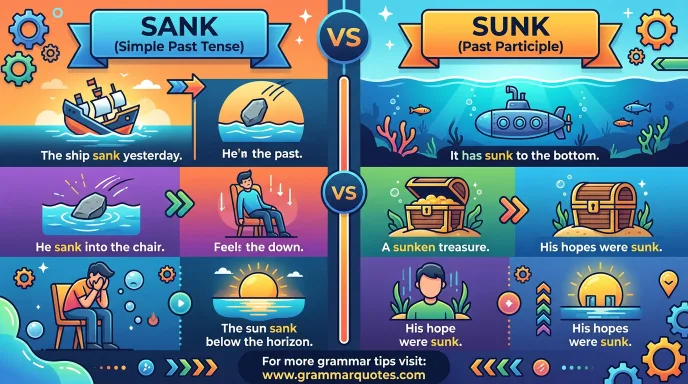
Sank and sunk are both forms of the verb sink, but they are used differently depending on the tense and sentence structure. Sank is the simple past tense, while sunk is mainly used as the past participle.
For example, you can say, “The boat sank yesterday,” because the action happened in the past. However, with has, have, or had, you normally use sunk: “The boat has sunk.”
Many English learners search for sunk or sank because both words describe the same basic action of moving downward or going below the surface. The confusion usually comes from knowing which form belongs in a particular sentence.
The good news is that the difference becomes simple once you understand the three main forms of sink:
Sink → sank → sunk
This article explains sunk or sank, their meanings, grammar rules, origins, examples, common mistakes, British and American English usage, and an easy trick to remember which form to use.
Sunk or Sank : Quick Answer
Sank is the simple past tense of sink, while sunk is the past participle.
- Sink → present/base form
- Sank → simple past
- Sunk → past participle
Examples
The ship sank yesterday.
The ship has sunk.
The boat had sunk before rescuers arrived.
The basic rule is:
Use “sank” for a simple past action.
Use “sunk” with an auxiliary verb such as has, have, or had.
Definition and Meaning
What Does Sink Mean?
Sink means to move downward, usually below the surface of water or another liquid. It can also mean to move to a lower position or become deeply involved in something.
Example:
The stone will sink in water.
What Does Sank Mean?
Sank is the simple past form of sink.
Example:
The stone sank to the bottom of the lake.
The action happened in the past.
What Does Sunk Mean?
Sunk is the past participle of sink.
It is normally used with helping verbs such as has, have, had, is, was, or been, depending on the sentence structure.
Examples:
The ship has sunk.
The boat had sunk before the storm ended.
The Origin of Sink, Sank, and Sunk
The verb sink comes from Old English and has been used for centuries to describe downward movement, especially going below water.
Like many common English verbs, sink is an irregular verb. Its past forms do not follow the normal ed pattern.
Instead, English uses different vowel changes:
Sink → sank → sunk
This type of verb is known as an irregular verb because its past forms are not created by simply adding ed.
Sank: When Should You Use It?
Use sank when you are describing a completed action in the simple past.
1. A Boat Sank
The boat sank during the storm.
2. Something Fell Into Water
The stone sank to the bottom.
3. A Person Moved Downward
He sank into the chair.
4. A Feeling Became Stronger
Sank can also be used figuratively.
My heart sank when I heard the news.
Here, sank does not mean physically moving downward. It describes a sudden feeling of disappointment, fear, or sadness.
5. A Situation Became Worse
The team’s chances sank after the defeat.
Again, the word is being used figuratively.
Sunk: When Should You Use It?
Use sunk mainly as a past participle.
It commonly appears after:
- has
- have
- had
- is
- was
- been
1. Present Perfect
The ship has sunk.
2. Past Perfect
The ship had sunk before help arrived.
3. Passive Construction
The boat was sunk during the battle.
In this sentence, sunk is part of a passive construction.
4. Figurative Use
The company has sunk a lot of money into the project.
Here, sunk means invested or put money into something.
Is Sank the Past Tense of Sink?
Yes.
Sank is the simple past tense of sink.
Examples:
The boat sank last night.
The temperature sank below zero.
His heart sank when he heard the result.
The important point is that sank normally stands alone as the main past tense verb.
Is Sunk the Past Tense of Sink?
Not exactly.
Sunk is the past participle of sink, not the standard simple past form.
For example:
❌ The boat sunk yesterday.
✅ The boat sank yesterday.
But:
✅ The boat has sunk.
So, if you are describing a simple past event without a helping verb, sank is normally the correct choice.
Sink, Sank, or Sunk?
The complete verb pattern is:
| Form | Word | Example |
| Present | Sink | The boat may sink. |
| Simple past | Sank | The boat sank yesterday. |
| Past participle | Sunk | The boat has sunk. |
This pattern is similar to other irregular verbs:
- drink → drank → drunk
- sing → sang → sung
- begin → began → begun
- sink → sank → sunk
The middle form usually describes the simple past, while the final form is used as a past participle.
Common Mistakes With Sunk or Sank
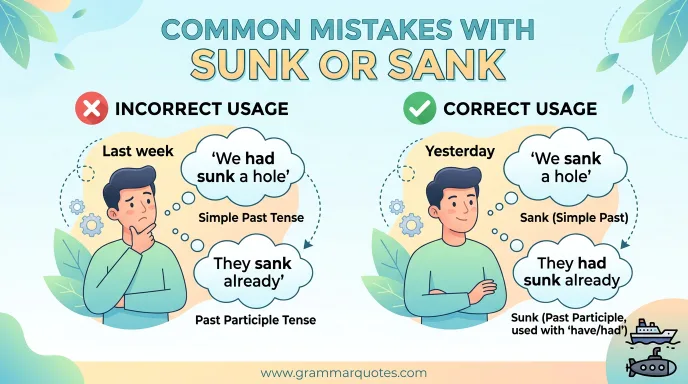
Mistake 1: Using Sunk as Simple Past
❌ The ship sunk yesterday.
✅ The ship sank yesterday.
Because yesterday indicates a simple past action, sank is normally used.
Mistake 2: Using Sank After “Has”
❌ The boat has sank.
✅ The boat has sunk.
After has, use the past participle sunk.
Mistake 3: Using Sank After “Had”
❌ The ship had sank before we arrived.
✅ The ship had sunk before we arrived.
Mistake 4: Confusing Sunk With Sunken
Sunken is another past participle form that is often used as an adjective.
For example:
The sunken ship was discovered underwater.
However, sank remains the simple past form.
Sank vs Sunk in Everyday Examples
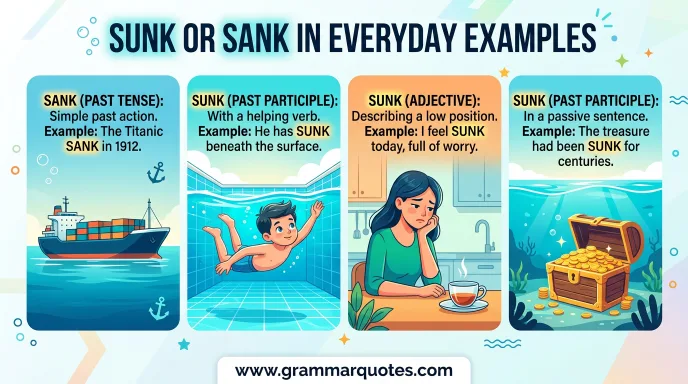
Here are some natural examples:
- The boat sank quickly.
- The ship has sunk.
- The stone sank to the bottom.
- The temperature sank overnight.
- His heart sank when he heard the news.
- The company has sunk millions into the project.
- The submarine sank below the surface.
- The water level had sunk considerably.
- The old ship was sunk during the conflict.
- Her hopes sank after the announcement.
Sunk or Sank in Formal Writing
Both sank and sunk are standard English forms, but their grammatical roles are different.
In formal writing, use sank as the simple past form:
The vessel sank in 1985.
Use sunk as the past participle:
The vessel had sunk before the investigation began.
Choosing the correct form makes your writing grammatically accurate and easier to understand.
British English vs American English
There is no major British American spelling difference between sank and sunk.
Both British and American English use:
Sink → sank → sunk
Examples:
British English:
The boat sank yesterday.
American English:
The boat sank yesterday.
Likewise:
The boat has sunk.
The grammar is essentially the same in both varieties.
Sunk or Sank in Passive Voice
Sunk can be used in passive constructions.
For example:
The ship was sunk during the war.
Here, the ship received the action.
Compare this with the active sentence:
The enemy sank the ship.
The difference is useful:
- Active: They sank the ship.
- Passive: The ship was sunk.
Sunk or Sank With Has, Have, and Had
A useful grammar rule is:
Has + sunk
The ship has sunk.
Have + sunk
Several boats have sunk.
Had + sunk
The ship had sunk before the rescue team arrived.
Do not normally use sank after these helping verbs.
❌ The ship has sank.
❌ The ship had sank.
✅ The ship has sunk.
✅ The ship had sunk.
Easy Trick to Remember Sunk or Sank
Use this three word pattern:
Sink → Sank → Sunk
Think of the middle word sank as the simple past form.
Think of sunk as the form that usually needs a helping verb.
Simple Memory Rule
Yesterday → sank
Has/Have/Had → sunk
For example:
The boat sank yesterday.
The boat has sunk.
This trick will help you choose the correct form in most everyday sentences.
Sunk or Sank: Comparison Table
| Feature | Sank | Sunk |
| Base verb | Sink | Sink |
| Grammar | Simple past | Past participle |
| Usually used alone | Yes | Usually no |
| Used with has/have/had | No | Yes |
| Example | The boat sank. | The boat has sunk. |
| British English | Yes | Yes |
| American English | Yes | Yes |
| Correct form | Yes | Yes |
Sunk or Sank : Google Trends & Usage
People often search “sunk or sank” because both words come from the same irregular verb and describe the same basic idea of moving downward.
The confusion is especially common in sentences such as:
- “The ship sank yesterday.”
- “The ship has sunk.”
- “The ship had sunk.”
Search interest around the two forms is generally connected to English grammar and irregular verbs rather than a difference between British and American spelling.
For learners, understanding the grammatical role of each word is more useful than simply memorizing that one is “right” and the other is “wrong.” Both are correct, but they belong in different sentence structures.
People Also Ask Questions About Sunk or Sank
1. Is it sunk or sank?
Both are correct forms of sink. Sank is the simple past, while sunk is the past participle.
2. Is sank the past tense of sink?
Yes. Sank is the simple past tense of sink.
3. Is sunk the past tense of sink?
Sunk is the past participle, not the normal simple past form.
4. Should I say “the boat sank” or “the boat sunk”?
Say “the boat sank” for a simple past sentence.
5. Should I say “has sank” or “has sunk”?
Use “has sunk.”
6. What are the three forms of sink?
The three main forms are sink, sank, sunk.
7. Is “sunk” grammatically correct?
Yes. Sunk is the correct past participle of sink.
8. Can you say “the ship has sank”?
No. In standard English, say “the ship has sunk.”
9. What is the difference between sank and sunk?
Sank is simple past, while sunk is the past participle.
10. What is the past participle of sink?
The past participle of sink is sunk.
Frequently Asked Questions
Is “sank” always the past tense?
Yes, sank is the standard simple past form of sink.
Is “sunk” always used with a helping verb?
Not always. It can also appear in certain adjective like or passive constructions, such as sunken being an adjective. But as a normal past participle, sunk commonly follows auxiliary verbs.
Which is correct: “The ship sank” or “The ship sunk”?
The ship sank is correct for the simple past.
Which is correct: “The ship has sank” or “The ship has sunk”?
The ship has sunk is correct.
What is the difference between sunk and sunken?
Sunk is the past participle of sink. Sunken is also used as a past participle/adjective, especially before nouns.
Example:
The ship has sunk.
The sunken ship was found underwater.
Can sank be used without “did”?
Yes.
The boat sank yesterday.
But after did, use the base form:
The boat did sink yesterday.
Not:
❌ The boat did sank yesterday.
Final Comparison: Sunk or Sank
The difference between sunk and sank becomes easy once you remember the three forms of the verb sink:
Sink → sank → sunk
Sank is the simple past form:
The boat sank yesterday.
Sunk is the past participle:
The boat has sunk.
This means both words are correct, but they cannot normally be exchanged freely. If the sentence describes a simple past action, use sank. If the sentence uses has, have, or had, use sunk.
The same rule works in many common sentences:
The temperature sank last night.
The temperature has sunk below zero.
Also remember that sunk can appear in passive constructions:
The ship was sunk during the battle.
Learning the pattern sink, sank, sunk is the easiest way to avoid mistakes.
Conclusion
Sank and sunk are both correct forms of the verb sink, but they have different grammatical functions. Sank is the simple past tense, while sunk is the past participle.
Use sank when describing a completed past action:
The boat sank yesterday.
Use sunk with helping verbs such as has, have, and had:
The boat has sunk.
The easiest way to remember the forms is:
Sink → sank → sunk
You can also use the simple memory rule “yesterday = sank” and “has/have/had = sunk.”
There is no important British American spelling difference here. Both varieties of English use the same forms and grammar.
Once you understand the difference between the simple past and past participle, choosing sank or sunk becomes much easier. The key is not to ask which word is correct in general, but which form the sentence requires.
Discover More Articles!
Nineth or Ninth: Which Spelling Is Correct?(2026)
Sewed vs Sowed: Definitions, Examples, and Usage(2026)
Poll or Pole: Meaning, Difference, and Correct Usage

Ethan Parker is an English-language writer known for his interest in words, language, and clear communication. His work focuses on making everyday English easier to understand through simple explanations and practical examples.