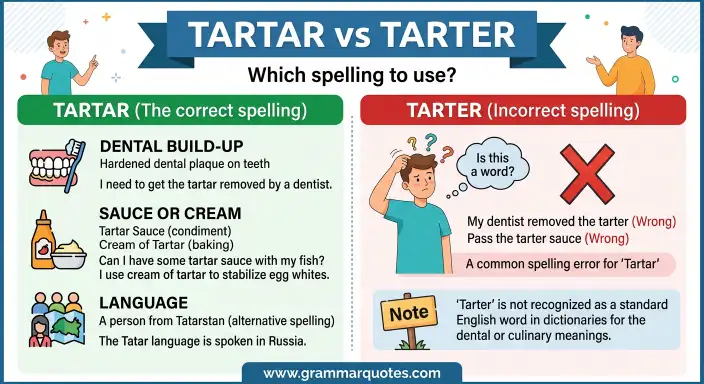
Tartar and tarter are both correct English words, but they have different meanings and uses. Tartar is commonly used for hardened deposits on teeth, a creamy sauce served with seafood, or a chemical substance called potassium bitartrate. Tarter is the comparative form of the adjective tart, meaning more sour, sharp, or harsh.
Imagine visiting a dentist who tells you that you have tartar on your teeth. Later, you taste two lemons and say that one tastes tarter than the other. Both words are correct in these situations, but they cannot be used interchangeably.
Many English learners confuse these words because their spelling differs by only one letter. Understanding their meanings helps you write more clearly in school assignments, everyday conversations, health related content, and food reviews.
In this guide, you will learn the definitions, pronunciation, origins, grammar rules, common mistakes, and everyday uses of both words. You will also find comparison tables and answers to frequently asked questions to help you choose the correct word.
Tartar or Tarter: Quick Answer
Both tartar and tarter are correct words. The right choice depends on the meaning of your sentence.
- Tartar (noun): A hardened deposit on teeth, a type of sauce, or a substance used in cooking.
- Tarter (adjective): More sour, sharp, or harsh than something else.
Examples:
- The dentist removed the tartar from my teeth.
- This lemon tastes tarter than the other one.
An Easy Way to Remember
Remember these simple rules:
- Tartar = a substance, deposit, or sauce.
- Tarter = more tart, sour, sharp, or harsh.
If you are comparing the taste of two foods, tarter may be the right choice. If you are talking about dental deposits or tartar sauce, use tartar.
Definition and Meaning
What Does “Tartar” Mean?
Tartar (noun): A word with several meanings, including hardened deposits on teeth, a sauce served with seafood, and a substance used in cooking.
Examples:
- The dentist found tartar near my gumline.
- We served fish with tartar sauce.
The meaning depends on the context.
What Does “Tarter” Mean?
Tarter (adjective): The comparative form of tart, meaning more sour, sharp, or biting in taste or tone.
Examples:
- The green apple tastes tarter than the red apple.
- Her reply sounded tarter than before.
The word can describe both flavor and speech. When it describes speech, it often suggests a sharper or more cutting tone.
What Does “Tart” Mean?
Tart can be an adjective or a noun.
As an adjective, it means sour or sharp in taste, or sometimes sharp in tone.
Examples:
- The berries have a tart flavor.
- He gave a tart response.
As a noun, tart can also mean a type of pastry with a filling.
Example:
- She baked an apple tart.
The Origin of Tartar and Tarter
Origin of “Tartar”
The word tartar has a long history in European languages. Its culinary and chemical uses developed through historical terminology for substances left behind during processes such as fermentation and winemaking. The word later became associated with deposits on teeth and tartar sauce.
Origin of “Tarter”
Tarter is formed from the adjective tart plus the comparative ending er.
- Tart = sour or sharp.
- Tarter = more sour or sharp.
This is a common English pattern, like fast → faster and dark → darker.
Historical Development
Old English (450–1100)
The modern word tartar was not commonly used in the same way during Old English. The adjective tart also developed later into its modern forms.
Middle English (1100–1500)
English adopted and developed words through contact with French and other European languages. Food related and descriptive vocabulary continued to grow.
Modern English (1500–Present)
Tartar became established in dental, culinary, and chemical contexts. Tarter developed naturally as the comparative form of tart and is used when comparing tastes or tones.
British English vs American English
Are Tartar and Tarter Different in British and American English?
The main distinction is the same in both varieties of English. Tartar is used as a noun, while tarter is the comparative form of tart.
| Feature | British English | American English |
| Dental deposits | Tartar | Tartar |
| Sauce | Tartar sauce | Tartar sauce |
| More sour | Tarter | Tarter |
| More sharp or biting in tone | Tarter | Tarter |
| Spelling difference | No major difference | No major difference |
Both spellings are standard in British and American English.
When Should You Use Tartar or Tarter?
Use “Tartar” for Dental Deposits
In dentistry, tartar refers to hardened dental plaque that builds up on teeth. It is also called dental calculus.
Examples:
- The dentist checked my teeth for tartar.
- Regular brushing and flossing help control plaque, which can harden into tartar.
Important: Once tartar has hardened, brushing alone generally cannot remove it. A dental professional can remove it during a cleaning.
Use “Tartar” for Food and Cooking
Tartar appears in food names and cooking terms.
Examples:
- Fish and chips are often served with tartar sauce.
- Cream of tartar is used in some baking recipes.
Cream of tartar is a powdered ingredient commonly used in baking. Despite its name, it is not the same thing as tartar on teeth.
Use “Tarter” When Comparing Sour Flavors
Use tarter when one food tastes more sour or sharp than another.
Examples:
- These green apples are tarter than the ripe ones.
- The sauce tastes tarter after adding lemon juice.
Use “Tarter” for a Sharper Tone
Tarter can also describe speech, comments, or expressions that sound more cutting or severe.
Examples:
- His response became tarter after the argument.
- The teacher gave a tarter reply than usual.
Common Mistakes with Tarter and Tartar
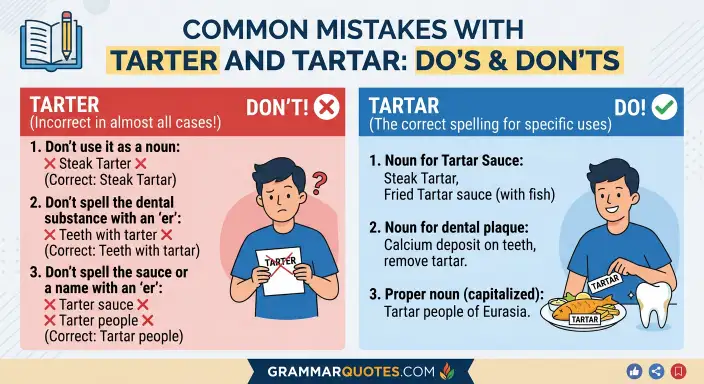
Mistake 1: Writing “Tarter” for Dental Deposits
Incorrect: The dentist removed the tarter from my teeth.
Correct: The dentist removed the tartar from my teeth.
Why? The dental substance is called tartar.
Mistake 2: Writing “Tartar” When Comparing Taste
Awkward: This lemon tastes tartar than that one.
Correct: This lemon tastes tarter than that one.
Why? Tarter is the comparative form of tart. You can also say “more tart.”
Mistake 3: Confusing Tartar Sauce with Cream of Tartar
Tartar sauce is a condiment, often served with seafood. Cream of tartar is a powdered cooking ingredient.
They have different uses, even though both contain the word tartar.
Mistake 4: Assuming “Tarter” Is Always a Misspelling
Incorrect claim: “Tarter is not a real word.”
Correct: “This fruit is tarter than the other one.”
Why? Tarter is a valid comparative adjective.
Mistake 5: Using “Tarter” as a Noun for Dental Calculus
Incorrect: I need to get the tarter removed.
Better: I need to get the tartar removed.
Why? In this context, the standard noun is tartar.
Tartar and Tarter in Everyday Examples
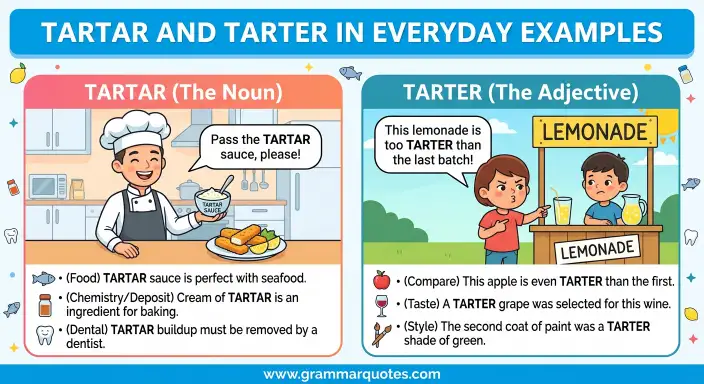
In Dental Care
- Tartar: The hygienist removed tartar during my dental cleaning.
- Tarter: Not normally used to describe dental deposits.
For Cooking
- Tartar: This recipe uses cream of tartar.
- Tarter: The lemon dressing tastes tarter with extra lemon juice.
In Food Reviews
- Tartar: The fish was served with tartar sauce.
- Tarter: The green apple was tarter than the sweet pear.
In Everyday Conversation
- Tartar: My dentist explained how tartar forms.
- Tarter: Today’s coffee tastes tarter than yesterday’s.
Describing Speech
- Tartar: The word is not normally used to compare someone’s tone.
- Tarter: His reply sounded tarter after the disagreement.
Tartar vs Tarter: Comparison Table
| Feature | Tartar | Tarter |
| Part of speech | Noun | Comparative adjective |
| Main meaning | Dental deposit, sauce, or chemical substance | More sour, sharp, or biting |
| Used in dentistry | Yes | No |
| Used in cooking | Yes | Yes, when comparing flavors |
| Used to compare tastes | Not usually | Yes |
| Used to compare tone | Not normally | Yes |
| Example | The dentist removed tartar. | This fruit is tarter. |
| Related word | Tartar sauce | Tart |
| British spelling | Tartar | Tarter |
| American spelling | Tartar | Tarter |
A Simple Trick to Remember the Difference
Think about if you are naming something or comparing something.
- Tartar: A thing, such as a dental deposit or sauce.
- Tarter: A comparison, meaning more tart.
Try these examples:
- The dentist removed the dental _____.
Answer: tartar - This apple is _____ than the other one.
Answer: tarter - We served the fish with _____ sauce.
Answer: tartar
Remember that tarter is formed by adding er to tart, just as sour becomes sourer.
Frequently Asked Questions
1. Is tartar or tarter correct?
Both are correct words. Tartar is a noun, while tarter is the comparative form of tart.
2. What is the difference between tartar and tarter?
Tartar can mean hardened dental deposits, a sauce, or a cooking ingredient. Tarter means more sour, sharp, or biting.
3. Is tarter a real English word?
Yes. It is the comparative form of tart.
4. Is tartar the same as plaque?
No. Plaque is a soft bacterial film that forms on teeth. When plaque hardens, it can become tartar, also called dental calculus.
5. What is tartar sauce?
Tartar sauce is a creamy condiment commonly served with fish and other seafood. Recipes often include mayonnaise, pickles, and other flavorings.
6. What is cream of tartar?
Cream of tartar is a powdered cooking ingredient, chemically known as potassium bitartrate. It is used in some baking recipes.
7. Does tarter mean more sour?
Yes. When describing taste, tarter means more sour or sharp.
8. Can tarter describe a person’s tone?
Yes. It can describe speech or a reply that sounds sharper, more cutting, or more severe.
9. Is tartar spelled differently in British and American English?
No. Tartar and tarter have the same standard spellings in British and American English.
10. How can I remember tartar vs tarter?
Remember that tartar names a substance or sauce, while tarter compares two things that differ in sourness or sharpness.
Conclusion
Understanding tartar or tarter is easy when you focus on their meanings. Tartar is a noun commonly used for hardened deposits on teeth, tartar sauce, and cream of tartar. Tarter is the comparative form of tart and means more sour, sharp, or biting. The two words are spelled differently because they perform different jobs in a sentence.
For example, a dentist removes tartar from teeth, while a person might describe a green apple as tarter than a sweet apple. Both words are correct, but choosing the right one depends on the context. Neither word is limited to British or American English.
Learning this distinction will help you write more accurately in everyday conversations, food reviews, dental content, and other forms of writing. Remember the simple rule: tartar is a noun, while tarter makes a comparison.
Discover More Articles!
Offered vs Offerred: Which Spelling Is Correct and Why It Matters
Orthopedics or Orthopaedics: Which Spelling Is Correct?(2026)
Bollard or Ballard: Which Spelling Is Correct?(2026)

Ethan Parker is an English-language writer known for his interest in words, language, and clear communication. His work focuses on making everyday English easier to understand through simple explanations and practical examples.