Confused about Warp or Woof? Learn the difference, meanings, and correct usage in simple English. This quick guide explains when to use each word with clear examples.
The confusion often comes from the expression “warp and woof.” This phrase combines the two weaving terms and is commonly used in a figurative sense to mean the basic structure, foundation, or essential parts of something. Merriam Webster defines “warp and woof” as a foundation or base.
There is also another reason this pair can be confusing. Woof has a completely different meaning in everyday English: it can represent the sound made by a dog. In a weaving context, however, woof has nothing to do with barking.
This guide explains the difference between warp and woof, their meanings, origins, regional usage, common mistakes, and the correct use of “warp and woof” in modern writing.
Warp or Woof: The Quick Answer for Google
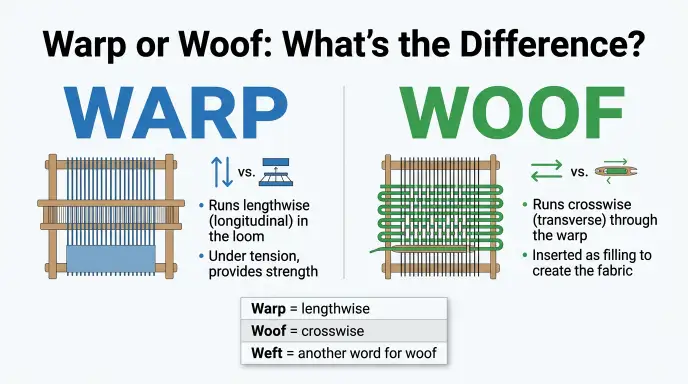
Warp and woof are both correct, but they refer to different threads in weaving. The warp consists of threads running lengthwise on a loom. The woof, also called the weft, consists of threads running across the warp. Together, they form woven fabric. Figuratively, “warp and woof” means the essential structure or foundation of something.
Warp or Woof: Quick Answer
Here is the simplest way to remember the difference:
- Warp = threads running lengthwise.
- Woof = threads running crosswise.
- Weft = another common word for woof.
- Warp and woof = the two sets of threads together.
- Warp and woof can also mean the fundamental structure of something.
Examples
- The warp threads were stretched tightly across the loom.
- The weaver passed the woof through the warp.
- Trust is part of the warp and woof of a strong friendship.
The third example uses the phrase figuratively. It means trust is an essential part of the relationship.
So, if you are asking “warp or woof?”, neither word is automatically more correct. The correct choice depends on which set of threads you mean.
What Does Warp Mean?
In weaving, warp is the set of yarns arranged lengthwise on a loom. These threads are usually held under tension while the weaver passes the crosswise yarn through them.
Merriam Webster defines warp as a series of yarns going lengthwise in a loom and crossed by the woof. The word also has unrelated meanings, including to twist or distort something from its original shape.
For example:
The weaver prepared the warp before beginning the pattern.
Here, warp is a technical weaving term.
The word also appears in ordinary English:
- The heat warped the wooden door.
- The experience warped his view of the world.
- The material became warped over time.
These meanings are different from the weaving sense.
Warp as a Figurative Noun
Warp can also refer to the underlying basis or structure of something. Merriam Webster lists “warp and woof” as a synonym for a foundation or base.
For example:
Family traditions form the warp of her worldview.
This use is less common than the literal weaving meaning but is still understandable in formal or literary writing.
What Does Woof Mean?
In weaving, woof refers to the threads that run across the warp. These threads are also commonly called the weft.
The American Heritage Dictionary defines woof as the threads that run crosswise in woven fabric, at right angles to the warp.
For example:
The colorful woof was woven through the dark warp.
The word woof can cause confusion because modern readers often associate it with a dog’s bark. In ordinary English, “woof” can indeed imitate the sound a dog makes.
So these two sentences have completely different meanings:
- The dog gave a loud woof.
- The weaver added another row of woof.
Context tells you which meaning is intended.
Woof and Weft
If you are learning textile vocabulary, remember that woof and weft can refer to the same crosswise threads.
In many modern explanations of weaving, weft is the more familiar term. “Woof” is still found in dictionaries and in the traditional phrase “warp and woof.”
The Origin of Warp and Woof
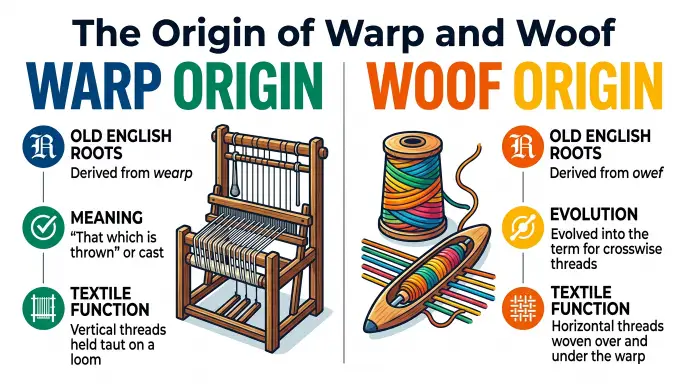
The two words have old roots connected with weaving and textile production.
Warp is an old English word associated with the lengthwise yarns used in weaving. Merriam Webster traces the noun to Middle English and Old English forms and records its first known use before the 12th century.
Woof has a more complicated history. The weaving noun developed from Middle English forms related to the threads of woven fabric. American Heritage traces it to Old English forms connected with weaving.
The spelling and form of woof were influenced by related weaving words such as warp and weft.
The expression “warp and woof” grew naturally from the idea that these two sets of threads work together to create a complete piece of fabric. Over time, the expression developed a figurative meaning.
Instead of referring only to cloth, writers began using it for the basic elements that make up a larger system, culture, relationship, or idea.
That is why you may see sentences such as:
Education is part of the warp and woof of modern society.
The writer is not talking about a literal loom. The phrase means education is deeply woven into the structure of society.
British English vs American English
There is little difference between British and American English when it comes to the basic meanings of warp and woof.
| Term | British English | American English | Example |
| Warp | Lengthwise threads in weaving | Lengthwise threads in weaving | The warp was placed on the loom. |
| Woof | Crosswise threads, also called weft | Crosswise threads, also called weft | The woof was woven through the warp. |
| Weft | Common term for crosswise threads | Common term for crosswise threads | The weft created the pattern. |
| Warp and woof | Literal and figurative expression | Literal and figurative expression | Culture is the warp and woof of society. |
The main difference is not usually regional spelling. It is frequency and context.
“Woof” is relatively specialized when it means a weaving thread. “Weft” is often easier for modern readers to recognize.
The phrase “warp and woof” remains established in English. Merriam Webster and Cambridge both provide examples of the expression being used figuratively.
Which Version Should You Use?
The best word depends on your audience and your subject.
In the United States
Use warp when referring to lengthwise threads and woof or weft when referring to crosswise threads.
For general readers, weft may be clearer than woof because many people know “woof” primarily as a sound made by a dog.
In the United Kingdom
The same basic distinction applies:
- Warp = lengthwise threads
- Woof/weft = crosswise threads
“Warp and woof” is also an established expression.
In Canada and Australia
The same textile distinction is generally understood. For technical writing, use the terminology preferred by your industry, textbook, or style guide.
For International Writing
If your audience may not know textile vocabulary, explain the term on first use.
For example:
The warp, or lengthwise threads, was placed under tension.
This removes ambiguity without adding much text.
For Academic Writing
Choose the terminology used by your academic field or source material. If discussing textile history, warp, weft, and woof may all be relevant.
If using warp and woof figuratively, make sure the surrounding sentence makes the meaning clear.
For Business Writing
“Warp and woof” is grammatically valid, but it can sound literary or old fashioned to some readers.
Instead of:
Communication is the warp and woof of our business.
You could write:
Communication is a fundamental part of our business.
Use the traditional phrase when its style fits your audience.
Common Mistakes With Warp and Woof
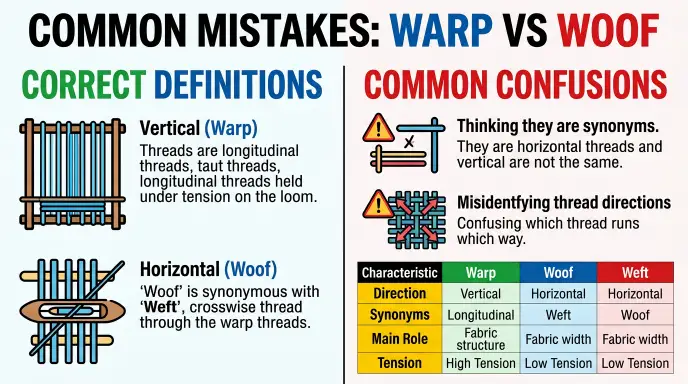
Mistake 1: Treating warp and woof as synonyms
Incorrect:
The warp and woof are the same type of thread.
Correct:
The warp and woof are two different sets of threads.
Explanation: Warp runs lengthwise, while woof runs crosswise.
Memory tip: Think of the two directions crossing each other to make fabric.
Mistake 2: Using “woof” only as a dog sound
Incorrect assumption:
Woof always refers to a dog’s bark.
Correct understanding:
Woof can refer to the crosswise threads in weaving.
Explanation: English words can have multiple meanings. Context determines the intended sense.
Mistake 3: Writing “warp or woof” when you mean the complete structure
If you mean the combination of the two, the established expression is:
warp and woof
For example:
These traditions are the warp and woof of the community.
The phrase means the essential elements or foundation of the community.
Mistake 4: Confusing woof with weft
Incorrect:
The warp is also called the weft.
Correct:
The woof is also called the weft.
The warp and weft are the two different directions of yarn in woven fabric.
Warp or Woof in Everyday Examples
Emails
These principles are part of the warp and woof of our company culture.
This is a formal, somewhat literary expression.
Business Writing
Customer service is part of the warp and woof of our organization.
Here, the phrase means customer service is fundamental to the organization.
News Headlines
Local Traditions Remain the Warp and Woof of Community Life
The phrase gives the headline a literary tone.
Blogs
Food is part of the warp and woof of every culture.
This means food is deeply connected with the structure and identity of culture.
Social Media
Music has always been part of the warp and woof of my life.
This is understandable, although a simpler phrase may feel more natural on social media.
Academic Writing
Language forms part of the warp and woof of social identity.
The expression can work well in humanities and cultural studies, especially when a more literary style is appropriate.
Daily Conversation
The literal words warp and woof are uncommon in ordinary conversation unless someone is discussing weaving.
A speaker might say:
What is the warp in this fabric?
But in everyday conversation, weft may be more familiar to people who know basic textile terminology.
Google Trends and Modern Usage
Searches for “warp or woof” are likely driven by several types of confusion.
First, people may encounter the unusual phrase “warp and woof” and want to know what it means. Second, readers may see woof and wonder if it refers to a dog sound or a textile term. Third, people learning about weaving may want to understand the difference between warp, woof, and weft.
There is no need to assume that one word is universally more popular based on a search phrase alone. Search interest can reflect confusion, educational research, dictionary lookups, or interest in a particular phrase.
Modern dictionaries still recognize both the literal weaving meaning and the figurative expression. Merriam Webster provides recent examples of “warp and woof” in discussions of culture, business, and history, showing that the phrase remains in use.
Cambridge also gives modern corpus examples in which “warp and woof” is used figuratively for the essential structure of society, politics, education, and other subjects.
The important point is this: warp and woof are not competing spellings. They are different words with different meanings.
Quick Comparison Table
| Version | Meaning | Correct? | Region | Example |
| Warp | Lengthwise threads in woven fabric | Yes | English speaking regions | The warp was stretched on the loom. |
| Woof | Crosswise threads in woven fabric | Yes | English speaking regions | The woof crossed the warp. |
| Weft | Crosswise threads in woven fabric | Yes | Widely used | The weft formed the pattern. |
| Warp and woof | Both thread systems together | Yes | British, American, and other English | They form the warp and woof of the fabric. |
| Warp and woof | Essential structure or foundation | Yes | General English | Trust is the warp and woof of friendship. |
| Woof | A dog’s bark or bark like sound | Yes | General English | The dog gave a loud woof. |
| Warp or woof | A question asking which term applies | Context dependent | General English | Is this the warp or the woof? |
Key Takeaways
- Warp means the lengthwise threads in woven fabric.
- Woof means the crosswise threads.
- Weft is another common term for woof.
- Warp and woof work together to create woven fabric.
- “Warp and woof” is an established phrase.
- Figuratively, “warp and woof” means the essential structure or foundation of something.
- Woof can also mean the sound made by a dog, so context matters.
- If you mean both elements together, use “warp and woof,” not “warp or woof.”
FAQs About Warp or Woof
1. What is a warp or woof in the Bible?
The Bible uses weaving terms when describing cloth and garments, especially in passages about wool, linen, and woven materials. Warp refers to the lengthwise threads, while woof refers to the threads woven across them. The exact wording can vary between Bible translations, so it is best to check the translation being studied.
2. What does the saying “warp and woof” mean?
“Warp and woof” means the basic structure, foundation, or essential parts of something. The phrase comes from weaving, where warp and woof threads work together to make fabric. For example, saying that family is the warp and woof of a community means family is a fundamental part of that community.
3. What does warp mean in slang?
Warp is not normally used as a common slang word in everyday English. Depending on context, however, “warp” can be used informally to describe something being twisted, distorted, or changed from its normal form. Its more established meanings relate to weaving, distortion, or figurative ideas.
4. What does woof mean?
Woof has two common meanings. In weaving, it refers to the threads that run across the warp, also known as the weft. In everyday English, “woof” represents the sound made by a dog. The context makes it clear which meaning is intended.
5. What is the difference between warp and woof?
The main difference is their direction in woven fabric. Warp threads run lengthwise on the loom, while woof threads run across them. They work together to create the finished fabric. So, when asking warp or woof, the correct term depends on which type of thread you mean.
6. Is woof the same as weft?
Yes. In textile terminology, woof can mean the same thing as weft. Both refer to the threads that pass across the lengthwise warp threads. “Weft” is often more familiar to modern readers, while “woof” is especially common in the traditional expression “warp and woof.”
7. Is “warp and woof” still used today?
Yes, although it has a somewhat literary or formal tone. Writers still use “warp and woof” to describe something that forms an essential part of a larger system, culture, or community. In simple everyday writing, words such as “foundation,” “basis,” or “essential part” may sound more natural.
8. What does “warp” mean in weaving?
In weaving, warp refers to the threads placed lengthwise on a loom. They are usually held under tension while the weft or woof threads are woven across them. This distinction is important when learning basic textile terms because warp and woof perform different roles in creating woven fabric.
9. What does “warp or woof” mean?
“Warp or woof” is usually a question about which type of thread is being described. Warp means the lengthwise threads, while woof means the crosswise threads. It should not be confused with “warp and woof,” which is the established expression referring to both threads or, figuratively, the essential structure of something.
10. How can I easily remember warp and woof?
A simple way to remember them is to focus on direction. Warp runs lengthwise, while woof runs across it. Once you picture a loom, the difference becomes much easier to remember. If both are being discussed together, use the familiar phrase “warp and woof.”
Conclusion
The difference between warp or woof is simple once you understand how weaving works. Warp refers to the threads that run lengthwise on a loom. Woof, also known as weft, refers to the threads that cross the warp. Both are correct terms, but they identify different parts of woven fabric.
The phrase “warp and woof” is different from the question “warp or woof.” When used literally, it describes the two systems of threads that make up woven material.
When used figuratively, it means the essential structure or foundation of something. Dictionaries continue to recognize this figurative meaning, and modern examples show the expression remains in use.
For clear modern writing, use warp for lengthwise threads and weft when you want the most familiar term for crosswise threads. Use woof when the textile context or traditional phrase calls for it.
The easiest rule to remember is: warp runs lengthwise, woof runs across, and together they make the fabric.
If this guide helped clear up the difference, use the same rule whenever you encounter these terms in books, dictionaries, textile guides, or formal writing.
Discover More Articles!
31th or 31st: Which Is Correct?
Telluride or Palisade: Which SUV Is Better?
Everybody’s vs Everybodies: Correct Spelling and Usage(2026)

Ethan Parker is an English-language writer known for his interest in words, language, and clear communication. His work focuses on making everyday English easier to understand through simple explanations and practical examples.