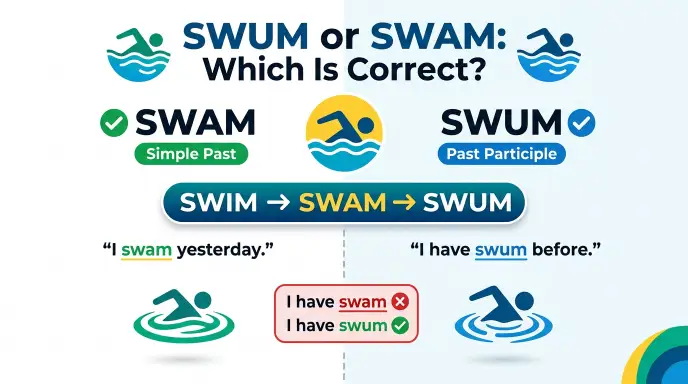
When choosing between swum or swam, the correct word depends on the tense and the structure of the sentence. Swam is the simple past tense of swim, while swum is the past participle and normally appears with an auxiliary verb such as have, has, had, or be.
This difference often confuses English learners because both words describe the same action: moving through water. The key is not the meaning, but the verb form and sentence structure. For example, “I swam yesterday” is correct, while “I have swum before” is correct. “I have swam” is not standard English.
In this guide, you will learn exactly when to use swam and swum, how they work in different tenses, common mistakes to avoid, and practical examples for everyday, academic, and professional writing.
Swum or Swam: The Quick Answer for Google & AI Overviews
Swam is the simple past tense of swim: “She swam across the lake.” Swum is the past participle: “She has swum across the lake.” Use swam without an auxiliary verb for a completed past action, and use swum after have, has, or had.
Swum or Swam : Quick Answer
The simplest way to remember the difference is:
- Swim = present/base form
- Swam = simple past
- Swum = past participle
- Swimming = ing form
Oxford lists the verb forms as swim, swam, swum, swimming.
Examples with swam
Use swam when talking about an action that happened in the past.
- I swam in the pool yesterday.
- She swam across the river.
- We swam for an hour last weekend.
Examples with swum
Use swum with an auxiliary verb in perfect constructions.
- I have swum in this pool before.
- She has swum across the lake.
- They had swum several miles before sunset.
The easiest rule
Swam = simple past. Swum = past participle.
If the sentence contains have, has, or had, swum is usually the form you need.
What Does Swum or Swam Mean?
Both swam and swum come from the verb swim, which means to move through water using your body, usually your arms and legs. Cambridge identifies swam as the past simple form and swum as the past participle.
The difference is grammatical rather than semantic.
What does swam mean?
Swam tells us that someone performed the action in the past.
For example:
Daniel swam across the pool.
The action happened in the past, and the sentence uses the simple past tense.
What does swum mean?
Swum is a past participle. It usually needs another verb to form a complete verb phrase.
For example:
Daniel has swum across the pool many times.
Here, has is the auxiliary verb, and swum is the past participle.
Compare the two
| Sentence | Verb | Why? |
| I swam yesterday. | Swam | Simple past |
| I have swum today. | Swum | Present perfect |
| She swam across the lake. | Swam | Simple past |
| She had swum across the lake. | Swum | Past perfect |
This distinction is the same in American and British English. The forms do not change by region.
The Origin of Swum or Swam
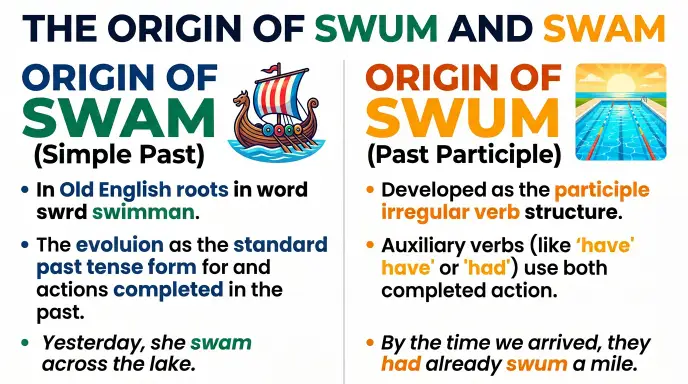
The words swam and swum are different forms of the same irregular verb, swim. Unlike regular verbs such as walk, which becomes walked in the past, swim changes its vowel to form its past and participle forms.
Oxford traces swim to Old English swimman, with Germanic connections including Dutch zwemmen and German schwimmen.
The modern pattern is:
swim → swam → swum
This type of verb is called an irregular verb because it does not form its past tense simply by adding ed.
The vowel changes can make English irregular verbs difficult for learners. However, learning the three main forms together makes the pattern much easier to remember.
I swim → I swam → I have swum
British English vs American English
There is no meaningful British versus American spelling difference between swam and swum. Both varieties use the same three principal forms: swim, swam, and swum. Oxford’s American dictionary and Cambridge both give swam as the past tense and swum as the past participle.
| British English | American English | Example |
| swim | swim | I swim every morning. |
| swam | swam | I swam yesterday. |
| swum | swum | I have swum here before. |
| swimming | swimming | She is swimming now. |
Regional differences
Unlike some English words that have different spellings in the UK and US, swam and swum follow the same standard grammar rules in both varieties.
So you do not need to choose swam for British English and swum for American English. Your choice depends on tense, not geography.
Style guides and publishing
Editors, teachers, and publishers generally expect the standard irregular verb pattern:
swim → swam → swum
Academic and professional writing should follow the same rule.
Which Version Should You Use?
The answer depends on the sentence rather than the country.
United States
Use swam for a simple past action:
I swam at the community pool yesterday.
Use swum with perfect constructions:
I have swum at that pool many times.
United Kingdom
The same distinction applies:
She swam in the sea last Sunday.
She has swum in the sea before.
Canada
Canadian English also follows the standard pattern:
We swam across the lake.
We have swum across it several times.
Australia
Australian English uses the same forms:
He swam five laps yesterday.
He has swum five laps already.
International writing
For international readers, focus on clear tense usage rather than regional spelling.
A useful formula is:
Past time + completed action → swam
Have/has/had + participle → swum
Academic writing
Academic writing often uses both forms.
- Swam: “The participants swam for 30 minutes.”
- Swum: “The participants had swum for 30 minutes before the test began.”
The important point is grammatical accuracy, not regional preference.
Business writing
Professional writing follows the same rule.
The team swam 2 kilometers during yesterday’s training session.
The team has swum more than 20 kilometers this month.
Common Mistakes with Swum or Swam
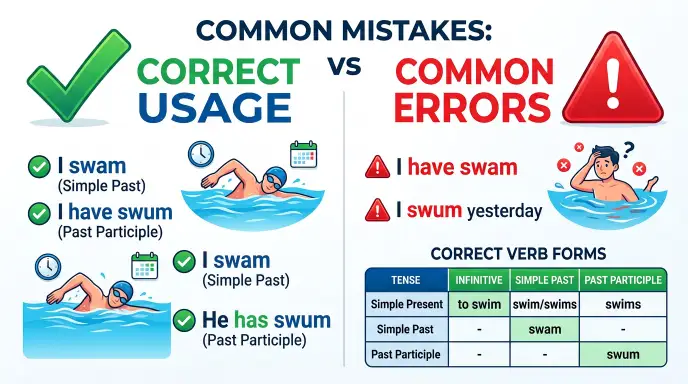
Mistake 1: Using swam after “have”
Incorrect:
I have swam in that pool before.
Correct:
I have swum in that pool before.
Why?
Have requires the past participle in a perfect construction.
Memory tip:
Have + swum, never standard have + swam.
Mistake 2: Using swum by itself as the simple past
Incorrect:
Yesterday, I swum across the lake.
Correct:
Yesterday, I swam across the lake.
Why?
The sentence uses the simple past, so the correct form is swam.
Memory tip:
If there is no auxiliary verb and you are describing a completed past action, think swam.
Mistake 3: Saying “I had swam”
Incorrect:
I had swam before the race began.
Correct:
I had swum before the race began.
Why?
Had is followed by the past participle.
Mistake 4: Confusing “swim” with “swam”
Incorrect:
Last weekend, we swim in the lake.
Correct:
Last weekend, we swam in the lake.
The time expression last weekend signals a completed past event.
Quick memory trick
Think of the three forms as a sequence:
Today: I swim.
Yesterday: I swam.
Before now: I have swum.
This simple pattern covers most everyday situations.
Swum or Swam in Everyday Examples
Seeing the words in real sentences is one of the fastest ways to understand the difference.
Emails
I swam at the hotel pool yesterday.
I have swum there several times this year.
Business writing
The athletes swam five kilometers during Monday’s training session.
The athletes have swum more than 100 kilometers this season.
News headlines
Headlines often use concise past tense structures:
Local Athlete Swam Across the River
If a perfect construction is needed in a full sentence, swum may appear:
The athlete has swum across the river several times.
Blogs
Last summer, I swam in the lake every morning.
I had never swum in open water before that trip.
Social media
I swam two miles today!
Can’t believe I’ve swum this far!
The grammar rule does not change because the writing is informal.
Academic writing
The participants swam for 20 minutes.
The participants had swum for 20 minutes before measurements were taken.
Daily conversation
“Did you swim yesterday?”
“Yes, I swam for an hour.”
“Have you ever swum in the ocean?”
“Yes, I have swum there several times.”
Google Trends & Modern Usage
People commonly search “swum or swam” because the two forms look and sound related but perform different grammatical jobs. Searches are especially useful for learners who encounter phrases such as “have swum” and wonder why swam cannot be used in the same position.
There is no need to assume that one form is more correct because of British or American English. Both swam and swum are standard forms in modern English. Cambridge and Oxford both identify swam as the past tense and swum as the past participle.
Usage is mainly determined by verb tense and sentence structure:
- swam appears in simple past constructions.
- swum appears as a past participle.
- Both are standard in US and UK English.
- Search confusion often comes from irregular verb patterns.
Exact search volume figures should not be claimed without current, verified keyword data. General usage patterns, however, clearly show why this is a common grammar question.
Quick Comparison Table
| Version | Meaning | Correct? | Region | Example |
| Swim | Present/base form | Yes | All English varieties | I swim every morning. |
| Swam | Simple past | Yes | All English varieties | I swam yesterday. |
| Swum | Past participle | Yes | All English varieties | I have swum before. |
| Swimming | Present participle/gerund | Yes | All English varieties | She is swimming now. |
| Have swam | Incorrect standard form | No | All varieties | ❌ I have swam. |
| Had swam | Incorrect standard form | No | All varieties | ❌ They had swam. |
Another useful comparison
| Situation | Correct Form | Example |
| Present action or habit | swim | I swim every week. |
| Completed past action | swam | I swam yesterday. |
| Present perfect | swum | I have swum today. |
| Past perfect | swum | I had swum before lunch. |
| Future perfect | swum | I will have swum ten miles by Friday. |
| Continuous action | swimming | I am swimming now. |
Key Takeaways
- Swam is the simple past form of swim.
- Swum is the past participle of swim.
- Use swam for a straightforward past action.
- Use swum after have, has, or had in perfect constructions.
- “I swam yesterday” is correct.
- “I have swum before” is correct.
- British and American English use the same forms.
- The best memory pattern is swim → swam → swum.
FAQs About Swum or Swam
Here are the frequently asked questions (FAQs) about the verb “swim” in English, formatted clearly for easy reading:
- Is “swum” a word?
Yes, “swum” is a real English word. It is the past participle form of the verb “swim” (e.g., swim, swam, swum). - Swum or swam (UK English)?
Both UK and US English follow the exact same grammar rules for this verb:- Use swam for simple past tense when there is no helping verb (e.g., “I swam yesterday”).
- Use swum for perfect tenses after helping verbs like have, has, or had (e.g., “I have swum”).
- “I haven’t swam” or “I haven’t swum”?
The correct sentence is “I haven’t swum.” Because the sentence contains “haven’t” (have not), it requires the past participle form “swum.” - How do you pronounce “swum”?
It is pronounced as /swʌm/. It rhymes with words like “sum,” “hum,” and “drum.” - What is the past participle of swim?
The past participle of swim is swum. - How do you use the past tense of swim in a sentence?
The simple past tense of swim is swam.- Example: “She swam two miles in the lake yesterday.”
- What are the past tense and past participle of swim?
- Base Form: Swim
- Past Tense (V2): Swam
- Past Participle (V3): Swum
- Is “I have swum” correct?
Yes, “I have swum” is completely grammatically correct. The auxiliary verb “have” is always followed by the past participle “swum.”
Conclusion
Choosing between swum or swam is much easier once you understand their grammatical roles. Both words are correct, but they cannot normally be used in the same places.
Swam is the simple past form, so it works in sentences such as “I swam yesterday.” Swum is the past participle, so it works with auxiliary verbs in sentences such as “I have swum before.”
The distinction is the same in British, American, Canadian, Australian, and international English. It is not a regional spelling issue. It is a question of verb tense and sentence structure.
For everyday writing, remember one simple sequence: swim → swam → swum. When you describe a completed past event, use swam. When you need a past participle after have, has, or had, use swum.
Once this pattern becomes familiar, you will avoid common errors such as “I have swam” and “I had swam.”
Remember: Swim today, swam yesterday, have swum before.
Discover More Articles!
Fringe or Bangs: Understanding the Difference(2026)
Misclick or Missclick: Common Spelling Mistake Explained(2026)
Graduate or Undergraduate: What’s the Difference?

Ethan Parker is an English-language writer known for his interest in words, language, and clear communication. His work focuses on making everyday English easier to understand through simple explanations and practical examples.