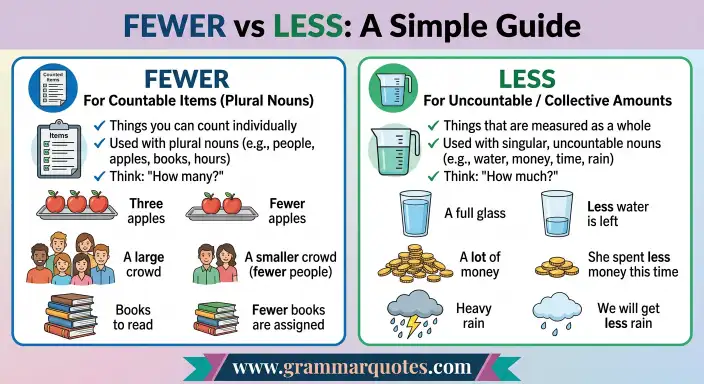
Have you ever wondered if to say “fewer mistakes” or “less mistakes”? Both fewer and less describe a smaller amount, but they are not always used in the same way. The main difference is that fewer is usually used with countable nouns, while less is usually used with uncountable nouns.
For example, you should say “fewer books” because you can count books one by one. However, “less water” is correct because water is usually measured rather than counted.
These words often confuse English learners because everyday speech does not always follow traditional grammar rules. You may also hear people use less with nouns that can be counted, especially when talking about time, money, distance, or measurements.
In this guide, you will learn the meaning of fewer and less, discover when to use each word, and explore common mistakes. You will also find practical examples, a comparison table, and answers to frequently asked questions. By the end, choosing between these two words will become much easier.
Fewer vs Less: Quick Answer
Use fewer with countable nouns and less with uncountable nouns.
- Fewer: Used with things you can count individually.
- Less: Used with things you usually measure or treat as a whole amount.
Examples of Fewer
- I made fewer mistakes this time.
- There are fewer students in the classroom today.
- She bought fewer apples than I did.
Examples of Less
- I need less sugar in my tea.
- We have less time than yesterday.
- He spends less money on clothes now.
Easy rule: If you can count the items separately, fewer is usually correct. If you measure the amount, less is usually correct.
Definition and Meaning
What Does Fewer Mean?
Fewer is the comparative form of few. It means a smaller number of people or things and is normally used with plural countable nouns.
Countable nouns are things you can count individually, such as books, chairs, students, and cars.
Examples:
- I have fewer books than my brother.
- Fewer people attended the meeting this year.
- We need fewer chairs for the event.
In each sentence, the noun refers to separate items or people that can be counted.
What Does Less Mean?
Less is the comparative form of little when referring to amount. It means a smaller quantity or degree and is usually used with uncountable nouns.
Uncountable nouns include things such as water, sugar, information, traffic, and furniture.
Examples:
- Please add less salt to the soup.
- There is less traffic on the road today.
- I need less information to complete this section.
Less can also describe time, distance, money, or degree.
Examples:
- The journey takes less than an hour.
- This bag costs less than that one.
- She feels less worried today.
The Origin of Fewer and Less
The Origin of Fewer
Fewer comes from few, a word with Old English roots. It has long been used to describe a small number of people or things.
Over time, fewer became the usual comparative form for comparing the number of countable items.
Examples:
- Fewer visitors came to the museum.
- We have fewer assignments this week.
The Origin of Less
Less also has Old English roots and is related to older Germanic words meaning smaller or not as much.
Today, it is commonly used to compare quantities, amounts, degrees, and measurements.
Examples:
- I drink less coffee than I used to.
- The second task requires less effort.
Although the words have related meanings, modern English generally distinguishes them by the type of noun they describe.
British English vs American English
The basic rule for fewer and less is the same in British and American English. Both varieties usually use fewer with countable nouns and less with uncountable nouns.
| Feature | British English | American English |
| Countable nouns | Fewer books | Fewer books |
| Uncountable nouns | Less water | Less water |
| Time | Less than an hour | Less than an hour |
| Money | Less than £10 | Less than $10 |
| Everyday speech | Some flexible uses | Some flexible uses |
Is Less Ever Used with Countable Nouns?
Yes. Although the traditional rule favors fewer with countable nouns, less is common and accepted in certain expressions involving time, distance, money, and measurements.
Examples:
- The trip is less than 10 miles.
- The item costs less than $20.
- We finished in less than five minutes.
You may also see less before numbers when referring to a total amount or measurement. However, in formal writing, use fewer for ordinary plural countable items.
For example:
- More traditional: Fewer than 20 students attended.
- Common and standard: Less than 20 miles away.
When to Use Fewer
Use fewer when comparing the number of separate people, objects, or items.
1. With People
Examples:
- Fewer students joined the class today.
- Fewer people use cash in some shops.
- Our team has fewer players this season.
The nouns students, people, and players refer to countable individuals.
2. With Objects
Examples:
- I bought fewer notebooks this month.
- There are fewer cars on the road.
- She owns fewer shoes than her sister.
You can count notebooks, cars, and shoes individually, so fewer is appropriate.
3. With Mistakes, Problems, and Tasks
Examples:
- I made fewer mistakes in my exam.
- The new system creates fewer problems.
- We have fewer tasks to finish today.
These nouns refer to separate things that can be counted.
4. With Plural Nouns in Formal Writing
In formal reports, academic work, and professional writing, fewer is generally the safer choice when the noun is countable.
Examples:
- The survey received fewer responses this year.
- The company recorded fewer complaints.
- The new process produced fewer errors.
When to Use Less
Use less when talking about an amount, quantity, degree, or something that is usually uncountable.
1. With Uncountable Nouns
Examples:
- I need less water.
- Add less sugar to your tea.
- We have less information than before.
Water, sugar, and information are normally treated as uncountable nouns in these sentences.
2. With Money and Spending
Examples:
- I want to spend less money this month.
- This phone costs less than the other model.
- She spends less on transport now.
Use less money because money is treated as an overall amount.
3. With Time and Distance
Examples:
- I need less time to finish this task.
- The new route takes less than an hour.
- The school is less than two miles away.
Time and distance can be measured, so less is common in these expressions.
4. With Abstract Ideas
Examples:
- He feels less stress at work.
- This task requires less effort.
- We need less patience for this simple activity.
Words such as stress, effort, and patience usually describe amounts or degrees rather than separate items.
Common Mistakes with Less and Fewer
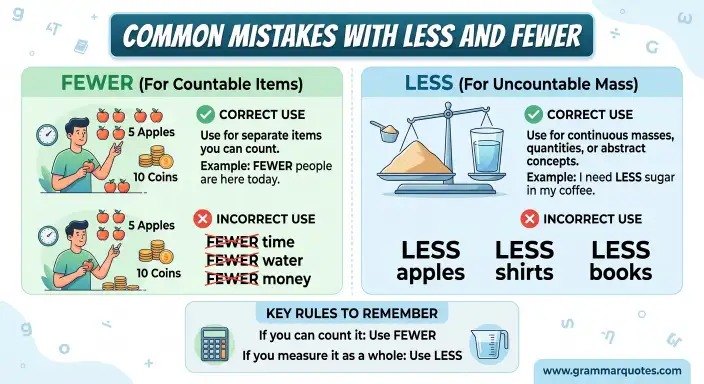
Mistake 1: Using Less with Countable Nouns
Incorrect: I have less books than you.
Correct: I have fewer books than you.
Why? Books are separate items that can be counted.
Mistake 2: Using Fewer with Uncountable Nouns
Incorrect: I drink fewer water now.
Correct: I drink less water now.
Why? Water is normally uncountable, so less is the right choice.
Mistake 3: Saying Less Mistakes
Incorrect in standard usage: I made less mistakes this time.
Better: I made fewer mistakes this time.
Why? Mistakes are separate events that can be counted.
Mistake 4: Forgetting Special Measurement Expressions
Incorrect: The road is fewer than five miles long.
Correct: The road is less than five miles long.
Why? In this sentence, less than five miles expresses a measurement of distance.
Mistake 5: Confusing Fewer with Fewest
Fewer compares two numbers or groups. Fewest usually identifies the smallest number among three or more groups.
Examples:
- Our class has fewer students than theirs.
- Of all the classes, ours has the fewest students.
Everyday Examples of Fewer vs Less
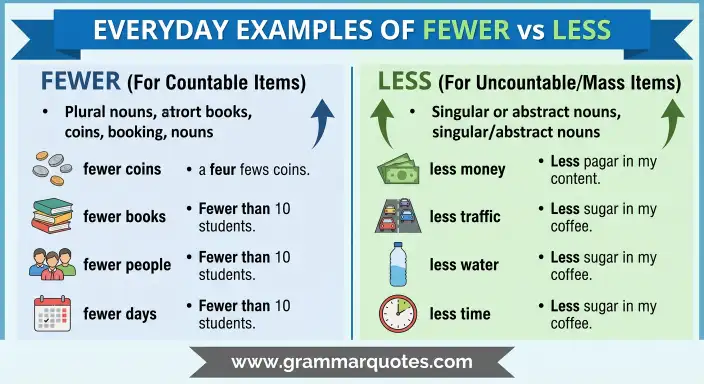
In Daily Conversation
- I have fewer errands to run today.
- Please put less milk in my coffee.
- We made fewer stops on this trip.
- I have less energy after a busy day.
In School and Academic Writing
- Students made fewer spelling mistakes after practice.
- The experiment used less water than expected.
- This essay contains fewer repeated words.
- The second question requires less explanation.
In Work and Professional Writing
- The company received fewer customer complaints.
- We need less time to process these orders.
- The new system produces fewer errors.
- This project requires less money than the previous one.
In Shopping and Everyday Spending
- I bought fewer items at the store.
- This laptop costs less than the other one.
- We purchased fewer bags this week.
- I spent less money during the sale.
Fewer vs. Less: Side by Side Comparison
| Feature | Fewer | Less |
| Main meaning | A smaller number | A smaller amount or degree |
| Usually used with | Countable plural nouns | Uncountable nouns |
| Example noun | Books | Water |
| Example sentence | I own fewer books. | I drink less water. |
| With mistakes | Fewer mistakes | Usually not preferred in standard writing |
| With time | Less than an hour | Less than an hour |
| With distance | Less than five miles | Less than five miles |
Can You Use Less with Countable Nouns?
Sometimes. Less is common in expressions about measurements, time, money, and distance, even when a number follows.
For ordinary countable nouns, however, fewer is usually the better choice.
Compare:
- Fewer than 10 students attended the class.
- The school is less than 10 miles away.
The first sentence counts individual students. The second describes a distance.
Easy Tricks to Remember the Difference
Trick 1: Ask “How Many?”
If the answer is a number of separate items, use fewer.
Examples:
- How many books? Fewer books.
- How many students? Fewer students.
- How many mistakes? Fewer mistakes.
Trick 2: Ask “How Much?”
If the answer refers to an amount, use less.
Examples:
- How much water? Less water.
- How much sugar? Less sugar.
- How much information? Less information.
Trick 3: Remember Countable and Uncountable Nouns
- Fewer = countable things.
- Less = uncountable amounts.
This rule works in most everyday sentences.
Trick 4: Learn Common Exceptions
Remember expressions such as less than an hour, less than five miles, and less than $20. These are normal English constructions.
Frequently Asked Questions
1. What Is the Difference Between Fewer and Less?
Fewer is usually used with countable plural nouns, while less is usually used with uncountable nouns or amounts.
2. Is It Fewer or Less People?
In standard English, fewer people is preferred because people can be counted individually.
Example: Fewer people attended the event.
3. Is It Fewer or Less Money?
Use less money because money is generally treated as an uncountable amount.
Example: I spent less money this month.
4. Is It Fewer or Less Time?
Use less time because time is normally treated as an amount.
Example: This task takes less time than the previous one.
5. Is It Fewer or Less Water?
Use less water because water is an uncountable noun in ordinary usage.
Example: We need less water to complete the experiment.
6. Is It Fewer or Less Mistakes?
Use fewer mistakes in standard English because mistakes are separate, countable events.
Example: She made fewer mistakes on her second test.
7. Can Less Be Used with Countable Nouns?
Yes, in certain expressions involving measurements, time, money, and distance. However, fewer is usually preferred with ordinary plural countable nouns.
8. Is It Less Than or Fewer Than?
Both expressions are correct, but they are used differently. Use fewer than for countable items and less than for amounts and measurements.
Examples: Fewer than 10 students attended. The trip took less than an hour.
9. What Is the Difference Between Fewest and Least?
Fewest refers to the smallest number of countable items. Least refers to the smallest amount or degree.
Examples: She made the fewest mistakes. He used the least water.
10. How Can I Remember Fewer vs. Less?
Ask yourself if you are counting items or measuring an amount. Use fewer for countable things and less for uncountable amounts.
Conclusion
The difference between fewer and less is simple once you understand countable and uncountable nouns. Use fewer when comparing the number of separate things, such as books, students, mistakes, or cars. Use less when comparing amounts or degrees, such as water, money, time, information, or effort.
For example, “I made fewer mistakes” is correct because mistakes can be counted. On the other hand, “I spent less money” is correct because money is treated as an amount.
Remember that English also has common expressions such as less than an hour and less than five miles. These are standard uses, even though a number appears in the phrase.
The easiest way to choose is to ask, “How many?” or “How much?” If you are counting individual items, fewer is usually the right choice. If you are describing an amount, less is usually better.
With practice, you can use both words naturally in conversations, school assignments, emails, and professional writing.
Discover More Articles!
Offered vs Offerred: Which Spelling Is Correct and Why It Matters
Boat or Ship: What’s the Difference?(2026)
YAML vs YML: What’s the Difference?(2026)

Ethan Parker is an English-language writer known for his interest in words, language, and clear communication. His work focuses on making everyday English easier to understand through simple explanations and practical examples.