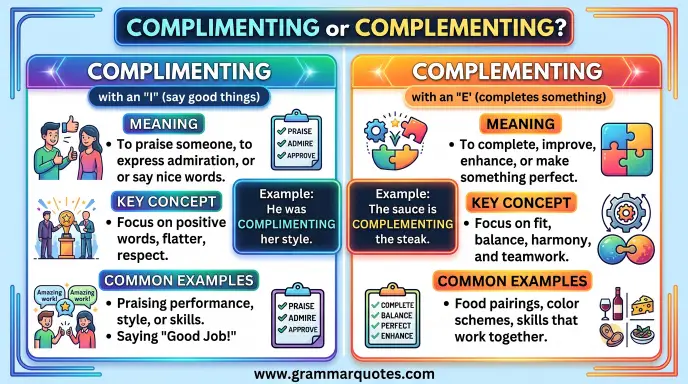
Complimenting and complementing are both correct words, but they have different meanings. Complimenting means praising someone, while complementing means completing, improving, or matching something well. Although these words sound alike, using the wrong one can change the meaning of your sentence.
For example, you are complimenting your friend when you tell them their presentation was excellent. However, you are complementing their presentation when you explain how its pictures make the information easier to understand.
The difference is simple once you learn what each word means. In this guide, you will discover their definitions, origins, spelling differences, and everyday uses. You will also learn common mistakes, easy memory tricks, and examples that help you choose the right word.
Quick Answer: Complimenting vs Complementing
The main difference is that complimenting means giving praise, while complementing means completing or enhancing something.
| Word | Meaning | Example |
| Complimenting | Praising someone or something | She is complimenting his artwork. |
| Complementing | Completing or improving something | The blue curtains are complementing the room. |
Remember: If you are praising someone, use complimenting. If something works well with or improves something else, use complementing.
What Does Complimenting Mean?
Complimenting means expressing admiration, approval, or praise. You can compliment someone on their appearance, skills, behavior, achievements, or ideas.
Examples:
- He is complimenting her cooking.
- My teacher was complimenting my essay.
- They kept complimenting his performance.
What Does Complementing Mean?
Complementing means adding something that completes, balances, or improves another thing. It can describe colors, flavors, skills, ideas, designs, and many other things.
Examples:
- The shoes are complementing her outfit.
- Lemon juice is complementing the flavor of the fish.
- Her communication skills are complementing his technical knowledge.
Definition and Meaning of Complimenting
Complimenting is the present participle of the verb compliment. It means saying something positive about a person, action, quality, or achievement.
People often give compliments to show appreciation, kindness, respect, or admiration. A compliment can be about someone’s work, personality, appearance, or effort.
Examples of Complimenting in Sentences
- I was complimenting my sister on her new hairstyle.
- The manager is complimenting the team for its hard work.
- She enjoys complimenting people when they do something well.
- He was complimenting the speaker’s confidence.
- My friends were complimenting my cooking skills.
When Should You Use Complimenting?
Use complimenting when someone is praising or expressing admiration for another person or thing.
Common situations include:
- Appearance: She is complimenting his new haircut.
- Work: The boss is complimenting her excellent report.
- Skills: The coach is complimenting the player’s performance.
- Personality: He was complimenting her kindness.
- Achievements: Everyone is complimenting them on their success.
Definition and Meaning of Complementing
Complementing is the present participle of the verb complement. It means completing, enhancing, or combining well with something else.
Two things can complement each other when they work together effectively or when one adds something that improves the other.
Examples of Complementing in Sentences
- The red flowers are complementing the white walls.
- Her calm personality is complementing his energetic nature.
- The sauce is complementing the taste of the meal.
- These two subjects are complementing each other.
- His leadership skills are complementing the team’s technical abilities.
When Should You Use Complementing?
Use complementing when something adds value, creates balance, or works well with another thing.
Common situations include:
- Clothing: Her handbag is complementing her dress.
- Colors: Green is complementing the golden decorations.
- Food: The spices are complementing the flavor of the dish.
- Skills: Their different strengths are complementing each other.
- Design: The furniture is complementing the room’s modern style.
Origin of Complimenting and Complementing
The words compliment and complement have similar historical roots and are related to older words associated with expressions of respect and completeness. Their spellings and meanings developed differently over time.
Compliment came into English through French and Italian forms associated with expressions of politeness and praise. Today, it refers to admiration or a positive remark.
Complement comes from Latin complementum, meaning something that completes or fills up. Its modern meaning still focuses on completion, enhancement, or something that goes well with another thing.
Their similar pronunciation makes them easy to confuse, but their meanings are different.
Complementing vs Complimenting: Key Differences
The easiest way to distinguish these words is to focus on what is happening in the sentence.
| Feature | Complimenting | Complementing |
| Main meaning | Giving praise | Completing or enhancing |
| Root word | Compliment | Complement |
| Common use | Admiration and appreciation | Balance, improvement, and compatibility |
| Typical object | A person, achievement, or quality | A color, design, flavor, skill, or item |
| Example | She is complimenting his speech. | The images are complementing his speech. |
| Memory clue | Praise | Complete |
Are Complimenting and Complementing Interchangeable?
No, these words are not interchangeable because they express different ideas.
Consider these sentences:
- She is complimenting his outfit. This means she is saying something nice about it.
- Her shoes are complementing his outfit. This means the shoes look good with the outfit or improve its overall appearance.
Changing one word can change the entire meaning of a sentence.
How to Remember Complimenting vs Complementing
You do not need to memorize complicated grammar rules. A simple spelling trick can help you choose the correct word.
1. Complimenting Has an “I”
Think of the letter I in complimenting as representing a person. You may say something nice to someone, such as, “I like your work.”
This is a memory trick, not the actual origin of the word.
Example: I am complimenting my friend on her drawing.
2. Complementing Has an “E”
Think of the letter E in complementing as standing for enhance or complete.
When one thing enhances or completes another, use complementing.
Example: The blue frame is complementing the painting.
3. Ask Yourself One Question
Before choosing a word, ask:
Am I praising something, or is something improving or completing something else?
- If you are praising, choose complimenting.
- If something is enhancing or completing something else, choose complementing.
This quick test works in most everyday situations.
Common Mistakes When Using Complimenting and Complementing
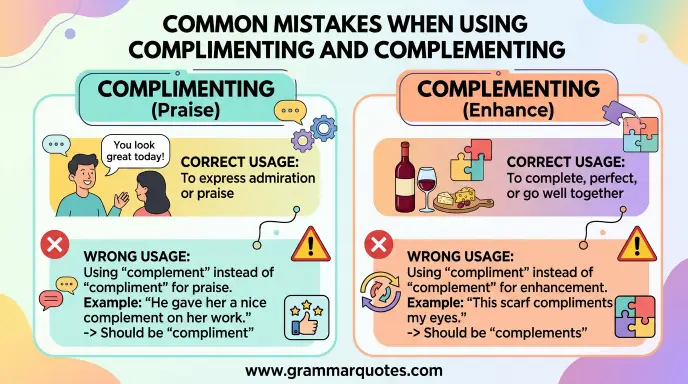
These words are often confused because they sound almost identical. Here are some common mistakes and their corrections.
Mistake 1: Using Complementing When You Mean Praising
Incorrect: She is complementing my presentation by saying it was excellent.
Correct: She is complimenting my presentation by saying it was excellent.
The sentence describes praise, so complimenting is correct.
Mistake 2: Using Complimenting When You Mean Improving
Incorrect: The blue curtains are complimenting the gray walls.
Correct: The blue curtains are complementing the gray walls.
The curtains go well with the walls, so complementing is the correct choice.
Mistake 3: Confusing the Nouns
The same distinction applies to the nouns compliment and complement.
- Compliment: Her teacher gave her a compliment.
- Complement: The scarf is a perfect complement to her coat.
A compliment is praise. A complement is something that completes or enhances something else.
Mistake 4: Assuming Both Words Mean “Making Something Better”
Complimenting can make someone feel appreciated, but it does not mean physically completing or improving something. Complementing describes how things work well together or add value to each other.
Correct: His teacher is complimenting his progress.
Correct: His practical experience is complementing his education.
Mistake 5: Forgetting the Spelling Difference
Both words begin with “compl ,” but the letters after that part are different.
- Complimenting = praise.
- Complementing = enhance or complete.
Paying attention to the i and e can help you avoid spelling mistakes.
Everyday Examples of Complimenting and Complementing
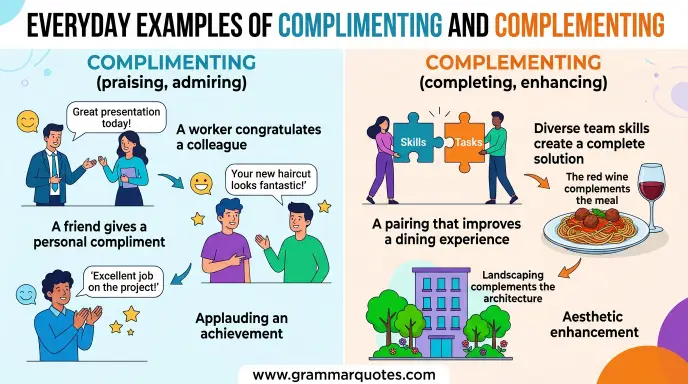
The following examples show how these words work in everyday conversations and writing.
Complimenting Examples
- She is complimenting her friend on her new dress.
- The teacher was complimenting the students for their effort.
- My parents keep complimenting my cooking.
- He is complimenting his colleague’s presentation.
- The customer was complimenting the restaurant’s service.
- They are complimenting her leadership skills.
- I was complimenting my brother on his progress.
- Everyone started complimenting the singer.
- The coach is complimenting the team after the match.
- She enjoys complimenting people on their achievements.
Complementing Examples
- The shoes are complementing her dress.
- The curtains are complementing the furniture.
- This sauce is complementing the flavor of the chicken.
- Her experience is complementing his knowledge.
- The lighting is complementing the room’s design.
- These colors are complementing each other.
- The new software is complementing the existing system.
- His creativity is complementing her planning skills.
- The side dish is complementing the main course.
- The illustrations are complementing the written explanation.
Complimenting or Complementing in Different Contexts
The correct choice becomes easier when you consider the situation.
In Personal Conversations
Use complimenting when someone says something positive about another person.
Example: He is complimenting his friend on his new shoes.
Use complementing when two things work well together.
Example: His shoes are complementing his suit.
In Fashion and Design
Use complimenting when a person praises a style or design.
Example: The designer is complimenting her choice of colors.
Use complementing when colors, accessories, or design elements look good together.
Example: The gold earrings are complementing her black dress.
In Food and Cooking
Use complimenting when someone praises a dish.
Example: The guests are complimenting the chef on the meal.
Use complementing when one ingredient enhances another flavor.
Example: The fresh herbs are complementing the soup.
In Work and Education
Use complimenting when a person praises someone’s work or effort.
Example: The manager is complimenting the employee on her report.
Use complementing when skills, knowledge, or tools work well together.
Example: His research skills are complementing her writing abilities.
People Also Ask About Complimenting and Complementing
1. What is the difference between complimenting and complementing?
Complimenting means praising someone or something. Complementing means completing, enhancing, or working well with something else.
2. Is complimenting someone correct?
Yes. Complimenting someone means expressing praise or admiration for that person.
Example: She is complimenting her friend on her hard work.
3. Is complementing a word?
Yes. Complementing is the present participle of complement, which means to complete, improve, or go well with something.
4. How do you spell complimenting correctly?
Spell it complimenting when you mean giving praise. The word contains an i after “compl.”
5. How do you spell complementing correctly?
Spell it complementing when you mean enhancing or completing something. The word contains an e after “compl.”
6. Is it complimenting or complementing an outfit?
Both can be correct, depending on the meaning.
- Complimenting an outfit means praising it.
- Complementing an outfit means matching or enhancing it.
7. Can a person complement another person?
Yes. A person can complement another person when their qualities, abilities, or personalities work well together.
Example: Their different strengths complement each other.
8. What is an example of complimenting?
“She is complimenting her colleague on his excellent work.”
This sentence describes praise.
9. What is an example of complementing?
“The silver necklace is complementing her blue dress.”
This sentence describes two things that look good together.
10. What is the easiest way to remember the difference?
Remember I = complimenting someone and E = complementing or enhancing something. This simple memory trick can help you choose the right spelling.
Conclusion
Complimenting and complementing may sound alike, but they have different meanings. Complimenting means praising someone or something, while complementing means completing, enhancing, or matching something well.
Use complimenting when someone expresses admiration, such as praising a friend’s work or a colleague’s achievement. Use complementing when two things work well together, such as colors in a room, flavors in a meal, or skills in a team.
The easiest way to remember the difference is to associate the i in complimenting with giving praise and the e in complementing with enhancing or completing. Once you understand this distinction, you can use both words confidently in everyday conversations, emails, and formal writing.
Discover More Articles!
Southpaw or Orthodox: What Is the Difference?(2026)
Aldi or Lidl: What Is the Difference?
Drove or Driven: What Is the Difference?(2026)

Ethan Parker is an English-language writer known for his interest in words, language, and clear communication. His work focuses on making everyday English easier to understand through simple explanations and practical examples.