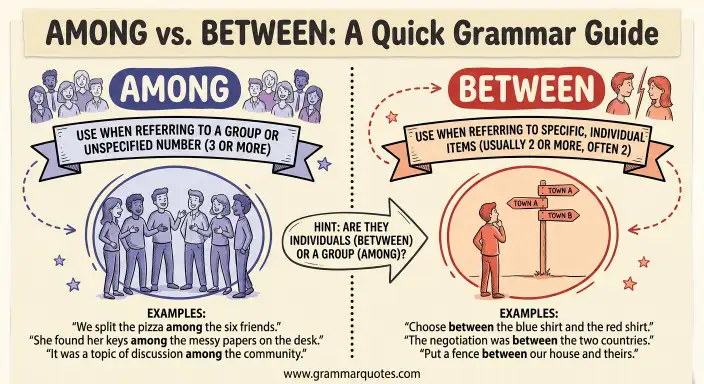
Have you ever wondered if to say “between the three friends” or “among the three friends”? Both among and between describe relationships involving people or things, but they are used in different ways. Between usually refers to separate people or things, while among usually refers to people or things considered as part of a group.
For example, you might say, “The money was divided between Ali and Ahmed” because you are talking about two people. However, “She felt comfortable among her classmates” means she felt comfortable as part of a group.
Many English learners believe that between is only used for two things and among is always used for three or more. This is a helpful starting point, but it is not a complete rule. Between can also be correct when discussing more than two clearly separate people or things.
In this guide, you will learn the meaning of among and between, understand when to use each word, and explore common mistakes. You will also find practical examples, comparison tables, and answers to frequently asked questions.
Among vs Between: Quick Answer
Use between for separate or distinct people and things. Use among when referring to someone or something within a group.
- Between: Often describes a relationship, choice, difference, or division involving distinct people or things.
- Among: Usually describes something surrounded by, included in, or shared within a group.
Examples of Between
- The ball rolled between the two chairs.
- The agreement was made between the three companies.
- She had to choose between tea and coffee.
Examples of Among
- He felt relaxed among his friends.
- The teacher distributed the books among the students.
- A small cottage stood among the trees.
Easy rule: Use between when the items are viewed separately. Use among when they are viewed as part of a group.
Definition and Meaning
What Does Between Mean?
Between is a preposition used to describe the position, relationship, or connection of someone or something in relation to distinct people or things.
It often appears when talking about two people or objects, but it can also be used with more than two when the individual items are clearly identified or treated separately.
Examples:
- The shop is between the bank and the school.
- The decision is between you and me.
- The prize was divided between the four winners.
In the last example, the four winners are treated as distinct individuals receiving their shares.
What Does Among Mean?
Among is a preposition used when someone or something is surrounded by, included in, or part of a group.
It is especially common when the members of the group are not being considered individually.
Examples:
- She was sitting among her classmates.
- The lost key was found among the papers.
- There was a sense of excitement among the crowd.
In these sentences, the people or objects are viewed as part of a larger group.
The Origin of Among and Between
The Origin of Between
Between comes from Old English betweonum, which referred to a position or relationship involving two sides or points. Over time, its meaning expanded to cover relationships among distinct people, objects, places, and ideas.
Today, it is used for physical positions as well as choices, agreements, comparisons, and relationships.
Examples:
- The village lies between two hills.
- There is a difference between the two answers.
The Origin of Among
Among comes from Old English ongemang, a word associated with being in a crowd or mixture. Its historical meaning reflects the modern idea of being within a group.
Today, it is commonly used when describing people or things surrounded by, included in, or mixed with others.
Examples:
- The child played among the flowers.
- The news spread quickly among the workers.
Although both words can describe relationships involving several things, their typical meanings remain different.
British English vs American English
The basic rules for among and between are the same in British and American English. Neither variety has a different spelling for these words.
| Feature | British English | American English |
| Position between two objects | Between | Between |
| Relationship among group members | Among | Among |
| Choice involving distinct options | Between | Between |
| Something within a crowd | Among | Among |
| Spelling difference | None | None |
Is There a Difference in Usage?
There is no major difference in the standard rules. Both British and American English use between for distinct relationships and among for membership in a group.
Examples:
- British English: She shared the sweets among the children.
- American English: She shared the candy among the children.
- Both: The agreement was between the three organizations.
The choice between sweets and candy reflects a regional vocabulary difference, not a difference between among and between.
When to Use Between
Use between when describing a relationship involving distinct people, objects, places, or choices.
1. Between Two People or Things
This is the most familiar use of between.
Examples:
- The park is between my house and the library.
- There is a strong bond between the sisters.
- The secret must stay between you and me.
The two people or places are identified separately.
2. Between More Than Two Distinct Items
A common grammar myth says that between must only be used for two things. In fact, it can be used with more than two when each person, place, or thing is treated as distinct.
Examples:
- The negotiations continued between Pakistan, China, and Turkey.
- The prize money was divided between the five winners.
- The road runs between the three buildings.
In these examples, the parties or places are treated as separate entities.
3. When Making a Choice
Use between when choosing from distinct alternatives.
Examples:
- I cannot decide between the red shirt and the blue shirt.
- She had to choose between three universities.
- We need to decide between the available plans.
4. When Describing Differences or Relationships
Between is common when comparing separate things or describing connections.
Examples:
- What is the difference between these two words?
- There is a clear link between sleep and concentration.
- The teacher explained the relationship between the two ideas.
When to Use Among
Use among when referring to something within a group or surrounded by several people or things.
1. Among a Group of People
Examples:
- He felt happy among his friends.
- The teacher walked among the students.
- There was excitement among the audience.
The focus is on the group rather than on each person separately.
2. Among Objects or Places
Examples:
- The small house stood among tall trees.
- I found my notebook among the books.
- A red flower grew among the green plants.
These examples describe something located within a larger collection.
3. When Sharing Within a Group
Use among when something is distributed within a group, especially when the group is viewed collectively.
Examples:
- The teacher distributed the worksheets among the students.
- The food was shared among the guests.
- The news spread among the employees.
Note that between can also be correct when the recipients are treated as distinct individuals receiving separate shares.
4. When Describing Opinions Within a Group
Examples:
- The proposal was popular among the workers.
- There was disagreement among the team members.
- The new policy caused concern among parents.
In these sentences, the focus is on the views or feelings present within a group.
Common Mistakes with Among and Between
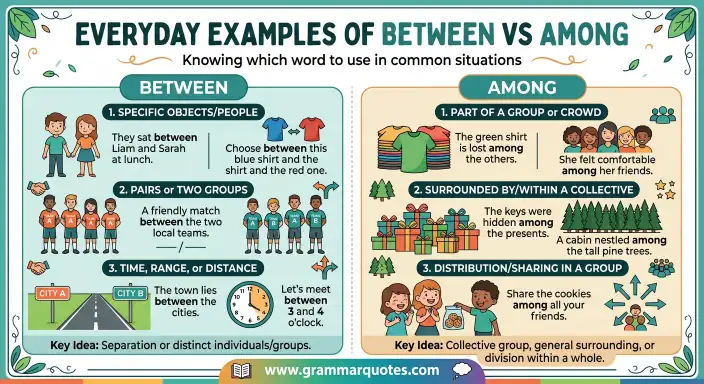
Mistake 1: Thinking Between Is Only for Two
Incorrect rule: Between can only be used for two things.
Better rule: Between is often used for two things, but it can also describe relationships among more than two distinct items.
Example:
Correct: The agreement was signed between the three companies.
Mistake 2: Using Among for Two Clearly Identified Items
Incorrect: The shop is among the bank and the school.
Correct: The shop is between the bank and the school.
Why? The sentence identifies two specific places that define the shop’s location.
Mistake 3: Using Between for a General Group
Less natural: She felt comfortable between the crowd.
Better: She felt comfortable among the crowd.
Why? Among is more natural when describing being part of or surrounded by a crowd.
Mistake 4: Assuming the Number Always Decides the Word
Incorrect rule: Use between for two and among for three or more.
Better rule: Think about if the people or things are treated as distinct individuals or as a group.
Examples:
- The deal was between the four partners.
- She was standing among the four children.
Both sentences are correct because they describe different relationships.
Everyday Examples of Between vs Among
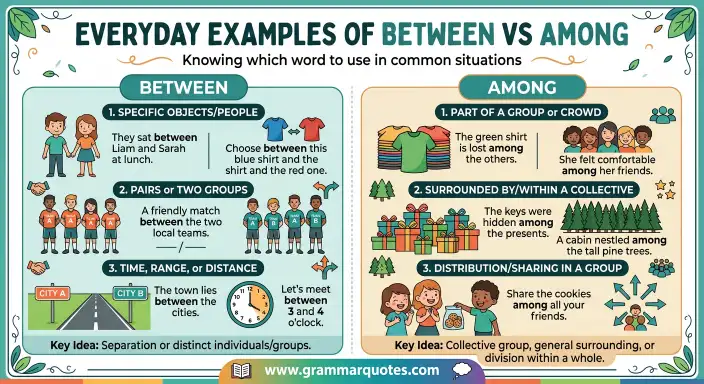
In Daily Conversation
- The café is between the bank and the pharmacy.
- I enjoy spending time among my friends.
- We had to choose between three movies.
- There was a lot of laughter among the children.
School and Academic Writing
- The teacher explained the difference between nouns and verbs.
- The students discussed the topic among themselves.
- The research explored the relationship between sleep and memory.
- The survey found agreement among most participants.
In Work and Professional Writing
- The contract was negotiated between the three companies.
- The manager encouraged cooperation among employees.
- There was a disagreement between the two departments.
- The new policy caused concern among customers.
In Travel and Everyday Activities
- The hotel is located between the station and the airport.
- We walked among the trees in the park.
- The road passes between three large buildings.
- A small village lies among the mountains.
Among vs Between: Side by Side Comparison
| Feature | Between | Among |
| Main idea | Relationship between distinct items | Being part of a group |
| Common use | Choices, agreements, positions | Groups, crowds, collections |
| Number of items | Two or more | Usually three or more |
| Example | The deal was between the partners. | She was among her friends. |
| Physical location | Between two buildings | Among the trees |
| Group relationships | Between distinct parties | Within a group collectively |
Can Between Be Used for Three or More Things?
Yes. Use between when the people or things are distinct and the relationship involves them separately.
For example:
“The agreement between the three countries was announced yesterday.”
The countries are separate parties to the agreement, so between is correct.
Can Among Be Used with Two Things?
In ordinary usage, among is most natural when referring to a group or collection. It is not usually used to describe a simple relationship between two clearly identified items.
For example:
- Better: The ball rolled between the two chairs.
- Better: The ball was hidden among the chairs.
The first sentence identifies the two chairs as separate boundaries. The second describes the ball as part of a larger arrangement of chairs.
Easy Tricks to Remember the Difference
Trick 1: Think of Separate Items
If the sentence focuses on individual people, places, or things, between is often correct.
Examples:
- Between Ali and Ahmed.
- Between three different universities.
- Between the bank and the school.
Trick 2: Think of a Group
If someone or something is surrounded by or included in a group, use among.
Examples:
- Among friends.
- Among the trees.
- Among the students.
Trick 3: Do Not Count Only the Items
Do not automatically choose between for two things and among for three or more. Consider how the items relate to one another.
Examples:
- The deal was between the four partners.
- She was among the four partners.
Both can be correct, but their meanings are different.
Trick 4: Ask What the Sentence Emphasizes
Ask yourself: “Am I describing a relationship between distinct things, or am I describing something within a group?”
- Distinct relationship: between.
- Group membership or surroundings: among.
Frequently Asked Questions
1. What Is the Difference Between Among and Between?
Between usually describes a relationship involving distinct people or things. Among usually describes someone or something as part of a group.
2. Is Between Only Used for Two Things?
No. Between can be used with more than two people or things when they are treated as distinct individuals or parties.
3. Is Among Used for Three or More People?
It is commonly used for groups of three or more, but the important point is if the people are being viewed as a group rather than as separate parties.
4. Is It Between or Among Friends?
Both can be correct, depending on the meaning. “Between friends” can describe a relationship or conversation involving distinct friends, while “among friends” usually means within a group of friends.
5. Is It Between or Among the Students?
Both may be correct. Use between when referring to specific relationships or separate students. Use among when describing something within the student group.
6. Can I Say Between Three Countries?
Yes. For example, “The agreement between three countries” is correct because each country is a distinct party.
7. Can Among Be Used for Two Things?
It is usually not the natural choice when referring to a simple relationship between two specific things. In that case, between is generally better.
8. Is Among or Between Correct in British English?
Both words are used in British English, following the same general rules as American English.
9. What Is the Difference Between Amongst and Among?
Amongst has the same basic meaning as among. It is more common in British English and can sound slightly more formal, but the two are generally interchangeable.
10. How Can I Remember Among vs. Between?
Use between for relationships involving distinct items and among for something within a group. Remember that the meaning matters more than the number of items.
Conclusion
The difference between among and between depends on how you view the people or things in a sentence. Use between when describing a relationship, choice, or position involving distinct individuals or items. Use among when describing someone or something as part of a group or surrounded by a collection.
For example, “The shop is between the bank and the school” identifies two specific places. However, “The cottage stood among the trees” describes the cottage as part of a larger group of trees.
Remember that between is not limited to two items. It can also be correct with three or more distinct people, countries, organizations, or objects. The best way to choose is to focus on the relationship rather than simply counting the items.
With regular practice, you will learn to use both words naturally in conversations, school assignments, emails, and professional writing. Keep the basic rule in mind: between for distinct relationships, among for group membership or surroundings.
Discover More Articles!
Offered vs Offerred: Which Spelling Is Correct and Why It Matters
Boat or Ship: What’s the Difference?(2026)
YAML vs YML: What’s the Difference?(2026)

Ethan Parker is an English-language writer known for his interest in words, language, and clear communication. His work focuses on making everyday English easier to understand through simple explanations and practical examples.