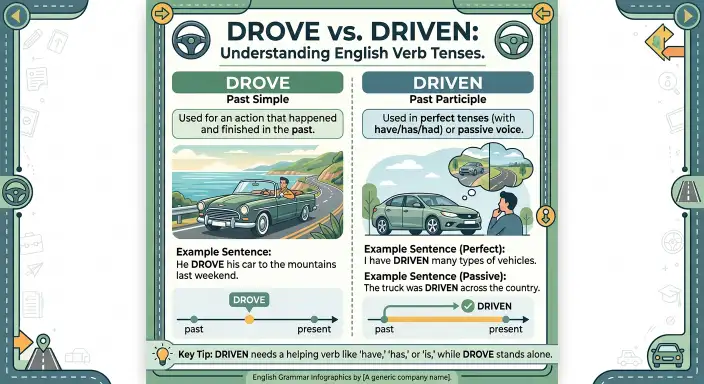
Drove and driven are both correct forms of the verb drive, but they are used differently. Drove is the simple past tense, while driven is the past participle.
The main difference is that drove usually stands alone to describe a completed action in the past, whereas driven is commonly used with helping verbs such as has, have, or had.
For example, “I drove to school yesterday” is correct because the sentence describes a completed action in the past. However, “I have driven to school many times” is correct because the present perfect tense uses have with the past participle driven.
Many English learners confuse these words because they describe the same action and look similar. However, choosing the correct form is important for clear and accurate writing.
In this guide, you will learn the meanings of drove and driven, understand their grammar rules, explore everyday examples, and discover common mistakes. You will also find simple memory tricks and answers to frequently asked questions to help you use both words correctly.
Drove or Driven: Quick Answer
Use drove when talking about a completed action in the simple past tense. Use driven when a sentence needs the past participle of drive, usually with a helping verb.
- Drove: Simple past tense of drive.
- Driven: Past participle of drive.
Examples:
- I drove to work yesterday.
- I have driven to work many times.
- She had driven for three hours before stopping.
The first sentence uses the simple past. The second uses the present perfect, and the third uses the past perfect.
Definition and Meaning
What Does Drove Mean?
Drove is the simple past tense of the verb drive.
It describes an action that happened and finished in the past. It is often used when talking about driving a car or another vehicle.
Examples:
- He drove to the office yesterday.
- We drove to the beach last weekend.
- She drove her parents to the airport.
In each sentence, drove describes an action that took place in the past.
What Does Driven Mean?
Driven is the past participle of the verb drive.
It is commonly used with helping verbs such as has, have, and had. It can also appear in passive constructions and as an adjective.
Examples:
- I have driven this car before.
- They had driven all night.
- The car was driven by a professional driver.
In these examples, driven works as part of a verb phrase or a passive construction.
The Origin of Drove and Driven
The Origin of Drove
Drove developed as the simple past form of drive. The verb drive has roots in Old English and originally referred to forcing or guiding something along. Its modern meanings include operating a vehicle and directing movement.
Today, drove is used to describe driving that happened in the past.
Example:
My uncle drove us to the airport yesterday.
The Origin of Driven
Driven is the past participle form of drive. It is used with helping verbs to form perfect tenses and in passive sentences.
Example:
She has driven across the country.
The word can also describe a person who is strongly motivated to achieve something.
Example: He is a driven student who works hard toward his goals.
Drove vs Driven: British English vs. American English
Both British and American English use drove and driven in the same grammatical way.
| Feature | British English | American English |
| Base verb | Drive | Drive |
| Simple past | Drove | Drove |
| Past participle | Driven | Driven |
| Simple past example | I drove home. | I drove home. |
| Present perfect example | I have driven before. | I have driven before. |
There is no standard British versus American spelling difference between these forms. The key is choosing the correct verb form for the sentence.
Main Differences Between Drove and Driven
1. Verb Tense and Form
The main difference is grammatical.
- Drove is the simple past tense.
- Driven is the past participle.
Example:
She drove to work yesterday.
Example:
She has driven to work every day this week.
The first sentence uses the simple past. The second uses the present perfect.
2. Use With Helping Verbs
Driven commonly follows helping verbs such as has, have, and had.
Correct examples:
- He has driven this car before.
- We have driven through the mountains.
- They had driven for hours.
In standard English, do not use drove after these helping verbs to form the perfect tenses.
Incorrect:
She has drove to school.
Correct:
She has driven to school.
3. Use in Passive Sentences
Driven is also used in passive constructions.
Example:
The bus was driven by an experienced driver.
Here, driven follows the helping verb was to form the passive voice.
4. Use as an Adjective
Driven can describe someone who is determined, ambitious, or strongly motivated.
Example: She is a driven athlete who practises regularly.
In this sentence, driven does not refer to operating a vehicle. It describes the person’s motivation.
When to Use Drove
Use drove when describing a completed driving action in the simple past tense.
Talking About a Past Journey
- I drove to Lahore yesterday.
- We drove to the countryside last Sunday.
- She drove home after work.
Describing a Past Event
- He drove his friends to the station.
- My father drove us to the hospital.
- They drove through the city during the evening.
Using Past Time Expressions
Drove often appears with expressions such as yesterday, last week, two days ago, and in 2024.
Examples:
- I drove to school yesterday.
- She drove to Islamabad last month.
- We drove to the village two days ago.
These expressions help show that the action happened at a specific time in the past.
When to Use Driven
Use driven when the sentence requires a past participle.
With Has or Have
Use has driven or have driven to describe experiences or actions connected to the present.
Examples:
- I have driven a truck before.
- She has driven this route many times.
- They have driven across several states.
With Had
Use had driven when describing an action that happened before another past event.
Examples:
- He had driven home before the storm began.
- We had driven for an hour when the rain started.
- She had driven the car before she bought her own.
In Passive Voice
Use driven when the focus is on the vehicle or the action rather than the person performing it.
Examples:
- The car was driven carefully.
- The truck had been driven for several hours.
- The vehicle is driven by trained staff.
As an Adjective
Use driven to describe someone who is motivated and determined.
Examples:
- She is a driven business owner.
- He is a highly driven student.
- They are driven to achieve their goals.
Common Mistakes With Drove and Driven
Mistake 1: Using Drove After Has or Have
Incorrect: I have drove this car before.
Correct: I have driven this car before.
Use the past participle driven after have when forming the present perfect tense.
Mistake 2: Using Driven Alone in the Simple Past
Incorrect: Yesterday, I driven to work.
Correct: Yesterday, I drove to work.
The simple past tense uses drove, not driven.
Mistake 3: Confusing Drove With Drive
Incorrect: Last night, she drive home.
Correct: Last night, she drove home.
Use drove when the action happened in the past.
Mistake 4: Forgetting the Helping Verb
Incorrect: He driven the car before.
Correct: He has driven the car before.
In this example, the present perfect tense requires the helping verb has.
Mistake 5: Assuming Driven Always Means Driving a Vehicle
Driven can also describe a person who is determined or motivated.
Example: He is driven to succeed.
This sentence means that he is highly motivated, not that someone is driving him in a vehicle.
Everyday Examples of Drove and Driven
Here are 10 examples to help you understand the difference.
- I drove to school yesterday.
- She drove her brother to the airport.
- We drove through the mountains last summer.
- He has driven this car many times.
- They have driven to that city before.
- I had driven for two hours before taking a break.
- The bus was driven by an experienced driver.
- She is a driven student who studies hard.
- My father drove us to the market last weekend.
- We have driven on this road several times.
Notice that drove describes a simple past action, while driven appears in perfect tenses, passive sentences, and adjective phrases.
Drove or Driven: Comparison Table
| Drove | Driven |
| Simple past tense | Past participle |
| Used for completed past actions | Used with helping verbs in perfect tenses |
| I drove yesterday. | I have driven before. |
| She drove to work. | She had driven to work. |
| Can stand alone as the main past tense verb | Usually needs a helping verb when used as a verb form |
| Describes a past driving action | Can also describe a motivated person |
A Simple Trick to Remember the Difference
Use this easy memory trick:
- Drive → Drove → Driven
- Yesterday, I drove.
- I have driven.
Remember that drove usually works on its own in the simple past, while driven commonly follows has, have, or had.
For example:
- Yesterday, I drove to school.
- I have driven to school before.
Practise these two sentence patterns until they become natural.
Frequently Asked Questions
1. What is the difference between drove and driven?
Drove is the simple past tense of drive. Driven is the past participle, used with helping verbs in perfect tenses and in passive constructions.
2. Is drove the past tense of drive?
Yes. Drove is the simple past tense of drive.
Example: She drove to the office yesterday.
3. Is driven the past participle of drive?
Yes. Driven is the past participle of drive.
Example: She has driven to the office many times.
4. Should I say “I have drove” or “I have driven”?
The correct form is “I have driven.” The present perfect tense uses have plus the past participle.
5. Is “I drove yesterday” correct?
Yes. Drove is correct because the sentence describes a completed action at a specific time in the past.
6. Can driven be used without has, have, or had?
Yes, in certain constructions. For example, “The car was driven carefully” uses driven in the passive voice. It can also be an adjective, as in “She is a driven person.”
7. What does driven mean when describing a person?
It means determined, ambitious, or strongly motivated to achieve something.
Example: He is a driven young professional.
8. Is “had driven” correct?
Yes. Had driven is the past perfect tense. It describes an action completed before another past event.
Example: They had driven home before sunset.
9. What are the three forms of drive?
The three main forms are drive, drove, driven.
- Base form: drive
- Simple past: drove
- Past participle: driven
10. What is the easiest way to remember drove and driven?
Remember these patterns: “I drove yesterday” and “I have driven before.” The first uses the simple past; the second uses the present perfect.
Conclusion
Drove and driven are two forms of the verb drive, but they serve different grammatical purposes. Drove is the simple past tense and is used to describe an action that happened in the past. Driven is the past participle and is commonly used with has, have, or had, as well as in passive constructions.
For example, “I drove to school yesterday” is correct because the sentence describes a completed past action. “I have driven to school before” is also correct because it uses the present perfect tense.
Remember the three forms of the verb: drive, drove, driven. When describing a simple past action, use drove. When using a perfect tense, choose driven with the appropriate helping verb.
With regular practice, you will find it easier to use both forms correctly in conversations, school assignments, emails, and everyday writing.
Discover More Articles!
Axises or Axes: Which Plural Form Is Correct?
DMV or BMV: What’s the Difference?(2026)
Unshakable or Unshakeable: Which Is Correct?

Ethan Parker is an English-language writer known for his interest in words, language, and clear communication. His work focuses on making everyday English easier to understand through simple explanations and practical examples.