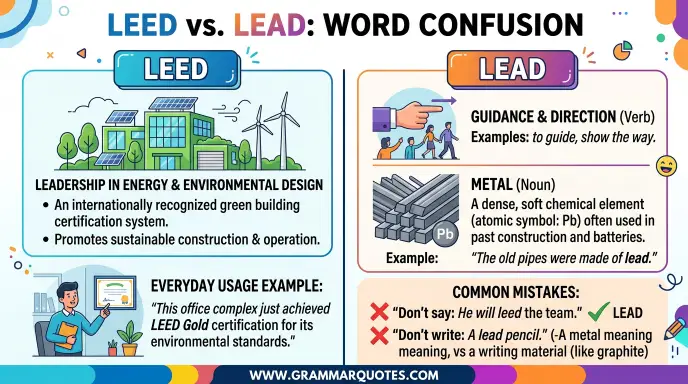
Lead is the standard English spelling, while leed is generally not a standard spelling when you mean the common word “lead.” The confusion happens because lead has different pronunciations and meanings.
In English, lead can be pronounced like “leed” when it means to guide, direct, or be in charge. However, the word is still spelled lead, not leed. The same spelling is also used for the metal lead, but in that meaning it is pronounced differently, like “led.”
This makes the word especially confusing for English learners. You may hear someone say “leed” and assume that it should be written that way. In standard English, however, the spelling remains lead.
Understanding the pronunciation, meaning, and grammar of this word can help you avoid mistakes in school assignments, emails, articles, and everyday writing.
Lead or Leed: Quick Answer
Lead is the correct standard spelling when you mean to guide, direct, or be in charge.
Leed is generally not the standard spelling for this meaning.
Examples:
- Correct: She will lead the team.
- Incorrect: She will leed the team.
For example:
He will lead the group.
Here, lead sounds like “leed.”
So, remember:
Spelling: lead
Pronunciation: leed
Meaning: to guide or direct
Definition and Meaning
The word lead has several meanings.
Lead as a Verb
As a verb, lead means to guide, direct, or take someone toward a place or goal.
Examples:
- She will lead the team.
- The teacher led the students into the classroom.
- He wants to lead the project.
- This road leads to the city.
Lead as a Noun
As a noun, lead can refer to a position of control or guidance.
Example:
The company has taken the lead in the industry.
It can also refer to the main person or position in a situation.
She played the lead role in the school play.
Lead as a Metal
Lead is also the name of a heavy metal.
Example:
The old paint contained lead.
This creates an important pronunciation difference:
- lead = “leed” → guide or direct
- lead = “led” → the metal
The Origin of Lead
The word lead has an old history in English and comes from Germanic roots.
The verb meaning “to guide” developed from Old English lǣdan, which meant to guide or conduct.
The noun referring to the metal comes from a different Old English word, lēad.
Although these words developed from different roots, modern English uses the same spelling, lead.
This is one reason the word can be confusing. English has many words where the spelling stayed the same even though the meanings and pronunciations developed differently.
The spelling leed does not normally replace lead in standard modern English.
British English vs American English
There is no major British American spelling difference for this word.
Both varieties normally spell it:
lead
The pronunciation depends on the meaning, not on if you are using British or American English.
| Meaning | British English | American English |
| Guide or direct | lead | lead |
| Metal | lead | lead |
| Past tense of guide | led | led |
| Common spelling | lead | lead |
So, if you are writing for readers in the UK or US, lead is the standard spelling.
Lead Pronunciation: Why Is It Confusing?
The biggest difficulty is that lead has two common pronunciations.
1. Lead = “Leed”
When it means to guide, direct, or be in charge, it is pronounced like “leed.”
Examples:
I will lead the team.
She leads the discussion.
He wants to lead the project.
2. Lead = “Led”
When it refers to the metal, it is pronounced like “led.”
Example:
The pipes contained lead.
The spelling stays the same, but the pronunciation changes according to meaning.
What Is the Past Tense of Lead?
This is another common source of confusion.
The present tense verb is:
lead
The past tense is:
led
Example:
She leads the team every Monday.
Past:
She led the team yesterday.
It is not spelled lead when referring to the past action.
Common Forms
| Form | Word |
| Base form | lead |
| Present third person | leads |
| Past tense | led |
| Past participle | led |
| ing form | leading |
Examples:
- I lead the group.
- He leads the team.
- She led the meeting.
- They have led the project.
- We are leading the discussion.
Why Do People Write “Leed”?
People may write leed because the verb lead is pronounced “leed.”
English spelling does not always match pronunciation perfectly. When people write a word based on how it sounds, they may choose a spelling that looks more natural to them.
For example:
He will leed the team.
This represents the pronunciation, but it is not the standard spelling.
The correct form is:
He will lead the team.
This is an example of a spelling mistake caused by pronunciation.
Common Mistakes
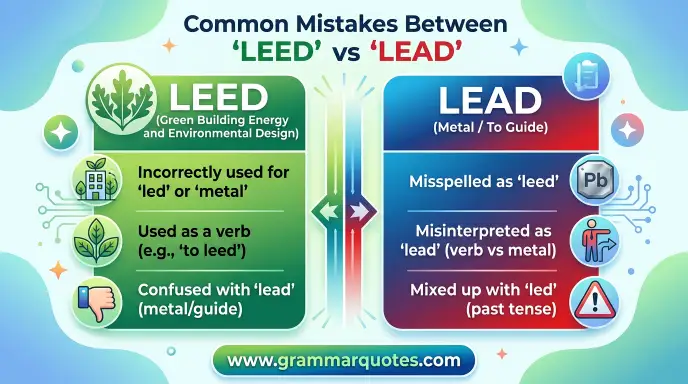
Mistake 1: Writing “leed” for the verb
Incorrect:
She will leed the group.
Correct:
She will lead the group.
Mistake 2: Using “lead” as the past tense
Incorrect:
He lead the team yesterday.
Correct:
He led the team yesterday.
Mistake 3: Confusing “lead” with “led”
Remember:
lead = present
led = past
Example:
I lead the team today.
I led the team yesterday.
Mistake 4: Confusing the metal pronunciation
The word lead referring to the metal is pronounced like “led.”
So:
Lead: Two Different Pronunciations
The word lead has two different pronunciations and meanings.
| Word | Pronunciation | Meaning | Example |
|---|---|---|---|
| lead | leed /liːd/ | To guide, direct, or be in charge | She will lead the team. |
| lead | led /led/ | A soft, heavy metal | The pipes contain lead. |
Lead = Guide → “Leed”
When lead means to guide, direct, or take someone somewhere, it is pronounced “leed.”
Examples:
- He will lead the group.
- She leads the team very well.
- The teacher will lead the discussion.
- This road leads to the city.
Lead = Metal → “Led”
When lead refers to the metal, it is pronounced “led.”
Examples:
- Lead is a heavy metal.
- Old paint may contain lead.
- The workers tested the water for lead.
- Exposure to lead can be harmful.
Important Point
The spelling stays exactly the same — lead — but the pronunciation changes according to the meaning:
lead = guide → “leed”
lead = metal → “led”
Also remember that the past tense of “lead” is “led,” not “lead.”
Present: She leads the team.
Past: She led the team.
Lead in Daily Uses
At School
The teacher will lead the discussion.
At Work
Sarah will lead the project.
In Sports
Our team leads the competition.
In Business
The company is leading the market.
In a Story
The path will lead you to the village.
Talking About the Past
He led the meeting yesterday.
These examples show why context is important when reading or hearing the word.
Lead vs Led vs Leed
| Word | Standard? | Meaning/Use | Pronunciation |
| lead | Yes | Guide or direct | “leed” |
| lead | Yes | The metal | “led” |
| led | Yes | Past tense of lead | “led” |
| leed | Generally no | Not the standard spelling for the verb | “leed” |
The most important point is that leed may represent the sound someone hears, but it is not the standard spelling of the verb.
Side by Side Comparison
| Feature | Lead | Leed |
| Standard English spelling | Yes | Generally no |
| Means “guide” | Yes | No |
| Can mean a metal | Yes | No |
| Used as a verb | Yes | No |
| Past tense | No, use led | No |
| Common in formal writing | Yes | No |
Which Spelling Should You Use?
Use lead when you mean to guide, direct, or be in charge.
For example:
She will lead the team.
Do not change the spelling to leed simply because the word sounds like “leed.”
If you are talking about a past action, use led:
She led the team last year.
If you are talking about the metal, the spelling is still lead, but the pronunciation changes:
The material contains lead.
For school, business, academic, and professional writing, these distinctions are especially important.
Google Trends and Usage
Searches around this word often come from people trying to understand its unusual pronunciation and the difference between lead and led.
The confusion is understandable because one spelling can represent two different pronunciations. Search interest may also come from learners checking if the sound “leed” should be written as lead or leed.
Exact Google Trends popularity can change over time and varies by country. For practical writing, the key point remains stable: lead is the standard spelling for the verb, while led is its past tense.
People Also Ask
Is “leed” a correct English word?
It is not the standard spelling when you mean the verb “to guide.” The correct spelling is lead.
Is lead pronounced “leed”?
Yes, when lead means to guide, direct, or be in charge, it is pronounced like “leed.”
Is lead pronounced “led”?
Yes, when lead refers to the metal, it is pronounced like “led.”
What is the past tense of lead?
The past tense is led.
Is “leed” the past tense of lead?
No. The past tense is led, not leed.
Why does lead have two pronunciations?
The word developed different meanings and pronunciations over time, while the spelling remained the same.
Is lead British or American English?
Lead is standard in both British and American English.
How do you remember lead and led?
Think of lead as the present action and led as the past action.
Can lead be a noun and a verb?
Yes. It can be a verb meaning “guide” and a noun referring to leadership, a main role, or the metal.
Is leed a spelling mistake?
In standard modern English, leed is generally a spelling mistake when it is intended to mean lead.
Final Takeaway
The standard spelling is lead, not leed, when you mean to guide, direct, or be in charge. The interesting part is that this form is pronounced like “leed,” which is why the spelling can easily cause confusion.
There is another pronunciation of lead when the word refers to the metal. In that case, it sounds like “led.” The past tense of the verb is also led, so context is essential.
The easiest way to remember the difference is simple: lead means guide in the present, while led describes that action in the past. If you hear the sound “leed,” do not automatically spell it that way. In standard English writing, the correct spelling is lead.
Using these forms correctly will make your schoolwork, emails, articles, and professional writing clearer and more accurate.
Discover More Articles!
Paster or Pastor: Which Spelling Is Correct?
Broche or Brooch: Which Spelling Is Correct?(2026)
Trouper or Trooper: What Is the Difference?(2026)

Ethan Parker is an English-language writer known for his interest in words, language, and clear communication. His work focuses on making everyday English easier to understand through simple explanations and practical examples.