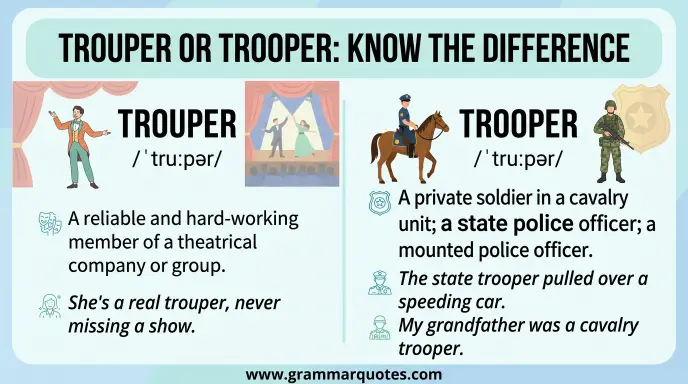
Trouper and trooper are both correct English words, but they have different meanings: a trouper is usually a dependable performer or a resilient person, while a trooper can refer to a soldier, police officer, or a person who keeps going despite difficulties.
These words are easy to confuse because they sound very similar and differ by only one letter. However, their meanings come from different words and contexts.
Trouper is closely connected with the word troupe, which means a group of performers. Over time, it also developed a broader meaning for someone who can be relied on, especially during a difficult situation.
Trooper, on the other hand, is connected with troop. It can describe a member of a military or police unit. In informal English, it can also describe someone who stays strong and continues despite problems.
Knowing the distinction is useful in writing because choosing the wrong spelling can completely change the intended meaning. This guide explains the definitions, origins, common uses, examples, pronunciation, British and American usage, common mistakes, and an easy memory trick.
Trouper or Trooper : Quick Answer
The main difference is meaning.
- Trouper → a performer or a dependable, resilient person
- Trooper → a member of a troop, especially a soldier or police officer; informally, a resilient person
Examples
- She is a real trouper who never gives up during a difficult performance.
- The trooper arrived at the scene.
- The actors praised him as a great trouper.
- The state trooper stopped the vehicle.
The surrounding context usually makes the intended meaning clear.
Definition and Meaning
What Does “Trouper” Mean?
A trouper originally referred to a member of a theatrical or performing troupe.
Today, it can also describe someone who is reliable, hardworking, or able to handle difficult situations without giving up.
Examples:
- She is a real trouper.
- He was a trouper during the long performance.
- Everyone called her a trouper because she stayed positive.
The word can therefore have both a literal performing connection and a broader figurative meaning.
What Does “Trooper” Mean?
A trooper is generally a member of a troop or organized unit.
Depending on the context, it may refer to:
- A soldier
- A cavalry soldier
- A police officer in certain regions
- A member of a military or law enforcement unit
It can also be used informally for someone who handles difficulties bravely.
Example:
He was a real trooper and kept working despite the long day.
This figurative meaning overlaps with one meaning of trouper, which is why the two words can be confusing.
The Main Difference
The easiest distinction is their word origins.
Trouper → troupe → performer
Trooper → troop → soldier or unit member
Think about the root word.
A troupe is a group of performers.
A troop is a group or unit, especially in military contexts.
Therefore:
Trouper = connected to troupe
Trooper = connected to troop
This memory trick works in many situations.
The Origin of “Trouper”
The word trouper comes from troupe, which refers to a group of performers.
A performer who belonged to a troupe could be described as a trouper. Over time, the word gained a figurative sense.
Someone who performs reliably, handles difficulties, or remains committed can also be called a trouper.
For example:
She was a real trouper during the difficult show.
The word therefore moved from a specific theatrical meaning to a broader description of resilience and reliability.
The Origin of “Trooper”
Trooper comes from troop, a word associated with a group or body of people, particularly soldiers.
Historically, a trooper could refer specifically to a cavalry soldier.
In modern usage, the word can also refer to certain police officers, particularly in the United States.
The exact meaning depends on the organization and context.
For example:
The state trooper pulled the car over.
Here, the word refers to a law enforcement officer.
When Should You Use “Trouper”?
Use trouper when talking about:
- A performer
- A member of a theatrical troupe
- Someone dependable in difficult circumstances
- Someone who continues despite challenges
Examples:
- The singer was a real trouper.
- She proved to be a reliable trouper.
- The actor remained a trouper throughout the tour.
The word is especially natural when discussing performance, entertainment, or personal resilience.
When Should You Use “Trooper”?
Use trooper when talking about:
- A soldier
- A cavalry member
- Certain police officers
- A member of a troop or organized unit
- Informally, someone who keeps going despite difficulties
Examples:
- The trooper checked the vehicle.
- A group of troopers arrived.
- The cavalry trooper rode across the field.
- He was a real trooper during the long journey.
The surrounding context determines which meaning applies.
Is “Trooper” Only a Military Word?
No.
Although the word has strong military associations, modern English uses it in several contexts.
In parts of the United States, trooper is commonly used for certain state police officers.
It can also have an informal meaning:
“She’s a real trooper.”
In this expression, the speaker usually means that the person is handling a difficult situation well.
Is “Trouper” Only Used for Actors?
Not necessarily.
Its original meaning is connected to performers, but modern English also uses it figuratively.
For example:
He was a real trouper when the project became difficult.
Here, the word does not necessarily mean that the person is an actor. It describes someone who remains dependable or resilient.
Common Mistakes
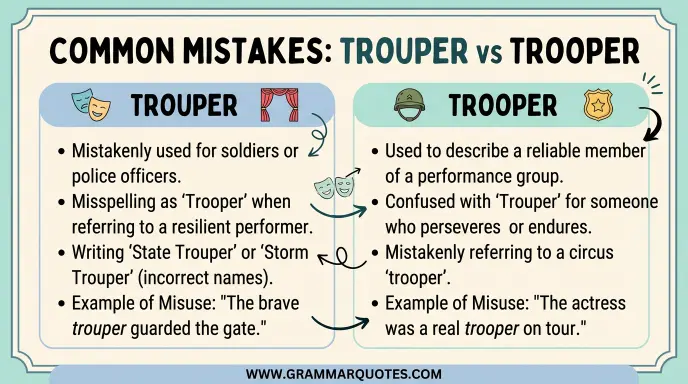
1. Using “Trooper” for a Performer
If you are specifically talking about a member of a theatrical troupe, trouper is the more direct word.
Incorrect for the intended theatrical meaning:
She is a talented trooper in the theater group.
Better:
She is a talented trouper in the theater group.
2. Using “Trouper” for a Police Officer
If you mean a state police officer, the standard word is trooper.
Correct:
The state trooper stopped the vehicle.
3. Confusing “Troupe” and “Troop”
These root words can help you remember the difference.
- Troupe → performers
- Troop → soldiers or an organized group
Therefore:
- Trouper → troupe
- Trooper → troop
4. Assuming They Are Interchangeable
The words can overlap when describing a resilient person, but they are not generally interchangeable in every sentence.
Context matters.
Trouper and Trooper in Everyday Examples
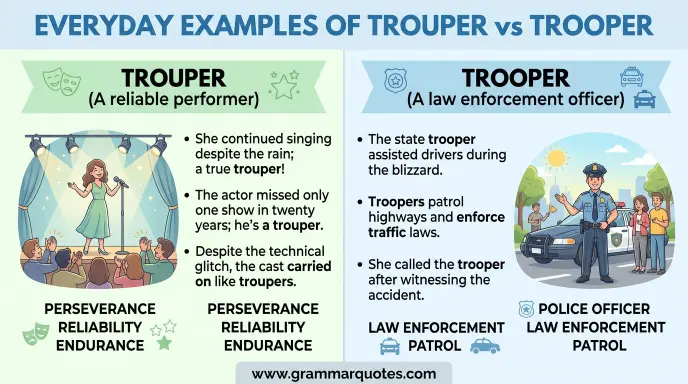
Entertainment
- The actor was a real trouper.
- She remained a trouper throughout the difficult tour.
- The theater group praised its lead performer.
Military
- The trooper followed the orders.
- The cavalry trooper returned to camp.
- Several troopers were stationed nearby.
Police
- The state trooper stopped the driver.
- A trooper arrived at the scene.
Informal Conversation
- You are a real trooper for helping us.
- She was a real trouper during the stressful performance.
The figurative meanings can sometimes overlap, so context is important.
Trouper vs Trooper: Comparison Table
| Feature | Trouper | Trooper |
| Main connection | Troupe | Troop |
| Traditional meaning | Performer | Soldier |
| Modern uses | Performer; resilient person | Soldier; police officer; resilient person |
| Theater context | Common | Usually incorrect |
| Military context | Usually incorrect | Common |
| Police context | Usually incorrect | Common |
| Figurative meaning | Reliable/resilient person | Strong/resilient person |
Pronunciation
The two words sound very similar.
- Trouper is commonly pronounced like “troo per.”
- Trooper is also commonly pronounced like “troo per.”
Because their pronunciation is so close, spelling and context are especially important.
When writing, think about the root word rather than relying only on sound.
British English vs American English
Both words are used in British and American English, but their common contexts can differ.
Trooper is particularly familiar in American English when referring to certain state police officers.
For example:
A state trooper stopped the vehicle.
In British English, military uses of the word are also understood, although specific police terminology differs by country.
Trouper retains its connection with performers and can also describe a dependable person in both varieties.
Formal Writing
In formal writing, choosing the correct word is important because the two terms can refer to completely different roles.
For example:
The state trooper investigated the incident.
Changing the spelling to trouper would make the sentence incorrect for that intended meaning.
Likewise:
The actor was a real trouper.
Using trooper would change the word and could confuse the reader.
When the context is clear, both forms are perfectly acceptable words.
An Easy Memory Trick
The easiest way to remember the difference is to focus on the middle vowel.
Trouper → Troupe
A troupe is a group of performers.
So:
troupe → trouper → performer
Trooper → Troop
A troop can refer to a group of soldiers.
So:
troop → trooper → soldier
This simple connection can help you choose the correct spelling quickly.
“A Real Trouper” vs “A Real Trooper”
Both expressions can describe a person who handles difficulties well.
For example:
She is a real trouper.
This often carries a connection to performing or the idea of being dependable.
She is a real trooper.
This is a common informal expression meaning that someone is coping well or continuing despite difficulties.
In these figurative uses, there can be some overlap. However, their original meanings remain different.
Which Word Should You Use?
Ask yourself what you mean.
Bilkul, is topic ke liye simple, readable related data table ki form mein rakh sakte ho:
| Word | Meaning | Example |
|---|---|---|
| Trouper | A dependable person who keeps going | She was a real trouper during the difficult project. |
| Trooper | A soldier or police officer | The trooper stopped the car for a routine check. |
Easy rule: Trouper = a tough or reliable person, while trooper = a soldier or police officer.
Quick Difference
Both words are pronounced similarly, so they are often confused.
Trouper: Someone who stays strong and continues despite difficulties.
Trooper: Usually refers to a soldier, police officer, or member of a mounted unit.
Quick Test
Ask:
“Am I thinking about a troupe or a troop?”
- Troupe → trouper
- Troop → trooper
Google Trends & Usage Data
Searches for these words are often driven by spelling confusion because they sound almost identical.
People commonly search phrases such as:
- trouper vs trooper
- trooper meaning
- trouper meaning
- real trooper meaning
- real trouper meaning
- trouper spelling
- trooper spelling
Search interest can vary depending on the country. American searches may show more interest in the law enforcement meaning of trooper, while entertainment related searches may bring more attention to trouper.
Exact Google Trends data should be checked for a specific country and date range because search interest changes over time.
People Also Ask: Common Search Questions
What is the difference between a trouper and a trooper?
A trouper is traditionally connected to performers, while a trooper is connected to a troop, soldier, or certain police officers.
Is “trouper” a real word?
Yes. It is a standard English word associated with performers and can also describe a dependable or resilient person.
Is “trooper” a real word?
Yes. It can refer to a soldier, certain police officers, or informally to someone who handles difficulties well.
Is it “real trouper” or “real trooper”?
Both expressions are used. Their meanings can overlap when describing a resilient person, although their origins differ.
Is a trooper a police officer?
In some places, especially in the United States, a trooper is a police officer belonging to a state police or highway patrol organization.
Is a trouper an actor?
Traditionally, a trouper can mean a member of a theatrical troupe or performer.
How do you remember the difference?
Connect trouper with troupe and trooper with troop.
Are trouper and trooper pronounced the same?
They are pronounced very similarly and may sound the same in many accents.
Can a woman be called a trooper?
Yes. The word is not limited by gender.
Can trouper describe someone who is not an actor?
Yes. It can be used figuratively for someone who remains dependable or resilient.
Frequently Asked Questions
What does trouper mean?
It can mean a member of a performing troupe or, more broadly, someone who is dependable and resilient.
What does trooper mean?
It can mean a soldier, a member of certain police forces, or informally someone who keeps going through difficulties.
Which word is related to theater?
Trouper is related to theater because it comes from troupe.
Which word is related to soldiers?
Trooper is related to troop and has military uses.
Can trooper mean a police officer?
Yes. In American English, it can refer to a state police officer.
Are the two words homophones?
They are very close in pronunciation and may be pronounced identically in some accents, although spelling and meaning differ.
Final Comparison
| Question | Trouper | Trooper |
| Related root | Troupe | Troop |
| Performer? | Yes | Usually no |
| Soldier? | Usually no | Yes |
| Police officer? | No | Yes, in some contexts |
| Resilient person? | Yes | Yes |
| Theater use? | Natural | Usually not |
| Military use? | Usually not | Natural |
Conclusion
Trouper and trooper look and sound very similar, but they developed from different words and usually carry different meanings.
A trouper is traditionally connected with a performing troupe. The word can also describe someone who is dependable, committed, or able to handle a difficult situation.
A trooper is connected with a troop and can refer to a soldier or, in certain places, a police officer. It also has an informal use for someone who continues despite difficulties.
The easiest way to remember the difference is to focus on the root words: troupe → trouper and troop → trooper.
When you are unsure, look at the context. If the sentence involves theater or performance, the first spelling may be appropriate. If it involves military or certain police contexts, the second is usually the intended word.
Although the words can overlap in their figurative meanings, they should not be treated as interchangeable in every sentence.
Discover More Articles!
Litre or Liter : Which Spelling Is Correct?
Portland or Homeless: What Do These Terms Mean?(2026)
Allways or Always: Which Spelling Is Correct?(2026)

Ethan Parker is an English-language writer known for his interest in words, language, and clear communication. His work focuses on making everyday English easier to understand through simple explanations and practical examples.