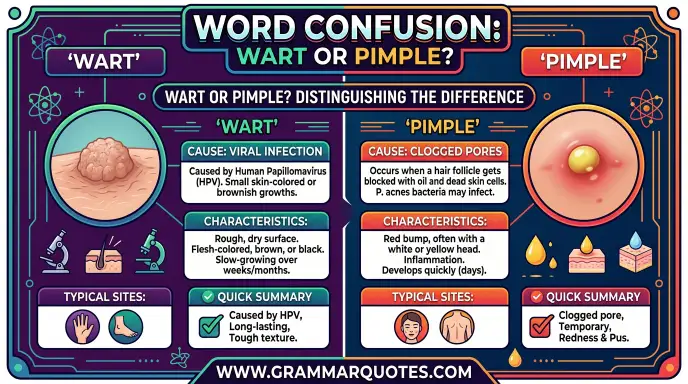
A wart and a pimple can both appear as small bumps on the skin, but they have different causes and usually look and feel different.
A wart is caused by certain types of human papillomavirus (HPV), while a pimple usually develops when a pore becomes clogged with oil, dead skin cells, and other material.
Because both can appear as raised spots, it is easy to confuse them at first glance. However, their texture, location, appearance, and development can provide useful clues.
Pimples are commonly associated with acne and often appear on areas such as the face, chest, back, and shoulders. Warts can develop on different parts of the body and may have a rough or uneven surface.
Understanding the basic differences can help you describe a skin bump more accurately. However, appearance alone cannot always confirm what a bump is. Some skin conditions can look similar, so a healthcare professional should be consulted when a spot is unusual, persistent, painful, changing, or difficult to identify.
Wart or Pimple : Quick Answer
A wart is usually a small, firm growth caused by certain types of HPV. A pimple is generally an inflamed or clogged pore associated with acne.
The two can often be distinguished by their appearance and texture.
| Feature | Wart | Pimple |
| Main cause | Certain HPV infections | Clogged or inflamed pores |
| Texture | Often rough or firm | Usually smoother or tender |
| Common appearance | Flesh colored or slightly darker bump | Red bump, whitehead, or blackhead |
| Common locations | Hands, fingers, feet, and other areas | Face, chest, back, shoulders |
| Related to acne | No | Yes |
| Can contain pus | Usually no | Sometimes |
| Contagious | Some types can spread | No |
These are general differences. A healthcare professional may be needed for a definite identification.
Definition and Meaning
What is a wart?
A wart is a small growth on the skin associated with certain types of human papillomavirus (HPV).
Warts can have different appearances depending on their type and location. Many have a rough or grainy surface, although some can be relatively smooth.
Common types include:
- Common warts
- Flat warts
- Plantar warts
- Filiform warts
They can appear on the hands, fingers, feet, face, or other areas.
What is a pimple?
A pimple is a type of acne lesion that develops when a hair follicle and its associated pore become clogged and inflamed.
Pimples may appear as:
- Red bumps
- Whiteheads
- Pustules
- Small tender spots
They are particularly common during adolescence and young adulthood, although people of many ages can experience acne.
How Can You Tell the Difference?
There is no single feature that can identify every skin bump, but several characteristics can provide clues.
1. Texture
Warts often feel firm or rough, especially common warts on the hands or fingers.
Pimples are often smoother and may feel tender when touched.
2. Surface
A wart may have an uneven or grainy surface.
A pimple often has a smoother surface and may develop a white or yellowish center when it contains pus.
3. Color
Warts can be:
- Flesh colored
- Grayish
- Brownish
- Slightly darker than surrounding skin
Pimples may appear:
- Red
- Pink
- White at the center
- Dark at the surface in the case of a blackhead
Color alone is not enough to identify a skin lesion.
4. Location
Pimples commonly occur in areas where there are many oil producing glands, such as the face, chest, shoulders, and back.
Warts can occur in many locations. Hands and feet are common sites, but they can also appear elsewhere.
What Causes Warts?
Warts are associated with certain types of HPV.
The virus can enter the skin through small cuts or breaks and may cause a growth to develop.
Different HPV types are associated with different kinds of warts.
Some warts can spread through direct contact or by contact with contaminated surfaces. The risk of spreading depends on the type and circumstances.
It is therefore useful to avoid picking at or damaging a suspected wart.
What Causes Pimples?
Pimples are usually part of acne.
Acne develops through processes involving:
- Increased oil production
- Dead skin cells
- Blocked hair follicles
- Inflammation
- Changes in skin bacteria
Hormonal changes can also contribute to acne, which is one reason pimples are common during puberty.
Certain medications and other factors can also contribute to acne in some people.
Wart vs Pimple: Appearance
The appearance can offer useful clues, but it should not be treated as a diagnosis.
Typical wart
A wart may look like:
- A firm raised bump
- A rough or uneven growth
- A flesh colored spot
- A small darker growth
Some types can have tiny dark dots within them, but these should not be used alone to identify a wart.
Typical pimple
A pimple may look like:
- A red raised bump
- A whitehead
- A small pus filled spot
- A blackhead
- An inflamed area around a pore
The surrounding skin may also look red or irritated.
British English vs American English
The words wart and pimple are used in both British and American English, but everyday terminology can vary.
| Meaning | British English | American English |
| Viral skin growth | Wart | Wart |
| Common acne bump | Spot / pimple | Pimple |
| Acne generally | Acne | Acne |
| Blackhead | Blackhead | Blackhead |
| Whitehead | Whitehead | Whitehead |
In British English, spot is commonly used for a pimple.
In American English, pimple is particularly common in everyday conversation.
Which Term Should You Use?
Use wart when referring to a skin growth associated with certain types of HPV.
Use pimple when referring to an acne related bump.
For example:
I have a small pimple on my forehead.
There is a rough wart on his finger.
If you are unsure what a skin bump actually is, it is better to describe its appearance rather than confidently label it.
For example:
There is a small, rough bump on my finger.
This gives a healthcare professional more useful information without assuming the diagnosis.
Common Mistakes
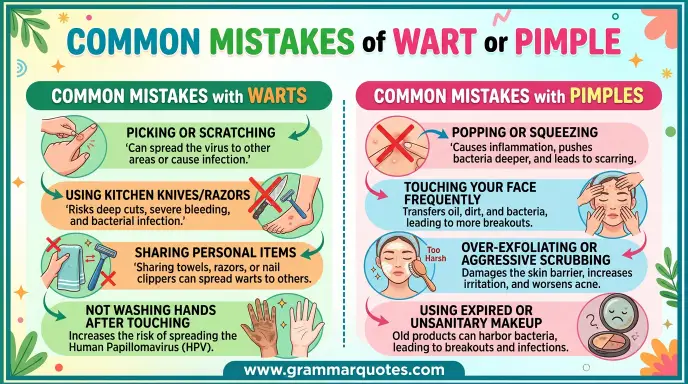
1. Assuming every small bump is a pimple
Not every skin bump is acne. Warts, insect bites, cysts, and other skin conditions can also produce raised areas.
2. Assuming every rough bump is a wart
Texture alone does not provide a definite diagnosis.
3. Picking at a suspected wart
Picking or scratching skin growths can irritate the area and may contribute to spreading certain viral warts.
4. Trying to identify a skin condition only from color
Several different skin conditions can appear red, brown, pink, or flesh colored.
5. Using home treatment without knowing what the bump is
Different skin conditions require different approaches. If you are uncertain, getting professional advice is safer than repeatedly treating an unknown lesion.
Wart or Pimple in Everyday Situations
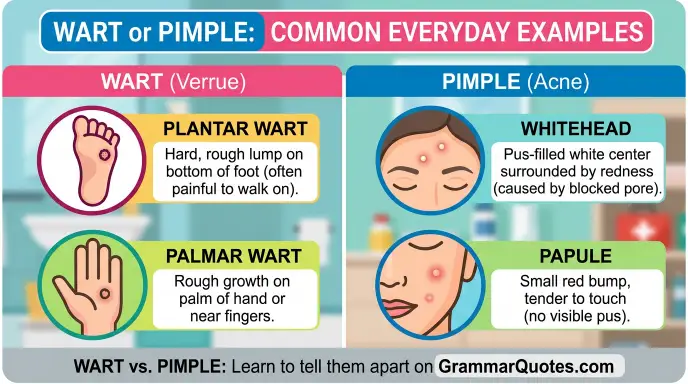
The distinction can be useful in everyday conversations.
Talking about acne
I have a pimple on my cheek.
Talking about a hand growth
There is a rough bump on my finger that might be a wart.
Talking to a doctor
Instead of saying:
This is definitely a wart.
You could say:
I have had this rough bump on my finger for several weeks.
This provides information without assuming the diagnosis.
Talking about skin changes
This spot has changed recently, so I want to have it checked.
This is especially useful when a mark looks unusual or different from other spots.
When Should You Get Medical Advice?
Most ordinary pimples do not require urgent medical attention. However, it is sensible to seek professional advice if a skin growth or bump:
- Changes noticeably
- Bleeds without an obvious reason
- Becomes very painful
- Grows quickly
- Does not heal
- Looks unusual
- Keeps returning
- Is difficult to identify
A healthcare professional can examine the area and determine if further evaluation is needed.
Do not try to diagnose a suspicious or unusual skin growth from a photo or a general online comparison alone.
Wart vs Pimple: Comparison Table
| Feature | Wart | Pimple |
| Main association | Certain HPV types | Acne |
| Typical texture | Firm or rough | Smooth or tender |
| Surface | Often uneven | Usually smooth |
| Common locations | Hands, feet, fingers | Face, chest, back, shoulders |
| Typical appearance | Raised growth | Inflamed or clogged pore |
| Pus | Usually absent | May be present |
| Contagious | Some can spread | No |
| Common in teenagers | Can occur | Very common |
| Diagnosis from appearance alone | Not always reliable | Not always reliable |
Why Is This Confusion So Common?
The confusion mainly comes from the fact that both conditions can produce a small raised bump.
A person may notice a new spot and assume it is a pimple because pimples are familiar. However, a wart can also start as a small bump and may not immediately look distinctive.
Location can help, but it is not a perfect rule. Pimples can occur outside the face, and warts can appear in places other than the hands or feet.
Texture and development can provide additional clues, but even these are not always enough for a definite answer.
That is why unusual or persistent skin changes are better assessed by a qualified healthcare professional.
Google Trends & Usage Data
Search interest for skin related comparison terms can vary over time and by country. People commonly search these questions when they notice an unfamiliar bump and want to understand possible differences.
For research, exact Google Trends figures should be checked for the target country and date range because search interest is not constant.
Useful related searches include:
- wart vs pimple
- how to tell a wart from a pimple
- what does a wart look like
- what does a pimple look like
- wart or acne
- difference between wart and pimple
- skin bump causes
- types of warts
- types of pimples
These related phrases can help create useful content without repeating the main keyword excessively.
People Also Ask Questions
1. How can you tell a wart from a pimple?
Warts are often firmer and rougher, while pimples are commonly smoother, red, or associated with a clogged pore. Appearance alone cannot always confirm the cause.
2. Can a wart look like a pimple?
Yes. Some warts can initially appear as small raised bumps and may be confused with other skin conditions.
3. Are warts caused by acne?
No. Warts are associated with certain types of HPV, while pimples are generally associated with acne.
4. Can a pimple turn into a wart?
A pimple does not normally transform into a wart. They have different underlying causes.
5. Are warts contagious?
Some warts can spread through contact because they are associated with viral infection.
6. Are pimples contagious?
Ordinary acne is not considered contagious.
7. Where do warts usually appear?
They can appear in different places, with common warts often occurring on the hands and fingers and other types appearing on areas such as the feet.
8. Where do pimples usually appear?
Pimples commonly appear on the face, chest, shoulders, and back.
9. Should I squeeze a suspected wart or pimple?
It is generally better not to pick or squeeze an unidentified skin bump. Doing so can irritate the skin and may cause additional problems.
10. When should a skin bump be checked by a doctor?
Consider professional evaluation if it is unusual, persistent, rapidly changing, painful, bleeding, or difficult to identify.
Conclusion
Warts and pimples can both look like small bumps, but they usually have different causes. A wart is associated with certain types of HPV, while a pimple is generally related to acne and blocked or inflamed pores.
Texture, location, color, and surface appearance can provide clues. Warts are often firmer or rougher, while pimples are more likely to be smooth, red, tender, or connected with a clogged pore. However, these features are not reliable enough to diagnose every skin condition.
The terminology can also vary slightly between British and American English. British speakers often use spot for a pimple, while pimple is especially common in American English. The word wart is used in both varieties.
If a bump is unusual, persistent, painful, changing, or difficult to identify, professional medical advice is more reliable than an online comparison. Avoid picking or treating an unidentified growth without knowing what it is.
Discover More Articles!
Weening or Weaning: One Letter Changes the Entire Meaning
Pidgeon vs Pigeon: Which Spelling Is Correct?
Fruits or Vegetables: What Is the Difference?

Ethan Parker is an English-language writer known for his interest in words, language, and clear communication. His work focuses on making everyday English easier to understand through simple explanations and practical examples.