Both duffel and duffle are correct spellings in English. They usually refer to the same type of sturdy bag or thick fabric. However, duffel is widely preferred in American English, while duffle is also common, especially in British English.
You may see both spellings when shopping for a travel bag, packing for a trip, or reading product descriptions. This can make it hard to know which one to use. The good news is that you do not need to worry about choosing the wrong word in most situations.
Both forms can describe a large, flexible bag used to carry clothes, sports gear, or travel items. The words can also refer to a thick, durable fabric traditionally used to make such bags.
In this guide, you will learn the meaning of each spelling, how British and American English use them, and which form works best in different situations. You will also find common mistakes, everyday examples, comparison tables, and answers to frequently asked questions.
Duffel or Duffle: Quick Answer
Duffel and duffle are both correct. They refer to the same kind of bag or fabric, but their spelling preferences can vary by region.
- Duffel: Commonly preferred in American English.
- Duffle: Also correct and often seen in British English.
- Duffel bag / duffle bag: Both mean a large, flexible bag used for travel, sports, or carrying equipment.
Examples:
- I packed my clothes in a duffel bag.
- She carried her gym shoes in a duffle bag.
Both sentences are correct. If you are writing for an American audience, duffel is a safe choice. For a British audience, duffle is also a natural option.
Definition and Meaning
What Does Duffel Mean?
Duffel is a noun that can refer to a sturdy fabric or a large, flexible bag made for carrying belongings.
A duffel bag often has a long, rounded shape, a wide main compartment, and handles or a shoulder strap. People use these bags for travel, sports, gym sessions, and outdoor activities.
Examples:
- He put his clothes in a duffel bag.
- My duffel is large enough for a weekend trip.
- The shop sells durable duffel bags for athletes.
The word can also describe a type of thick woollen fabric traditionally associated with the town of Duffel in Belgium.
What Does Duffle Mean?
Duffle is an alternative spelling of duffel. It has the same general meaning and can refer to either the fabric or the bag.
Examples:
- She bought a new duffle bag for her holiday.
- His duffle was full of sports equipment.
- The outdoor shop sells waterproof duffle bags.
The spelling does not change the basic meaning. In most everyday situations, duffle bag and duffel bag refer to the same type of item.
The Origin of Duffel and Duffle
Origin of Duffel
The word duffel comes from Duffel, a town in Belgium historically associated with a thick woollen cloth. The name of the fabric later became connected with bags made from it.
Over time, the term became widely used for large, practical bags designed to carry clothing and equipment. Today, duffel bags are commonly made from materials such as canvas, nylon, and polyester.
Origin of Duffle
Duffle developed as an alternative spelling of duffel. English has many words with more than one accepted spelling, and this is one example.
The two forms have the same historical connection and are often used interchangeably. The preferred spelling may depend on the country, publisher, or brand.
British English vs American English
The main difference between duffel and duffle is spelling preference rather than meaning.
| Feature | American English | British English |
| Common spelling | Duffel | Duffle is also common |
| Alternative spelling | Duffle | Duffel |
| Bag meaning | Large carrying bag | Large carrying bag |
| Fabric meaning | Thick, durable fabric | Thick, durable fabric |
| Are both forms accepted? | Yes | Yes |
These are general preferences, not strict rules. Both spellings appear in English language publications and product descriptions on both sides of the Atlantic.
When Should You Use Each Word?
When to Use Duffel
Use duffel when you want to follow the common American English spelling or when a style guide, retailer, or product name uses this form.
Examples:
- I need a duffel bag for my gym clothes.
- He bought a waterproof duffel for camping.
- The duffel bag fits easily in the car.
This spelling is a reliable choice for American audiences and general international writing.
When to Use Duffle
Use duffle when it matches your audience’s spelling preference or the spelling used by a particular brand or publication.
Examples:
- She packed her duffle bag the night before travelling.
- His duffle holds all his football gear.
- I need a small duffle for my weekend away.
This form is correct and should not automatically be treated as a spelling mistake.
When to Use Duffel Bag or Duffle Bag
Both expressions are correct. Choose one spelling and use it consistently throughout your article, product listing, or other document.
For example, if your product title says duffel bag, keep that spelling in the description and headings. Consistency makes your writing easier to follow.
Common Mistakes With Duffel and Duffle
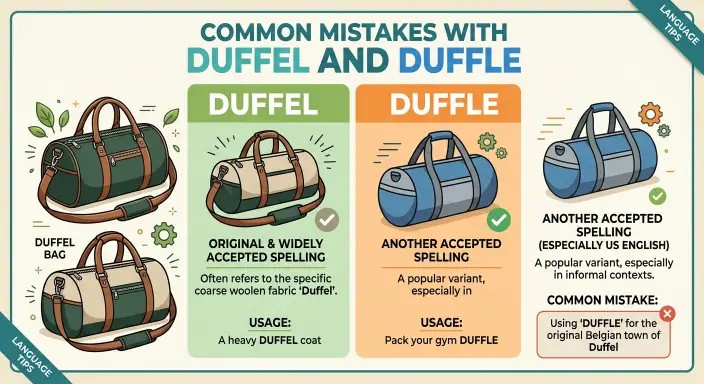
Mistake 1: Thinking One Spelling Is Always Wrong
Incorrect claim: Duffle is always a spelling mistake.
Correct: Both duffel and duffle are accepted spellings.
The best choice depends on regional preference and context.
Mistake 2: Assuming the Words Have Different Meanings
Some readers think a duffel bag and a duffle bag are different products.
In normal usage, both terms refer to the same type of bag. Any difference in design depends on the product, not the spelling.
Mistake 3: Switching Spellings Without a Reason
Example: “I bought a duffel bag. My new duffle is very spacious.”
This is not necessarily grammatically wrong, but switching forms can look inconsistent in formal writing.
Better: Choose duffel or duffle and use it throughout the same piece of writing.
Mistake 4: Confusing the Bag With Its Material
Duffel and duffle can refer to both a bag and a type of fabric. The meaning depends on the sentence.
For example, “She packed a duffel” refers to a bag, while “The coat was made from duffel” refers to fabric.
Everyday Examples of Duffle and Duffel
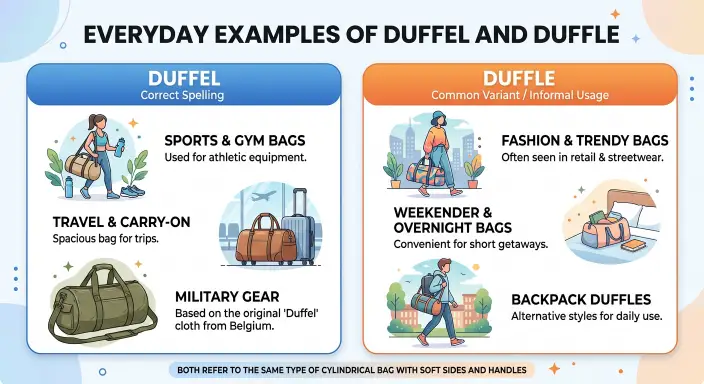
In Daily Conversation
- I left my duffel bag by the door.
- Can you put your duffle in the car?
- My duffel is too small for all these clothes.
At School or College
- He carried his sports kit in a duffel bag.
- I keep my training clothes in a duffle.
- The team received matching duffel bags.
While Travelling
- She packed a duffel for her weekend trip.
- My duffle bag fits in the overhead storage area.
- We used duffel bags to carry our camping gear.
In Shopping and Product Descriptions
- This duffel bag has a separate shoe compartment.
- The store sells lightweight duffle bags for travel.
- Choose a waterproof duffel for outdoor activities.
These examples show that both spellings work naturally in everyday English.
Duffel vs Duffle: Comparison Table
| Feature | Duffel | Duffle |
| Correct spelling | Yes | Yes |
| Meaning | Bag or fabric | Bag or fabric |
| American English | Widely preferred | Also used |
| British English | Also used | Commonly used |
| Example | A travel duffel | A travel duffle |
| Main difference | Spelling preference | Spelling preference |
The important point is that the meaning stays the same. Neither spelling is universally wrong.
A Simple Trick to Remember the Difference
Use this easy rule:
- Duffel: A common choice for American English.
- Duffle: Another correct spelling, often seen in British English.
- Both: Mean the same thing in most everyday uses.
If you are unsure, use the spelling preferred by your audience or the one used by your chosen dictionary or style guide. If you are writing about a specific product, follow the spelling in its official product name.
FAQs About Duffel or Duffle
1. Is it duffel or duffle?
Both spellings are correct. Duffel is widely preferred in American English, while duffle is also common, especially in British English.
2. Is duffle a real word?
Yes. Duffle is an accepted spelling variant of duffel. It can refer to a sturdy bag or a thick type of fabric.
3. What is a duffel bag?
A duffel bag is a large, flexible bag used to carry clothes, sports equipment, travel items, or other belongings. It often has handles and a shoulder strap.
4. Is a duffle bag different from a duffel bag?
No. In ordinary usage, they refer to the same kind of bag. The difference is in spelling, not the basic meaning.
5. Which spelling is American: duffel or duffle?
Duffel is widely preferred in American English. However, duffle is also understood and used.
6. Which spelling is British: duffel or duffle?
Duffle is common in British English, but duffel is also used. Neither form is limited exclusively to one country.
7. What is the plural of duffel?
The plural is duffels. For example, “The shop sells travel duffels in different sizes.”
8. What is the plural of duffle?
The plural is duffles. For example, “The team ordered new duffles for its players.”
9. Where does the word duffel come from?
The word comes from Duffel, a town in Belgium historically associated with a thick woollen cloth. The name later became associated with bags made from this material.
10. Which spelling should I use in an article?
Choose one spelling based on your audience, style guide, or product name. Duffel is a good choice for American English, while duffle is also suitable for British English. Use the chosen form consistently.
Conclusion
Both duffel and duffle are correct English spellings. They generally refer to the same type of sturdy bag or thick fabric, so the choice does not change the basic meaning.
The main difference is regional preference. Duffel is widely preferred in American English, while duffle is also common, especially in British English. However, both forms appear in many English speaking countries.
If you are writing an article, preparing a product description, or choosing a word for schoolwork, consider your audience and keep the spelling consistent. When describing a specific product, follow the spelling used by the manufacturer.
The easiest rule to remember is simple: both spellings are correct, and the meaning is usually the same.
Discover More Articles!
Among vs Between: Meaning, Differences, and Examples
Latter or Later: Which One Is Correct?(2026)
Lose vs Loose: Meaning, Difference, and Examples(2026)

Ethan Parker is an English-language writer known for his interest in words, language, and clear communication. His work focuses on making everyday English easier to understand through simple explanations and practical examples.