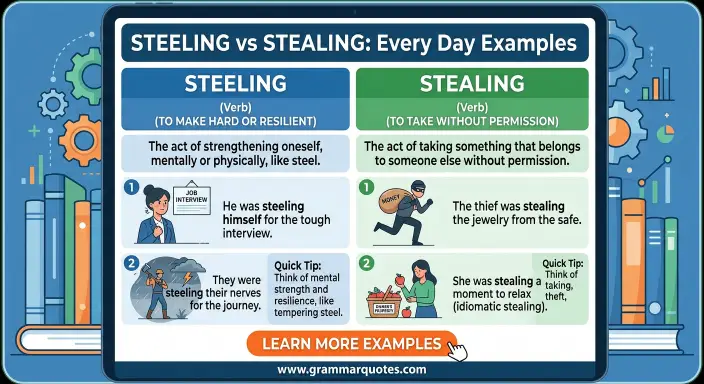
Have you ever wondered if to write steeling or stealing? Both words are correct, but they have very different meanings. Stealing means taking something that belongs to another person without permission. Steeling means making something stronger or preparing yourself mentally to face a difficult situation.
These words sound almost the same, so it is easy to mix them up when writing. However, using the wrong spelling can change the meaning of your sentence. For example, “He is stealing money” describes taking money without permission, while “She is steeling herself for the challenge” means she is preparing herself mentally.
In this guide, you will learn the meanings of both words, how to use them correctly, and how to avoid common spelling mistakes. You will also find a comparison table, everyday examples, and answers to frequently asked questions.
Quick Answer: Steeling vs Stealing
- Steeling: Making something stronger or preparing yourself mentally for something difficult.
- Stealing: Taking something that belongs to someone else without permission.
Examples:
- He is stealing a wallet.
- She is steeling herself for the difficult news.
Easy memory tip: Stealing is related to steal. Steeling is related to steel, a strong metal.
What Does Stealing Mean?
Stealing is the present participle of the verb steal. It means taking another person’s property without permission. It can also describe taking something dishonestly or secretly.
Stealing as an Action
Use stealing when someone takes something that does not belong to them.
Examples:
- Someone is stealing my bicycle.
- He was caught stealing money.
- The boy admitted to stealing the book.
- Stealing is wrong because it violates other people’s rights.
Stealing in Everyday English
The word can also be used in expressions and informal speech. For example, “stealing the show” means attracting the most attention or becoming the most impressive person in an event.
Examples:
- The young singer is stealing the show.
- Her performance was stealing everyone’s attention.
- The team kept stealing the spotlight during the event.
These expressions are figurative. They do not mean that someone is literally taking property.
What Does Steeling Mean?
Steeling is the present participle of the verb steel. It can mean making something stronger or preparing yourself mentally to face something difficult.
The word comes from steel, a strong metal often linked with strength and toughness.
Steeling Yourself Mentally
The most common use of steeling is in the phrase “steeling yourself.” It means building courage or emotional strength before a difficult experience.
Examples:
- She is steeling herself for the exam results.
- He was steeling himself for the difficult conversation.
- They are steeling themselves for the challenge ahead.
- I took a deep breath, steeling myself to speak in public.
Steeling in the Sense of Making Stronger
Steeling can also refer to strengthening something with steel or making it more steel like, depending on the context.
Examples:
- The workers are steeling the structure with metal supports.
- The project involves steeling parts of the building.
This technical use is less common than the expression “steeling yourself.”
Steeling or Stealing: Key Differences
| Feature | Steeling | Stealing |
| Base word | Steel | Steal |
| Main meaning | Strengthening or mentally preparing | Taking something without permission |
| Part of speech | Verb form ( ing) | Verb form ( ing) |
| Common phrase | Steeling yourself | Stealing money |
| Example | He is steeling himself for the test. | He is stealing a phone. |
| Memory clue | Steel means strength | Steal means take without permission |
When Should You Use Stealing?
Use stealing when talking about taking something without permission or using the word in a figurative expression.
Common Uses of Stealing
1. Taking property without permission
- Someone is stealing items from the shop.
- The police investigated the report of stealing.
- He denied stealing the money.
2. Figurative expressions
- The actor is stealing the show.
- The beautiful view is stealing everyone’s attention.
- The player kept stealing the spotlight.
Remember that the base verb is steal, so its ing form is stealing.
When Should You Use Steeling?
Use steeling when describing mental preparation, courage, or strengthening something.
Common Uses of Steeling
1. Preparing for something difficult
- She is steeling herself for the interview.
- He spent a few minutes steeling himself before the speech.
- We are steeling ourselves for the final match.
2. Strengthening with steel
- The builders are steeling the support structure.
- Engineers discussed steeling parts of the design.
In everyday writing, the mental preparation meaning is the one you are most likely to need.
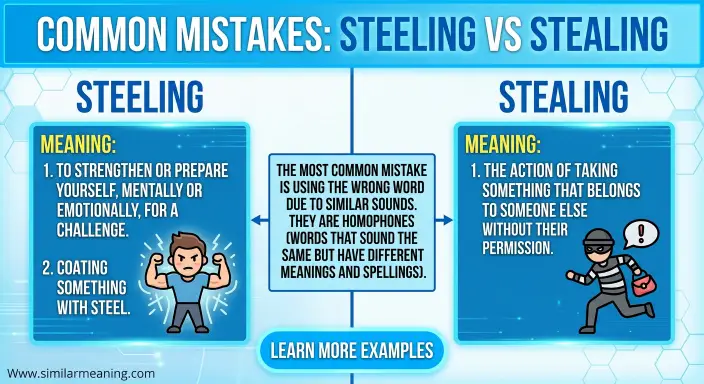
Common Mistakes: Steeling and Stealing
| Incorrect word for the intended meaning | Correct sentence |
| He was steeling money from the shop. | He was stealing money from the shop. |
| She is stealing herself for the exam. | She is steeling herself for the exam. |
| They were steeling the neighbour’s bicycle. | They were stealing the neighbour’s bicycle. |
| I am stealing myself for the bad news. | I am steeling myself for the bad news. |
The correct spelling depends on the meaning. If someone takes something without permission, write stealing. If someone prepares mentally for a challenge, write steeling.
Everyday Examples of Stealing vs Steeling
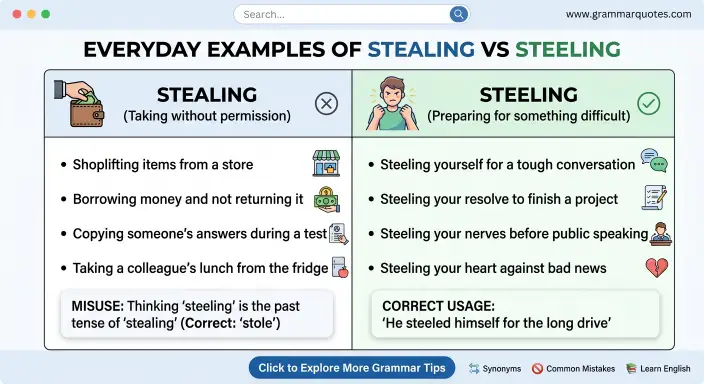
| Sentence | Correct word | Why? |
| He is ______ a wallet. | Stealing | He is taking property without permission. |
| She is ______ herself for the exam. | Steeling | She is preparing mentally. |
| The thief was caught ______ a phone. | Stealing | The action involves taking property. |
| I am ______ myself for the difficult news. | Steeling | The speaker is preparing emotionally. |
| The performer is ______ the show. | Stealing | This is a figurative expression meaning impressing everyone. |
| He was ______ himself to face the challenge. | Steeling | He was building courage. |
Steeling vs Stealing: Word Origins
Origin of Stealing
Stealing comes from the verb steal, which has roots in Old English. The verb has long been used to describe taking something secretly or without permission.
Origin of Steeling
Steeling comes from the word steel, the strong metal. Over time, steel became a symbol of strength and toughness. This led to expressions such as “steeling yourself,” meaning preparing yourself mentally to face something difficult.
Their different roots explain why these words have different meanings, even though they sound similar.
Is Steeling or Stealing More Common?
Stealing is generally more common because it is used to describe taking things without permission and appears in many everyday contexts. Steeling is less common and is often used in the phrase “steeling yourself.”
Search interest can vary by country and over time. Google Trends can help compare interest in both spellings for a selected location and period. However, search popularity does not decide which spelling is correct; the meaning of the sentence does.
Steeling vs Stealing: Common Questions
1. What is the main difference between steeling and stealing?
Steeling means strengthening something or preparing yourself mentally. Stealing means taking something that belongs to another person without permission.
2. Is steeling a real word?
Yes. Steeling is the ing form of steel. It is commonly used in the phrase “steeling yourself,” which means preparing mentally for something difficult.
3. Is stealing a real word?
Yes. Stealing is the ing form of steal. It describes taking something without permission.
4. How do you spell stealing something?
The correct spelling is stealing, with an a. For example: “He was stealing a bicycle.”
5. What does steeling yourself mean?
It means preparing yourself mentally or emotionally to face a difficult, frightening, or unpleasant situation.
6. Why do steeling and stealing sound similar?
They are pronounced alike or very similarly in many English accents. Their spelling and meanings, however, are different.
7. What is the base word of steeling?
The base word is steel. In the phrase “steeling yourself,” it suggests building strength or courage.
8. What is the base word of stealing?
The base word is steal, which means taking something without permission.
9. Can stealing be used in a positive expression?
Yes. In the expression “stealing the show,” it means attracting the most attention or giving the most impressive performance.
10. Which word should I use before “yourself for the exam”?
Use steeling: “She is steeling herself for the exam.” It means she is mentally preparing for the experience.
Frequently Asked Questions
Is it steeling or stealing yourself?
The correct phrase is steeling yourself. It means preparing mentally for something difficult.
Does stealing always mean taking money?
No. Stealing can refer to taking any property without permission, not just money. It can also appear in figurative expressions such as “stealing the show.”
What is the past tense of steal?
The past tense is stole. For example: “He stole my book.” The past participle is stolen, as in “The book was stolen.”
What is the past tense of steel?
The past tense is steeled. For example: “She steeled herself before the interview.”
What is a simple way to remember the difference?
Remember that steel is a strong metal, so steeling yourself means building strength or courage. Stealing comes from steal, which means taking something without permission.
Conclusion
The difference between steeling and stealing becomes clear when you focus on their meanings. Stealing describes taking something that belongs to another person without permission. It can also appear in expressions such as “stealing the show,” which means attracting the most attention.
Steeling comes from steel and often describes preparing yourself mentally or emotionally for a difficult situation. For example, “He is steeling himself for the interview” means he is building the courage to face it.
Although the two words sound very similar, their spellings come from different base words. This makes it easier to remember which one to use. Think of steel as a symbol of strength and steal as taking something without permission.
When you write, ask yourself one simple question: Am I talking about taking something, or am I talking about building strength? Choose stealing for the first meaning and steeling for the second. With this rule and the examples in this guide, you can use both words correctly and confidently.
Discover More Articles!
Curtesy vs Courtesy: Meaning, Difference, and Examples(2026)
Java AND or OR: Meaning, Differences, and Examples
Seeked or Sought: Which Spelling Is Correct?

Ethan Parker is an English-language writer known for his interest in words, language, and clear communication. His work focuses on making everyday English easier to understand through simple explanations and practical examples.