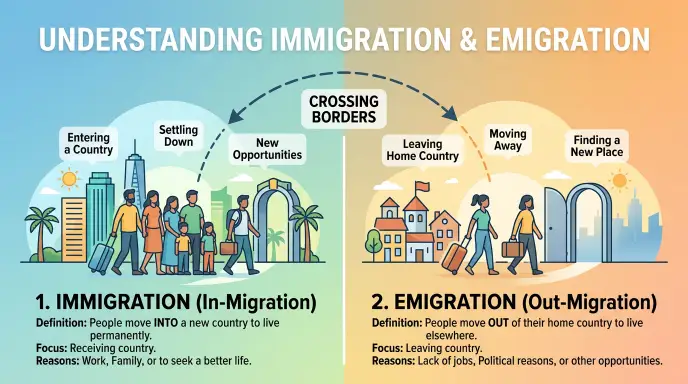
Immigration and emigration both describe people moving from one country to another, but the difference depends on the direction of the move. Immigration means moving into a country to live there, while emigration means leaving your own country to live somewhere else.
For example, if a person moves from Pakistan to Canada, that person is emigrating from Pakistan and immigrating to Canada. The same move can therefore be described using both words, depending on the country being discussed.
This difference can be confusing because the two words look and sound similar. They also come from the same Latin root and are closely connected in meaning.
The easiest way to remember them is to focus on the direction. Immigration is about coming into a country, while emigration is about going out of a country.
These terms are common in news reports, visa applications, government documents, travel discussions, university admissions, and discussions about people moving abroad.
Understanding the distinction can help you use the correct word when talking about international migration.
Immigration or Emigration : Quick Answer
Immigration means moving into another country to live there.
Emigration means leaving your own country to live somewhere else.
For example, imagine someone moves from Pakistan to Australia:
- From Pakistan’s perspective, the person is emigrating from Pakistan.
- From Australia’s perspective, the person is immigrating to Australia.
- The overall process is called migration.
Easy Rule
Immigration = IN
Emigration = EXIT
A simple memory trick is to focus on the first letter:
- Immigration → In
- Emigration → Exit
Definition and Meaning
What Does “Immigration” Mean?
Immigration refers to the process of moving into a foreign country with the intention of living there, either temporarily or permanently depending on the situation.
A person who moves into a country is called an immigrant.
Examples:
- “She immigrated to Canada.”
- “The country has strict immigration rules.”
- “He applied for an immigration visa.”
The word is often used from the perspective of the country receiving the person.
What Does “Emigration” Mean?
Emigration refers to leaving your own country to live in another country.
A person who leaves their country is called an emigrant.
Examples:
- “He emigrated from Pakistan.”
- “The country experienced increased emigration.”
- “Her family emigrated to Australia.”
The word focuses on the country the person is leaving.
The Origin of the Words
Both words come from Latin.
Immigration comes from Latin roots associated with moving into a place. The prefix im is related to the idea of “in” or “into.”
Emigration comes from Latin roots associated with moving away or out. The prefix e means “out of” or “from.”
This difference in the prefixes explains the modern distinction:
im → into
e → out
Both words eventually became part of English through forms of Latin and later European languages.
The Main Difference
The biggest difference is direction.
Immigration Means Moving In
If a person moves to a new country, that country may describe the person as an immigrant.
For example:
“A family moved from Pakistan to Germany.”
Germany sees the family as immigrants because they are coming into Germany.
Emigration Means Moving Out
Pakistan, on the other hand, may describe the same family as emigrants because they are leaving Pakistan.
“The family emigrated from Pakistan.”
So, the same person can be both an immigrant and an emigrant at the same time.
The difference simply depends on which side of the move you are describing.
Clear Comparison Table
| Feature | Immigration | Emigration |
| Basic meaning | Moving into another country | Moving out of your country |
| Focus | Destination country | Country of origin |
| Direction | In | Out |
| Person | Immigrant | Emigrant |
| Common preposition | Immigration to a country | Emigration from a country |
| Example | “She immigrated to Canada.” | “She emigrated from Pakistan.” |
| Memory trick | I = In | E = Exit |
| Related general term | Migration | Migration |
| Opposite perspective | Emigration | Immigration |
Immigration vs Emigration vs Migration
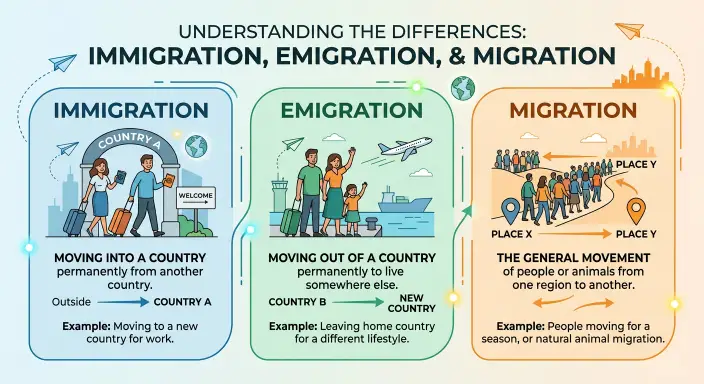
These three terms are closely related but should not be treated as identical.
Immigration
Focuses on entering a country to live there.
“He immigrated to Australia.”
Emigration
Focuses on leaving a country to live elsewhere.
“He emigrated from Pakistan.”
Migration
Is the broader term for movement from one place to another. It can refer to international or internal movement depending on context.
“Migration has increased in the region.”
One Move, Three Descriptions
Suppose a person moves from Pakistan to Australia.
You could say:
“He emigrated from Pakistan.”
Or:
“He immigrated to Australia.”
Or more generally:
“He migrated from Pakistan to Australia.”
All three can describe the same movement, but each word emphasizes something different.
Immigration and Emigration in Visa Applications
These words often appear in travel and government contexts.
Immigration is commonly associated with:
- Immigration departments
- Immigration visas
- Immigration laws
- Immigration officers
- Immigration applications
- Immigration status
For example:
“The applicant submitted an immigration application.”
Emigration is more often used when discussing people leaving their country, population movement, or demographic changes.
For example:
“The country has experienced significant emigration.”
However, everyday speakers often use immigration much more frequently than emigration.
British English vs American English
There is no major spelling difference between British and American English for these words.
| British English | American English |
| immigration | immigration |
| immigrant | immigrant |
| emigration | emigration |
| emigrant | emigrant |
| immigrate | immigrate |
| emigrate | emigrate |
| migration | migration |
The spelling is the same in both varieties.
The difference is mainly about meaning and direction, not British versus American English.
When Should You Use “Immigration”?
Use immigration when focusing on people entering a country.
Examples:
- “Canada has immigration programs for skilled workers.”
- “He is applying for immigration to Australia.”
- “Immigration officials checked the documents.”
- “The country changed its immigration policy.”
Use immigrant for the person:
“She is an immigrant in Canada.”
Use immigrate as the verb:
“She immigrated to Canada.”
Common Pattern
Immigrate + to + destination
“They immigrated to Australia.”
When Should You Use “Emigration”?
Use emigration when focusing on people leaving a country.
Examples:
- “Emigration has increased in recent years.”
- “The report discusses emigration from rural areas.”
- “His family planned their emigration from the country.”
Use emigrant for the person:
“He became an emigrant after leaving his country.”
Use emigrate as the verb:
“He emigrated from Pakistan.”
Common Pattern
Emigrate + from + country of origin
“They emigrated from Pakistan.”
Common Mistakes
Mistake 1: Thinking Immigration Means Leaving
This is one of the most common mistakes.
Immigration focuses on coming into a country.
“She immigrated to Canada.”
Emigration focuses on leaving a country.
“She emigrated from Pakistan.”
Mistake 2: Using “Immigrate From”
The verb immigrate is normally used with the destination.
“He immigrated to Australia.”
When focusing on the country he left, use emigrate from:
“He emigrated from Pakistan.”
Mistake 3: Confusing Immigrant and Emigrant
An immigrant is someone who moves into another country.
An emigrant is someone who leaves their country to live elsewhere.
The same person can be both, depending on the perspective.
Mistake 4: Thinking Migration Is the Same as Immigration
Migration is the broader term.
It can describe movement between countries or movement within a country, depending on the context.
Mistake 5: Using the Wrong Preposition
Remember:
Immigrate to
“She immigrated to Germany.”
Emigrate from
“She emigrated from Pakistan.”
Everyday Examples
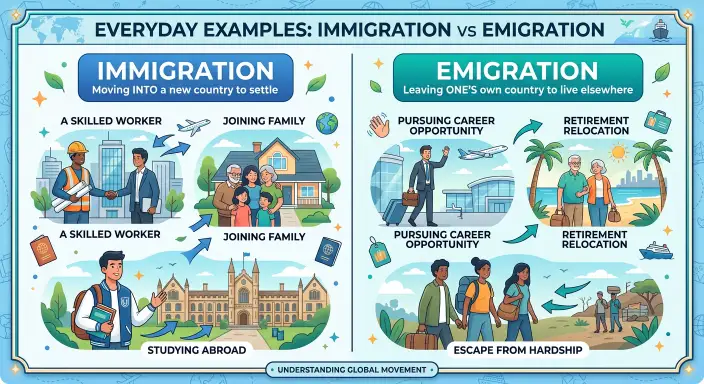
Immigration Examples
- “He wants to immigrate to Canada.”
- “She is researching immigration requirements.”
- “The immigration officer checked his passport.”
- “The country has a new immigration program.”
Emigration Examples
- “His family decided to emigrate from Pakistan.”
- “The report examines emigration trends.”
- “Emigration can affect a country’s population.”
- “She planned her emigration carefully.”
Migration Examples
- “Migration between countries has many causes.”
- “The study examines international migration.”
- “Migration can happen for work, education, family, or other reasons.”
Examples Using the Same Person
This is the easiest way to understand the difference.
Imagine Ali moves from Pakistan to Germany.
From Pakistan’s perspective:
“Ali emigrated from Pakistan.”
From Germany’s perspective:
“Ali immigrated to Germany.”
In general:
“Ali migrated from Pakistan to Germany.”
All three sentences describe the same move from different perspectives.
Which Word Should You Use?
Ask yourself one simple question:
Am I focusing on where the person is going or where the person is leaving?
Focus on the Destination?
Use immigration.
“She immigrated to Australia.”
Focus on the Country Being Left?
Use emigration.
“She emigrated from Pakistan.”
Talking About Movement Generally?
Use migration.
“International migration has increased.”
This simple approach prevents most mistakes.
Immigration and Emigration in Formal Writing
Both words are common in formal writing, but immigration appears more frequently in many everyday contexts.
You may see immigration in:
- Government websites
- Visa information
- Immigration laws
- University information
- News reports
- Employment programs
You may see emigration more often in:
- Population studies
- Economic reports
- Demographic research
- Academic writing
- Discussions about population loss
The choice depends on the perspective of the writer.
Google Trends & Usage Data
Searches for these terms are common among people researching international relocation, visas, citizenship, migration, and English vocabulary.
Common related searches include:
- Immigration vs emigration
- Difference between immigration and emigration
- Immigration meaning
- Emigration meaning
- Immigrant vs emigrant
- Emigrate vs immigrate
- Immigration definition
- Emigration definition
- What is immigration?
- What is emigration?
Search interest can vary by country and by major changes in visa rules, international migration, education opportunities, and employment trends.
Because search interest changes over time, fixed Google Trends numbers should not be treated as permanent. For content, explaining the direction based difference is more useful than relying on a single search volume figure.
Side by Side Examples
| Situation | Correct Term | Example |
| Moving into Canada | Immigration | “She immigrated to Canada.” |
| Leaving Pakistan | Emigration | “She emigrated from Pakistan.” |
| General movement between countries | Migration | “International migration is complex.” |
| Person entering a country | Immigrant | “He is an immigrant in Canada.” |
| Person leaving their country | Emigrant | “He became an emigrant from Pakistan.” |
| Country receiving people | Immigration | “Canada manages immigration.” |
| Country losing residents to another country | Emigration | “The report discusses emigration.” |
People Also Ask
1. What is the difference between immigration and emigration?
Immigration means moving into another country, while emigration means leaving your country to live somewhere else.
2. Is immigration coming in or going out?
Immigration means coming into a country.
3. Is emigration coming in or going out?
Emigration means going out of your country.
4. Is it immigrate to or immigrate from?
The usual pattern is immigrate to a destination.
“She immigrated to Canada.”
5. Is it emigrate to or emigrate from?
The usual pattern is emigrate from the country being left.
“She emigrated from Pakistan.”
6. Can someone be both an immigrant and an emigrant?
Yes. A person moving from one country to another can be an emigrant from the country they leave and an immigrant in the country they enter.
7. What is the difference between an immigrant and an emigrant?
An immigrant is someone who moves into another country, while an emigrant is someone who leaves their country to live elsewhere.
8. What is migration?
Migration is the broader term for movement from one place to another. It can include international movement and, depending on context, movement within a country.
9. Which word is used for moving abroad?
Both can be correct depending on the perspective. You emigrate from your home country and immigrate to your destination country.
10. What is an easy way to remember immigration and emigration?
Remember I = In for immigration and E = Exit for emigration.
Easy Trick to Remember the Difference
Use this simple rule:
Immigration = IN
Emigration = EXIT
Think about a person moving from Pakistan to Australia:
Pakistan → Emigration
Australia → Immigration
Or remember the sentence:
“I immigrate IN, I emigrate OUT.”
This makes the difference much easier to remember.
Conclusion
Immigration and emigration describe the same general process of people moving between countries, but they focus on different directions. Immigration describes moving into a country, while emigration describes leaving a country to live somewhere else.
For example, if someone moves from Pakistan to Australia, Australia can describe that person as an immigrant, while Pakistan can describe the same person as an emigrant. The person has immigrated to Australia and emigrated from Pakistan.
The broader word migration can describe the movement itself without focusing on if someone is entering or leaving.
The easiest way to remember the difference is I = In for immigration and E = Exit for emigration. You can also remember the common grammar patterns: immigrate to a destination and emigrate from a country of origin.
Once you understand the direction, these words become much easier to use correctly in everyday conversation, formal writing, visa discussions, news articles, and academic contexts.
Discover More Articles!
Paster or Pastor: Which Spelling Is Correct?
Broche or Brooch: Which Spelling Is Correct?(2026)
UTI or Period: What’s the Difference? Symptoms and Key Signs

Ethan Parker is an English-language writer known for his interest in words, language, and clear communication. His work focuses on making everyday English easier to understand through simple explanations and practical examples.