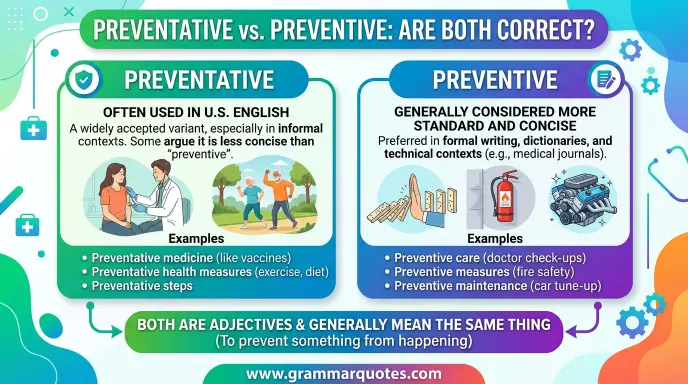
Preventive and preventative are both accepted English words, and both mean something that helps stop a problem before it happens. The main difference is usage, style, and preference rather than meaning.
You may see preventive more often in formal, medical, academic, and professional writing. Preventative is also correct, but it can sound slightly longer or less common in some contexts.
For example, you can talk about preventive measures or preventative measures. Both expressions refer to actions taken to avoid an unwanted event or problem.
The choice can sometimes depend on the English variety, industry, publication style, or personal preference. If you want a concise and widely used form, preventive is a common choice.
Understanding the difference between these two forms can help you choose the right word for essays, reports, healthcare writing, business documents, and everyday communication.
Preventative or Preventive: Quick Answer
Both preventive and preventative are correct standard English words.
They have essentially the same meaning:
Preventive = intended to prevent something.
Preventative = also intended to prevent something.
Examples:
- The doctor recommended preventive treatment.
- The doctor recommended preventative treatment.
Both sentences are grammatically correct.
However, preventive is often preferred when a shorter, more direct form is wanted.
| Word | Correct? | Meaning |
| Preventive | Yes | Intended to prevent something |
| Preventative | Yes | Intended to prevent something |
| Prevent | Yes | To stop something from happening |
| Prevention | Yes | The act of stopping something |
Definition and Meaning
Preventive
Preventive is an adjective describing something designed to stop a problem, illness, accident, or unwanted event before it occurs.
Examples:
- preventive care
- preventive measures
- preventive treatment
- preventive maintenance
- preventive action
Example sentence:
Regular maintenance is an important preventive measure.
Preventative
Preventative has the same basic meaning. It describes something intended to prevent a problem before it happens.
Examples:
- preventative care
- preventative measures
- preventative treatment
- preventative action
Example:
The company introduced preventative measures to reduce accidents.
The meaning does not normally change when you add the extra at .
The Origin of Preventative and Preventive
Both forms are connected to the verb prevent, which comes from Latin praevenire, meaning to come before or anticipate.
The shorter adjective preventive developed naturally from prevent.
The longer form preventative developed later as an expanded form influenced by other English words ending in ative.
English has many cases where a shorter and longer form coexist. Sometimes one becomes more common in certain contexts, while another remains perfectly acceptable.
That is what happened with these two words. Both survived in English, and both can be found in modern writing.
British English vs American English
Both preventive and preventative are used in British and American English.
There is no strict rule saying that one belongs only to Britain and the other only to America.
| Usage | American English | British English |
| Preventive | Common | Common |
| Preventative | Used | Used |
| Meaning | Same | Same |
| Main difference | Usage preference | Usage preference |
The important difference is therefore not a simple British versus American spelling rule.
Instead, writers and organizations may have their own preferences.
Is Preventive and Preventative More Common?
Preventive is generally the shorter and more widely preferred form in many formal contexts.
It is especially common in phrases such as:
- preventive medicine
- preventive care
- preventive maintenance
- preventive measures
- preventive action
Preventative is also established English and appears in many contexts, including healthcare, education, business, and general writing.
If you are unsure which one to choose, preventive is a straightforward choice because it is concise and widely recognized.
However, using preventative is not automatically a spelling mistake.
Which Form Should You Use?
Use “Preventive” for Concise Formal Writing
Preventive works well in:
- Academic writing
- Business reports
- Medical writing
- Technical documents
- Government documents
- Professional communication
Example:
The company has introduced preventive safety measures.
Use “Preventative” When It Fits Your Style
Preventative is also acceptable when it fits the wording or style of your writing.
Example:
The school introduced preventative measures to improve student safety.
There is no major difference in meaning.
Follow Your Style Guide
If you are writing for a specific organization, publication, school, or website, check its preferred style.
Consistency is often more important than choosing one form over the other.
Preventive or Preventative in Different Contexts
Healthcare
Both forms can describe actions taken to reduce the risk of illness.
Preventive care can help people maintain good health.
Preventative care can help people maintain good health.
Maintenance
In engineering and technology, preventive maintenance is a common phrase.
The machine requires regular preventive maintenance.
Safety
Both forms can describe safety steps.
Workers received training on preventive safety measures.
Workers received training on preventative safety measures.
Business
Businesses may use either form when discussing risk reduction.
The company created preventive policies.
The company created preventative policies.
Common Mistakes
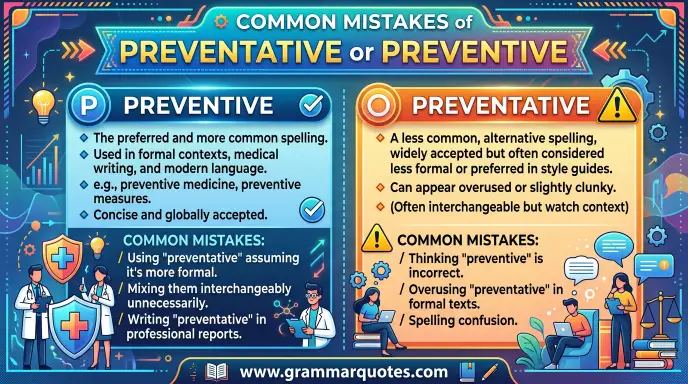
Mistake 1: Thinking “preventative” is always wrong
This is incorrect.
Preventative is an accepted English word.
It may be less preferred in some formal styles, but it is not simply a spelling error.
Mistake 2: Thinking the two words have different meanings
In normal modern usage, the two words have essentially the same meaning.
Both describe something intended to prevent a problem.
Mistake 3: Assuming one is British and the other is American
There is no strict British American division here.
Both forms are used in both varieties.
Mistake 4: Changing the meaning of a sentence unnecessarily
For most sentences, replacing one form with the other does not significantly change the meaning.
For example:
Preventive measures were introduced.
and
Preventative measures were introduced.
Both communicate the same basic idea.
Everyday Examples
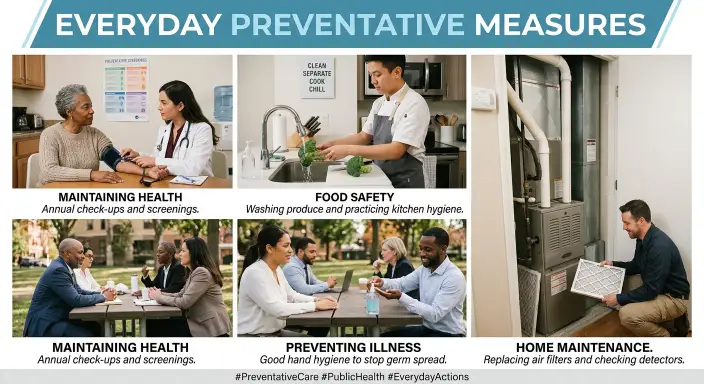
School
Students were taught preventive safety practices.
Workplace
The company uses preventive measures to reduce accidents.
Healthcare
Regular checkups can be part of preventive care.
Technology
Preventive maintenance can reduce equipment problems.
Home
Cleaning the filter is a preventive step.
General Writing
Taking action early can be an effective preventative measure.
These examples show that both forms can work naturally depending on the writer’s preference.
Preventative or Preventive : Side by Side Comparison
| Feature | Preventive | Preventative |
| Standard English | Yes | Yes |
| Meaning | Intended to prevent | Intended to prevent |
| Adjective | Yes | Yes |
| British English | Used | Used |
| American English | Used | Used |
| Formal writing | Very common | Accepted |
| Length | Shorter | Longer |
| Main difference | Usage preference | Usage preference |
Related Words
Understanding the word family can make the distinction easier.
Prevent
A verb meaning to stop something from happening.
Good planning can prevent problems.
Prevention
A noun describing the act of preventing something.
Prevention is often better than dealing with a problem later.
Preventive
An adjective describing something intended to prevent a problem.
The doctor recommended preventive care.
Preventatively
An adverb that means in a preventive manner.
The equipment was maintained preventatively.
Google Trends and Usage
Search interest around these two forms usually comes from people checking whether preventative is a mistake or whether preventive is preferred.
Usage can vary by country, industry, and context. Medical and technical writing often favors concise terminology, while general writing may use either form.
Google Trends can show changes in search interest over time, but search volume alone does not determine whether a word is correct. Both forms are established English words.
For and general content, the best approach is to use the form that fits the target audience and maintain consistency throughout the page.
People Also Ask
Is preventive or preventative correct?
Both are correct. They have essentially the same meaning.
Is preventative a real word?
Yes. Preventative is an established English word.
Is preventive more correct than preventative?
Not in a simple right or wrong sense. Both are accepted, although preventive is often preferred as the shorter form.
Is preventative grammatically correct?
Yes. It can be used as an adjective meaning intended to prevent something.
Which is more common, preventive or preventative?
Preventive is generally more common in many formal and technical contexts, but usage varies.
Is preventive British or American?
It is used in both British and American English.
Is preventative British English?
It is used in British English, but it is not exclusively British.
What is the difference between preventive and preventative?
The main difference is form and usage preference. Their basic meaning is the same.
Should I use preventive care or preventative care?
Both are understandable and correct. Preventive care is a concise and widely used choice.
Is preventative a spelling mistake?
No. Preventative is a valid English word.
Frequently Used Phrases
Both forms can appear in many of the same expressions.
| Common phrase | Alternative |
| preventive care | preventative care |
| preventive measures | preventative measures |
| preventive action | preventative action |
| preventive treatment | preventative treatment |
| preventive maintenance | preventative maintenance |
| preventive medicine | preventative medicine |
| preventive strategy | preventative strategy |
In many professional contexts, the shorter form is preferred because it is concise and familiar.
Final Takeaway
Preventive and preventative are both correct English words. They describe something intended to stop a problem or unwanted event before it happens.
The main difference is not meaning but usage preference. Preventive is shorter and is widely used in formal, medical, technical, and professional contexts. Preventative is also established English and can be used naturally in many of the same situations.
There is no strict rule that makes one British and the other American. Both forms appear in different English varieties.
If you want a simple default for professional or formal writing, preventive is a practical choice. However, you do not need to treat preventative as a spelling mistake.
The most important point is consistency. Choose the form that matches your audience, organization, or preferred style, and use it consistently throughout your writing.
Discover More Articles!
Paster or Pastor: Which Spelling Is Correct?
Broche or Brooch: Which Spelling Is Correct?(2026)
Trouper or Trooper: What Is the Difference?(2026)

Ethan Parker is an English-language writer known for his interest in words, language, and clear communication. His work focuses on making everyday English easier to understand through simple explanations and practical examples.