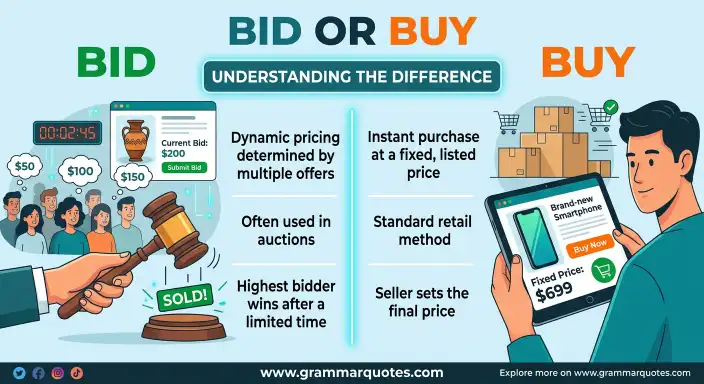
Bid and buy are both correct English words, but they have different meanings and uses. The word bid can mean to offer a price for something, especially in an auction, or to make a formal offer for a contract. It can also mean to command or express something in certain phrases, such as “bid farewell.” The word buy means to purchase something by paying money.
For example, “I will bid $50 for the painting” means you are offering $50, while “I will buy the painting” means you intend to purchase it. Understanding this difference helps you choose the correct word when talking about shopping, auctions, business, and everyday activities.
Quick Answer: Bid vs Buy
- Bid: To offer a price for something, compete for a contract, or express something in certain phrases.
- Buy: To purchase something by paying money.
- Use bid when making an offer in an auction or competing for a project.
- Use buy when purchasing goods or services.
- Both words are correct, but they are not interchangeable in most situations.
Examples:
- I will bid $100 for the painting. (I am offering a price.)
- I will buy the painting for $100. (I am purchasing it.)
Bid vs Buy: Comparison Table
| Feature | Bid | Buy |
| Main meaning | To offer a price or make an offer | To purchase something |
| Part of speech | Verb and noun | Verb |
| Past tense | Bid | Bought |
| Past participle | Bid | Bought |
| Common context | Auctions, tenders, contracts, competitions | Shopping, purchases, transactions |
| Example | She bid $200 at the auction. | She bought a new phone. |
| Money involved | Often an offered price | Usually payment for a purchase |
| Key idea | Making an offer | Purchasing something |
Remember: You can bid on an item without winning it. When you buy an item, you purchase it, although payment and delivery may occur at different times.
What Does Bid Mean?
Bid is a verb that commonly means to offer a specific amount of money for something. It is especially common in auctions, where several people may compete by offering different prices.
It can also refer to making an offer for a contract or project. As a noun, a bid means an offer or attempt to achieve something.
Examples of Bid in Sentences
- He decided to bid $500 for the antique watch.
- She bid higher than the other buyers.
- The company plans to bid for the construction contract.
- Several businesses submitted a bid for the project.
- He made a final bid before the auction ended.
In these examples, bid refers to an offer or an attempt to win something.
Bid in Auctions
In an auction, a person makes a bid by offering an amount they are willing to pay for an item.
For example:
- The opening bid was $100.
- I bid $150 for the painting.
- Another buyer bid $200.
- The highest bidder won the item.
Making a bid does not automatically mean that you own the item. Your offer generally needs to be accepted under the auction’s rules.
Bid in Business
Businesses may bid for contracts, projects, or services. They submit offers explaining the price and, often, the terms under which they will complete the work.
Examples:
- Three companies bid for the government contract.
- Our company submitted a competitive bid.
- The contractor plans to bid on the new project.
In business, a bid may include more than a price. It can also contain a proposed schedule, service details, or other conditions.
Bid as a Noun
Bid can also be used as a noun to mean an offer or an attempt.
Examples:
- The company made a bid to acquire another business.
- His bid was rejected.
- She made a strong bid for the championship.
The exact meaning depends on the context.
What Does Buy Mean?
Buy is a verb that means to obtain something by paying money or providing something of value in exchange. It is commonly used in everyday shopping, business transactions, and online purchases.
The past tense and past participle of buy are both bought.
Examples of Buy in Sentences
- I want to buy a new laptop.
- She will buy groceries after work.
- We bought a television last month.
- He has bought a ticket for the concert.
- They plan to buy a house next year.
In each sentence, buy or its past form refers to purchasing something.
Buy in Everyday Shopping
The word buy is used whenever someone purchases an item from a shop, seller, or online store.
Examples:
- I will buy a phone from the market.
- She wants to buy a new dress.
- We bought fresh fruit from the shop.
- He plans to buy a gift for his friend.
Buy in Business
In business, buy can refer to purchasing goods, equipment, materials, or services.
Examples:
- The company will buy new computers.
- We bought office supplies yesterday.
- The business plans to buy materials in bulk.
Unlike bid, which often refers to making an offer, buy focuses on the purchase itself.
Bid vs Buy: Verb Forms and Grammar
Understanding the verb forms of bid and buy helps prevent common grammar mistakes.
| Verb form | Bid | Buy |
| Base form | Bid | Buy |
| Third person singular | Bids | Buys |
| Present participle | Bidding | Buying |
| Simple past | Bid | Bought |
| Past participle | Bid | Bought |
| Example | He bid $100. | He bought a watch. |
How to Use Bid Correctly
Use bid after modal verbs such as will, can, may, and should.
Examples:
- I will bid on the painting.
- She may bid for the contract.
- We can bid at the auction.
- They are bidding against other companies.
In many auction and offer related uses, the past tense of bid remains bid.
Example: He bid $300 for the artwork.
How to Use Buy Correctly
Use buy as the base form, buys with a third person singular subject in the simple present, and bought for the past tense.
Examples:
- I buy groceries every week.
- She buys coffee every morning.
- We bought a new computer yesterday.
- They have bought their tickets.
Common mistake: “I buyed a phone” is incorrect in standard English. The correct sentence is “I bought a phone.”
Bid vs Buy: Real Life Examples
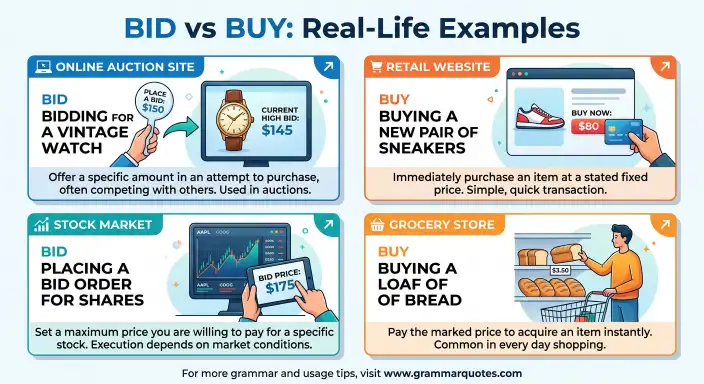
The following examples show how these words are used in different situations.
| Situation | Example sentence | Correct word |
| Online auction | I will bid $75 for the watch. | Bid |
| Shopping | I want to buy a watch. | Buy |
| Property auction | They bid on the house. | Bid |
| Grocery shopping | She will buy vegetables. | Buy |
| Business contract | The company submitted a bid. | Bid |
| Purchasing equipment | The company will buy new machines. | Buy |
| Online marketplace | He placed a bid on the collectible. | Bid |
| Paying for a product | I bought the collectible yesterday. | Buy |
| Competition | She made a bid for the championship. | Bid |
| Personal purchase | He bought a gift for his mother. | Buy |
Bid vs Buy in Online Shopping and Auctions
The difference between bid and buy is especially important when using online marketplaces.
What Does Bid Mean Online?
On an auction website, bid means offering an amount for an item. Other users may offer higher amounts, depending on the auction rules.
Example:
“I placed a bid of $40 on the headphones.”
This means you offered $40; it does not necessarily mean you won the headphones.
What Does Buy Mean Online?
On a shopping website, buy means purchasing an item. A “Buy Now” option commonly lets a customer purchase an item at a listed price, subject to the seller’s terms.
Example:
“I clicked Buy Now and ordered the headphones.”
This means you initiated the purchase rather than merely making a competing offer.
Bid vs Buy Now
| Feature | Bid | Buy Now |
| Purpose | Make an offer | Purchase at a listed price |
| Price | May change as offers compete | Usually displayed before purchase |
| Competition | Other bidders may participate | Usually does not require competing bids |
| Outcome | You may or may not win | The purchase proceeds according to the seller’s terms |
| Example | I bid $50. | I chose Buy Now for $60. |
The exact process depends on the platform. Some websites offer both auction bidding and fixed price purchases.
Buy vs Bid Farewell: An Important Difference
The word bid has another established meaning in certain expressions, especially bid farewell or bid goodbye. In this use, it does not refer to offering money.
Examples:
- She bid farewell to her colleagues.
- We bid goodbye to our old teacher.
- He bade farewell to his friends.
In traditional and formal English, bade is a past tense form of bid in this expression. In everyday speech, people may also use alternatives such as “said goodbye.”
You would not use buy in these expressions because buying refers to purchasing something.
Common Mistakes When Using Buy and Bid
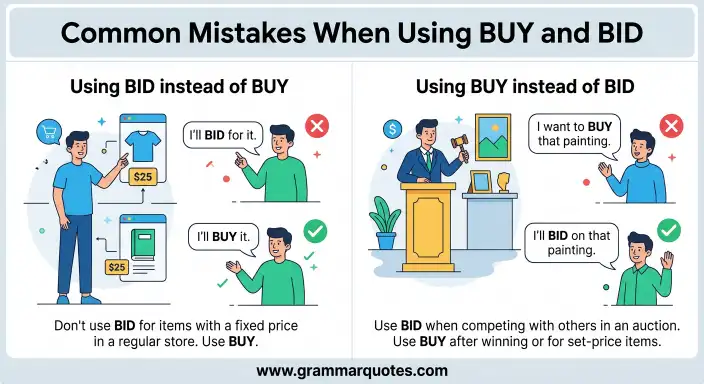
1. Using Buy Instead of Bid in an Auction
Incorrect: I bought $100 for the painting.
Correct: I bid $100 for the painting.
Why? The intended meaning is that you offered $100, not that you purchased $100 worth of something.
2. Using Bid When You Mean Purchase
Incorrect: I will bid a new phone from the shop.
Correct: I will buy a new phone from the shop.
Why? In an ordinary shop, you usually buy an item at its selling price rather than bid for it.
3. Writing Buyed Instead of Bought
Incorrect: She buyed a new laptop.
Correct: She bought a new laptop.
Why? Buy is an irregular verb. Its past tense is bought, not buyed.
4. Assuming Every Bid Is a Successful Purchase
Incorrect idea: I placed a bid, so I automatically own the item.
Correct understanding: A bid is an offer. if you win depends on the auction rules and outcome.
5. Confusing Bid With Bidding
Bid can be a base verb or a noun, while bidding often describes the ongoing process of making offers.
Examples:
- I placed a bid.
- I will bid on the item.
- Several buyers are bidding on the item.
Each form has a different grammatical role.
Synonyms for Bid and Buy
The words have different synonyms because their meanings differ.
Synonyms for Bid
| Synonym | Meaning | Example |
| Offer | Present a price or proposal | She made an offer for the painting. |
| Propose | Suggest a plan or terms | The firm proposed a new contract. |
| Tender | Formally submit an offer, often for a contract | The company submitted a tender. |
| Compete | Try to win against others | Several firms competed for the project. |
| Attempt | Try to achieve something | He made an attempt to win the title. |
These words are not interchangeable in every sentence. For example, tender is especially associated with formal contract offers in some varieties of English.
Synonyms for Buy
| Synonym | Meaning | Example |
| Purchase | Buy something, often in a more formal context | She purchased a new laptop. |
| Acquire | Obtain or gain possession of something | The company acquired new equipment. |
| Shop for | Look for items to buy | We went to shop for clothes. |
| Obtain | Get something | He obtained a ticket. |
| Procure | Obtain something, often through a planned process | The office procured new supplies. |
Purchase is the closest general synonym for buy, while offer is often a useful alternative for the price related meaning of bid.
British English vs American English
Bid and buy are used in both British and American English. Their main meanings and spellings are the same in both varieties.
| Feature | British English | American English |
| Bid | Used for offers and auctions | Used for offers and auctions |
| Buy | Used for purchases | Used for purchases |
| Past tense of buy | Bought | Bought |
| Past tense of bid in auctions | Bid | Bid |
| Main distinction | Offering versus purchasing | Offering versus purchasing |
Examples:
- British English: She bid for the painting and later bought it.
- American English: She bid for the painting and later bought it.
There is no standard British versus American spelling difference between these words.
How to Remember Bid vs. Buy
Use these simple memory tricks to choose the correct word.
- Bid = offer: You offer a price or compete for something.
- Buy = purchase: You pay for something to obtain it.
- Bought = purchased in the past: Remember that buy changes to bought in the past tense.
Memory tip: You bid to try to win an item, and you buy it when you purchase it.
Frequently Asked Questions
1. What is the difference between bid and buy?
Bid means to offer a price or make an offer, while buy means to purchase something. For example, you bid $100 at an auction, but you buy a product when you purchase it.
2. Is bid the past tense of buy?
No. The past tense of buy is bought. In auction related usage, bid is also the past tense of the verb bid.
3. Can you bid and then buy an item?
Yes. You can place a bid in an auction and buy the item if you win under the auction’s rules. However, placing a bid does not guarantee that you will purchase the item.
4. What is the past tense of buy?
The past tense of buy is bought. For example, “I bought a new phone yesterday.”
5. What does bid mean in online shopping?
On an auction based website, bid means offering an amount of money for an item. Other buyers may make higher offers, and the winner is determined according to the platform’s rules.
People Also Ask
Is it bid or buy at an auction?
Use bid when offering a price at an auction. If your offer wins and the transaction is completed, you can say that you bought the item.
Does bid mean purchase?
Not exactly. A bid is an offer or an attempt to win something, while a purchase is the act of buying something. A successful bid may lead to a purchase.
What is the difference between bid and bidding?
Bid can refer to an offer or the act of making one. Bidding usually refers to the ongoing process of offering prices, especially when several buyers compete in an auction.
Is “I bid $100” correct English?
Yes. “I bid $100” is correct when you mean that you offered $100 for something, especially in an auction.
What is another word for buy?
Purchase is the closest common synonym for buy. Other alternatives include acquire, obtain, and procure, depending on the context.
Conclusion
When deciding between bid or buy, remember that both words are correct but have different meanings. Bid usually means offering a price, competing for a contract, or making an attempt to win something. Buy means purchasing something in exchange for money or value. In an auction, you may bid on an item before eventually buying it.
Also, remember that the past tense of buy is bought, while the past tense of bid in auction related usage is generally bid. Choosing the right word will make your English clearer and more accurate.
Discover More Articles!
Poufy or Poofy: Which Spelling Is Correct?(2026)
Ingenuous or Ingenious: Which Spelling Is Correct?
Sometime or Some Time: Which One Is Correct?

Ethan Parker is an English-language writer known for his interest in words, language, and clear communication. His work focuses on making everyday English easier to understand through simple explanations and practical examples.