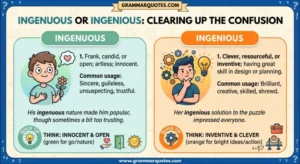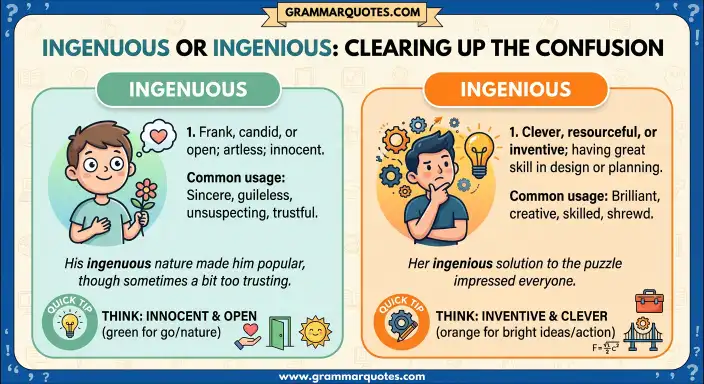
Ingenuous and ingenious are both correct words, but they have very different meanings. Ingenuous describes someone who is innocent, sincere, open, or honest, sometimes because they lack experience. Ingenious describes someone or something that is clever, inventive, or exceptionally good at solving problems.
For example, “The ingenuous child answered every question honestly” means the child was innocent and sincere. In contrast, “The engineer designed an ingenious machine” means the machine was clever and innovative.
These words are easy to confuse because they look and sound similar, but using one instead of the other can change the meaning of a sentence. In this guide, you will learn their definitions, pronunciation, origins, synonyms, examples, and key differences so you can choose the right word confidently.
Quick Answer: Ingenuous or Ingenious?
- Ingenuous: Innocent, sincere, frank, or open in manner.
- Ingenious: Clever, inventive, original, or skillful at solving problems.
- Part of speech: Both are adjectives.
- Ingenuous example: Her ingenuous response showed that she was speaking honestly.
- Ingenious example: His ingenious solution saved the company time and money.
- Main difference: Ingenuous relates to honesty and innocence; ingenious relates to intelligence and creativity.
Memory trick: Ingenuous is associated with innocence and sincerity. Ingenious is associated with ingenuity and invention.
Ingenuous vs Ingenious: Comparison Table
The clearest way to understand these words is to compare their meanings, typical uses, and examples.
| Feature | Ingenuous | Ingenious |
| Part of speech | Adjective | Adjective |
| Core meaning | Innocent, sincere, or frank | Clever, inventive, or resourceful |
| Describes | A person’s nature, manner, or response | A person, idea, design, method, or solution |
| Main idea | Honesty and lack of pretence | Intelligence and originality |
| Common contexts | Personality, conversations, behavior, literature | Inventions, technology, problem solving, creativity |
| Positive meaning | Genuine, open, trustworthy | Smart, creative, innovative |
| Possible negative implication | Naive or inexperienced | Can suggest cleverness used for an improper purpose, depending on context |
| Common synonyms | Sincere, candid, artless, guileless | Inventive, creative, resourceful, clever |
| Example | She gave an ingenuous answer. | She developed an ingenious answer to the problem. |
| Quick memory clue | Innocence | Invention |
The words are not interchangeable. An ingenuous person is open and sincere, while an ingenious person is clever and inventive.
What Does Ingenuous Mean?
Ingenuous is an adjective that describes someone who is sincere, honest, open, or innocent. It often suggests that a person speaks or behaves naturally without trying to deceive others.
Depending on the context, ingenuous can also suggest that someone is inexperienced or somewhat naive because they trust others easily.
Examples of Ingenuous in Sentences
- The ingenuous child admitted that he had broken the vase.
The child was honest and did not try to hide the truth. - Her ingenuous smile made everyone feel welcome.
Her smile appeared natural and sincere. - He gave an ingenuous answer to the difficult question.
His answer was open and straightforward. - The new employee’s ingenuous attitude impressed her colleagues.
Her behavior seemed genuine and free from pretence. - His ingenuous trust in strangers sometimes caused problems.
He trusted people easily because he lacked experience or suspicion.
Synonyms for Ingenuous
Common synonyms for ingenuous include:
- Sincere: Genuine in feelings or intentions.
- Candid: Honest and direct.
- Frank: Open and straightforward.
- Guileless: Free from deceit or cunning.
- Artless: Natural and without pretence.
- Naive: Lacking experience or judgment in a particular situation.
- Open: Willing to share thoughts and feelings honestly.
- Unpretentious: Not trying to appear more important or impressive than one is.
These synonyms have slightly different meanings. For example, sincere emphasizes genuine feelings, while naive emphasizes a lack of experience or awareness. Naive can sound critical, whereas ingenuous can convey a more positive sense of innocence and honesty.
What Does Ingenious Mean?
Ingenious is an adjective that describes someone or something that shows exceptional cleverness, imagination, or problem solving ability.
It is commonly used for inventions, designs, plans, ideas, methods, and people who find original solutions to difficult problems.
Examples of Ingenious in Sentences
- The engineer created an ingenious device to save energy.
The device was cleverly designed. - She found an ingenious way to organize the small room.
Her solution was creative and practical. - The student developed an ingenious method for solving the equation.
The method showed originality and intelligence. - His ingenious plan helped the team finish the project early.
The plan was clever and effective. - The author used an ingenious plot twist in the novel.
The story included a surprising and clever development.
Synonyms for Ingenious
Common synonyms for ingenious include:
- Inventive: Good at creating new ideas or things.
- Creative: Able to produce original ideas.
- Clever: Quick to understand or solve problems.
- Resourceful: Skilled at finding solutions with available resources.
- Innovative: Introducing new methods or ideas.
- Original: New or different from what is usual.
- Skillful: Showing a high level of ability.
- Imaginative: Having a strong ability to think creatively.
These words are related but not identical. Innovative often emphasizes introducing something new, while resourceful emphasizes finding effective solutions in challenging situations.
Origin of Ingenuous and Ingenious
The words ingenuous and ingenious share a historical connection to Latin words associated with natural qualities and inborn abilities. Their similar origins help explain why their spellings are close, but their modern meanings have developed in different directions.
Origin of Ingenuous
Ingenuous comes from Latin ingenuus, meaning freeborn, noble, or naturally candid. Over time, English usage developed the sense of being sincere, open, innocent, or free from deceit.
Today, the word often describes an honest manner or a person’s natural lack of pretence.
Example: Her ingenuous nature made her easy to trust.
Origin of Ingenious
Ingenious comes from Latin ingeniosus, meaning talented, clever, or endowed with natural ability. It is related to ingenium, which refers to natural character, talent, or intellectual ability.
In modern English, ingenious is associated with creativity, invention, and clever problem solving.
Example: The inventor created an ingenious mechanism that made the task easier.
Pronunciation of Ingenuous and Ingenious
Although the words look similar, they have different pronunciations.
| Word | American English (IPA) | British English (IPA) | Main Stress |
| Ingenuous | /ɪnˈdʒen.ju.əs/ | /ɪnˈdʒen.ju.əs/ | Second syllable |
| Ingenious | /ɪnˈdʒiː.ni.əs/ | /ɪnˈdʒiː.ni.əs/ | Second syllable |
Pronunciation may vary slightly by accent. The main difference is in the middle vowel sounds:
- Ingenuous: The middle sounds like “jen.”
- Ingenious: The middle sounds like “jee.”
Practice these examples aloud:
- Ingenuous: She was ingenuous about her mistake.
- Ingenious: She designed an ingenious solution.
Paying attention to the vowel sounds can help you distinguish the two words when speaking.
Ingenuous vs Ingenious: Grammar and Usage
Both words are adjectives, but they usually describe different qualities.
How to Use Ingenuous in a Sentence
Use ingenuous when describing honesty, openness, innocence, or a lack of pretence.
Common word combinations include:
- Ingenuous person
- Ingenuous response
- Ingenuous smile
- Ingenuous question
- Ingenuous attitude
- Ingenuous expression
Examples:
- The ingenuous student asked a question that others were afraid to ask.
- Her ingenuous response showed that she had nothing to hide.
- His ingenuous expression made his surprise seem genuine.
How to Use Ingenious in a Sentence
Use ingenious when describing clever ideas, inventions, designs, plans, or problem solving methods.
Common word combinations include:
- Ingenious solution
- Ingenious invention
- Ingenious design
- Ingenious idea
- Ingenious method
- Ingenious plan
Examples:
- The team developed an ingenious solution to the technical problem.
- The inventor demonstrated an ingenious design for a compact device.
- Her ingenious idea helped reduce waste.
Can You Use Both Words to Describe a Person?
Yes, but the meanings differ.
- She is ingenuous. This suggests that she is sincere, open, or innocent.
- She is ingenious. This suggests that she is clever, inventive, or resourceful.
A person can be both. Someone may be honest and straightforward while also being highly creative.
Ingenious or Ingenuous: Common Mistakes
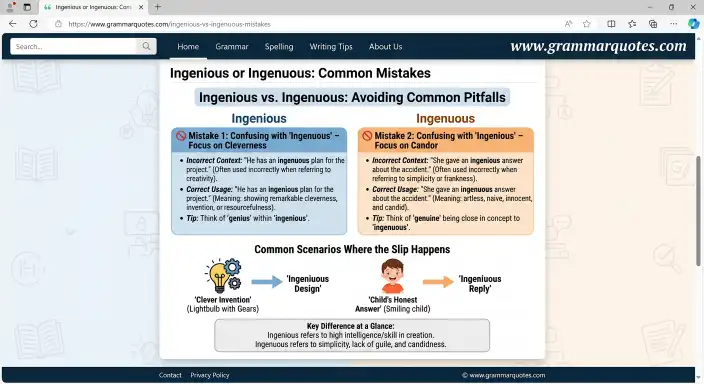
Because these words differ by only a few letters, they are often confused in writing.
Mistake 1: Using Ingenious When You Mean Honest
Incorrect: He gave an ingenious answer because he did not want to lie.
Correct: He gave an ingenuous answer because he did not want to lie.
Why? The sentence focuses on honesty and sincerity, not cleverness.
Mistake 2: Using Ingenuous When You Mean Clever
Incorrect: The engineer developed an ingenuous machine to solve the problem.
Correct: The engineer developed an ingenious machine to solve the problem.
Why? The machine is described as clever and innovative.
Mistake 3: Assuming the Words Are Synonyms
Incorrect assumption: Ingenuous and ingenious both mean intelligent.
Correct explanation: Ingenuous primarily concerns sincerity and innocence. Ingenious concerns cleverness and inventiveness.
Mistake 4: Confusing Ingenious With Genius
The words ingenious and genius are related in meaning, but they serve different grammatical roles.
- Ingenious: An adjective describing something clever or inventive.
- Genius: A noun referring to exceptional intellectual ability or a person with such ability.
Example: The genius inventor created an ingenious machine.
Here, genius refers to exceptional talent, while ingenious describes the machine.
Ingenuous vs Ingenious: Everyday Examples
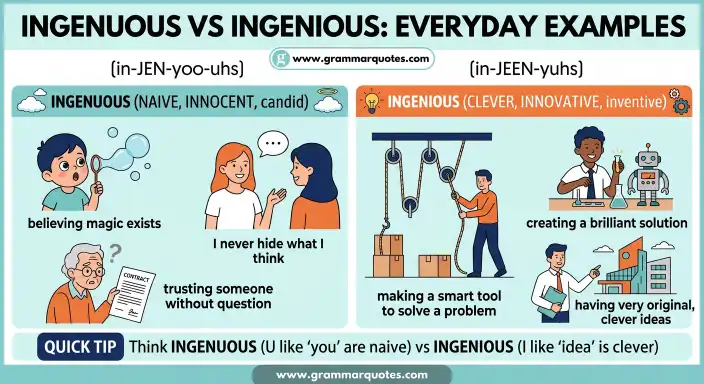
Compare the following sentences to understand how the meaning changes.
| Ingenuous | Ingenious |
| She gave an ingenuous answer. | She developed an ingenious answer to the problem. |
| He showed an ingenuous attitude. | He proposed an ingenious strategy. |
| The child’s ingenuous question showed curiosity. | The child’s ingenious experiment impressed the teacher. |
| Her ingenuous smile seemed genuine. | Her ingenious design saved space. |
| He made an ingenuous admission. | He invented an ingenious tool. |
| The speaker was ingenuous about his feelings. | The speaker presented an ingenious argument. |
| Her ingenuous nature made her trustworthy. | Her ingenious thinking solved the challenge. |
| The ingenuous remark showed honesty. | The ingenious method improved the process. |
| His ingenuous behavior seemed natural. | His ingenious plan helped the group succeed. |
| The ingenuous child trusted the adults. | The ingenious inventor built a new device. |
Key takeaway: Choose ingenuous when the main idea is honesty or innocence. Choose ingenious when the main idea is cleverness or invention.
Antonyms of Ingenuous and Ingenious
An antonym is a word with an opposite or contrasting meaning. Since ingenuous and ingenious describe different qualities, they also have different antonyms.
Antonyms of Ingenuous
| Antonym | Meaning | Example |
| Deceitful | Dishonest or misleading | His deceitful answer hid the truth. |
| Cunning | Clever in a secretive or potentially dishonest way | The cunning plan fooled the others. |
| Sly | Secretive or crafty | She gave him a sly smile. |
| Insincere | Not expressing genuine feelings | His insincere apology did not sound convincing. |
| Wary | Careful because of possible danger or deception | She was wary of strangers. |
These words are not exact opposites in every context. For example, wary means cautious, whereas ingenuous suggests openness or innocence.
Antonyms of Ingenious
| Antonym | Meaning | Example |
| Unimaginative | Lacking creativity | The unimaginative design looked ordinary. |
| Uninventive | Not showing originality | The solution was uninventive. |
| Inept | Lacking skill or ability | The inept approach failed to solve the issue. |
| Clumsy | Awkward or poorly handled | The clumsy design was difficult to use. |
| Unoriginal | Not new or creative | The proposal was unoriginal. |
The best antonym depends on what you want to contrast: creativity, skill, originality, or cleverness.
How to Remember Ingenuous and Ingenious
Use these simple memory tricks to avoid confusion.
1. Ingenuous Means Genuine
Think of ingenuous as describing someone who is genuine, sincere, and open.
Example: Her ingenuous answer was honest and straightforward.
2. Ingenious Means Inventive
Think of ingenious as describing someone who can invent, create, or solve problems cleverly.
Example: His ingenious invention made the job easier.
3. Ask What You Want to Describe
Before using either word, ask yourself:
- Am I describing honesty, innocence, or openness? Use ingenuous.
- Am I describing cleverness, creativity, or an invention? Use ingenious.
This simple check can help you choose the right word in seconds.
Frequently Asked Questions
1. What is the difference between ingenuous and ingenious?
Ingenuous means innocent, sincere, or open. Ingenious means clever, inventive, or resourceful. The first concerns a person’s manner or honesty, while the second concerns intelligence and creativity.
2. Is ingenuous a positive word?
Usually, yes. It often describes someone as sincere, honest, or free from pretence. However, it can sometimes imply naivety or inexperience.
3. Does ingenious mean intelligent?
It is closely related to intelligence, but it more specifically means clever, inventive, or skillful at solving problems. An ingenious idea is an idea that shows originality and practical cleverness.
4. Can a person be both ingenuous and ingenious?
Yes. A person can be sincere and honest while also being clever and inventive. For example, an ingenuous and ingenious scientist could be both straightforward in communication and creative in research.
5. What is a synonym for ingenious?
Common synonyms include inventive, creative, clever, resourceful, innovative, and original. The best choice depends on the context.
People Also Ask
1. What is the easiest way to remember ingenuous vs. ingenious?
Remember that ingenuous relates to genuine honesty, while ingenious relates to inventive thinking.
2. Is ingenuous the same as naive?
Not exactly. Both can suggest innocence or inexperience, but ingenuous often emphasizes sincerity and openness, while naive more strongly suggests a lack of experience or judgment.
3. What is an example of an ingenious idea?
Creating a foldable desk that saves space in a small room is an example of an ingenious idea because it solves a practical problem creatively.
4. What is the noun form of ingenious?
The related noun is ingenuity, meaning the ability to think creatively and develop clever solutions.
Example: Her ingenuity helped the team overcome the technical challenge.
5. What is the noun form of ingenuous?
The related noun is ingenuousness, meaning the quality of being sincere, open, or innocent.
Example: His ingenuousness made his explanation seem genuine.
Conclusion
The difference between ingenuous and ingenious comes down to two distinct qualities. Ingenuous describes honesty, innocence, and openness, while ingenious describes cleverness, creativity, and the ability to solve problems in original ways. Use ingenuous when talking about a sincere answer, an innocent expression, or a person who speaks without pretence.
Use ingenious when describing a clever invention, a creative idea, or an effective solution. Both words are adjectives, and both can describe people, but they communicate different things about those people.
To remember the distinction, connect ingenuous with being genuine and ingenious with being inventive. By understanding their definitions, pronunciation, synonyms, and sentence patterns, you can avoid this common vocabulary mistake and express your ideas more precisely.
Discover More Articles!
Advisers vs Advisors: Meaning, Difference, and Correct Spelling
Wegovy or Mounjaro: Which Is Better?(2026)
Pajamas or Pyjamas: Which Spelling Is Correct?(2026)

Ethan Parker is an English-language writer known for his interest in words, language, and clear communication. His work focuses on making everyday English easier to understand through simple explanations and practical examples.