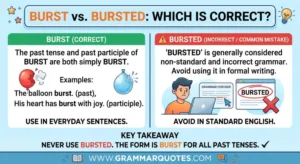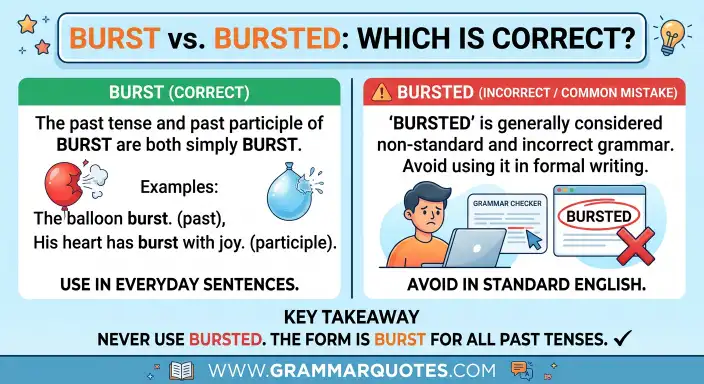
Burst is the correct standard form in modern English, while bursted is generally considered nonstandard. The verb burst means to break open suddenly, explode, or become full of something. It stays the same in the present, past, and past participle forms.
For example, you should write “The balloon burst yesterday,” not “The balloon bursted yesterday.” Learning this simple rule will help you avoid a common grammar mistake in everyday writing and speaking.
Quick Answer: Bursted or Burst?
Burst is the correct spelling for standard English in the present tense, past tense, and past participle.
- Burst: Correct standard form — “The balloon burst.”
- Bursted: Generally nonstandard — avoid it in formal writing and standard English.
- Present tense: The balloon bursts when it is overfilled.
- Past tense: The balloon burst yesterday.
- Past participle: The balloon has burst.
The verb burst is an irregular verb, which means it does not form its past tense by adding ed.
Bursted vs Burst: Comparison Table
| Feature | Burst | Bursted |
| Standard spelling | Correct | Nonstandard |
| Part of speech | Verb; also a noun | Nonstandard verb form |
| Present tense | Correct | Not standard |
| Past tense | Correct | Generally incorrect in standard English |
| Past participle | Correct | Generally incorrect in standard English |
| Formal writing | Recommended | Avoid |
| Example | The pipe burst last night. | The pipe bursted last night. |
Remember: Use burst instead of bursted when describing something that breaks, opens, or explodes suddenly.
What Does Burst Mean?
Burst means to break open suddenly because of pressure, force, or excessive fullness. It can also describe a sudden, strong expression of emotion, sound, activity, or movement.
Examples of Burst in Sentences
- The balloon burst when it touched the sharp object.
- The old water pipe burst during the night.
- She burst into tears after hearing the news.
- The children burst out laughing at the joke.
- The runner burst into action near the finish line.
In each sentence, burst describes a sudden event or action.
Burst as a Noun
Burst can also be used as a noun to describe a short, sudden period of activity, sound, or energy.
Examples:
- He completed the work in a burst of energy.
- The room filled with a burst of laughter.
- She finished the task in a short burst of activity.
What Does Bursted Mean?
Bursted is a form people sometimes use by adding ed to the verb burst. However, it is generally not accepted as the standard past tense or past participle form in modern English.
This mistake often happens because many regular verbs form their past tense by adding ed. For example:
- Walk → walked
- Jump → jumped
- Open → opened
However, burst is irregular. Its form does not change in the past tense.
Incorrect: The balloon bursted during the party.
Correct: The balloon burst during the party.
Incorrect: The pipe has bursted.
Correct: The pipe has burst.
For school assignments, professional writing, exams, and everyday standard English, always choose burst.
Why Is Burst an Irregular Verb?
An irregular verb does not follow the usual pattern of adding ed to form the past tense.
Regular verbs follow this pattern:
- Play → played
- Clean → cleaned
- Watch → watched
Irregular verbs follow different patterns:
- Go → went
- Write → wrote
- Break → broke
- Burst → burst
The verb burst belongs to the group of irregular verbs whose base form, past tense, and past participle are identical.
The Three Forms of Burst
| Verb Form | Word | Example |
| Base form | Burst | Do not burst the balloon. |
| Past tense | Burst | The balloon burst yesterday. |
| Past participle | Burst | The balloon has burst. |
| Present participle | Bursting | The balloon is bursting. |
| Third person singular | Bursts | The balloon bursts easily. |
Notice that bursting is correct because the verb takes ing for the present participle. This does not mean bursted is correct.
When Should You Use Burst?
Use burst whenever the sentence requires the base form, simple past tense, or past participle.
1. Use Burst for the Present Tense
Use burst with subjects such as I, you, we, and they, or after modal verbs such as can, may, and will.
Examples:
- I do not want the balloon to burst.
- They watched the pipe burst.
- The balloon may burst if it becomes too full.
For the third person singular subject he, she, or it, use bursts in the simple present.
Example: The balloon bursts easily.
2. Use Burst for the Past Tense
Use burst to describe something that happened in the past.
Examples:
- The balloon burst at the birthday party.
- The water pipe burst last winter.
- The audience burst into applause.
- He burst out laughing.
Even though these events happened in the past, the spelling remains burst.
3. Use Burst After Has, Have, or Had
Use the past participle burst after auxiliary verbs such as has, have, and had.
Examples:
- The balloon has burst.
- Two pipes have burst this month.
- The tire had burst before the driver stopped.
Do not write “has bursted” or “had bursted” in standard English.
Common Expressions with Burst
The verb burst appears in many common English expressions. Learning these phrases can improve your vocabulary and help you use the word naturally.
| Expression | Meaning | Example |
| Burst into tears | Start crying suddenly | She burst into tears. |
| Burst out laughing | Start laughing suddenly | Everyone burst out laughing. |
| Burst into flames | Suddenly catch fire | The dry material burst into flames. |
| Burst with pride | Feel extremely proud | His parents burst with pride. |
| Burst at the seams | Be too full or crowded | The suitcase was bursting at the seams. |
| Burst into action | Start acting suddenly and energetically | The team burst into action. |
| Burst someone’s bubble | Disappoint someone by correcting an expectation | I hate to burst your bubble, but the shop is closed. |
These expressions use burst, not bursted, in standard English.
Common Mistakes with Bursted and Burst
Many English learners assume that every verb forms its past tense by adding ed. This rule works for regular verbs but not for irregular verbs such as burst.
Here are common mistakes and their corrections:
| Incorrect Sentence | Correct Sentence |
| The balloon bursted yesterday. | The balloon burst yesterday. |
| The tire has bursted. | The tire has burst. |
| The pipes had bursted overnight. | The pipes had burst overnight. |
| She bursted into tears. | She burst into tears. |
| The children bursted out laughing. | The children burst out laughing. |
| The bag is bursted. | The bag has burst. |
Grammar tip: When you are unsure about a verb’s past tense, check if it is regular or irregular instead of automatically adding ed.
Everyday Examples of Burst
The following sentences show how burst works in different situations.
| Situation | Example Sentence |
| A balloon | The red balloon burst suddenly. |
| A tire | The car’s tire burst on the road. |
| A water pipe | The pipe burst during the cold weather. |
| An emotion | He burst into tears after the announcement. |
| Laughter | We burst out laughing at the funny story. |
| A crowded place | The small room was bursting with people. |
| A sudden sound | The quiet room burst into noise. |
| A sudden movement | The horse burst into a run. |
| A container | The bag burst under the weight of the books. |
| An unexpected event | The old dam burst after days of heavy rain. |
In every example, burst is the standard form. The exact meaning depends on the context.
British English vs. American English: Bursted or Burst
There is no important difference between standard British and American English when using the past tense of burst. Both varieties use burst as the standard past tense and past participle form.
| English Variety | Standard Past Tense | Standard Past Participle |
| British English | Burst | Burst |
| American English | Burst | Burst |
Examples in both varieties:
- The balloon burst during the celebration.
- The pipe has burst.
- She burst into laughter.
Although you may encounter bursted in informal speech, learner writing, or nonstandard usage, burst is the safest choice in both British and American English.
Synonyms of Burst
Depending on the sentence, you can use several words with meanings similar to burst. However, these words are not interchangeable in every situation.
| Synonym | Meaning | Example |
| Explode | Break apart suddenly and violently | The firework exploded in the sky. |
| Pop | Make a sudden sound or break open | The balloon popped. |
| Rupture | Break or tear under pressure | The pipe ruptured. |
| Break | Separate into pieces or stop functioning | The old container broke. |
| Split | Divide or tear into parts | The bag split at the side. |
| Erupt | Break out suddenly, often with force | The volcano erupted. |
| Overflow | Spill because something is too full | Water overflowed from the container. |
Choose a synonym that matches the situation. For example, pop often works for a balloon, while rupture may be more appropriate for a pipe or medical context.
Easy Trick to Remember Burst
A simple way to remember the correct spelling is to learn the three principal forms together:
Burst → Burst → Burst
- Present: The balloon may burst.
- Past: The balloon burst yesterday.
- Past participle: The balloon has burst.
Compare this with a regular verb:
Jump → Jumped → Jumped
The verb burst does not follow the regular ed pattern. If you remember that its three principal forms stay the same, you can avoid writing bursted.
Frequently Asked Questions
1. Is bursted a real word?
Bursted occurs in some informal or nonstandard usage, but it is generally not accepted as the standard past tense or past participle of burst. Use burst in standard English.
2. Is burst the past tense of burst?
Yes. Burst is both the base form and the simple past tense. For example, “The balloon burst yesterday” is correct.
3. Is it burst or bursted into tears?
Burst into tears is correct. The phrase means to start crying suddenly. For example, “She burst into tears after hearing the news.”
4. Should I write has burst or has bursted?
Write has burst. The past participle of burst remains unchanged, so “The pipe has burst” is correct.
5. What are the three forms of the verb burst?
The three principal forms are burst, burst, burst: base form, simple past tense, and past participle. The present participle is bursting, and the third person singular present form is bursts.
People Also Ask
1. Why is burst an irregular verb?
Burst is irregular because its past tense does not follow the usual pattern of adding ed. Its base form, past tense, and past participle are all burst.
2. Can I use bursted in an English exam?
It is best to avoid bursted in English exams. Burst is the standard form expected in formal writing and standard grammar.
3. What is the past participle of burst?
The past participle is burst. For example, “The balloon has burst.”
4. Is bursting grammatically correct?
Yes. Bursting is the correct ing form of the verb burst. For example, “The balloon is bursting.”
5. What is the difference between burst and bursts?
Burst is the base form and past tense, while bursts is the third person singular present form. For example, “The balloon may burst” and “The balloon bursts easily.”
Conclusion
When choosing between bursted or burst, remember that burst is the correct standard form for the base verb, simple past tense, and past participle. Although many regular verbs take ed in the past tense, burst is irregular and does not change its spelling in these three forms.
Write “The balloon burst,” “The pipe has burst,” and “She burst into tears.” Avoid bursted in school assignments, professional writing, exams, and other situations that require standard English. Remember the simple pattern: burst, burst, burst.
Discover More Articles!
Wegovy or Mounjaro: Which Is Better?(2026)
Chili or Chile: Which Spelling Is Correct?(2026)
Pajamas or Pyjamas: Which Spelling Is Correct?(2026)

Ethan Parker is an English-language writer known for his interest in words, language, and clear communication. His work focuses on making everyday English easier to understand through simple explanations and practical examples.