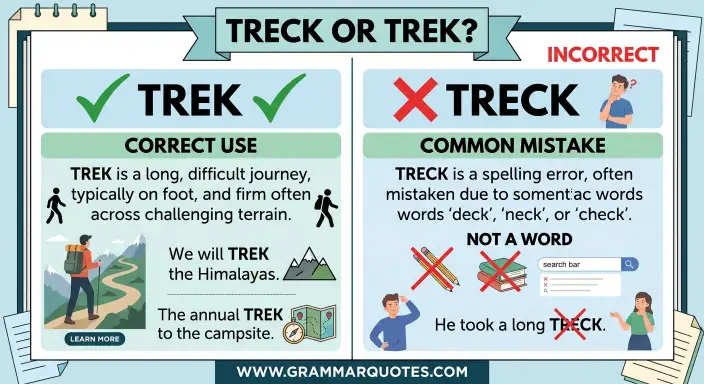
Is it treck or trek? If you are writing about a long walk, a mountain adventure, or a journey through nature, the correct spelling is trek. The word treck is a common misspelling of trek.
A trek usually involves traveling on foot over a long distance, often through mountains, forests, or other natural areas. It can also describe a difficult journey that requires time and effort.
In this guide, you will learn the meaning of trek, how to use it in sentences, why people confuse these spellings, and which related words you should know. You will also find common mistakes, everyday examples, and answers to frequently asked questions.
Quick Answer: Treck or Trek?
Trek is the correct spelling in standard English.
Treck is generally considered a misspelling when someone intends to use the word trek.
- Correct: We went on a long trek through the mountains.
- Incorrect: We went on a long treck through the mountains.
Remember: Use trek when talking about a long or challenging journey, especially on foot.
Meaning of Trek
Definition of Trek
The word trek can be used as both a noun and a verb.
As a noun, it means a long or difficult journey, usually made on foot.
As a verb, it means to travel a long distance on foot, often through a challenging area.
Examples of Trek
- The hikers completed a long trek through the forest.
- Our mountain trek took several hours.
- We plan to trek across the hills next summer.
- The village is a difficult trek from the nearest town.
- They trekked through the valley to reach the campsite.
Connotative Meaning of Trek
The word trek often suggests adventure, effort, endurance, and exploration. It can describe an enjoyable outdoor activity or a tiring journey.
For example:
- We went on a trek through the mountains. — This suggests an outdoor adventure.
- It was a long trek to the bus station. — This suggests that reaching the station required a lot of walking or effort.
The word does not always refer to hiking in the wilderness. It can also describe any long or tiring journey.
Origin and Short History of Trek
The English word trek comes from Afrikaans trek, meaning a journey or migration. It is related to the Dutch verb trekken, meaning “to pull” or “to travel.”
The word became associated with long journeys in southern Africa, particularly journeys made by settlers traveling by ox wagon. Over time, English speakers began using trek more broadly for long, challenging journeys, including hiking trips.
Pronunciation of Trek
- American English IPA: /trɛk/
- British English IPA: /trɛk/
- Syllables: One
- Part of speech: Noun and verb
The word rhymes with check, deck, and neck.
Word Forms of Trek
Here are the common forms of the word:
| Word form | Example |
| Trek | We planned a trek. |
| Treks | She enjoys mountain treks. |
| Trekked | They trekked across the hills. |
| Trekking | We went trekking last weekend. |
| Trekker | The trekker carried a backpack. |
Notice that the past tense trekked and the form trekking use a double k.
Treck vs Trek: Key Differences
| Feature | Treck | Trek |
| Standard spelling | No, not for this meaning | Yes |
| Meaning | Usually a misspelling of trek | A long or difficult journey |
| Part of speech | Not the standard form for this meaning | Noun and verb |
| Example | Incorrect: a mountain treck | Correct: a mountain trek |
Why Do People Write Treck Instead of Trek?
People may write treck because they are unsure about the spelling or because they associate the sound with other words ending in ck.
However, the standard English spelling is trek. The word does not need a c before the k.
Trek vs Track: What Is the Difference?
Trek is sometimes confused with track, but the words have different meanings.
- Trek: A long or difficult journey.
- Track: A path, route, trail, or mark left by someone or something. It can also refer to following or monitoring something.
Examples:
- We went on a trek through the mountains.
- We followed a narrow track through the forest.
A trek is a journey; a track may be the path used during that journey.
Common Mistakes With Trek

Mistake 1: Writing Treck Instead of Trek
Incorrect: We went on a treck in the hills.
Correct: We went on a trek in the hills.
Why? The standard spelling is trek, without a c.
Mistake 2: Misspelling Trekked
Incorrect: They treked for five hours.
Correct: They trekked for five hours.
Why? The past tense doubles the final k before adding ed.
Mistake 3: Misspelling Trekking
Incorrect: She enjoys treking in the mountains.
Correct: She enjoys trekking in the mountains.
Why? The present participle also doubles the final k before adding ing.
Mistake 4: Confusing Trek With Track
Incorrect: We went on a track across the mountains. (If you mean a long journey.)
Correct: We went on a trek across the mountains.
Why? Use trek for the journey and track for a path or route.
Everyday Examples of Trek in Sentences

Here are more examples showing how to use trek naturally.
Trek as a Noun
- The trek to the summit was exhausting.
- Our family enjoyed a weekend trek in the hills.
- The campsite was a three hour trek from the village.
- Their journey became a difficult trek through the snow.
- The students prepared for a school trek in the countryside.
Trek as a Verb
- We will trek through the forest tomorrow.
- They trek across the hills every summer.
- The explorers trekked through a remote region.
- She is trekking with a group of experienced hikers.
- We had to trek several miles to reach the hotel.
Synonyms of Trek
The best synonym depends on the context. These words can describe a journey or walking activity, but they are not exact replacements in every sentence.
- Hike: A long walk, especially in the countryside or mountains.
- Journey: Travel from one place to another.
- Expedition: An organized journey for a specific purpose.
- Trail: A path, often used for walking or hiking.
- March: To walk steadily, often with a particular purpose.
- Voyage: A long journey, especially by sea or through space.
Example: We went on a long hike through the forest.
Frequently Asked Questions
1. Is Treck a Correct Word?
Treck is generally an incorrect spelling when you mean a long journey. The correct spelling is trek.
2. Is It Trek or Trecking?
The correct spelling is trekking, with a k followed by another k. Trecking is a misspelling.
3. What Is the Plural of Trek?
The plural is treks.
Example: The region offers several challenging mountain treks.
4. What Is the Past Tense of Trek?
The past tense is trekked.
Example: We trekked through the forest yesterday.
5. What Does Trek Mean in Simple English?
A trek is a long or difficult journey, usually on foot.
6. Is Trek a Noun or a Verb?
Trek can be both a noun and a verb. As a noun, it means a journey. As a verb, it means to travel a long distance on foot.
7. What Is the Difference Between Trek and Hike?
A hike is generally a long walk outdoors. A trek often suggests a longer or more challenging journey, although the words can overlap.
Conclusion
The correct spelling is trek, not treck, when you mean a long or challenging journey. You can use trek as both a noun and a verb. For example, you can go on a trek or trek through the mountains.
Remember the related forms trekked and trekking, which double the final k. Also, do not confuse trek with track: a trek is a journey, while a track is a path or route.
Learning the correct spelling helps you write clearly and avoid common mistakes in schoolwork, travel writing, blog posts, and everyday communication. When in doubt, remember this simple rule: trek is the correct spelling.
Discover More Articles!
Okay or OK: Meaning, Differences, Examples, and Mistakes
Ertz vs Ferguson: Meaning, Origin, and Usage(2026)
Artisan or Agriculturist: What Is the Difference?

Ethan Parker is an English-language writer known for his interest in words, language, and clear communication. His work focuses on making everyday English easier to understand through simple explanations and practical examples.