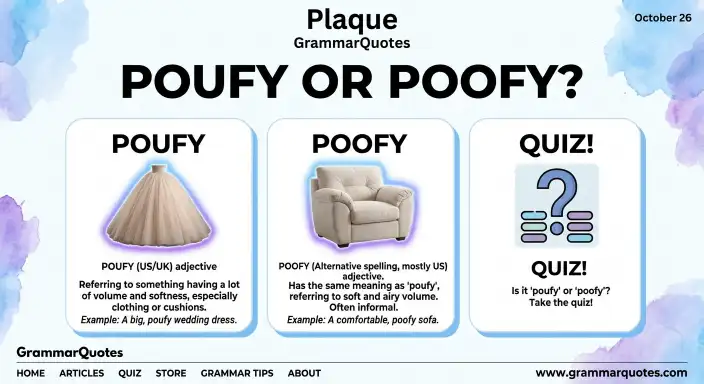
Poofy is the more common and widely recognized spelling in modern English, while poufy is a less common variant. Both words can describe something that looks puffy, fluffy, rounded, or full of volume, especially hair, clothing, and decorative styles.
However, if you want the clearest and most familiar spelling for everyday writing, choose poofy. In formal writing, words such as puffy, fluffy, or voluminous may be more suitable, depending on the context.
Quick Answer: Poufy vs Poofy
- Poofy: A common informal adjective meaning puffy, fluffy, rounded, or full of volume.
- Poufy: A less common spelling variant that may be used with the same meaning.
- Best choice: Use poofy for general informal writing because it is more widely recognized.
- Formal alternative: Use puffy, fluffy, or voluminous when a more standard or precise word is needed.
Example: Her hair looked poofy after she brushed it.
Poufy vs. Poofy: Comparison Table
| Feature | Poofy | Poufy |
| Spelling status | Common informal spelling | Less common variant |
| Meaning | Puffy, fluffy, or full of volume | Usually the same meaning |
| Common use | Hair, dresses, skirts, cushions, and clouds | Occasional informal descriptions |
| Recognition | More widely recognized | Less familiar to many readers |
| Formal writing | Usually replace with a more precise word | Usually replace with a more precise word |
| Recommended choice | Preferred for general use | Use only when intentionally following this variant |
The main difference is spelling frequency and familiarity, not a reliable difference in meaning. Neither spelling should automatically be treated as a different word with a separate definition.
What Does Poofy Mean?
Poofy is an informal adjective used to describe something that appears puffy, fluffy, rounded, or unusually full. It often refers to the shape or volume of hair, clothing, or soft objects.
Examples of Poofy in Sentences
- Her hair became poofy in the humid weather.
- The little girl wore a poofy pink dress to the party.
- These cushions look soft and poofy.
- The clouds appeared white and poofy against the blue sky.
- The skirt has a poofy shape that makes it look fuller.
In each example, poofy describes something with noticeable volume or a rounded, fluffy appearance.
Common Synonyms for Poofy
The best synonym depends on what you are describing.
| Synonym | Meaning | Example |
| Puffy | Swollen or rounded | His jacket had puffy sleeves. |
| Fluffy | Soft and light | The towel felt fluffy. |
| Voluminous | Having a lot of volume | She styled her hair to look voluminous. |
| Full | Having a rounded or abundant shape | The dress had a full skirt. |
| Bulky | Large or taking up space | The coat felt bulky. |
| Feathery | Light and soft in appearance | The decoration had a feathery texture. |
These words are not always interchangeable. For example, fluffy emphasizes softness, while voluminous emphasizes size or volume.
What Does Poufy Mean?
Poufy is a less common spelling variant of poofy. When people use it, they generally mean something that looks puffy, fluffy, rounded, or full of volume.
It may appear in informal descriptions of hairstyles, clothing, and decorative objects. However, because it is less familiar to many readers, poofy is generally the safer choice when you want your meaning to be immediately understood.
Examples of Poufy in Sentences
- Her hairstyle looked poufy after the styling session.
- The costume had a poufy skirt.
- The decorative pillows looked poufy and soft.
- She wanted a slightly poufy hairstyle for the celebration.
- The dress had a poufy shape around the waist.
These examples illustrate how the less common spelling may be used. For general audiences, changing poufy to poofy would usually make the writing more familiar.
Poufy or Poofy: Origin and Word History
The words poofy and poufy belong to informal English vocabulary associated with puffiness and volume.
The familiar word puff refers to a soft swelling, a short burst of air, or something that expands outward. English also uses related words such as puffy and puffiness to describe rounded or swollen appearances.
Poofy is an informal adjective formed in the same general family of expressive words. Its spelling reflects a pronunciation and style associated with softness and volume. Poufy is a less common alternative spelling.
It is best not to assume that the two spellings have separate historical origins or distinct meanings without reliable evidence. In ordinary modern usage, they are generally used to communicate a similar idea.
How to Pronounce Poofy and Poufy
Both spellings are generally pronounced the same way when used with the same meaning.
- Poofy: /ˈpuː.fi/
- Poufy: /ˈpuː.fi/
A simple pronunciation guide is POO fee.
The first syllable rhymes with too, and the second syllable sounds like fee.
Because these are informal words, pronunciation may vary slightly among speakers, but the two spellings do not usually indicate different pronunciations.
Is Poofy a Real Word?
Yes. Poofy is an established informal English word used to describe something that is puffy, fluffy, rounded, or full of volume.
It is especially useful in casual conversation, fashion descriptions, and discussions about hairstyles. However, it is less formal than alternatives such as voluminous, puffy, or full.
For example:
- Informal: Her hair looks poofy today.
- More formal: Her hair looks unusually voluminous today.
Both sentences communicate a similar idea, but the second sounds more suitable for formal or professional writing.
Is Poufy Incorrect?
Poufy is not necessarily incorrect, but it is much less common than poofy. It is better understood as a variant spelling rather than a separate word with a clearly different meaning.
For most everyday writing, use poofy. If you are writing for a professional audience, consider if puffy, fluffy, or voluminous expresses your meaning more precisely.
For example:
- Less familiar: The dress had a poufy skirt.
- More familiar: The dress had a poofy skirt.
- More formal: The dress had a voluminous skirt.
The best option depends on the tone of your writing and the image you want to communicate.
Common Mistakes When Using Poofy and Poufy

1. Assuming the Words Have Different Meanings
A common mistake is believing that poofy and poufy describe two different things. In ordinary informal usage, both generally refer to a puffy or voluminous appearance.
Correct approach: Use poofy as the more familiar spelling for the shared meaning.
2. Using Poofy in Every Formal Situation
Although poofy is understandable, it may sound too casual in academic, business, or professional writing.
Informal: The dress has a poofy skirt.
More formal: The dress has a full, voluminous skirt.
3. Confusing Poofy with Puffy
Poofy and puffy overlap in meaning, but they are not always identical in tone.
- Poofy: Often suggests a fluffy, rounded, or exaggerated shape.
- Puffy: Can describe swelling, fullness, or a rounded appearance and is more standard in general English.
For example, you might describe hair as poofy, but swollen eyes are more naturally described as puffy.
4. Assuming Poufy Is the Preferred Standard Spelling
The existence of a variant does not mean both spellings are equally common. Poofy is generally the more recognizable choice.
5. Choosing a Synonym Without Considering Context
The word bulky can suggest heaviness, while fluffy emphasizes softness. Neither always conveys the same meaning as poofy.
Choose the word that best describes the object or appearance.
Everyday Examples: Poufy vs Poofy

The following table shows how the words may appear in everyday English and which alternatives sound most natural in different contexts.
| Context | Example sentence | Recommended wording |
| Hair | Her hair looks poofy today. | Poofy |
| Fashion | She wore a poofy dress to the party. | Poofy |
| Skirts | The costume had a poofy skirt. | Poofy |
| Cushions | The sofa has poofy cushions. | Poofy or fluffy |
| Clouds | White, poofy clouds floated overhead. | Poofy or fluffy |
| Eyes | His eyes looked puffy after a long night. | Puffy |
| Formal fashion description | The gown had a voluminous silhouette. | Voluminous |
| Informal alternative spelling | The dress looked poufy. | Poofy is more familiar |
These examples show that poofy works best in casual descriptions, while more precise alternatives can improve clarity in formal writing.
British English vs. American English
Unlike spelling pairs such as colour and color, poofy and poufy are not well established British versus American spelling alternatives.
| Question | Answer |
| Is poofy American English only? | No. It can be understood in informal English beyond the United States. |
| Is poufy the British spelling? | It is not a standard British versus American distinction. |
| Which spelling is more familiar? | Poofy is generally the more familiar spelling. |
| Which word suits formal writing? | Puffy, fluffy, or voluminous, depending on the context. |
Do not choose poufy simply because you are writing for a British audience. The two spellings do not follow a dependable regional spelling rule.
How to Remember the Correct Spelling
Use these simple tips to remember poofy.
- Choose the familiar spelling: Remember poofy as the first choice for casual writing.
- Connect it with puffiness: Think of something that looks puffy, rounded, or full.
- Use the context: If you mean swollen, try puffy. If you mean soft, try fluffy. If you mean having a lot of volume, try voluminous.
- Keep formal writing precise: Replace informal poofy with a more exact word when appropriate.
Memory tip: When in doubt, choose poofy for informal descriptions and voluminous for a more formal description of fullness or volume.
Frequently Asked Questions
1. Is it poufy or poofy?
Poofy is the more common and widely recognized spelling. Poufy is a less common variant generally used with the same meaning.
2. What does poofy mean?
Poofy means puffy, fluffy, rounded, or full of volume. It is often used to describe hair, dresses, skirts, cushions, and clouds.
3. Is poufy a misspelling?
Poufy is better described as a less common variant spelling rather than automatically being considered an error. However, poofy is the safer choice for general writing.
4. What is the difference between poofy and puffy?
Poofy often describes something fluffy, rounded, or full of volume, especially hair or clothing. Puffy is a more standard adjective that can also describe swelling, as in puffy eyes or a puffy jacket.
5. What is a formal word for poofy?
Useful formal alternatives include voluminous, full, and bulky, depending on the context. For example, a voluminous dress is a more formal description than a poofy dress.
People Also Ask
Is poofy a proper English word?
Yes. Poofy is an informal English adjective used to describe something with a puffy, fluffy, or voluminous appearance.
How do you spell poofy hair?
The usual spelling is poofy hair. You can also say fluffy hair, puffy hair, or voluminous hair, depending on the style.
Can I use poufy in writing?
Yes, you may encounter poufy as a spelling variant. However, poofy is more familiar to many readers and is generally the better choice.
Is poofy the same as fluffy?
Not exactly. Poofy emphasizes a rounded or voluminous shape, while fluffy emphasizes softness and a light texture. The words can overlap in some contexts.
What is another word for poofy?
Common alternatives include puffy, fluffy, full, and voluminous. The best synonym depends on if you are describing softness, shape, swelling, or volume.
Conclusion
When deciding between poufy or poofy, choose poofy for most informal English writing. It is the more common and recognizable spelling and describes something that looks puffy, fluffy, rounded, or full of volume.
Although poufy appears as a less common variant, it is not a standard British versus American spelling difference. For formal descriptions, consider alternatives such as puffy, fluffy, or voluminous. Choosing the right word for your context will make your writing clearer and more natural.
Discover More Articles!
Advisers vs Advisors: Meaning, Difference, and Correct Spelling
Wegovy or Mounjaro: Which Is Better?(2026)
Pajamas or Pyjamas: Which Spelling Is Correct?(2026)

Ethan Parker is an English-language writer known for his interest in words, language, and clear communication. His work focuses on making everyday English easier to understand through simple explanations and practical examples.