Few and a few are both used with countable plural nouns, but they express slightly different ideas. Few usually means not many and often suggests that the number is smaller than expected or not enough.
A few means some or a small number and usually expresses a more positive idea. Understanding the difference between few and a few will help you speak naturally, write clearly, and avoid common English grammar mistakes.
Quick Answer: Few or A Few?
Both few and a few are correct English expressions, but their meanings are different.
- Few means hardly any or not many, often suggesting that something is insufficient.
- A few means some or a small number of something.
Examples:
- I have few friends in this city. (I have hardly any friends here.)
- I have a few friends in this city. (I have some friends here.)
Definition and Meaning of Few
Few is a determiner or pronoun used with countable plural nouns. It refers to a small number of people or things and often emphasizes that the number is not enough.
It generally has a negative meaning or feeling, especially when the speaker wants to show disappointment or a lack of something.
Examples:
- Few students understood the difficult question.
- He has few opportunities to practise English.
- Few people attended the meeting.
- There are few chairs available in the room.
Definition and Meaning of A Few
A few is an expression used with countable plural nouns to describe some people or things. It means a small number, but it usually suggests that there are at least some available.
Unlike few, the expression a few often has a positive or neutral meaning.
Examples:
- I have a few friends at college.
- She bought a few apples from the market.
- We have a few minutes before the class starts.
- A few students answered the question correctly.
Origin of Few and A Few
The word few comes from Old English fēawe, meaning a small number or not many. It has long been used to describe limited quantities of countable things.
The expression a few combines the article a with few. In this expression, the article helps present the small number as some existing amount rather than emphasizing a lack.
This small difference makes a big change in the meaning of a sentence.
A Few vs Few: Key Differences
| Feature | Few | A Few |
| Meaning | Not many; hardly any | Some; a small number |
| General tone | Often negative | Usually positive or neutral |
| Nouns | Countable plural nouns | Countable plural nouns |
| Suggests | A possible shortage | Some amount is available |
| Example | Few people came. | A few people came. |
When to Use Few
Use few when you want to emphasize that the number of people or things is very small or less than what is needed or expected.
1. To Show a Lack of Something
Use few when there are not enough people or things available.
Examples:
- There are few job opportunities in this area.
- He has few friends to talk to.
- We have few resources to complete the project.
- There are few buses after midnight.
2. To Describe a Small Number Negatively
Few can show that something is uncommon or happens less often than expected.
Examples:
- Few students passed the difficult test.
- Few people understand this rule.
- Few visitors came to the museum.
- Few businesses remained open during the storm.
3. In Formal English
Few is often used in formal writing, reports, and academic discussions to emphasize a limited number.
Examples:
- Few studies have examined this issue.
- Few applicants met all the requirements.
- Few examples support this argument.
- Few countries use exactly the same system.
When to Use A Few
Use a few when you want to say that some people or things exist or are available, even if the number is small.
1. To Talk About Some People or Things
Use a few when referring to a small number without emphasizing a shortage.
Examples:
- I have a few books about English grammar.
- She invited a few friends to her birthday party.
- We bought a few vegetables from the market.
- He made a few mistakes in his essay.
2. To Talk About Time
A few is commonly used with countable units of time, such as minutes, hours, and days.
Examples:
- Wait for a few minutes.
- I will call you in a few hours.
- We are leaving in a few days.
- She stayed there for a few weeks.
3. To Express a Positive or Hopeful Idea
A few can emphasize that something useful or helpful is available.
Examples:
- I have a few ideas for the project.
- There are a few ways to solve this problem.
- We still have a few chances to improve.
- I learned a few useful words today.
Few and A Few in Everyday English
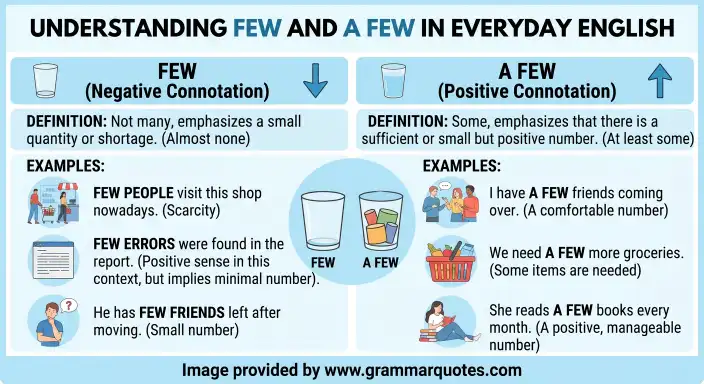
Both expressions are commonly used in conversations, schoolwork, and daily writing. The context helps you understand if the speaker is emphasizing a shortage or simply describing a small number.
| Situation | Few | A Few |
| Friends | I have few friends here. | I have a few friends here. |
| Money related items | Few coins were available. | I found a few coins. |
| Students | Few students passed. | A few students passed. |
| Books | I have few books to read. | I have a few books to read. |
| Opportunities | There are few opportunities. | There are a few opportunities. |
| Minutes | Few minutes remained. | We have a few minutes left. |
Common Mistakes With A Few and Few

English learners sometimes confuse few and a few because both refer to a small number.
1. Forgetting the Difference in Meaning
Incorrect for a positive meaning: I have few good friends, and I am happy about that.
Better: I have a few good friends, and I am happy about that.
Why? A few clearly communicates that some friends are available.
2. Using Few With Uncountable Nouns
Incorrect: I have few money.
Correct: I have little money.
Why? Money is normally uncountable in English, so use little or a little, not few or a few.
3. Using A Few With a Singular Noun
Incorrect: I have a few book.
Correct: I have a few books.
Why? A few must be followed by a countable plural noun.
4. Thinking Few and A Few Mean Exactly the Same Thing
Incorrect assumption: Few people came and a few people came mean exactly the same thing.
Correct understanding:
- Few people came suggests that not many people came, perhaps fewer than expected.
- A few people came means that some people came.
Easy Ways to Remember the Difference
You can remember these expressions with a simple trick:
- Few = Hardly any: Think of a number that seems too small.
- A few = Some: Think of a small number that is available.
Memory examples:
- Few students completed the work. (Almost none or not many completed it.)
- A few students completed the work. (Some students completed it.)
Remember: Adding the article a changes the feeling of the sentence from a possible shortage to the idea that some things are available.
Everyday Examples of Few and A Few
Here are ten simple sentences to help you understand both expressions.
- Few students arrived on time for the class.
- I have a few friends who help me with my studies.
- There are few shops open at night.
- She bought a few apples from the market.
- Few people understood the complicated instructions.
- We have a few minutes before the train arrives.
- He has few opportunities to travel abroad.
- I read a few pages of the book every evening.
- Few applicants qualified for the position.
- She shared a few useful tips with her classmates.
Frequently Asked Questions (FAQs)
1. What is the main difference between few and a few?
Few usually means hardly any or not many, while a few means some or a small number.
2. Is few negative or positive?
Few generally has a negative meaning because it emphasizes that the number is small or insufficient.
3. Is a few positive or negative?
A few usually has a positive or neutral meaning because it suggests that at least some people or things are available.
4. Do few and a few take singular or plural nouns?
Both are used with countable plural nouns.
Examples:
- Few students.
- A few students.
5. Can we use few with money?
No, not in standard English when money is treated as an uncountable noun. Use little money or a little money instead.
6. What is the difference between few and a little?
Few is used with countable plural nouns, while a little is used with uncountable nouns.
Examples:
- A few books.
- A little water.
7. Is the sentence “I have a few friends” correct?
Yes. It means you have some friends, even if the number is small.
8. What does “few people know” mean?
It means that not many people know something. The expression emphasizes that the information is known by a small number of people.
9. Can we use a few for time?
Yes. You can say a few minutes, a few hours, or a few days because these are countable units of time.
10. How can I remember few vs a few?
Remember few = hardly any and a few = some. This simple rule will help you choose the correct expression in most everyday sentences.
Conclusion
Few and a few are important English expressions that describe small numbers, but their meanings are slightly different. Use few when you want to emphasize that something is limited or insufficient. Use a few when you mean that some people or things are available.
For example, few friends suggests that someone has hardly any friends, while a few friends means that the person has some friends. Learning this difference will help you improve your grammar, write more naturally, and communicate your ideas clearly.
Discover More Articles!
Army or Marines: Meaning, Differences, Roles, and Examples
Bait or Retardation: Meaning, Differences, and Correct Usage
Love or Hate: Meaning, Differences and Examples

Ethan Parker is an English-language writer known for his interest in words, language, and clear communication. His work focuses on making everyday English easier to understand through simple explanations and practical examples.