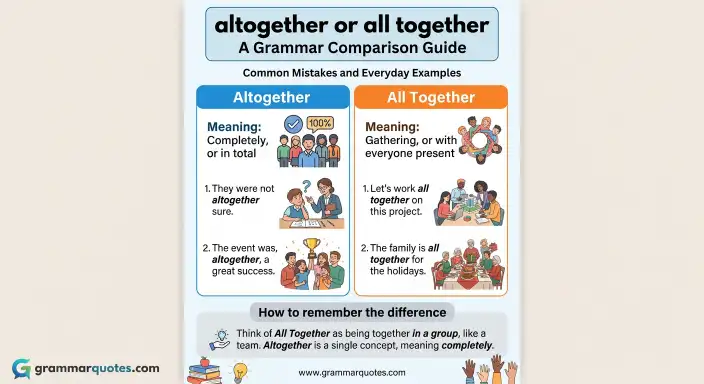
Altogether and all together are both correct, but they have different meanings. Altogether is an adverb that means completely, entirely, or on the whole. All together means everyone or everything in one place or at the same time.
For example, “The plan was altogether different” is correct when describing a complete difference. However, “We sat all together at the table” is correct when describing people sitting in one group. Choosing between these expressions can be confusing because they contain the same words and sound similar when spoken. Yet, using the wrong form can change the meaning of your sentence.
In this guide, you will learn the difference between altogether and all together, explore their definitions and origins, and see practical examples from everyday English. You will also learn how to use both expressions in academic writing, emails, business communication, and casual conversations. By the end, you will know which expression to choose and how to avoid common grammar mistakes.
Altogether or All Together: Quick Answer
The difference between altogether and all together depends on the meaning of your sentence. Both expressions are grammatically correct, but they are not interchangeable in every situation.
When to Use Altogether
Use altogether when you mean:
- Completely: The situation is altogether different now.
- Entirely: I am not altogether sure about the answer.
- On the whole: Altogether, the event was a success.
- In total: The repairs cost $500 altogether.
When to Use All Together
Use all together when you mean:
- In one group: We gathered all together in the hall.
- At the same time: The children shouted all together.
- In one place: Put all the books together on the shelf.
Easy rule: If you can replace the phrase with completely or in total, use altogether. If you mean everyone together or everything in one group, use all together.
What Does Altogether Mean?
Altogether is an adverb. It describes the degree of something, gives an overall judgment, or expresses a total amount.
It usually means completely, entirely, on the whole, or in total. The exact meaning depends on the sentence.
1. Altogether Means Completely
Use altogether when something is complete or total.
Examples:
- The new design is altogether different from the old one.
- I am not altogether convinced by his explanation.
- The rules were altogether changed after the meeting.
In these examples, altogether describes how complete or total the change, feeling, or condition is.
2. Altogether Means On the Whole
You can also use altogether to give an overall opinion or judgment.
Examples:
- Altogether, it was a wonderful experience.
- The book is altogether worth reading.
- Her performance was altogether impressive.
Here, the word helps express an overall view rather than describing a group in one place.
3. Altogether Means In Total
Altogether can also describe the combined total of several things.
Examples:
- We spent $100 altogether.
- There were 25 guests altogether.
- The three items cost $75 altogether.
In these sentences, altogether means the total amount or number.
Synonyms of Altogether
The best synonym depends on the context.
| Synonym | Meaning | Example |
| Completely | In every way | The room was completely empty. |
| Entirely | Wholly or fully | I entirely agree with you. |
| Totally | To the full extent | The plan was totally unexpected. |
| Overall | Considering everything | Overall, the results were good. |
| Generally | In most cases or as a broad judgment | Generally, the service was excellent. |
| In total | As a combined amount | The tickets cost $60 in total. |
Remember that these words do not fit every sentence in exactly the same way. Choose a synonym that preserves the intended meaning.
What Does All Together Mean?
All together is a two word expression. It refers to people or things being in one group, in one place, or doing something at the same time.
The word all refers to everyone or everything in a group. The word together shows that the members of that group are united, gathered, or acting at the same time.
1. All Together Means In One Group
Use all together when people gather or remain in the same group.
Examples:
- We sat all together at the dinner table.
- The family gathered all together for a photograph.
- The students stood all together outside the classroom.
These sentences describe people sharing a place or group.
2. All Together Means At the Same Time
You can also use all together when several people perform the same action at once.
Examples:
- The students answered all together.
- Everyone started singing all together.
- The children clapped all together after the show.
In these examples, the phrase emphasizes that the action happens at the same time.
3. All Together Refers to Things Kept in One Place
The expression can also describe objects gathered into one group.
Examples:
- Keep all the documents all together in one folder.
- We placed the toys all together in a box.
- Put the ingredients all together on the kitchen counter.
These sentences focus on keeping things grouped or collected.
Synonyms of All Together
| Synonym or Phrase | Meaning | Example |
| As a group | As members of one group | We worked as a group. |
| In one place | Gathered in the same location | All the files are in one place. |
| At the same time | Happening simultaneously | They arrived at the same time. |
| Collectively | As a group or whole | The team collectively made the decision. |
| Side by side | Next to one another | The children stood side by side. |
| In unison | Acting or speaking together | Everyone spoke in unison. |
These alternatives work in different contexts. For example, in unison is especially useful when people speak, sing, or act at the same time.
The Origin of Altogether and All Together
The expressions altogether and all together are related in meaning and history, but modern English uses them in different ways.
The Origin of Altogether
Altogether developed from the combination of all and together. Over time, the joined form became established as an adverb with meanings such as completely, entirely, and in total.
Today, standard dictionaries recognize altogether as one word with these established meanings.
The Origin of All Together
All together retains the separate meanings of its two words. All refers to the whole group, while together describes being united, gathered, or acting at the same time.
For example:
- Altogether: The result was altogether unexpected.
- All together: We gathered all together after the ceremony.
The difference is not simply a matter of spelling. It is a difference in meaning and grammatical use.
British English vs. American English
There is no major spelling difference between British and American English for these expressions. Both varieties use altogether as one word and all together as two words, with the same basic distinction in meaning.
| British English | American English | Example |
| Altogether | Altogether | The result was altogether surprising. |
| All together | All together | We stood all together for the photograph. |
| Altogether meaning in total | Altogether meaning in total | The tickets cost £40 altogether in the UK or $40 altogether in the US. |
| All together meaning as a group | All together meaning as a group | The team gathered all together before the match. |
The currency examples simply illustrate regional differences in currency, not differences in grammar.
Do British and American Style Guides Prefer Different Forms?
No. The main distinction remains the same in both varieties.
- British English: Use altogether for a total or overall judgment and all together for a group.
- American English: Follow the same rule.
- Academic and professional writing: Choose the expression that matches the intended meaning.
- Editing and publishing: Maintain consistent spelling and usage throughout the document.
The same distinction is also useful in Canadian, Australian, and other varieties of standard English.
Which Version Should You Use?
Your choice should depend on the meaning you want to communicate, not on your country.
United States
In American English, use altogether for meanings such as completely or in total.
Example: The two repairs cost $300 altogether.
Use all together for a group or simultaneous action.
Example: We arrived all together.
United Kingdom
British English follows the same rule.
Example: The journey was altogether easier than expected.
Example: The children sat all together in the garden.
Canada
Canadian English also uses the standard distinction.
Example: The expenses came to $200 altogether.
Example: The whole class worked all together on the project.
Australia
Australian English follows the same spelling and meaning conventions.
Example: The new arrangement is altogether better.
Example: The family gathered all together for lunch.
International Writing
For international readers, choose the form that makes the sentence easiest to understand. Avoid using altogether when you mean that people are physically gathered in one place.
Academic Writing
In essays and research papers, use altogether to express a total or an overall judgment.
Example: The findings were not altogether consistent.
Use all together when describing a group acting or working as one.
Example: The participants completed the activity all together.
Business Writing
In business emails and reports, altogether is useful for totals, costs, and general assessments.
Example: The three invoices amount to $1,200 altogether.
Use all together when discussing people, items, or tasks grouped in one place.
Example: Please keep all the project files all together in the shared folder.
For a clearer business sentence, you could also write, “Please keep all the project files in one folder.”
Common Mistakes with Altogether and All Together
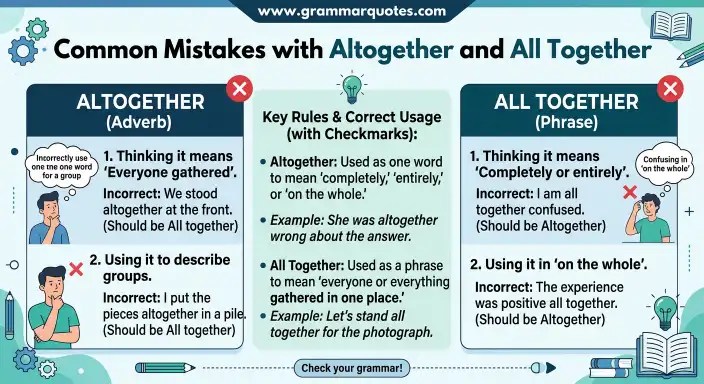
The most common mistake is choosing the spelling without checking the sentence’s meaning.
| Incorrect or Confusing Example | Correct Example | Explanation |
| We spent $50 all together. | We spent $50 altogether. | Altogether expresses the total cost. |
| The plan was all together different. | The plan was altogether different. | Altogether means completely. |
| Everyone gathered altogether in the hall. | Everyone gathered all together in the hall. | All together emphasizes the group. |
| The students answered altogether at once. | The students answered all together. | All together emphasizes simultaneous action. |
| The project was all together unsuccessful. | The project was altogether unsuccessful. | Altogether means entirely or completely. |
Some sentences can be understood in more than one way, depending on context. The goal is to choose the expression that clearly conveys the intended meaning.
A Simple Memory Trick
Remember these two rules:
- Altogether = all in total. Think of a total amount or a complete judgment.
- All together = all in one group. Think of people or things gathered in the same place or acting at the same time.
Test the sentence by replacing the expression:
- If completely fits, use altogether.
- If in one group fits, use all together.
- If in total fits, use altogether.
For example, “The meal cost $80 altogether” works because in total fits. “We ate all together” works because the phrase describes people sharing a meal as a group.
Everyday Examples of All Together and Altogether
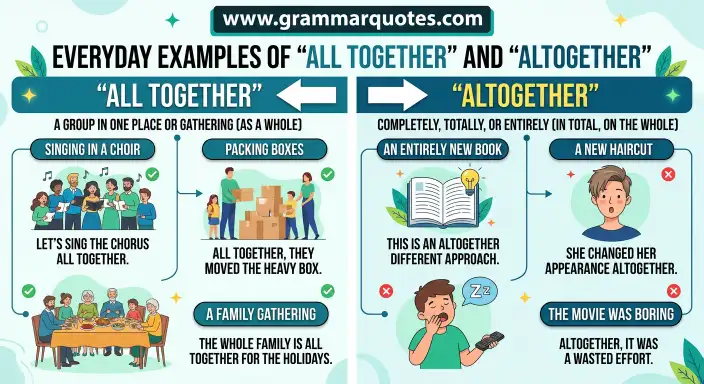
These examples show how both expressions appear in everyday writing and conversation.
| Context | Example Using Altogether | Example Using All Together |
| Emails | The total comes to $250 altogether. | Let’s meet all together before the call. |
| Business writing | The three orders cost $900 altogether. | Keep all the reports all together in one folder. |
| News headlines | The proposal was altogether rejected by the committee. | The team stood all together before the ceremony. |
| Blogs | The new design is altogether more useful. | We traveled all together as a family. |
| Social media | That was an altogether amazing experience! | We were all together at the concert. |
| Academic writing | The evidence is not altogether conclusive. | The students worked all together on the assignment. |
| Daily conversation | The movie was altogether worth watching. | Let’s sit all together. |
| Shopping | The items cost $45 altogether. | We put all the shopping bags all together near the door. |
Some examples can be made smoother by removing unnecessary words. For instance, “Keep all the reports in one folder” is more concise than “Keep all the reports all together in one folder.”
More Examples in Complete Sentences
Altogether:
- The weather was altogether different from what we expected.
- I am not altogether certain that this is the right answer.
- The restaurant bill came to $120 altogether.
- Her explanation was altogether convincing.
- The new policy changed the situation altogether.
All together:
- The cousins stood all together for a family photograph.
- We sang the birthday song all together.
- The books were placed all together on the desk.
- Everyone arrived all together at the meeting point.
- The players warmed up all together before the match.
Google Trends and Modern Usage
People search for altogether or all together because the expressions sound similar and contain the same words. The main challenge is knowing if the sentence refers to a total or to a group.
In modern English, both forms remain useful. Altogether commonly appears in statements about totals, complete changes, and overall judgments. All together appears in descriptions of people gathering, objects being grouped, or actions happening at the same time.
Which Form Is More Popular?
Exact search popularity can change over time and by region. Without a specific Google Trends comparison and date range, it would be misleading to claim that one form receives a particular percentage more searches than the other.
The important usage distinction is clear:
- Searchers often look up altogether vs. all together to check if one or two words are needed.
- Writers may confuse the expressions when describing a total cost or a group.
- Students often need examples to understand the difference between an adverb and a phrase.
- Editors and proofreaders check both spelling and context to preserve the intended meaning.
For an accurate comparison of search interest, use Google Trends with both phrases, choose a region such as the United States or worldwide, and set the same time range for each term. Search interest indicates what people look for, not which expression is grammatically correct.
Quick Comparison Table
| Version | Meaning | Correct? | Region | Example |
| Altogether | Completely | Yes | Standard English worldwide | The room was altogether empty. |
| Altogether | In total | Yes | Standard English worldwide | We paid $75 altogether. |
| Altogether | On the whole | Yes | Standard English worldwide | Altogether, it was a good day. |
| All together | In one group | Yes | Standard English worldwide | We sat all together. |
| All together | At the same time | Yes | Standard English worldwide | They answered all together. |
| All together | Everything gathered in one place | Yes | Standard English worldwide | Put the documents all together. |
Both forms are correct. The intended meaning determines which one you should use.
Key Takeaways
- Altogether is one word.
- All together is two words.
- Altogether means completely, entirely, on the whole, or in total.
- All together means in one group, in one place, or at the same time.
- Both expressions are correct in British and American English.
- Use altogether when discussing a total cost, amount, or overall judgment.
- Use all together when describing people or things gathered as a group.
- When unsure, replace the phrase with completely, in total, or in one group to check the meaning.
Frequently Asked Questions
1. Is altogether one word or two words?
Altogether is one word when it means completely, entirely, on the whole, or in total. For example, “The repairs cost $200 altogether.” The two word expression all together is also correct, but it refers to people or things being grouped or acting at the same time.
2. What is the difference between altogether and all together?
Altogether describes a total, a complete state, or an overall judgment. All together refers to a group of people or things gathered in one place or doing something simultaneously. For example, “The plan was altogether different” and “We sat all together” use the expressions correctly.
3. Is all together grammatically correct?
Yes, all together is grammatically correct when you mean that people or things are gathered as a group or are doing something at the same time. For example, “The students sang all together.” You should not replace it with altogether if the group meaning is important to your sentence.
4. Does altogether mean completely?
Yes. One common meaning of altogether is completely or entirely. For example, “The new system is altogether different” means the new system is completely different. However, altogether can also mean in total or on the whole, depending on how it is used.
5. Can altogether mean in total?
Yes. Altogether can mean in total when you combine amounts, costs, or numbers. For example, “The three books cost $60 altogether” means that the combined cost of the books is $60. In this context, all together would not be the clearest standard choice.
6. Is altogether or all together correct in British English?
Both expressions are correct in British English. Use altogether for a total, complete state, or overall judgment. Use all together for a group gathered in one place or doing something at the same time. American, Canadian, and Australian English follow the same basic distinction.
7. How do you remember the difference between altogether and all together?
Use a simple memory trick: altogether means in total, while all together means in one group. If you can replace the word with completely, entirely, or in total, choose altogether. If you mean everyone gathered or acting at once, choose all together.
8. Should I write the total cost altogether or all together?
When describing a combined cost, write altogether. For example, “The tickets cost $100 altogether.” This means that the total cost is $100. The phrase all together is more suitable when describing people or objects gathered into a group, rather than calculating a total amount.
9. Can altogether and all together be used in the same sentence?
Yes. You can use both expressions in one sentence when each has a different meaning. For example, “The family was altogether pleased that they could sit all together.” Here, altogether means completely or entirely, while all together describes the family sitting as a group.
10. Which spelling should I use in formal writing?
Both spellings are correct, so choose the one that matches your meaning. In formal writing, use altogether for a total or overall assessment and all together for a group or simultaneous action. If a sentence seems unclear, rewrite it with a more direct phrase such as in total or as a group.
Conclusion
Choosing between altogether and all together becomes easy once you understand their meanings. Altogether is one word that means completely, entirely, on the whole, or in total. All together is a two word expression that describes people or things gathered in one place or doing something at the same time. Both expressions are correct in British, American, Canadian, and Australian English, so the decision depends on the context rather than the region.
When writing an email, preparing an essay, editing a blog post, or speaking in daily conversation, check what you want to say before choosing the spelling. If you mean a total amount, use altogether. If you mean a group acting or gathering as one, use all together. These small differences can make your writing clearer and more natural.
Remember: Altogether means in total, while all together means in one group. Keep this simple rule in mind, and you will find it much easier to use both expressions correctly. For more helpful English grammar tips, keep practicing with real examples and compare similar words whenever you are unsure.
Discover More Articles!
Swoll or Swole: Which Spelling Is Correct?(2026)
Ingenuous or Ingenious: Which Spelling Is Correct?
Sometime or Some Time: Which One Is Correct?

Ethan Parker is an English-language writer known for his interest in words, language, and clear communication. His work focuses on making everyday English easier to understand through simple explanations and practical examples.