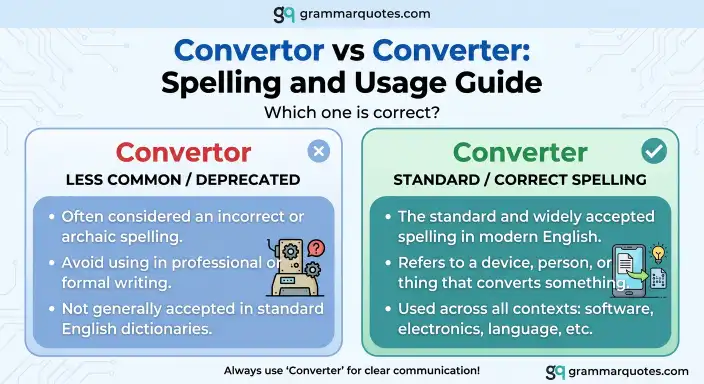
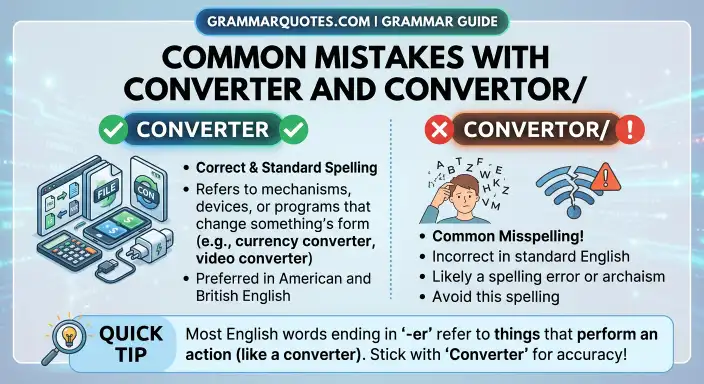
Converter is the standard and most widely accepted spelling in modern English, while convertor is a less common variant that is also recognized in some dictionaries. Both words refer to a person or device that converts something from one form, type, or system into another.
For example, a currency converter changes one currency into another, while an audio converter changes an audio file into a different format. Although convertor is not always incorrect, converter is the safer choice for most readers, professional writing, websites, and technical documents.
The difference can be confusing because both spellings look reasonable and follow familiar English word patterns. In this guide, you will learn the meanings of convertor and converter, how they are used in different contexts, and which spelling is best for American, British, and international English. You will also discover common examples, technical applications, spelling tips, and practical ways to choose the correct form for your writing.
Convertor or Converter: Quick Answer
The main difference between convertor and converter is their spelling and frequency of use, not their basic meaning.
- Converter: The standard, widely preferred spelling.
- Convertor: A less common spelling variant.
- Currency converter: A tool that changes one currency into another.
- File converter: Software that changes a file from one format to another.
- Voltage converter: A device that changes electrical voltage.
Which Spelling Should You Choose?
Use converter in most situations, especially when writing for a general audience.
For example:
- Correct and preferred: I used an online currency converter.
- Correct and preferred: Download a video converter to change the file format.
- Less common variant: The technician installed a convertor.
The third example uses a spelling variant. It is understandable, but converter is generally the better choice unless a product name, technical specification, or publication specifically uses convertor.
What Does Converter Mean?
Converter is a noun formed from the verb convert. It refers to a person, device, program, or system that changes something from one form, type, or condition into another.
The word appears in many fields, including technology, electronics, computing, finance, and engineering.
1. Converter in Technology
In technology, a converter changes data, files, or signals into another format.
Examples:
- I used an online PDF converter to change the document into a Word file.
- This video converter supports several file formats.
- The software includes an image converter for digital photographs.
- An audio converter can change a WAV file into an MP3 file.
In these examples, the converter changes the format of digital information.
2. Converter in Electronics
In electronics, a converter changes one type of electrical power or signal into another.
Examples:
- The device uses a voltage converter to provide the required voltage.
- A power converter changes electrical power from one form to another.
- The engineer tested the signal converter before installing the equipment.
The exact function depends on the device. Some converters change voltage, while others change the type or characteristics of an electrical signal.
3. Converter in Finance
In finance, a converter can refer to a tool or system that changes one currency or financial unit into another.
Examples:
- I checked the exchange rate with a currency converter.
- The website provides a free currency converter.
- Use a measurement or unit converter to change miles into kilometers.
A currency converter typically calculates an equivalent amount using an exchange rate. Actual transaction rates and fees may differ from the displayed estimate.
4. Converter as a Person or Thing That Converts
The word can also describe a person or something that causes a change.
Examples:
- The new process acts as a converter of raw materials into useful products.
- The machine is an efficient converter of energy.
- The device serves as a converter between two systems.
In ordinary English, however, converter is especially common in the names of tools and technical equipment.
What Does Convertor Mean?
Convertor is a less common spelling variant of converter. It has the same general meaning: a person, device, or system that converts something.
Although it may appear in some dictionaries, technical materials, and product descriptions, it is less common than converter in general English.
Examples of Convertor in Sentences
- The company sells a convertor for older electronic equipment.
- The manual refers to a signal convertor.
- The product description uses the term convertor for the device.
These examples demonstrate how the spelling may appear in real world text. However, when writing a new article, report, or product description, converter is usually the better default choice.
Is Convertor Incorrect?
Not necessarily. Convertor is a recognized variant in some dictionaries, so it should not automatically be labeled a misspelling in every context.
The important distinction is that converter is much more widely established in general usage. If you are unsure which spelling to use, choose converter.
There are also situations where you should preserve convertor, such as when it is part of an official product name or a manufacturer’s exact terminology. In those cases, follow the original spelling.
Convertor vs Converter: Word Origin and Spelling
Both spellings are connected to the verb convert, which comes through French from Latin convertere, meaning to turn or change.
The English noun converter follows a familiar word building pattern: a verb ending in a silent e loses that final e before the suffix er is added.
For example:
- Convert → Converter
- Write → Writer
- Drive → Driver
- Create → Creator
The spelling convertor uses the suffix or, which also appears in many English nouns.
Examples include:
- Act → Actor
- Invent → Inventor
- Inspect → Inspector
Both er and or occur in English nouns that describe people or things performing an action. However, English spelling does not provide one universal rule that determines which suffix every word must use.
Converter is the established choice for most modern uses of this particular word. The existence of other words ending in or does not mean that convertor should automatically be preferred.
British English vs American English
Both British English and American English generally prefer converter. The less common spelling convertor can still appear in either variety, particularly in specialized or product specific contexts.
| Feature | British English | American English | Example |
| Preferred spelling | Converter | Converter | currency converter |
| Alternative spelling | Convertor may appear | Convertor may appear | a technical convertor |
| General writing | Converter | Converter | file converter |
| Electronics | Converter is common | Converter is common | voltage converter |
| Computing | Converter is common | Converter is common | video converter |
| Formal documents | Prefer converter | Prefer converter | digital converter |
Do British and American Dictionaries Use Different Spellings?
There is no major British versus American spelling rule that requires convertor in one country and converter in the other.
Both forms may be documented as variants, but converter is the most practical choice for an international audience.
For academic work, follow the dictionary or style guide recommended by your institution. For a company website, use the spelling that matches established industry terminology and remain consistent throughout the content.
Which Version Should You Use?
Your choice depends on the audience, the type of document, and if you are referring to a particular product.
United States
For American readers, use converter.
Examples:
- currency converter
- power converter
- file converter
- voltage converter
These are familiar forms in everyday and technical writing.
United Kingdom
For British readers, converter is also the recommended general spelling.
Example: The technician replaced the faulty power converter.
Use convertor only when a specific source, product name, or technical document requires it.
Canada
Canadian English generally follows the same practical recommendation.
Example: The website includes a currency converter for international payments.
For professional documents, prioritize consistency and the terminology used by the organization.
Australia
In Australian English, converter is the safer choice for general and technical communication.
Example: The device includes a digital converter for processing the signal.
Check the manufacturer’s documentation if you are discussing a named product.
International Writing
If your article is intended for readers around the world, choose converter. It is widely recognizable and helps avoid distracting readers with an unfamiliar variant.
This is especially useful for websites, educational articles, software instructions, and product descriptions.
Academic Writing
Use converter unless your institution’s preferred dictionary or a cited technical source specifies otherwise.
Example: The researchers used a digital converter to process the input signal.
If you quote a source that uses convertor, preserve the original spelling in the quotation.
Business and Technical Writing
Use the spelling established by the relevant industry or manufacturer. In most cases, that will be converter.
For example, use currency converter in a financial guide and voltage converter in an electronics manual.
If a product’s official name contains Convertor, retain that exact name when referring to the product.
Common Mistakes with Converter and Convertor
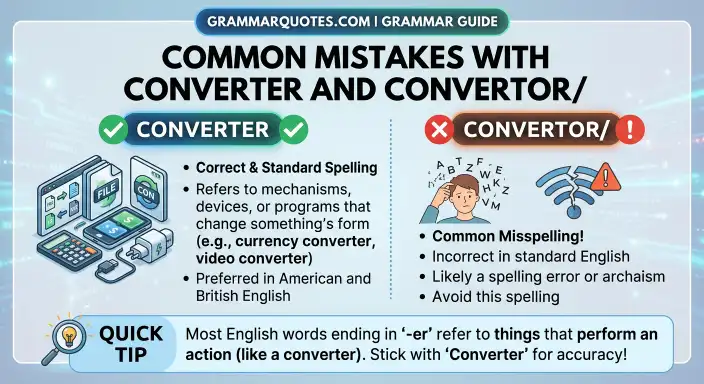
The most common mistake is assuming that both spellings are equally common or that one must be completely wrong.
| Common Issue | Recommended Form | Explanation |
| Writing for a general audience | Converter | This is the widely preferred form. |
| Writing “currency convertor” in a new article | Currency converter | The standard expression is currency converter. |
| Writing “file convertor” in software instructions | File converter | This is the more familiar spelling. |
| Editing a product’s official name | Preserve the official spelling | Names should match the manufacturer’s terminology. |
| Mixing spellings in one article | Use converter consistently | Consistency improves readability. |
| Calling every instance of convertor incorrect | Check the context | It is a recognized variant in some references. |
How to Remember the Correct Spelling
Use this simple memory tip:
Convert + er = converter.
Think of common English words such as writer, driver, and builder. The ending er often describes a person or thing that performs an action.
Then remember the practical rule: converter is the default; convertor is the less common variant.
This does not mean that every English noun must end in er. Words such as actor and inventor show that English uses both suffixes. Learn the established spelling of each word rather than applying one suffix rule to everything.
Everyday Examples of Converter and Convertor
The following examples show how the preferred spelling appears in different types of writing.
| Context | Example Sentence |
| Emails | Please use the currency converter before confirming the payment. |
| Business writing | Our website includes a unit converter for international customers. |
| News articles | The company introduced a new power converter for its equipment. |
| Blogs | A free image converter can help you change file formats. |
| Social media | I found a useful online video converter today. |
| Academic writing | The researchers used an analog to digital converter to collect data. |
| Daily conversation | Do you have a converter for this plug? |
| Product descriptions | This voltage converter supports the device’s required input voltage. |
| Software documentation | The converter exports files in several formats. |
| Technical manuals | Connect the signal converter according to the manufacturer’s instructions. |
Common Compound Words with Converter
The word converter appears in many established expressions.
| Term | Meaning |
| Currency converter | A tool that calculates the equivalent value of one currency in another. |
| Unit converter | A tool that changes measurements from one unit to another. |
| File converter | Software that changes a file’s format. |
| Video converter | Software that changes video formats or encoding. |
| Audio converter | Software or hardware that changes audio formats or signals. |
| Voltage converter | Equipment that changes electrical voltage. |
| Analog to digital converter | A device that changes an analog signal into digital data. |
| Digital to analog converter | A device that changes digital data into an analog signal. |
| Catalytic converter | A vehicle exhaust component that helps reduce harmful emissions. |
| Power converter | Equipment that changes electrical power from one form to another. |
These terms are useful examples because they show that converter is established across several fields. The exact function varies, but the preferred spelling remains the same.
Google Trends and Modern Usage
People search for convertor or converter because both spellings look plausible. The word building patterns in English can make the choice less obvious, especially for writers who know words such as actor, inventor, and creator.
In modern general English, converter is the more common and safer spelling. It is widely used in technology, electronics, software, finance, and consumer product descriptions.
Why Do People Search for Convertor vs. Converter?
Common reasons include:
- Spelling uncertainty: People want to know if the ending should be er or or.
- Technical terminology: Product manuals and listings may use different spellings.
- Search queries: Users may encounter convertor online and wonder if it is correct.
- Professional editing: Writers want consistent spelling in websites, reports, and product descriptions.
Which Spelling Is More Popular?
Without a defined Google Trends comparison, region, and date range, it would be misleading to give exact search figures or percentages.
General usage supports converter as the preferred spelling. Google Trends can help compare search interest for the two terms over a selected period, but search popularity alone does not determine if a spelling is acceptable.
For practical writing, you do not need to wait for search statistics. Use converter unless a reliable, context specific reason calls for convertor.
Quick Comparison Table
| Version | Meaning | Correct? | Usage | Example |
| Converter | A person, device, or system that converts something | Yes, preferred | General and technical English | Use a currency converter. |
| Convertor | A person, device, or system that converts something | Yes, as a less common variant in some references | Some technical or product specific contexts | The manual uses the term convertor. |
| Currency converter | A tool for calculating currency equivalents | Yes | Finance and travel | Check the amount with a currency converter. |
| File converter | Software that changes file formats | Yes | Computing | The file converter supports PDF files. |
| Voltage converter | A device that changes voltage | Yes | Electronics | The voltage converter supports the required input. |
Final choice: For most writing, choose converter. Use convertor only when the context or an authoritative source specifically calls for it.
Key Takeaways
- Converter is the standard, widely preferred spelling in modern English.
- Convertor is a less common variant recognized in some dictionaries and contexts.
- Both words refer to a person, device, or system that converts something.
- British and American English generally prefer converter.
- Common terms include currency converter, file converter, and voltage converter.
- The spelling choice is not determined by a strict rule that every noun must end in er or or.
- Follow official product names and source terminology when referring to a specific device.
- For general, academic, business, and international writing, converter is the safest default.
Frequently Asked Questions
1. Is convertor or converter correct?
Converter is the standard and widely preferred spelling. Convertor is a less common variant recognized in some dictionaries and contexts. Both generally refer to a person or device that converts something. For everyday writing, websites, and professional documents, choose converter unless a particular source or product name uses the alternative.
2. Is convertor a real word?
Yes, convertor is documented as a variant in some dictionaries and usage references. However, it is much less common than converter in general modern English. It is best to avoid labeling every occurrence as a spelling error, but writers should normally choose converter for broad readability and consistency.
3. Why is converter more common than convertor?
The spelling converter is well established across general and technical English. It appears in familiar expressions such as currency converter, file converter, and voltage converter. Although English uses both er and or endings, there is no universal rule that determines the ending for every word. Established usage matters.
4. Is converter correct in British English?
Yes. Converter is the preferred general spelling in British English, as it is in American English. It is used for tools, electronic devices, and systems that change something from one form to another. The variant convertor may occur, but it is not generally necessary for ordinary British writing.
5. Is converter correct in American English?
Yes. Converter is the standard choice in American English. You will see it in expressions such as currency converter, power converter, and file converter. When writing for American readers, use converter unless you are reproducing an official product name or a source that uses convertor.
6. Should I write currency convertor or currency converter?
Write currency converter. This is the widely established spelling for a tool that calculates the equivalent value of one currency in another. A currency converter usually provides an estimate based on an exchange rate. Actual exchange services may use different rates or charge additional fees.
7. What is the plural of converter?
The plural of converter is converters. For example, “The laboratory uses several digital converters.” If you are using the less common variant convertor, its regular plural is convertors, but the standard form converters is preferable in most writing.
8. Is a voltage converter the same as a power converter?
Not always. A voltage converter specifically changes voltage, while a power converter can refer to equipment that changes other electrical characteristics or the form of electrical power. The exact functions depend on the device. Both terms use the standard spelling converter.
9. How do you spell converter in technical writing?
In most technical writing, spell it converter. Common examples include analog to digital converter, digital to analog converter, and voltage converter. However, when documenting a specific product, follow the manufacturer’s official terminology. Consistency and technical accuracy matter more than changing a product name to match a general preference.
10. How can I remember convertor vs. converter?
Remember the familiar spelling in phrases such as currency converter and file converter. The word comes from convert, and converter is the standard noun form for most modern uses. Although convertor appears in some references, using converter is the simplest way to avoid confusion in everyday and professional writing.
Conclusion
When deciding between convertor or converter, the best choice for most situations is converter. It is the standard, widely preferred spelling in modern English and appears in common terms such as currency converter, file converter, voltage converter, and power converter. The spelling convertor is a less common variant, so it should not automatically be treated as incorrect in every context. However, it is usually unnecessary when writing for a general audience.
The same practical recommendation applies to British, American, Canadian, Australian, and international English. In academic work, business documents, technical articles, and website content, use converter unless an official product name or reliable source requires the alternative. This choice makes your writing familiar, consistent, and easy to understand.
Remember: Converter is the preferred spelling, while convertor is a less common variant. If you are unsure, choose converter and check an authoritative dictionary or the manufacturer’s documentation when the exact technical term matters.
Discover More Articles!
Sometime or Some Time: Which One Is Correct?
Ingenuous or Ingenious: Which Spelling Is Correct?
Swoll or Swole: Which Spelling Is Correct?(2026)

Ethan Parker is an English-language writer known for his interest in words, language, and clear communication. His work focuses on making everyday English easier to understand through simple explanations and practical examples.