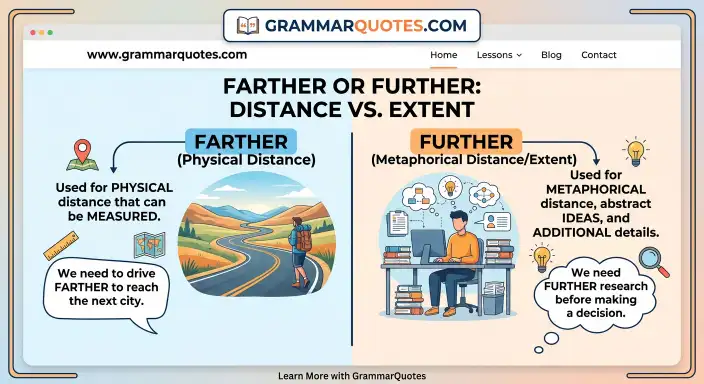
Farther and further are both correct English words, but they are often used in different ways. Farther usually refers to a greater physical distance, while further often means additional, more, or to a greater extent.
For example, you can say, “The school is farther from my house than the library” when comparing distances. You can say, “We need further information” when asking for more details. These words sometimes overlap, especially in everyday American English, which can make them confusing for students and writers.
Understanding their main difference helps you choose the right word in essays, emails, conversations, and professional writing. In this guide, you will learn their meanings, pronunciation, examples, common mistakes, and simple tips for remembering when to use farther or further.
Quick Answer: Further vs Farther
- Farther: Usually refers to a greater physical distance.
- Further: Usually means additional, more, or to a greater extent.
Examples:
- The bus stop is farther away than I expected.
- We need further information before making a decision.
Remember: farther = physical distance and further = additional or more. However, some uses overlap.
Definition and Meaning of Farther
Farther is commonly used as a comparative form of far. It describes a greater distance between places or objects.
Examples of Farther
- My school is farther from home than yours.
- We walked farther along the road.
- The airport is farther away than the train station.
- Can you throw the ball farther?
- Their house is farther down the street.
Definition and Meaning of Further
Further can mean additional, more, or to a greater extent. It is often used when talking about information, discussion, progress, or development. It can also refer to distance.
Examples of Further
- We need further information about the course.
- The teacher explained the topic further.
- Please contact us for further details.
- She wants to further her education.
- We should discuss this matter further.
Farther vs Further: Key Differences
| Feature | Farther | Further |
| Main meaning | Greater physical distance | Additional or to a greater extent |
| Common use | Places, travel, physical distance | Information, discussion, progress |
| Part of speech | Adjective or adverb | Adjective, adverb, or verb |
| Example | We walked farther today. | We need further details. |
| Can refer to distance? | Yes | Yes |
| Can mean additional? | Rarely in standard usage | Yes |
Why Do People Confuse Farther and Further?
People often confuse these words because both are related to far and can describe distance.
- Similar meanings: Both can sometimes refer to moving or extending a distance.
- Overlapping usage: In everyday English, further is sometimes used for physical distance too.
- Regional preferences: Some speakers make a clearer distinction than others.
- Different writing habits: Writers may use one word for both meanings without considering the context.
The easiest approach is to use farther for physical distance and further for additional information or progress.
How to Remember the Correct Use of Farther and Further
1. Remember the Word “Far”
The word farther contains the word far, which can help you connect it with physical distance.
- We walked farther down the road.
- The next town is farther away.
2. Connect Further With “More”
Think of further as meaning “more” or “additional.”
- I need further explanation.
- We need further evidence.
- Let’s discuss the issue further.
3. Check the Meaning of Your Sentence
Ask yourself what you want to describe.
- If you mean a greater physical distance, use farther.
- If you mean additional information, progress, or discussion, use further.
For example, “The shop is farther away” refers to distance, while “Please provide further details” asks for more information.
British English vs American English
Both British and American English use farther and further. However, the preferred choice can vary by context and style.
| Context | British English | American English |
| Physical distance | Farther or further | Farther is often preferred |
| Additional information | Further | Further |
| Further discussion | Further | Further |
| Further education or progress | Further | Further |
The distinction is a useful guideline, not an absolute rule. Further is also used for physical distance in standard English, particularly in British English.
Common Mistakes With Farther and Further
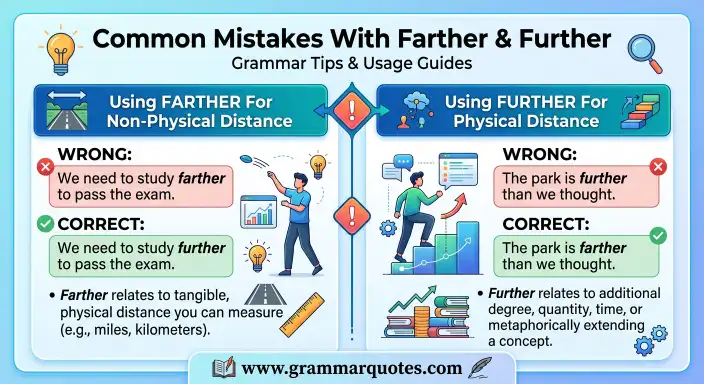
1. Using Farther for Additional Information
Less suitable: Please send me farther information.
Better: Please send me further information.
Use further when you mean additional details.
2. Using Further When Comparing Physical Distance
Common choice: We walked farther than yesterday.
Also acceptable: We walked further than yesterday.
Both can be correct, but farther clearly emphasizes physical distance.
3. Confusing Further With Father
Further and father have different meanings.
- Further: Additional or more.
- Father: A male parent.
Example: My father gave me further advice.
4. Assuming Further Never Refers to Distance
Incorrect rule: Further can only mean additional.
Better rule: Further often means additional, but it can also refer to physical distance.
Example: We travelled further than we planned.
Everyday Examples of Farther
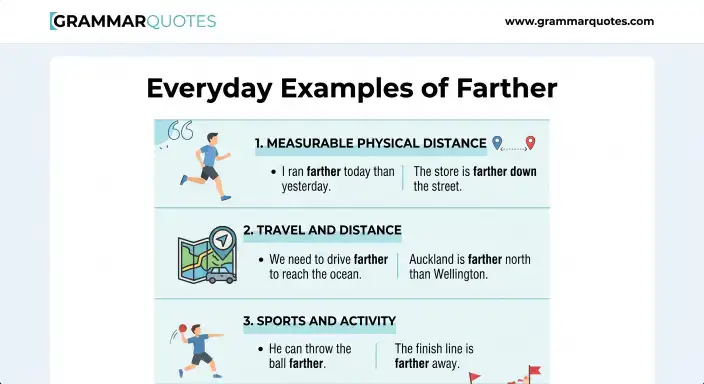
Here are some natural examples of farther used for physical distance.
- The park is farther from my house.
- We drove farther than we expected.
- She ran farther than her brother.
- The village is farther down the road.
- Can you move the chair farther away?
- The hotel is farther from the airport.
- I walked farther today than yesterday.
- The finish line is farther ahead.
- They travelled farther north.
- The next petrol station is farther away.
Everyday Examples of Further
Here are some natural examples of further used to mean additional or more.
- I need further information about the university.
- We should investigate the problem further.
- Please read the document for further details.
- She wants to further her career.
- The teacher gave further instructions.
- We need further evidence to support the claim.
- Let’s discuss this matter further.
- He continued his studies to further his knowledge.
- No further action is required.
- For further assistance, contact the office.
Google Trends and Search Interest
People often search for “farther vs further” because the words have similar meanings and overlapping uses. Students, English learners, and professional writers commonly look for a simple rule to distinguish them.
A useful starting point is that farther usually emphasizes physical distance, while further often means additional or more. However, further can also describe distance, so context matters when choosing between them.
People Also Ask (PAA)
1. Is Farther or Further Correct?
Both are correct words. Farther usually describes physical distance, while further often means additional or more.
2. What Is the Main Difference Between Farther and Further?
Farther is commonly used for physical distance. Further is commonly used for additional information, discussion, or progress.
3. Can Further Be Used for Physical Distance?
Yes. Further can describe physical distance, although farther is often preferred when the distance is literal.
4. Is Further Information or Farther Information Correct?
Further information is the standard expression because further means additional in this context.
5. Do British and American English Use Farther and Further Differently?
Both varieties use the two words. American English often prefers farther for physical distance, while British English may use further more broadly.
Frequently Asked Questions (FAQs)
1. What Is the Correct Spelling: Farther or Further?
Both spellings are correct. The difference is mainly in their meaning and usage.
2. Is Farther Only Used for Physical Distance?
Farther is mainly associated with physical distance. Further is more common for additional information or progress.
3. Can I Say “Further Away”?
Yes. “Further away” is correct and commonly used. “Farther away” is also correct, especially when emphasizing physical distance.
4. What Is a Synonym for Further?
Depending on the context, synonyms include additional, more, extra, greater, and beyond.
5. What Is a Synonym for Farther?
Depending on the sentence, synonyms include more distant, farther away, and at a greater distance.
Conclusion
The difference between farther and further becomes easier when you focus on the meaning of your sentence. Farther usually refers to physical distance, such as the distance between two towns or how far someone walks. Further commonly means additional, more, or to a greater extent, as in “further information” or “further discussion.
” However, further can also refer to physical distance, so the distinction is not absolute. Both words are correct in British and American English, although preferences can vary. To remember the main guideline, connect farther with far and further with more. Practicing these examples will help you choose the right word in school assignments, emails, articles, and everyday conversations.
Discover More Articles!
Defences or Defenses: Which Spelling Is Correct?(2026)
Finasteride or Propecia: Understanding the Difference Between Them
Publicly or Publically: Which Spelling Is Correct?

Ethan Parker is an English-language writer known for his interest in words, language, and clear communication. His work focuses on making everyday English easier to understand through simple explanations and practical examples.