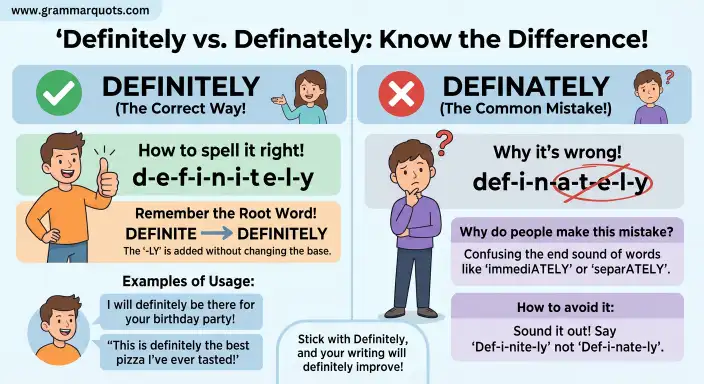
Definitely is the correct spelling, while definately is a common misspelling. Definitely means “without a doubt,” “certainly,” or “clearly.” For example, you can say, “I will definitely attend the meeting” when you are sure you will go. Many people misspell this word as definately because they confuse its pronunciation with its spelling.
The correct word contains the letters i t e l y in the final part: definitely. The incorrect version, definately, replaces the second “i” with an “a.” Learning this difference can help you avoid spelling mistakes in emails, school assignments, articles, and everyday messages. In this guide, you will learn the meanings, pronunciation, examples, common mistakes, and simple tricks to remember the correct spelling of definitely.
Quick Answer: Definitely vs Definately
- Definitely: Correct spelling. It means certainly or without a doubt.
- Definately: Incorrect spelling. It is a common spelling mistake.
Example: I will definitely finish my homework today.
Remember to write definitely, not definately.
Definition and Meaning of Definitely
Definitely is an adverb used to show that something is certain, clear, or decided. It can express confidence, agreement, or a strong decision.
Examples of Definitely
- I will definitely call you tomorrow.
- She is definitely the right person for the job.
- We should definitely visit that museum.
- This is definitely a good idea.
- He will definitely pass the test if he prepares well.
Definition and Meaning of Definately
Definately is a misspelling of definitely. It is not the standard spelling used in formal English.
People often make this mistake because the pronunciation of definitely may sound as if it contains an “a” sound. However, the correct written form uses an “i.”
Examples of the Common Mistake
- Incorrect: I will definately come tomorrow.
- Correct: I will definitely come tomorrow.
- Incorrect: She definately likes this book.
- Correct: She definitely likes this book.
Definitely vs Definately: Key Differences
| Feature | Definitely | Definately |
| Spelling status | Correct | Incorrect |
| Part of speech | Adverb | Misspelling |
| Meaning | Certainly; without a doubt | No separate standard meaning |
| Formal writing | Correct to use | Avoid |
| Example | I definitely agree. | I definately agree. |
Why Do People Confuse Definitely and Definately?
People often confuse these spellings because English pronunciation does not always make every letter easy to identify.
- Pronunciation confusion: The unstressed vowels in definitely can sound unclear during normal speech.
- Vowel substitution: Writers may use “a” instead of the correct “i.”
- Typing quickly: People may write the familiar looking misspelling without checking it.
- Memory errors: Repeated exposure to the incorrect spelling can make it look familiar.
The best way to avoid this mistake is to remember the correct spelling and check it when writing.
How to Remember the Correct Spelling of Definitely
Here are a few simple tricks to help you spell definitely correctly.
1. Remember the Word “Finite”
Definitely is related to definite, which contains the word sequence finite.
- Definite
- Definitely
Think of the correct spelling as definite + ly. This makes it easier to remember that definitely contains an “i,” not an “a.”
2. Break the Word Into Parts
Write the word slowly:
Def i nite ly → Definitely
Practice spelling it a few times until the correct form becomes familiar.
3. Use It in a Sentence
Writing the word in a sentence can help you remember it.
- I will definitely practice English today.
- This spelling is definitely correct.
- She will definitely enjoy the book.
British English vs American English
There is no spelling difference between British and American English for this word.
| English variety | Correct spelling | Example |
| British English | Definitely | I will definitely be there. |
| American English | Definitely | I will definitely be there. |
Both British and American English use definitely. The spelling definately is incorrect in both varieties.
Common Mistakes With Definitely

1. Writing Definately
Incorrect: I definately understand the lesson.
Correct: I definitely understand the lesson.
2. Confusing Definitely With Definite
Incorrect: I definite agree with you.
Correct: I definitely agree with you.
Use definite as an adjective and definitely as an adverb.
3. Using Definitely When You Mean Defiantly
These words look similar but have different meanings.
- Definitely: Certainly or without a doubt.
- Defiantly: In a way that shows resistance or disobedience.
Examples:
- I will definitely help you.
- He defiantly refused to follow the rule.
Everyday Examples of Definitely

Here are some natural examples of the correct spelling.
- I will definitely finish this task.
- You should definitely try this recipe.
- She is definitely a talented student.
- We will definitely meet again.
- This is definitely worth reading.
- I definitely remember that day.
- He definitely needs more practice.
- They will definitely enjoy the trip.
- I would definitely recommend this book.
- You are definitely improving your English.
Google Trends and Search Interest
People commonly search for “definitely vs definately” because the incorrect spelling is easy to make and remember. Search interest in spelling comparisons often reflects a desire to check which form is correct before writing an email, assignment, article, or social media post.
The main point is simple: definitely is the standard spelling in both British and American English. Definately is a spelling error, not an alternative regional form.
People Also Ask (PAA)
1. Is Definitely or Definately Correct?
Definitely is correct. Definately is a common misspelling.
2. Why Do People Spell Definitely as Definately?
People often confuse the unstressed vowel sounds and mistakenly write “a” instead of “i.”
3. What Does Definitely Mean?
Definitely means certainly, clearly, or without a doubt.
4. Is Definitely Spelled the Same in British and American English?
Yes. Both British and American English use definitely.
5. How Can I Remember the Spelling of Definitely?
Remember the word definite and add ly to form definitely.
Frequently Asked Questions (FAQs)
1. What Is the Correct Spelling: Definitely or Definately?
The correct spelling is definitely. Definately is incorrect.
2. Is Definately a Real Word?
Definately appears in informal writing as a spelling mistake, but it is not the accepted standard spelling.
3. What Is a Synonym for Definitely?
Common synonyms include certainly, surely, undoubtedly, and unquestionably.
4. Can I Use Definitely in Formal Writing?
Yes. Definitely is standard English and is appropriate in formal and informal writing.
5. What Part of Speech Is Definitely?
Definitely is an adverb. It modifies a verb, an adjective, or another adverb to express certainty.
Conclusion
The difference between definitely and definately is simple: definitely is the correct spelling, and definately is a common spelling mistake. Definitely means certainly or without a doubt, and it is used in both British and American English. People often make this error because the vowel sounds can be confusing, especially when typing quickly.
To remember the correct spelling, start with the word definite and add ly. Practicing sentences such as “I will definitely try again” can also help you remember it. Whenever you are unsure, check the spelling before submitting an assignment, publishing an article, or sending a professional email. Using the correct spelling makes your writing clearer and more professional.
Discover More Articles!
Defences or Defenses: Which Spelling Is Correct?(2026)
Finasteride or Propecia: Understanding the Difference Between Them
Publicly or Publically: Which Spelling Is Correct?

Ethan Parker is an English-language writer known for his interest in words, language, and clear communication. His work focuses on making everyday English easier to understand through simple explanations and practical examples.