Discreet and discrete are both correct English words, but they have different meanings. Discreet means being careful, private, or avoiding unnecessary attention. Discrete means separate, distinct, or individually different.
For example, “Please be discreet about this conversation” means you should keep it private. On the other hand, “The course has three discrete sections” means the course has three separate parts. Although these words sound exactly the same, their meanings and uses are different. Understanding the difference between discreet and discrete will help you improve your spelling, writing, and everyday English.
Quick Answer: Discreet or Discrete?
Both discreet and discrete are correct spellings. The right word depends on what you want to say.
- Discreet: Careful, private, or not attracting attention.
- Discrete: Separate, distinct, or individually different.
Examples:
- Please be discreet about the surprise party.
- The experiment has four discrete stages.
Easy tip: Use discreet when talking about privacy or careful behavior. Use discrete when talking about separate things or parts.
Definition and Meaning of Discreet
Discreet is an adjective that describes someone who behaves carefully and avoids drawing unnecessary attention. It can also describe actions that protect private information or sensitive situations.
People often use this word when discussing confidential conversations, personal matters, or situations that require good judgment.
Examples of Discreet in Sentences
- Please be discreet when discussing the company’s plans.
- She gave me a discreet warning about the mistake.
- He is discreet about his personal life.
- The hotel offers discreet service to its guests.
- We need a discreet way to discuss this issue.
Synonyms of Discreet
Some common synonyms include:
- Tactful: Careful not to upset or offend others.
- Private: Not meant for everyone to know.
- Cautious: Careful to avoid problems or risks.
- Subtle: Not obvious or easy to notice.
- Prudent: Showing good judgment.
- Confidential: Intended to remain secret or private.
These words have related meanings, but they are not always interchangeable. For example, tactful focuses on handling people or situations sensitively, while discreet often focuses on privacy and avoiding attention.
Definition and Meaning of Discrete
Discrete is an adjective that means separate, distinct, or individually identifiable. It describes things that can be considered as different units rather than one continuous whole.
This word is common in mathematics, science, technology, education, and everyday descriptions of separate items or categories.
Examples of Discrete in Sentences
- The project consists of five discrete tasks.
- The teacher divided the lesson into discrete sections.
- These are two discrete problems that require different solutions.
- The data contains several discrete categories.
- The machine has three discrete operating modes.
Synonyms of Discrete
Common synonyms of discrete include:
- Separate: Not joined together.
- Distinct: Clearly different from something else.
- Individual: Considered separately from others.
- Independent: Not controlled by or dependent on another thing.
- Different: Not the same.
- Unconnected: Not linked together.
The best synonym depends on the context. In mathematics, discrete can describe values that are separate and countable, while in general writing, separate or distinct may be more natural.
Key Differences Between Discreet and Discrete
The easiest way to understand these words is to compare their meanings, uses, and examples.
| Feature | Discreet | Discrete |
| Part of speech | Adjective | Adjective |
| Main meaning | Careful, private, or unobtrusive | Separate or distinct |
| Common use | Personal matters and confidential situations | Objects, categories, stages, and data |
| Related idea | Privacy and good judgment | Separation and individuality |
| Example | Be discreet about the news. | The system has discrete components. |
| Common context | Social situations and communication | Mathematics, science, and organization |
Remember that both words are pronounced the same way in standard English. Their spelling and meaning are what make them different.
Why Do People Confuse Discreet and Discrete?
People often confuse discreet and discrete because they are homophones. Homophones are words that sound alike but have different meanings and spellings.
Both words are pronounced approximately as “dih SKREET.” When speaking, listeners usually understand the intended meaning from the context. However, when writing, choosing the wrong spelling can change the meaning of a sentence.
For example:
- Correct: Please be discreet about the meeting.
- Incorrect for the intended meaning: Please be discrete about the meeting.
The second sentence suggests separation rather than privacy, so it does not communicate the intended idea naturally.
Another example:
- Correct: The program has several discrete modules.
- Incorrect for the intended meaning: The program has several discreet modules.
Here, discreet would suggest that the modules are careful or unobtrusive, which is not the intended meaning.
How to Remember the Difference Between Discreet and Discrete
You can remember these spellings with a few simple tricks.
1. Remember the Extra E in Discreet
The word discreet has two e’s at the end: ee. Associate those two e’s with the idea of keeping something private between people.
Example: “Be discreet with the information.”
This is a memory trick, not a formal spelling rule, but it can help you remember the correct word.
2. Associate Discrete With Separate Units
Think of discrete as describing distinct or separate units. It is often used when something is divided into individual parts.
Example: “The report contains four discrete sections.”
3. Look at the Meaning of the Sentence
Before choosing a word, ask yourself what you mean.
- Are you talking about privacy, tact, or avoiding attention? Use discreet.
- Are you talking about separate items, stages, or categories? Use discrete.
4. Practice With Both Words
Write one sentence using each word:
- My friend was discreet about my personal news.
- The building has three discrete sections.
Practicing these words in context will make the difference easier to remember.
British English vs American English
There is no spelling difference between discreet and discrete in British and American English. Both spellings are standard in both varieties.
| Meaning | British English | American English |
| Careful or private | Discreet | Discreet |
| Separate or distinct | Discrete | Discrete |
| Private conversation | A discreet conversation | A discreet conversation |
| Separate categories | Discrete categories | Discrete categories |
Although some English words have different British and American spellings, these two do not. The distinction is about meaning, not regional spelling.
Common Mistakes With Discrete and Discreet
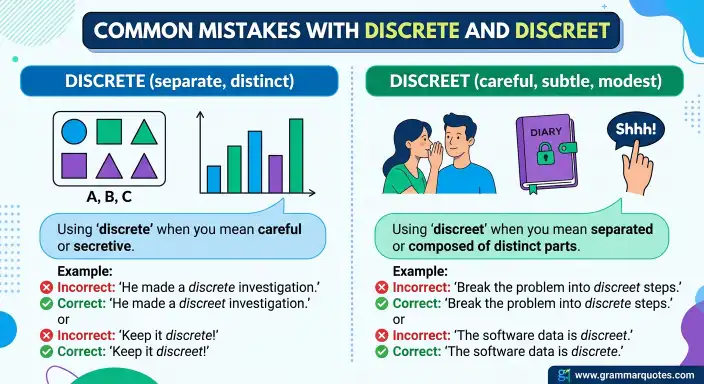
Even experienced English speakers sometimes choose the wrong word. Here are some common mistakes and their corrections.
Mistake 1: Using Discrete to Mean Private
Incorrect: Please be discrete about my personal information.
Correct: Please be discreet about my personal information.
Explanation: The sentence is about keeping information private, so discreet is correct.
Mistake 2: Using Discreet to Mean Separate
Incorrect: The machine contains four discreet parts.
Correct: The machine contains four discrete parts.
Explanation: The parts are separate or distinct, so discrete is the appropriate word.
Mistake 3: Thinking One Word Is Incorrect
Incorrect: Discrete is always a misspelling of discreet.
Correct: Both discreet and discrete are correct words.
Explanation: These words have different meanings. Neither is a misspelling of the other.
Mistake 4: Choosing by Sound Alone
Incorrect approach: Choosing a spelling because it sounds right.
Correct approach: Consider the meaning and context before choosing the spelling.
Explanation: Since both words sound the same, pronunciation alone cannot tell you which one to use.
Everyday Examples of Discreet and Discrete

The following examples show how each word works in common situations.
Discreet Examples
- The assistant was discreet when handling the private documents.
- She asked a discreet question about the problem.
- Please keep our conversation discreet.
- He made a discreet exit from the room.
- The manager handled the complaint in a discreet manner.
- They looked for a discreet place to talk.
- A discreet reminder helped him correct the error.
- The journalist promised to be discreet about the source.
Discrete Examples
- The textbook is divided into discrete chapters.
- The survey groups responses into discrete categories.
- The device has two discrete settings.
- The students completed three discrete assignments.
- The scientist examined each discrete sample.
- The process consists of several discrete steps.
- The database stores information in discrete fields.
- In mathematics, discrete values are distinct rather than continuously varying.
Discreet vs Discrete: Quick Practice
Choose the correct word for each sentence.
- Please be ______ about the confidential discussion.
- The project contains four ______ stages.
- She gave me a ______ signal to leave.
- The researcher studied several ______ groups.
Answers:
- Discreet
- Discrete
- Discreet
- Discrete
Google Trends and Search Interest
People may search for “discreet or discrete” when checking spelling, editing an email, preparing an assignment, or learning English vocabulary. The words are particularly easy to confuse because they have the same pronunciation.
Search interest can vary according to school terms, writing tasks, professional communication, and general language learning needs. However, without checking current Google Trends data, it would be inaccurate to claim that one word receives more searches than the other.
For writers and students, the most useful approach is to learn the meanings of both words and use the correct spelling according to the context.
People Also Ask
1. Is Discreet or Discrete the Correct Spelling?
Both are correct spellings. Discreet means careful or private, while discrete means separate or distinct.
2. What Is the Difference Between Discreet and Discrete?
Discreet describes careful behavior or privacy. Discrete describes separate things, categories, or units.
3. Are Discreet and Discrete Pronounced the Same?
Yes. They are homophones and are pronounced the same way in standard English, although their meanings and spellings differ.
4. How Do You Use Discreet in a Sentence?
You can write, “Please be discreet about the personal information.” It means you should handle the information carefully and privately.
5. How Do You Use Discrete in a Sentence?
You can write, “The course has four discrete units.” It means the course contains four separate units.
Frequently Asked Questions (FAQs)
1. Is Discreet a Real Word?
Yes. Discreet is a standard English adjective used to describe careful, tactful, private, or unobtrusive behavior.
2. Is Discrete a Real Word?
Yes. Discrete is also a standard English adjective. It means separate, distinct, or individually identifiable.
3. Can Discreet and Discrete Be Used Interchangeably?
No. They have different meanings and generally cannot replace each other. Use discreet for privacy and careful behavior, and discrete for separate things.
4. What Is an Easy Trick to Remember Discreet?
Associate discreet with keeping information private. You can remember its double e as a simple spelling trick.
5. What Is the Opposite of Discrete?
The opposite depends on the context. Continuous is a common opposite when discussing quantities or processes. Connected or combined may work in other situations.
Conclusion
The difference between discreet and discrete is simple once you understand their meanings. Discreet refers to privacy, careful behavior, and avoiding unnecessary attention. Discrete refers to separate, distinct, or individually identifiable things. Both words are correctly spelled, and neither is a British or American spelling variation of the other.
When writing, focus on the meaning of your sentence rather than how the word sounds. Use discreet for confidential conversations and sensitive matters, and discrete for separate parts, stages, or categories. With a little practice, you can use both words confidently in everyday English, academic writing, and professional communication.
Discover More Articles!
Defences or Defenses: Which Spelling Is Correct?(2026)
Finasteride or Propecia: Understanding the Difference Between Them
Publicly or Publically: Which Spelling Is Correct?

Ethan Parker is an English-language writer known for his interest in words, language, and clear communication. His work focuses on making everyday English easier to understand through simple explanations and practical examples.