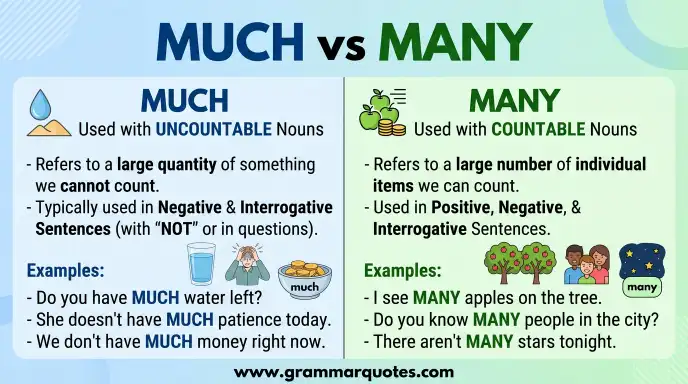
Much and many are both used to talk about quantities, but they are not used with the same types of nouns. Use much with uncountable nouns and many with countable plural nouns. Understanding this simple rule will help you use both words correctly in English.
In other words, much is used for quantities or amounts, whereas many is used for numbers or counts. Understanding the difference between much and many can make your English speaking and writing more natural. You will also learn when to use too much, too many, so much, and so many in everyday sentences.
This guide explains their meanings, grammar rules, synonyms, and practical examples in simple English. By the end, you will know how to use both words confidently and avoid common grammar mistakes.
Quick Answer: Much or Many?
Both much and many are correct English words, but they have different grammatical uses.
- Much is used with uncountable nouns, such as water, money, time, and information.
- Many is used with countable plural nouns, such as books, students, cars, and apples.
Examples:
- How much water do you drink?
- How many books do you have?
Definition and Meaning of Much and Many
Much is a determiner and pronoun used to refer to a large quantity or amount of something that cannot normally be counted individually.
It is commonly used with uncountable nouns, especially in questions and negative sentences.
Examples:
- I don’t have much money.
- How much time do we have?
- There isn’t much water in the bottle.
- She doesn’t have much information about the topic.
Definition and Meaning of Many or Much
Many is a determiner and pronoun used to refer to a large number of people, animals, objects, or other things that can be counted individually.
It is used with countable plural nouns.
Examples:
- I have many books.
- How many students are in your class?
- There aren’t many chairs in the room.
- She has many friends.
Origin of Much and Many
The word much comes from Old English micel, meaning great or large in amount. Over time, it developed into its modern use for describing quantities.
The word many comes from Old English manig, meaning numerous or a large number. It has been used for centuries to describe countable quantities.
Both words are commonly used in modern English to talk about amounts and numbers.
Much or Many: Key Differences
| Feature | Much | Many |
| Part of speech | Determiner / pronoun | Determiner / pronoun |
| Meaning | A large amount | A large number |
| Used with | Uncountable nouns | Countable plural nouns |
| Noun form | Usually singular uncountable | Plural countable |
| Example | Much water | Many bottles |
| Question | How much money? | How many people? |
When to Use Much
Use much when talking about an amount of something that cannot normally be counted as separate items.
1. With Uncountable Nouns
Use much with nouns such as water, milk, sugar, money, time, and information.
Examples:
- I don’t have much money.
- There isn’t much milk left.
- We need much more information.
- How much sugar do you want?
2. In Negative Sentences
Much is commonly used in negative sentences with uncountable nouns.
Examples:
- She doesn’t have much free time.
- I don’t drink much coffee.
- There isn’t much food in the kitchen.
- He didn’t show much interest.
3. In Questions
Use much when asking about the amount of something.
Examples:
- How much money do you need?
- How much water is in the glass?
- How much time is left?
- How much information did you receive?
4. With Too Much and So Much
You can also use much with too and so to describe a large or excessive amount.
Examples:
- You are spending too much money.
- There is so much traffic today.
- She has too much work.
- Thank you so much for your help.
When to Use Many
Use many when talking about things that can be counted individually.
1. With Countable Plural Nouns
Use many with plural nouns such as books, pens, students, houses, and cars.
Examples:
- I have many books.
- There are many students in the classroom.
- She bought many apples.
- How many cars are outside?
2. In Negative Sentences
Many is commonly used in negative sentences when talking about countable things.
Examples:
- I don’t have many friends.
- There aren’t many people here.
- She didn’t buy many clothes.
- We don’t have many options.
3. In Questions
Use many when asking about the number of people or things.
Examples:
- How many brothers do you have?
- How many students passed the exam?
- How many days are left?
- How many books have you read?
4. With Too Many and So Many
Use many with too and so when referring to a large number.
Examples:
- There are too many people in the room.
- She has so many responsibilities.
- I made too many mistakes.
- There are so many beautiful places to visit.
Much and Many in Everyday English
Both words are common in daily conversations, writing, and questions.
| Situation | Much | Many |
| Money | Much money | Many coins |
| Water | Much water | Many bottles of water |
| Time | Much time | Many hours |
| Food | Much food | Many meals |
| Education | Much knowledge | Many lessons |
| People | Not used with people | Many people |
| Books | Not used with books | Many books |
Common Mistakes Of Much and Many

English learners sometimes confuse much and many because both describe large quantities.
Here are some common mistakes:
1. Using much with countable plural nouns
Incorrect: I have much friends.
Correct: I have many friends.
2. Using many with uncountable nouns
Incorrect: How many water do you need?
Correct: How much water do you need?
3. Forgetting the plural form after many
Incorrect: There are many student in my class.
Correct: There are many students in my class.
4. Using much with a countable noun
Incorrect: She bought much apples.
Correct: She bought many apples.
5. Using many with an uncountable noun
Incorrect: I don’t have many money.
Correct: I don’t have much money.
Easy Ways to Remember the Difference
You can remember these words with a simple trick:
- Much = Amount: Use it for things you cannot normally count individually.
- Many = Number: Use it for things you can count individually.
Memory examples:
- Water cannot normally be counted as individual items, so use much water.
- Bottles can be counted individually, so use many bottles.
Remember: Much goes with uncountable nouns, while many goes with countable plural nouns.
Everyday Examples of Much and Many
Here are ten simple sentences to help you understand both words.
- How much money do you have?
- How many books are on the table?
- I don’t have much free time.
- There are many students in our college.
- How much milk do you drink every day?
Frequently Asked Questions
1. What is the main difference between much and many?
Much is used with uncountable nouns, while many is used with countable plural nouns.
2. Is much used with singular or plural nouns?
Much is generally used with uncountable nouns, which usually have a singular grammatical form.
Example: There isn’t much water.
3. Is many used with singular or plural nouns?
Many is used with plural countable nouns.
Example: I have many friends.
4. Do we say much money or many money?
The correct phrase is much money because money is an uncountable noun in standard English.
5. Do we say much people or many people?
The correct phrase is many people because people is a plural countable noun.
6. Can we use much in positive sentences?
Yes. Much can be used in positive sentences, especially with so, too, and as.
Examples:
- I have so much work.
- She has too much homework.
7. Can we use many in positive sentences?
Yes. Many is commonly used in positive sentences.
Example: Many people enjoy reading books.
8. What is the difference between too much and too many?
Too much is used with uncountable nouns, while too many is used with countable plural nouns.
Examples:
- Too much sugar.
- Too many sweets.
9. What is the difference between so much and so many?
So much describes a large amount, while so many describes a large number.
Examples:
- So much water.
- So many people.
10. Is much or many correct with time?
Use much time when referring to time as an amount. Use many hours or many days when counting units of time.
Examples:
- How much time do we have?
- How many hours do you study?
Conclusion
Much and many are important English words used to describe quantities and numbers. The main difference is simple: use much with uncountable nouns and many with countable plural nouns.
For example, say much water and many bottles. Once you understand this basic grammar rule, you can use both words correctly in everyday conversations, questions, and writing.
Discover More Articles!
AWD or RWD: What Is the Difference?(2026)
Finaly or Finally: Spelling, Meaning, Examples, and Mistakes
Ascent vs Assent: Meaning, Differences, Examples, and Mistakes

Ethan Parker is an English-language writer known for his interest in words, language, and clear communication. His work focuses on making everyday English easier to understand through simple explanations and practical examples.