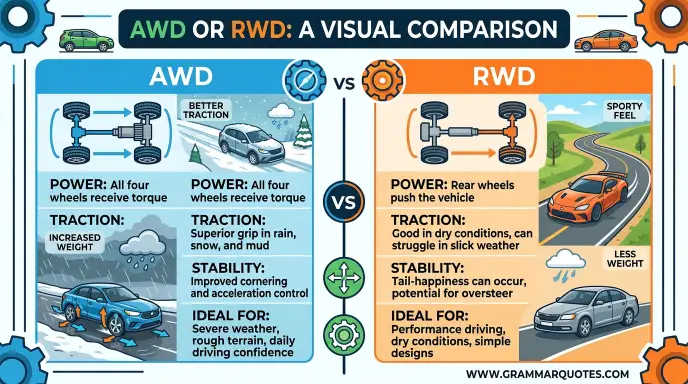
AWD (All Wheel Drive) sends power to all four wheels, while RWD (Rear Wheel Drive) sends power to the rear wheels. Both are drivetrain systems that affect how a vehicle moves, handles, and responds to different road conditions.
AWD is often useful when extra traction is needed, while RWD is popular in sports cars, performance vehicles, and some trucks.
For example, an AWD vehicle can help maintain traction on slippery roads by delivering power to all four wheels. A RWD sports car sends engine power to the rear wheels, which can support balanced handling and an engaging driving experience.
Neither system is always better. The right choice depends on your driving needs, weather, road conditions, vehicle type, and budget. In this guide, you will learn the meanings of AWD and RWD, their main differences, advantages, disadvantages, common uses, and practical examples. You will also discover how to choose the right drivetrain for your needs.
Quick Answer: AWD vs RWD
The main difference is that AWD can send power to all four wheels, while RWD sends power to the rear wheels only.
| Feature | AWD | RWD |
| Full form | All Wheel Drive | Rear Wheel Drive |
| Powered wheels | All four wheels, as needed by the system | Two rear wheels |
| Main advantage | Improved traction in many slippery conditions | Balanced handling and performance potential |
| Common vehicles | SUVs, crossovers, some cars | Sports cars, luxury sedans, many pickup trucks |
| Fuel efficiency | Often uses more fuel than a comparable RWD vehicle | May use less fuel in comparable vehicles |
| Best suited for | Drivers who often face rain, snow, or loose surfaces | Drivers who prioritize handling, performance, or towing capability |
Easy way to remember: AWD means power can reach all four wheels. RWD means power goes to the rear wheels.
Definition and Meaning of AWD
AWD stands for All Wheel Drive. It is a drivetrain system designed to deliver engine or motor power to all four wheels, either continuously or when the system determines that additional traction is needed.
Depending on the vehicle, AWD may distribute power automatically between the front and rear axles. Some systems can also adjust power delivery based on wheel slip, acceleration, and road conditions.
AWD is common in SUVs, crossovers, and passenger cars designed for a range of driving conditions.
Examples of AWD Vehicles
- Subaru Forester
- Subaru Outback
- Toyota RAV4 AWD
- Honda CR V AWD
- Audi quattro equipped models
Availability varies by model, year, trim, and market. Not every version of these vehicles has AWD.
What Does AWD Do?
AWD can help a vehicle maintain traction when road surfaces are slippery or uneven.
Common benefits include:
- Providing power to all four wheels.
- Helping reduce wheelspin when traction is limited.
- Supporting acceleration on wet or loose surfaces.
- Improving confidence in some changing road conditions.
- Distributing power according to the vehicle’s control system.
However, AWD does not guarantee that a vehicle will stop faster or avoid skidding. Tires, speed, road conditions, and driver behavior remain important.
When Should You Use AWD?
AWD may be a good choice if you:
- Regularly drive on wet or slippery roads.
- Travel through areas with snow or ice.
- Frequently use gravel roads or uneven surfaces.
- Want extra traction when accelerating.
- Prefer an SUV or crossover with an AWD option.
AWD is not a substitute for winter tires, careful driving, or suitable ground clearance.
Definition and Meaning of RWD
RWD stands for Rear Wheel Drive. It is a drivetrain system in which the engine or motor sends power to the rear wheels, while the front wheels generally handle steering.
RWD is commonly used in sports cars, performance sedans, luxury vehicles, and many pickup trucks. It can provide balanced handling because the front and rear wheels have different primary roles.
Examples of RWD Vehicles
- Mazda MX 5 Miata
- Toyota GR86
- Many BMW sedans and coupes
- Ford Mustang in many configurations
- Many pickup trucks, depending on their configuration
The drivetrain depends on the specific model, year, trim, and market.
What Does RWD Do?
RWD sends driving power to the rear wheels. This layout can offer several benefits:
- Balanced handling in many vehicle designs.
- Good acceleration potential in performance cars.
- Separation between steering and driving functions.
- Suitability for some towing and heavy duty applications.
- A driving experience favored by many enthusiasts.
RWD vehicles can lose rear wheel traction on slippery surfaces, especially if the tires are unsuitable or the driver accelerates too aggressively.
When Should You Use RWD?
RWD may be a suitable choice if you:
- Prefer a sports car or performance sedan.
- Value responsive handling.
- Drive mostly on well maintained roads.
- Need a pickup truck with a suitable towing or load rating.
- Want a vehicle with a traditional rear drive layout.
RWD can perform well in many conditions, but drivers need to adapt their speed and driving style to the road surface.
Origin of AWD and RWD
The terms AWD and RWD developed from the engineering language used to describe how a vehicle’s engine or motor delivers power to its wheels.
Origin of AWD
All wheel drive describes a system that can drive all the vehicle’s wheels. Such systems became increasingly common as manufacturers developed vehicles intended for challenging roads, utility work, and a broader range of weather conditions.
Modern AWD systems vary significantly. Some operate continuously, while others send power to another axle when extra traction is required.
Origin of RWD
Rear wheel drive describes a layout in which power is delivered to the rear wheels. It has been used in many early automobiles and remains common in performance cars, some luxury vehicles, and pickup trucks.
Both terms are now standard in automotive specifications and vehicle comparisons.
AWD vs RWD: Key Differences
Although AWD and RWD are both drivetrain systems, they differ in power delivery, traction, handling, and typical applications.
| Feature | AWD | RWD |
| Power delivery | All four wheels | Rear wheels |
| Traction | Often better when accelerating on slippery surfaces | Depends more heavily on rear wheel grip |
| Handling | Can provide strong grip but varies by design | Often offers balanced, responsive handling |
| Fuel use | May use more fuel due to added components and weight | May be more efficient in comparable vehicles |
| Maintenance | Additional drivetrain components may increase complexity | Often has a simpler layout than AWD |
| Performance | Can provide strong launches and corner exit traction | Popular for performance oriented driving |
| Winter driving | Helpful with appropriate tires and careful driving | Requires more attention to traction |
| Off road use | Useful on suitable surfaces, depending on the vehicle | More limited in low traction conditions without additional equipment |
Are AWD and RWD Interchangeable?
No. AWD and RWD describe different drivetrain layouts.
- AWD: Power can be delivered to all four wheels.
- RWD: Power is delivered to the rear wheels.
The distinction affects how a vehicle responds to acceleration and low traction surfaces, but it does not determine every aspect of performance. Suspension design, tires, weight distribution, electronic stability control, and power output also matter.
RWD vs AWD in Different Road Conditions

The best drivetrain depends partly on where and how you drive.
On Wet Roads
AWD can help a vehicle accelerate with less wheelspin when grip is limited. However, all vehicles need appropriate tires and a safe following distance on wet roads.
Example: An AWD crossover may pull away more confidently on a slippery incline than a comparable RWD vehicle with similar tires.
This advantage mainly concerns acceleration and traction. AWD does not automatically improve braking distance.
On Snow and Ice
AWD can help distribute power to more wheels, which may be useful when moving through snow. However, it cannot eliminate the risk of slipping.
Winter tires and cautious driving are important for both AWD and RWD vehicles.
Example: An AWD car with suitable winter tires may have an advantage when accelerating on a snowy road, while a RWD car requires particular care to avoid excessive wheelspin.
On Dry Roads
Both AWD and RWD can perform well on dry pavement.
RWD is common in sports cars because it can support balanced handling and responsive driving. AWD can provide strong acceleration and traction, particularly in high powered vehicles.
The better choice depends on the vehicle’s design and your driving preferences.
On Gravel Roads
AWD may help when accelerating on loose gravel because power can reach all four wheels. However, ground clearance, tires, and suspension are also important.
RWD vehicles can drive on many gravel roads, but traction may be more limited in loose or uneven conditions.
Advantages and Disadvantages of AWD
AWD has several benefits, but it also involves trade offs.
Advantages of AWD
- Extra traction: Power can reach all four wheels.
- Useful in changing conditions: It can help on wet, snowy, or loose surfaces.
- Acceleration: Some AWD vehicles can put power down effectively when starting or accelerating.
- Versatility: It is available in many types of cars and SUVs.
Disadvantages of AWD
- Higher cost: AWD versions may cost more than comparable two wheel drive models.
- Potentially higher fuel consumption: Extra weight and drivetrain components can reduce efficiency.
- More complexity: Additional components may affect maintenance and repair costs.
- No guarantee of safety: AWD does not prevent skids or guarantee shorter stopping distances.
Advantages and Disadvantages of RWD
RWD can be an excellent choice for many drivers, particularly those who value handling or drive on well maintained roads.
Advantages of RWD
- Balanced handling: Many RWD cars have a layout designed for responsive driving.
- Performance potential: RWD is popular in sports and performance cars.
- Power delivery: Rear wheel drive can work well with powerful engines.
- Towing applications: Many suitable RWD trucks are designed for towing and carrying loads.
Disadvantages of RWD
- Reduced traction in some slippery conditions: The rear wheels may lose grip during acceleration.
- More careful winter driving: Snow and ice can make rear wheel traction more difficult to manage.
- Limited low traction capability: It may struggle on certain loose or uneven surfaces compared with a suitable AWD vehicle.
- Vehicle differences: Handling and traction vary depending on tires, weight distribution, and electronic safety systems.
How to Choose Between AWD and RWD
The right drivetrain depends on your everyday needs, budget, local climate, and preferred vehicle type.
Choose AWD If You Need More Traction
AWD may be a good fit if you often drive on slippery roads, encounter snow, or travel on loose surfaces.
Consider AWD if:
- Your region experiences frequent snow or ice.
- You drive on wet or uneven roads regularly.
- You want extra traction when accelerating.
- The vehicle’s added cost and maintenance are within your budget.
Choose RWD If You Prefer Handling or Performance
RWD may be suitable if you drive mostly on paved roads and want a vehicle designed around rear wheel drive handling.
Consider RWD if:
- You enjoy sports cars or performance sedans.
- You value responsive handling.
- You drive mainly in dry or moderate conditions.
- You need a suitable pickup for your work or towing requirements.
Which Is Better for Everyday Driving?
Neither is best for everyone. A front wheel drive car may also be a practical option for everyday commuting, depending on your needs.
When comparing AWD and RWD vehicles, consider the complete package: tires, fuel economy, purchase price, maintenance, safety features, and the conditions you drive in most often.
Common Mistakes When Comparing AWD and RWD
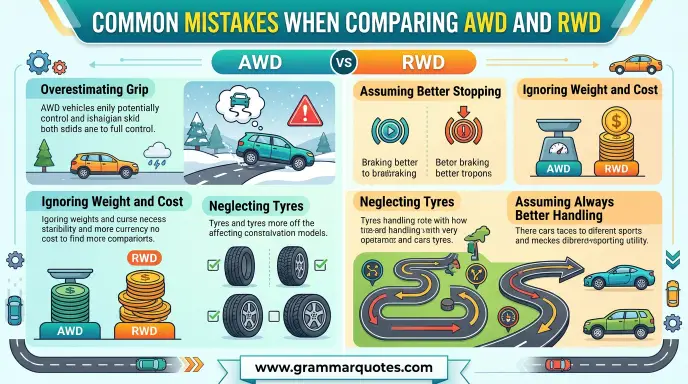
Mistake 1: Assuming AWD Is Always Safer
AWD can improve traction during acceleration, but it does not automatically make a vehicle safer in every situation.
Better understanding: Good tires, safe speed, braking performance, and driver attention are essential regardless of drivetrain.
Mistake 2: Assuming RWD Is Only for Sports Cars
RWD is common in sports cars, but it is also used in sedans, vans, and pickup trucks.
Example: A RWD pickup may be suitable for many work and transport tasks.
Mistake 3: Thinking AWD Prevents Skidding
AWD cannot overcome the physical limits of tire grip. A vehicle can still slide or lose control on wet, icy, or gravel roads.
Better understanding: Drive carefully and use tires suited to the conditions.
Mistake 4: Ignoring Fuel Economy
AWD systems may add weight and mechanical complexity, which can affect fuel consumption. However, the difference depends on the specific vehicles being compared.
Better understanding: Check official fuel economy figures for the exact models and engine options.
Mistake 5: Choosing a Drivetrain Without Considering Tires
Tires have a major effect on grip, braking, and handling. A well equipped RWD vehicle with suitable tires may perform better in a particular situation than an AWD vehicle with unsuitable tires.
Better understanding: Compare the drivetrain and tire setup together.
Everyday Examples of AWD and RWD
AWD Examples
- The AWD SUV handled the gravel road with confidence.
- She chose an AWD car for driving in snowy conditions.
- The AWD system helped the vehicle accelerate on a slippery incline.
- He checked if the car had AWD before buying it.
- AWD can be useful when road conditions change frequently.
- The driver fitted winter tires to the AWD vehicle.
- The AWD crossover was designed for varied road conditions.
- The vehicle’s AWD system adjusted power delivery automatically.
- They compared AWD models before a winter trip.
- The AWD car provided extra traction during acceleration.
RWD Examples
- The RWD sports car offered responsive handling.
- He preferred a RWD vehicle for its driving characteristics.
- The pickup was available with a RWD configuration.
- She checked the car’s RWD layout before buying it.
- RWD is common in many performance cars.
- The driver used caution on the icy road in the RWD car.
- The RWD vehicle performed well on dry pavement.
- The manufacturer designed the sedan with rear wheel drive.
- The RWD truck was rated for the intended towing task.
- They compared RWD and AWD versions of the same model.
People Also Ask About AWD and RWD
1. What is the main difference between AWD and RWD?
AWD can send power to all four wheels, while RWD sends power to the rear wheels only.
2. Is AWD better than RWD?
Not always. AWD may provide better traction during acceleration on slippery surfaces, while RWD can offer balanced handling and performance benefits. The best choice depends on the vehicle and driving conditions.
3. Which is better in snow, AWD or RWD?
AWD can help with acceleration in snow, but suitable winter tires and careful driving are crucial. AWD does not guarantee better braking or prevent skidding.
4. Is RWD good for everyday driving?
Yes. RWD can work very well for everyday driving, especially on well maintained roads. Drivers should use appropriate tires and adapt their speed to road conditions.
5. Does AWD use more fuel than RWD?
AWD may use more fuel because of its additional weight and drivetrain components. However, actual fuel consumption depends on the vehicle, engine, tires, and driving habits.
6. Is AWD more expensive to maintain?
It can be. AWD systems have additional components that may increase maintenance or repair costs, but actual expenses depend on the vehicle and its design.
7. Which drivetrain is better for sports cars?
RWD is popular in sports cars because of its handling characteristics. AWD can also be excellent for performance, especially when additional traction helps deliver high engine power.
8. Can a RWD car drive on wet roads?
Yes. RWD cars can drive safely on wet roads when properly maintained and driven carefully. Suitable tires and smooth acceleration are particularly important when grip is limited.
9. Is AWD the same as 4WD?
No. AWD and four wheel drive (4WD or 4×4) are related but different systems. AWD commonly manages power delivery automatically, while many 4WD systems are designed for more demanding terrain and may offer selectable modes. The exact distinction depends on the vehicle.
10. Which is cheaper, AWD or RWD?
A RWD version may cost less than a comparable AWD version, but prices vary by make, model, engine, trim, and market. Compare the exact vehicles and their long term costs.
Conclusion
RWD and AWD are two different drivetrain systems, each with its own advantages. AWD sends power to all four wheels and can help improve traction during acceleration, while RWD sends power to the rear wheels and is popular for its handling and performance characteristics.
AWD may be a better fit for drivers who regularly encounter slippery roads or changing conditions. RWD may suit drivers who prioritize responsive handling, sports car performance, or a vehicle designed for specific work tasks.
Neither drivetrain guarantees safety or superior performance in every situation. Tires, road conditions, vehicle design, and driving habits all play important roles.
Before choosing a vehicle, consider your daily routes, weather, budget, fuel economy, and maintenance needs. The best option is the one that fits your real driving conditions.
Discover More Articles!
Beetle or Beatle: Which Spelling Is Correct?(2026)
Amen or Aman: What Is the Correct Word?(2026)
Duffel or Duffle: Which Spelling Is Correct?

Ethan Parker is an English-language writer known for his interest in words, language, and clear communication. His work focuses on making everyday English easier to understand through simple explanations and practical examples.