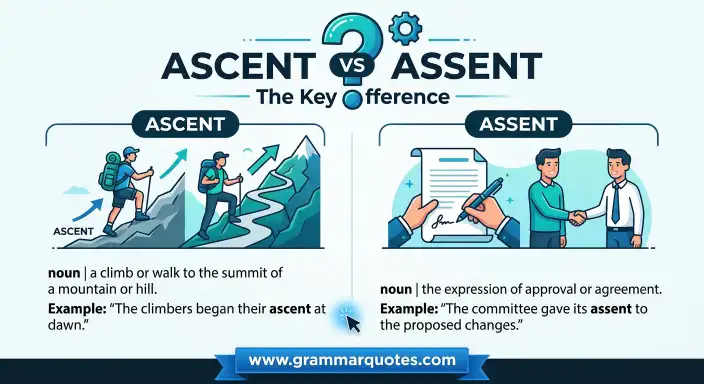
Ascent vs assent is a common English word confusion because both words sound the same but have different meanings and spellings. Ascent means an upward movement or climb, while assent means agreement or approval. Although they are pronounced alike, you cannot use them interchangeably.
For example, you might describe a mountain climber’s ascent to the summit, but you would use assent when someone agrees to a proposal. Knowing the difference helps you avoid spelling mistakes and communicate your ideas more clearly.
In this guide, you will learn the meanings of both words, how to use them in sentences, their origins, common mistakes, and simple tips to remember which spelling is correct. You will also find everyday examples and answers to frequently asked questions.
Quick Answer: Ascent or Assent?
Both ascent and assent are correct English words, but they have different meanings.
- Ascent: An upward movement, climb, or rise.
- Example: The climber began the ascent to the mountain’s peak.
- Assent: Agreement, approval, or acceptance.
- Example: The committee gave its assent to the proposal.
Easy way to remember: Ascent has a C, like climb. Assent has two S letters, and you can connect it with say yes or support an idea.
Ascent vs Assent: Meaning and Definition
Understanding the definition of each word is the easiest way to use it correctly.
What Does Ascent Mean?
Ascent is a noun that means moving upward, climbing to a higher place, or rising in position or status. It can describe a physical climb or progress toward success.
Examples:
- The ascent to the mountain peak was difficult.
- The airplane began its ascent after takeoff.
- Her rapid ascent in the company surprised everyone.
In these examples, ascent describes movement or progress from a lower level to a higher one.
What Does Assent Mean?
Assent means agreement, approval, or acceptance of an idea, request, or proposal. It can be used as both a noun and a verb.
Examples:
- The manager gave her assent to the plan.
- He assented to the terms of the agreement.
- The proposal was accepted with everyone’s assent.
As a noun, assent means agreement. As a verb, it means to agree or express approval.
Difference Between Assent and Ascent
The main difference is that ascent describes going up, while assent describes agreeing.
| Feature | Ascent | Assent |
| Part of speech | Noun | Noun and verb |
| Meaning | Upward movement or rise | Agreement or approval |
| Common use | Mountains, stairs, airplanes, careers | Decisions, proposals, requests |
| Example | The ascent was steep. | She gave her assent. |
| Related word | Ascend | Agree |
| Memory clue | C for climb | S for say yes |
Ascent vs Assent: Pronunciation
Both words are generally pronounced the same way: uh SENT (/əˈsent/).
This makes them homophones, meaning words that sound alike but have different meanings and spellings.
Because pronunciation does not help you distinguish them, you need to pay attention to the context of the sentence.
Origin of Ascent and Assent
The two words have different historical roots, which helps explain their meanings.
Origin of Ascent
Ascent comes from Latin roots associated with climbing or rising. It is related to the verb ascend, which means to move upward.
Example: “The hikers’ ascent became harder as they approached the summit.”
Origin of Assent
Assent comes through French from Latin roots associated with agreeing or consenting. It is related in meaning to consent and agreement.
Example: “The board gave its assent to the new policy.”
Although the words sound alike, their meanings developed along different paths.
When Should You Use Ascent?
Use ascent when you are describing physical movement upward or progress toward a higher level.
1. Climbing a Mountain
Use ascent to describe climbing a hill, mountain, or other elevated place.
Example: The hikers began their ascent before sunrise.
2. Air Travel
Use ascent when an aircraft rises after takeoff.
Example: The plane’s ascent was smooth and steady.
3. Career or Social Progress
Use ascent figuratively to describe someone’s rise in power, success, or status.
Example: His ascent to the position of director took many years.
4. Stairs or Steep Paths
Use ascent to describe an upward route or climb.
Example: The final ascent up the stairs left us tired.
Remember: If the sentence involves rising, climbing, or moving to a higher level, ascent is usually the correct choice.
When Should You Use Assent?
Use assent when you mean agreement, permission, or approval.
1. Agreeing to a Proposal
Example: The committee gave its assent to the proposed changes.
Here, assent means that the committee agreed to the changes.
2. Formal Decisions
Example: The agreement required the assent of all parties.
This sentence describes formal approval.
3. Expressing Agreement as a Verb
Example: She assented to the suggestion after considering it carefully.
In this sentence, assented means that she agreed.
4. Legal or Official Contexts
Example: The document required the client’s assent before proceeding.
In formal settings, assent can refer to agreement or approval. The exact legal meaning may depend on the circumstances and applicable rules.
Remember: If the sentence involves agreeing, accepting, or approving something, assent is usually the correct choice.
Ascent or Assent: Examples in Everyday Sentences

The following examples show how the words work in different contexts.
Examples of Ascent
- The climbers’ ascent began early in the morning.
- The airplane’s ascent was barely noticeable.
- We stopped halfway through the steep ascent.
- Her ascent to fame happened very quickly.
- The path becomes narrow during the final ascent.
Examples of Assent
- The manager gave her assent to the request.
- The committee’s assent made the plan possible.
- He assented to the proposal without hesitation.
- The contract required the assent of both parties.
- She nodded her assent to the suggestion.
Common Mistakes When Using Assent and Ascent
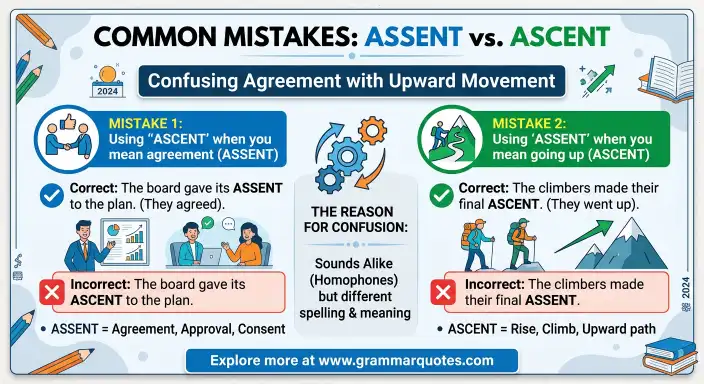
Even experienced English writers can confuse these words because they sound alike. Here are common mistakes to avoid.
1. Using Assent for a Climb
Incorrect: The hikers began their assent up the mountain.
Correct: The hikers began their ascent up the mountain.
Why? The sentence describes upward movement, so ascent is the correct noun.
2. Using Ascent for Agreement
Incorrect: The manager gave her ascent to the proposal.
Correct: The manager gave her assent to the proposal.
Why? The manager is agreeing to something, not climbing.
3. Confusing the Verb Forms
Ascent is a noun, while ascend is the verb meaning to move upward. Assent can be both a noun and a verb.
Examples:
- Correct: The climbers ascended the mountain.
- Correct: The climbers began their ascent.
- Correct: She assented to the proposal.
- Correct: She gave her assent.
4. Choosing the Word by Sound Alone
Both words sound alike, so pronunciation will not help you decide which spelling to use.
Instead, identify the meaning:
- Is something moving upward? Use ascent.
- Is someone agreeing? Use assent.
5. Assuming Both Words Have the Same Meaning
Although they are homophones, they are not synonyms. Replacing one with the other can change the meaning of an entire sentence.
Incorrect: The committee began its ascent to the new rules.
Better: The committee gave its assent to the new rules.
The second sentence correctly expresses approval.
Easy Tricks to Remember Ascent vs Assent
Use these simple memory tricks whenever you are unsure which word to choose.
Trick 1: Ascent Has C for Climb
The word ascent contains the letter C, just like climb.
Example: The ascent up the hill was exhausting.
Trick 2: Assent Means Say Yes
Think of assent as agreeing with or accepting an idea.
Example: She gave her assent to the plan.
Trick 3: Replace the Word With a Simpler One
If you can replace the word with climb or rise, use ascent. If you can replace it with agreement or approval, use assent.
- The plane began its rise. → Ascent
- The board gave its approval. → Assent
These simple checks can help you choose the correct spelling quickly.
Ascent vs Assent: Frequently Asked Questions
1. What is the difference between ascent and assent?
Ascent means an upward movement or rise, while assent means agreement or approval. For example, climbing a mountain is an ascent, and agreeing to a proposal is assent.
2. Are ascent and assent pronounced the same?
Yes. Both are generally pronounced “uh SENT.” They are homophones because they sound alike but have different meanings and spellings.
3. Is ascent a noun or a verb?
Ascent is a noun. The related verb is ascend, which means to move upward.
Example: The ascent was difficult. The climbers ascended the mountain.
4. Can assent be used as a verb?
Yes. Assent can be a noun or a verb. As a noun, it means agreement; as a verb, it means to agree or express approval.
Example: She assented to the proposal.
5. What is a synonym for ascent?
Common synonyms include climb, rise, upswing, elevation, and upward movement. The best synonym depends on the context.
6. What is a synonym for assent?
Common synonyms include agreement, approval, consent, acceptance, and acquiescence. These words have slightly different shades of meaning.
7. Which word should I use for climbing a mountain?
Use ascent. For example: “The ascent to the mountain’s peak took several hours.”
8. Which word should I use for agreeing to a plan?
Use assent. For example: “The team gave its assent to the plan.”
9. What is the opposite of ascent?
Depending on the context, opposites include descent, decline, and fall. Descent is the most direct opposite when describing movement downward.
10. What is the opposite of assent?
Depending on the context, opposites include dissent, disagreement, and objection. Dissent is especially relevant when someone expresses a different opinion.
Conclusion
Understanding ascent vs assent is simple once you remember their meanings. Ascent describes upward movement, climbing, or progress toward a higher level. Assent describes agreement, acceptance, or approval of an idea or proposal.
Although both words sound the same, they serve different purposes in writing. Use ascent when talking about mountains, airplanes, stairs, or career progress. Use assent when discussing decisions, requests, proposals, or formal approval.
The easiest way to remember the difference is C for climb in ascent and assent means agreement. Keep this rule in mind, and you will be able to choose the correct word confidently.
Discover More Articles!
Council vs Counsel: Meaning, Differences, and Examples
Understanding the Difference Between Lynx and Linx(2026)
Implicit or Explicit: What Is the Difference?(2026)

Ethan Parker is an English-language writer known for his interest in words, language, and clear communication. His work focuses on making everyday English easier to understand through simple explanations and practical examples.