When people see goods or services, they are usually trying to decide if something is a physical product or an activity provided for a customer.
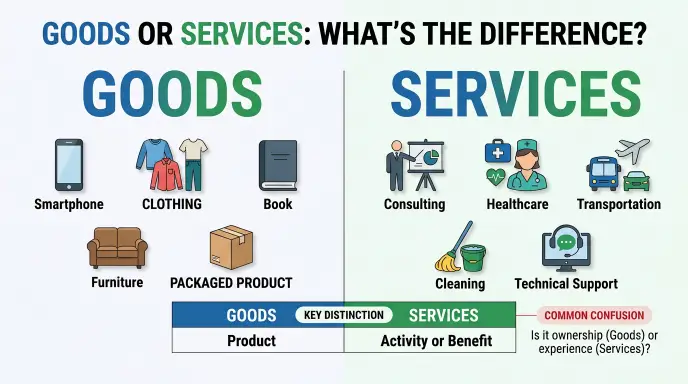
The basic distinction is simple: goods are products that can generally be owned and transferred, while services are activities or benefits provided to someone.
This distinction appears in business, economics, marketing, contracts, taxes, websites, and everyday conversation. It can become confusing because some modern products, such as software, digital content, repairs, and subscriptions, do not fit neatly into a simple “physical item versus activity” rule. The IMF and OECD both note that the boundary between goods and services can sometimes be difficult to define.
In this guide, you will learn what goods or services means, how the two categories differ, when to use each term, common mistakes to avoid, and how the phrase appears in business and formal writing.
Goods or Services: The Quick Answer for Searchers
Goods or services refers to two broad types of products or economic output. Goods are generally physical products that can be owned and transferred, such as clothing or furniture. Services are activities or benefits provided to a customer, such as consulting, transportation, or haircuts. The phrase is widely used in business and economics.
Goods or Services: Quick Answer
The easiest way to understand the difference is to ask what the customer receives.
- Goods are generally items or products.
- Services are activities, work, or benefits provided to a customer.
- A business can provide goods, services, or both.
- Some modern products can have characteristics of both.
For example:
- A clothing store sells goods because customers purchase physical clothing.
- A lawyer provides a service because the customer pays for professional expertise.
- A computer company may sell a laptop as a good and provide technical support as a service.
Cambridge defines goods as items for sale or possessions that can be moved, while its business definition of “goods and services” covers products and services bought and sold in an economy.
What Does Goods or Services Mean?
Goods or services is a broad business and economic phrase used when referring to things that organizations produce, sell, provide, or deliver to customers.
What are goods?
Goods are products that can generally be owned and transferred from one party to another.
Examples include:
- Cars
- Books
- Furniture
- Clothing
- Food
- Mobile phones
- Machinery
- Office equipment
Goods are commonly associated with physical products. However, economic classification can be more complex than simply asking if something can be touched. The IMF, for example, describes goods in economic accounts as produced items over which ownership rights can be established and transferred.
What are services?
Services are activities or benefits provided to another person or organization.
Examples include:
- Legal advice
- Medical treatment
- Accounting
- Transportation
- Cleaning
- Consulting
- Hairdressing
- Website development
- Education
The U.S. Bureau of Labor Statistics regularly uses the distinction between businesses that produce goods and those that provide services.
Why do people say “goods or services”?
The word or is important.
When a form asks:
“Do you provide goods or services?”
it usually wants to know which type of output a business provides.
For example:
- A bakery may provide goods.
- A cleaning company may provide services.
- A restaurant may provide both, depending on how its activities are classified.
When discussing both categories together, the more common phrase is goods and services.
The Origin and Development of Goods and Services

The words goods and services are not new business terms. They developed from much older English words and became especially important as commerce and economic theory developed.
The word goods is the plural of good. In commercial English, goods came to refer to items or possessions, especially things that could be bought, sold, transported, or traded.
The word service has a different history. It developed from older forms connected with the idea of serving or performing work for another person.
Over time, business and economic writing needed clearer ways to distinguish physical products from activities performed for customers. That distinction became especially important in accounting, trade, national economic statistics, taxation, and business classification.
Today, international economic frameworks still distinguish between goods and services, while recognizing that the boundary is not always perfectly clear.
Why has the distinction become harder?
Modern businesses often combine products and services.
For example:
- A company sells a smartphone and provides cloud storage.
- A car dealer sells vehicles and offers maintenance.
- A software company sells access to a digital platform and provides technical support.
- A manufacturer produces equipment and also provides installation.
This is why simply asking if something is “physical” is not always enough.
British English vs American English
There is no major British versus American spelling difference between goods and services.
Both British and American English use:
- goods
- services
- goods and services
- goods or services
- consumer goods
- business services
The difference is mainly related to context, legal rules, industry terminology, and regional conventions, not spelling.
| British English | American English | Example |
| goods | goods | The company sells electrical goods. |
| services | services | The company provides consulting services. |
| goods and services | goods and services | The business supplies goods and services. |
| goods or services | goods or services | Select if you provide goods or services. |
| consumer goods | consumer goods | Consumer goods include many household products. |
| business services | business services | The firm provides business services. |
Government and economic organizations in both the UK and U.S. use the terms in formal contexts. For example, the UK’s Office for National Statistics measures business turnover from different goods and services, while the U.S. Bureau of Labor Statistics uses the categories in economic and employment data.
Style and publishing preferences
The phrase goods and services is especially common when the writer is discussing both categories together.
Use goods or services when the meaning is alternative or inclusive:
The company sells goods or services online.
Use goods and services when both categories are being discussed together:
The company sells goods and services to businesses worldwide.
Which Version Should You Use?
The choice depends less on geography and more on what you mean.
United States
Use goods, services, goods and services, or goods or services according to the intended meaning. American business and government writing commonly uses all of these forms.
United Kingdom
The same basic terms are standard in British English. UK business and government sources regularly use goods and services when discussing economic activity.
Canada
Use the same standard terminology. There is no need to replace goods or services with a special Canadian alternative.
Australia
Australian business and economic writing also uses goods, services, and goods and services in their normal meanings.
International writing
For international readers, goods and services is usually the clearest broad phrase.
If you need to distinguish between the two categories, define them briefly on first use.
Academic writing
Academic writing should be precise.
Instead of:
The company sells many things.
write:
The company provides both goods and services.
If the distinction matters to your argument, explain what you classify as a good and what you classify as a service.
Business writing
In business documents, clarity is more important than complexity.
Use:
- goods for products
- services for activities or professional work
- goods and services for both
- goods or services when either category could apply
Common Mistakes With Goods or Services
Mistake 1: Treating goods and services as exact synonyms
Incorrect:
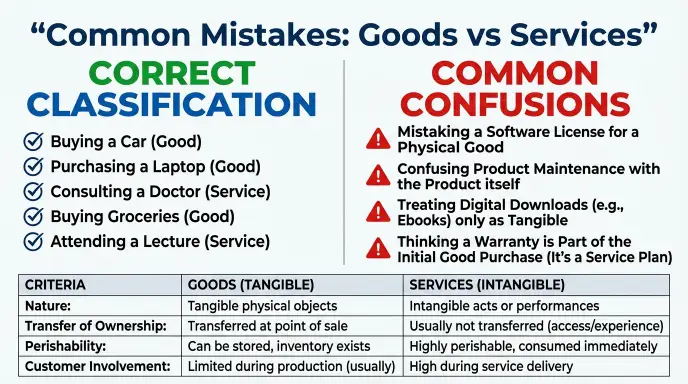
A haircut is a good.
Correct:
A haircut is a service.
Why?
The customer is paying for work performed by another person, not normally taking ownership of a physical product.
Memory tip:
Good = product. Service = activity or benefit.
Mistake 2: Assuming every physical item is always a good
This rule is useful but not absolute in specialized economic classification.
A physical object can be connected to a service transaction.
For example:
A technician repairs a laptop.
The laptop is a good, but the repair work is a service.
International economic standards recognize that some transactions involve goods and services together.
Mistake 3: Using “or” when you mean both
Less clear:
Our company provides goods or services to businesses.
This suggests the company may provide one category or the other.
Better when both apply:
Our company provides goods and services to businesses.
Mistake 4: Assuming services cannot involve physical products
A service can involve goods.
For example:
The mechanic replaced the car’s brake pads.
The brake pads are goods, while the installation or repair work is a service.
This is one reason the goods services boundary can become complicated in real business transactions.
Mistake 5: Treating digital products as automatically simple “goods”
Digital products can be difficult to classify.
Software, digital information, and intellectual property may have characteristics that do not fit neatly into the traditional physical product model. The IMF and OECD both acknowledge special cases involving knowledge based products.
Goods or Services in Everyday Examples
The phrase appears in many different types of writing.
Emails
Please let us know if your company provides goods or services.
This is useful when asking a supplier to describe its business.
Business Writing
Our platform helps businesses manage the sale of goods and delivery of services.
Here, and is correct because both categories are included.
News Headlines
Consumer spending on goods and services remains an important economic indicator.
This broad usage is common in economic reporting. Cambridge also uses the phrase in its Business English definition.
Blogs
Small businesses can sell goods or services through an online store.
Here, or works because the writer is discussing either type of business activity.
Social Media
Do you sell goods or offer services? Tell us what your business provides.
This is a natural conversational use.
Academic Writing
The study examines consumer demand for goods and services.
This is appropriate when discussing both categories.
Daily Conversation
What goods or services does the company offer?
This means:
What products does it sell, or what work does it provide?
Google Trends and Modern Usage
Searches for goods or services are usually driven by practical questions rather than spelling confusion. People encounter the phrase on business websites, government forms, tax documents, contracts, e commerce pages, and educational resources.
There is also strong demand for explanations of the underlying difference between goods and services. This makes sense because businesses frequently operate across both categories.
For example, a company might sell a physical product while also offering installation, maintenance, delivery, training, or technical support.
Modern economic classifications also show why the topic cannot always be reduced to a strict physical versus nonphysical rule. The OECD notes that some products can have characteristics of both goods and services.
The exact classification can also depend on the purpose of the classification. Tax rules, accounting standards, trade statistics, contracts, and business descriptions may apply different rules to particular transactions.
So, if a legal or tax document asks if something is a good or service, do not rely only on the everyday definition. Check the rules that apply to that specific context.
Quick Comparison Table
| Version | Meaning | Correct? | Typical Context | Example |
| Goods | Products or items that can generally be owned or transferred | Yes | Retail, trade, business | The store sells goods. |
| Services | Activities or benefits provided to customers | Yes | Professional and business work | The firm provides services. |
| Goods and services | Both categories together | Yes | Business, economics, government | We provide goods and services. |
| Goods or services | Either category, depending on the situation | Yes | Forms, questions, business descriptions | Do you sell goods or services? |
| Good or service | One individual item classified as one category | Yes | Accounting, business, economics | Is this transaction a good or service? |
A useful shortcut is:
Goods = what you generally receive and can own.
Services = what someone provides or performs for you.
That shortcut works well in everyday English, although specialized classifications can be more complex.
Key Takeaways
- Goods generally refer to products or items that can be owned and transferred.
- Services generally refer to activities, work, or benefits provided to customers.
- Goods or services means either category.
- Goods and services means both categories together.
- There is no important British American spelling difference in these terms.
- Businesses can provide goods, services, or a combination of both.
- Some digital and mixed transactions do not fit neatly into a simple category.
- For tax, legal, or accounting purposes, use the definition required by the relevant rules.
FAQs
What are goods or services?
Goods or services are two broad categories of products or economic output. Goods generally include products that can be owned and transferred, while services are activities or benefits provided to customers. A company may provide goods, services, or both. The exact classification can vary in specialized legal, tax, and economic contexts.
What is the difference between goods and services?
Goods are generally products that can be owned, stored, and transferred. Services are activities or benefits performed or provided for a customer. For example, a laptop is a good, while computer repair is a service. The distinction is useful in business, economics, marketing, accounting, and everyday communication.
Is it “goods or services” or “goods and services”?
Both phrases are correct, but they have different meanings. Use goods or services when either category could apply. Use goods and services when you mean both categories together. For example, “Do you provide goods or services?” asks about alternatives, while “We provide goods and services” says the business provides both.
Are goods and services the same thing?
No. Goods and services are related but distinct categories. Goods generally involve products over which ownership can be established, while services are generally activities or benefits that cannot be owned in the same way. However, some modern products and transactions have characteristics of both, so the boundary is not always absolute.
Is a product a good or a service?
A physical product is generally treated as a good. A service is usually an activity provided to a customer. However, the word product can be used broadly in business to include both goods and services. For example, a company may describe consulting as one of its “products” even though consulting is a service.
Is software a good or a service?
It depends on how the software is provided and the classification system being used. Software can have characteristics that make the distinction more complicated than the traditional physical product rule. A software download, license, or cloud subscription may be treated differently under different economic, legal, accounting, or tax frameworks.
Can a business sell both goods and services?
Yes. Many businesses do both. A computer company may sell laptops and provide installation or technical support. A car company may sell vehicles and offer maintenance. The BLS also recognizes that businesses can produce goods or provide services, while some organizations engage in activities involving both.
What is an example of goods and services?
A restaurant can illustrate both concepts. The food sold may be treated as a good, while the preparation, serving, and related customer experience involve services. A repair shop provides another clear example: replacement parts are goods, while the repair work is a service.
Why do businesses use the phrase “goods and services”?
Businesses use goods and services because it is a broad, familiar way to describe what organizations produce or provide. The phrase is common in business, economics, government, taxation, and trade. Cambridge describes goods and services as products and services bought and sold in an economy.
Conclusion
Understanding goods or services is much easier once you focus on what the customer receives. Goods generally refer to products that can be owned and transferred, while services refer to activities, work, or benefits provided to customers. A book, phone, or piece of furniture is a typical example of a good. Consulting, transportation, cleaning, and legal advice are typical services.
The phrase goods or services is correct when either category may apply. When a business provides both categories, goods and services is the better expression. There is no major British American spelling difference, so your choice should be based on meaning and context rather than region.
One important point is that modern business does not always fit into two perfectly separate boxes. Software, digital products, repairs, subscriptions, and bundled offers can involve characteristics of both categories. International economic frameworks recognize this complexity.
Remember: goods are generally products you can own, while services are benefits or activities someone provides.
Discover More Articles!
Of or For: Which Preposition Is Correct?
Bended or Bent: Which One Is Correct?
GMT or UTC: What’s the Difference?

Ethan Parker is an English-language writer known for his interest in words, language, and clear communication. His work focuses on making everyday English easier to understand through simple explanations and practical examples.