Finally is the correct spelling in standard English, while finaly is a common spelling mistake. The word finally means “at the end,” “after a long time,” or “as the last point.” It is often used when something happens after a delay or when someone wants to introduce the last idea in a discussion.
For example, you should write, “I finally finished my homework,” not “I finaly finished my homework.” The difference is just one letter, but spelling the word correctly makes your writing clearer and more professional.
Many English learners forget the second l because they assume the word follows a simple spelling pattern. However, finally is formed from final by adding the suffix ly, which keeps both the existing l and the suffix’s l.
In this guide, you will learn the correct spelling, meaning, pronunciation, grammar rules, examples, and common mistakes. You will also discover easy tricks to remember the spelling and answers to frequently asked questions.
Quick Answer: Finaly or Finally?
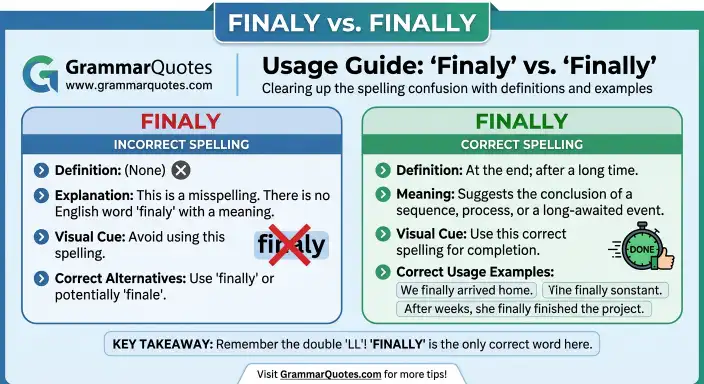
Finally is the correct spelling. Finaly is incorrect in standard English.
- Finally: Correct spelling.
- Finaly: Incorrect spelling.
Examples:
- Correct: We finally reached our destination.
- Incorrect: We finaly reached our destination.
Easy rule to remember: The word final already ends in l. When you add ly, you get finally, with two consecutive letter Ls.
Finally: Definition and Meaning
Finally is an adverb that means at the end of a process, after a long wait, or as the last point in a series.
It is commonly used in three ways:
1. After a Long Time
Use finally when something happens after waiting, difficulty, or delay.
Example: She finally received the results of her examination.
This means she received the results after waiting for some time.
2. At the End of a Process
Use finally to describe the last step or event in a sequence.
Example: Finally, add the sugar and stir the mixture.
Here, finally introduces the last instruction.
3. To Introduce the Last Point
Use finally when presenting the final idea in a speech, essay, or discussion.
Example: Finally, we should consider the cost of the project.
In this sentence, finally signals the last point being discussed.
Why Is Finally Correct and Finaly Incorrect?
The correct spelling is finally because it combines the word final with the suffix ly.
- Base word: final
- Suffix: ly
- Correct word: finally
The final l in final remains when the suffix is added. The suffix also begins with l, so the finished word contains two consecutive Ls.
Final + ly = finally
The incorrect spelling finaly leaves out one of these letters.
Finally and Finaly: Comparison Table
| Feature | Finally | Finaly |
| Spelling status | Correct | Incorrect |
| Meaning | At last; in the end | No standard meaning |
| Part of speech | Adverb | Not a standard English word |
| Grammar | Standard English | Spelling error |
| Example | I finally understand the lesson. | I finaly understand the lesson. |
| Appropriate for formal writing | Yes | No |
Always use finally in school assignments, professional emails, articles, social media posts, and other standard English writing.
How to Use Finally in Sentences
The word finally can appear at the beginning, middle, or end of a sentence, depending on what you want to emphasize.
1. Finally at the Beginning
When finally introduces the last point or step, it often appears at the beginning of a sentence.
Examples:
- Finally, we arrived at the hotel.
- Finally, check that all the doors are locked.
- Finally, I want to thank everyone who helped me.
When it introduces a sentence as a transition, it is often followed by a comma.
2. Finally in the Middle
Finally can appear before a main verb or after an auxiliary verb.
Examples:
- I finally completed my assignment.
- They have finally agreed to the proposal.
- She was finally able to relax.
Its position depends on the sentence structure and which part of the sentence you want to emphasize.
3. Finally at the End
Although less common, finally can also appear at the end of a sentence.
Examples:
- We reached an agreement finally.
- The missing package arrived finally.
In everyday English, “We finally reached an agreement” and “The missing package finally arrived” generally sound more natural.
Final or Finally: What Is the Difference?
The words final and finally are related, but they have different grammatical functions.
Final is usually an adjective that describes the last thing in a series. Finally is an adverb that describes when something happens or introduces the last point.
| Word | Part of speech | Meaning | Example |
| Final | Adjective | Last in a series | This is my final answer. |
| Finally | Adverb | At last or in the end | I finally found the answer. |
Examples of Final
- We attended the final meeting of the year.
- She submitted her final assignment.
- The final decision will be announced tomorrow.
Examples of Finally
- We finally finished the meeting.
- She finally submitted her assignment.
- The decision was finally announced.
Remember: Use final to describe a noun and finally to describe an action, a sequence, or the last point in a discussion.
Finally Synonyms and Alternatives
Several words and phrases have similar meanings to finally. The best choice depends on the context.
| Synonym or phrase | Meaning | Example |
| At last | After waiting | At last, the bus arrived. |
| Eventually | After some time | Eventually, they solved the problem. |
| Ultimately | In the end or as the final result | Ultimately, the choice is yours. |
| In the end | After everything is considered | In the end, we chose the simpler option. |
| Lastly | As the last item or point | Lastly, remember to save your work. |
| In conclusion | To introduce a conclusion | In conclusion, the plan was successful. |
| After all | Used to emphasize a conclusion or reconsideration | After all, we had done our best. |
These expressions are related, but they are not always interchangeable. For example, lastly works well when listing points, while eventually emphasizes the passage of time.
Common Mistakes When Using Finally
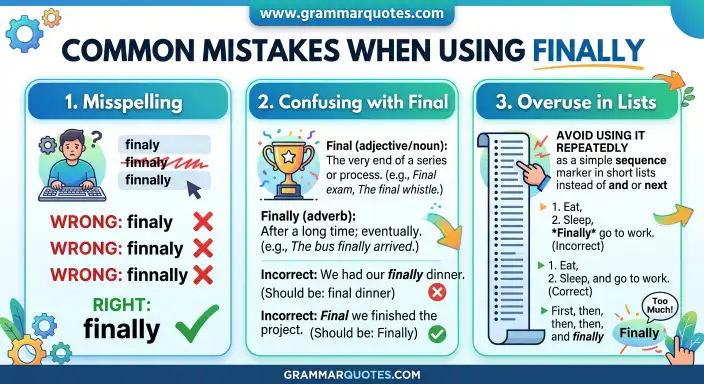
Even a familiar word can cause spelling and grammar errors. Here are some common mistakes to avoid.
1. Leaving Out One L
Incorrect: I finaly completed the task.
Correct: I finally completed the task.
Why? The word contains two consecutive Ls: one from final and one from the suffix ly.
2. Confusing Final With Finally
Incorrect: I final finished my homework.
Correct: I finally finished my homework.
Why? Final is an adjective, while finally is the adverb needed to describe when the homework was completed.
3. Using Finally When Eventually Is More Precise
Sometimes eventually is a better choice when emphasizing that something happened after a long process.
Example:
- Finally, the team reached a decision.
- Eventually, the team reached a decision.
Both sentences are correct. However, eventually can place more emphasis on the passage of time, while finally can emphasize the result or the end of a wait.
4. Forgetting the Comma After an Introductory Finally
When finally introduces a sentence as a transition, a comma is generally appropriate.
Less clear: Finally we reached the summit.
Preferred: Finally, we reached the summit.
The comma helps separate the introductory word from the main sentence.
5. Repeating Finally Too Often
Using finally in every paragraph can make writing repetitive.
Instead, consider alternatives such as lastly, eventually, or in conclusion, where their meanings fit.
Example:
“First, prepare the ingredients. Next, mix them together. Lastly, bake the mixture until golden.”
Easy Tricks to Remember Finally
Try these simple methods to remember the correct spelling.
Trick 1: Remember Final + Ly
Break the word into two parts:
FINAL + LY = FINALLY
The word final ends with L, and the suffix ly starts with L. Keep both letters.
Trick 2: Count the Ls
The correct word has two Ls together:
- F I N A L L Y — finally
- F I N A L Y — finaly (incorrect)
If you see only one L, check the spelling again.
Trick 3: Remember a Simple Sentence
Use this sentence as a spelling reminder:
“I finally finished my work.”
Writing and repeating the correct form can help you remember it.
Finally: Everyday Examples
Here are 15 examples showing how to use finally correctly in different situations.
- I finally finished my homework.
- She finally found her missing keys.
- We finally arrived at the station.
- Finally, the rain stopped.
- He finally understood the question.
- They have finally announced the results.
- Finally, I would like to thank my teachers.
- The movie finally began after a long delay.
- She finally decided which university to attend.
- We finally completed the project.
Each example uses the correct spelling, finally, with two consecutive Ls.
Finally or Finaly: Frequently Asked Questions
1. Is finaly or finally correct?
Finally is correct. Finaly is a common spelling mistake and is not accepted as the standard spelling of this word.
2. Why does finally have two Ls?
Finally is formed by adding ly to final. The final L of final and the first L of ly remain together, producing two consecutive Ls.
3. What does finally mean?
Finally means at last, after a period of waiting, or as the last point in a series.
Example: “We finally reached home.”
4. Is finally an adverb?
Yes. Finally is an adverb. It can describe when an action happens or introduce the final point in a sequence or discussion.
5. What is the difference between final and finally?
Final is usually an adjective meaning last, while finally is an adverb meaning at last or in the end.
Example: “This is the final test.” “I finally passed the test.”
6. What are synonyms for finally?
Common alternatives include at last, eventually, ultimately, lastly, and in the end. Choose the one that best fits the sentence.
7. Can I use finally at the beginning of a sentence?
Yes. For example: “Finally, we reached our destination.” A comma is generally used after finally when it introduces the sentence as a transition.
8. Is finally formal or informal?
Finally is appropriate in both formal and informal English. It works in academic writing, professional communication, everyday conversation, and creative writing.
9. How do you pronounce finally?
Finally is commonly pronounced FYE nuh lee. Its pronunciation is different from the incorrect spelling issue; the standard written form always includes two consecutive Ls.
10. How can I avoid spelling finally incorrectly?
Remember the formula final + ly = finally. Check that the word has two Ls together before submitting your writing.
Conclusion
The difference between finaly and finally is simple: finally is the correct spelling, while finaly is a spelling mistake. The word finally means at last, after waiting, or as the last point in a series.
To remember the spelling, break it into final and ly. Because both parts contribute an L, the correct word contains two consecutive Ls. Use finally in sentences such as “I finally completed the task” or “Finally, we reached our destination.”
Learning this small spelling rule can improve your writing and help you avoid a common English mistake.
Discover More Articles!
Treck or Trek: Meaning, Examples, and Common Mistakes
Dandruff or Psoriasis: How to Tell the Difference
Goods or Services: What’s the Difference?

Ethan Parker is an English-language writer known for his interest in words, language, and clear communication. His work focuses on making everyday English easier to understand through simple explanations and practical examples.