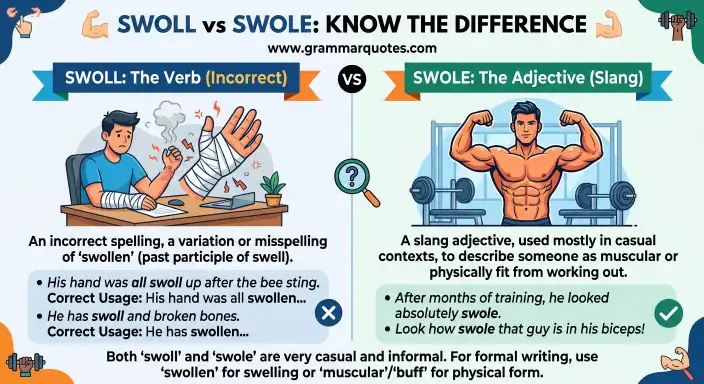
Swole is the more widely recognized informal spelling, while swoll is a less common variant. Both forms are associated with swell, a verb that means to become larger, but they are not equally common in modern English. Swole is especially popular in informal American English and fitness culture, where it describes someone who is muscular or has developed large muscles.
For example, “He looks swole after months of training” means he looks muscular. Swoll sometimes appears in slang, humorous writing, and online conversations, but it is less established and may be treated as a nonstandard spelling. If you are writing a fitness caption or casual social media post, swole is generally the safer choice. In formal writing, use a clearer expression such as muscular or well built instead.
Quick Answer: Swoll or Swole?
- Swole: The more common informal slang spelling, often meaning muscular or physically well developed.
- Swoll: A less common, nonstandard variant associated with the same slang use.
- Part of speech: Usually an informal adjective in modern slang.
- Swole example: He looks swole after months of strength training.
- Swoll example: The word swoll sometimes appears in informal online posts.
- Best choice: Use swole in casual writing when you mean muscular.
Important: Neither swoll nor swole is usually the best choice for formal academic or professional writing. Consider the standard word that expresses your intended meaning.
Swoll vs Swole: Comparison Table
The following table explains how the two spellings differ in usage, familiarity, and appropriateness.
| Feature | Swole | Swoll |
| Status | Established informal slang | Less common variant |
| Common meaning | Muscular or physically well developed | Usually intended to mean muscular |
| Typical use | Fitness slang, social media, casual conversation | Informal posts, playful spelling, occasional slang |
| Recognition | More widely recognized | Less widely recognized |
| Standard formal English | Generally avoided | Generally avoided |
| Example | He looks swole after training. | He wrote swoll in his humorous caption. |
| Recommended use | Preferred for casual slang | Use only when intentionally matching a nonstandard style |
The main difference is not a major change in meaning. It is the level of acceptance and common usage. Swole is generally the preferred spelling for the slang adjective.
What Does Swole Mean?
Swole is an informal slang adjective that commonly describes someone who is muscular, strong looking, or physically well developed. It is particularly common in fitness communities and online discussions about exercise and bodybuilding.
The word is connected to swell, which can mean to become larger. In slang, swole often refers specifically to muscular development rather than swelling caused by an injury or medical condition.
Examples of Swole in Sentences
- He looks swole after months of strength training.
- The fitness influencer posted a picture showing his swole arms.
- My friend joked that he wanted to get swole before summer.
- The character in the video game looks unusually swole.
- That is a popular gym caption: “Getting swole one workout at a time.”
These examples use swole in a casual, humorous, or fitness related context.
Synonyms for Swole
The best synonym depends on if you mean muscular appearance, physical strength, or an increase in size.
- Muscular: Having well developed muscles.
- Strong: Having physical power or strength.
- Well built: Having a solid or muscular body structure.
- Buff: Informal slang for muscular or physically fit.
- Jacked: Informal slang for very muscular.
- Ripped: Informal slang for having visibly defined muscles.
- Brawny: Strong and muscular.
- Powerful: Having great strength or force.
These words are not exact substitutes in every sentence. For example, strong refers to strength, while ripped emphasizes visible muscle definition.
What Does Swoll Mean?
Swoll is a less common spelling sometimes used to express the same slang meaning as swole. It may appear in casual online conversations, jokes, captions, and informal writing.
However, swoll is less widely recognized as the preferred form. Readers may understand the intended meaning, but the spelling can look nonstandard or deliberately playful.
Examples of Swoll in Sentences
- The comment used “swoll” as a humorous alternative to “swole.”
- He copied the unusual spelling into his gym caption.
- Some online posts use “swoll” when joking about fitness culture.
- The writer chose “swoll” to create an informal, playful tone.
These examples illustrate the spelling’s informal use rather than recommending it for standard writing.
Should You Use Swoll?
Use swoll only when you deliberately want a nonstandard or playful style. If you want the slang word that most readers are likely to recognize, choose swole.
For formal writing, choose a more precise word such as muscular, strong, or well built, depending on the meaning.
Origin and Etymology of Swoll and Swole
Both spellings are associated with the verb swell, whose older English forms include swollen and swoll. The verb has a long history in English and generally describes something becoming larger or increasing in size.
Over time, informal English developed swole as a slang adjective associated with muscular appearance, particularly in American fitness culture. The term became more visible in gym conversations, internet memes, social media captions, and popular culture.
Swoll appears as a less common spelling variant. Its use may reflect informal pronunciation, playful spelling, or an individual’s writing style.
The historical relationship between these forms explains their connection, but modern usage generally favors swole for the slang meaning “muscular.”
Pronunciation of Swoll and Swole
The two spellings are often pronounced similarly in informal speech, though pronunciation may vary by speaker and region.
| Word | General Pronunciation | Notes |
| Swole | /swoʊl/ in American English | Rhymes with “whole” for many speakers |
| Swoll | Often /swɑːl/ or /swɒl/, depending on accent and intended use | A less standardized spelling and pronunciation |
Because swoll is not a consistently standardized form, its pronunciation is less predictable than that of swole.
Example:
- He wants to get swole through consistent training.
Grammar and Usage of Swole
In modern slang, swole is usually an adjective. It describes a person or appearance as muscular.
Common Word Combinations
- Get swole
- Look swole
- Stay swole
- Swole arms
- Swole physique
- Swole gym buddy
Examples
- He hopes to get swole over time.
- The fictional character looked swole in the illustration.
- The caption said, “Stay swole.”
- The comedian used the word swole as part of a fitness joke.
These phrases are casual and may sound unnatural in formal writing. In a school essay or professional report, use more standard wording.
Is Swole a Verb?
In contemporary slang, swole is most often an adjective. It is not usually used as the main standard verb in a sentence.
Instead of writing, “He swoled up,” which may sound unusual or nonstandard, write “He became more muscular” or “His muscles grew.”
Common Mistakes With Swole and Swoll
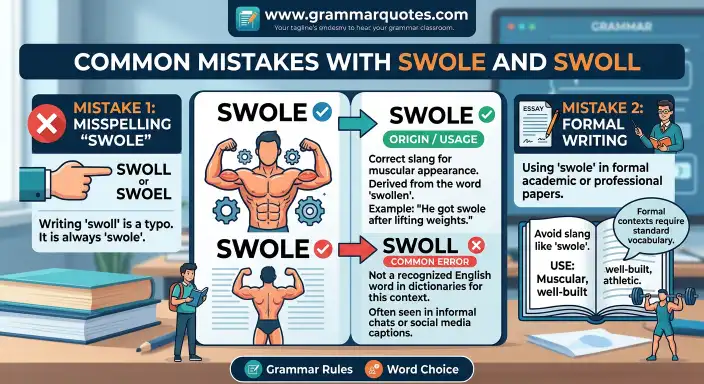
Mistake 1: Assuming Swoll Is the Preferred Spelling
Less preferred: He looks swoll after training.
More widely recognized: He looks swole after training.
Why? Swole is the more established spelling for the informal adjective meaning muscular.
Mistake 2: Using Swole in Formal Writing
Informal: He became swole after working out.
More formal: He became more muscular after consistent strength training.
Why? Swole is slang and may not suit academic, scientific, or professional writing.
Mistake 3: Confusing Swole With Swollen
Swole commonly describes a muscular appearance in slang. Swollen is a standard adjective that means enlarged, often because of fluid, inflammation, injury, or another cause.
Examples:
- Slang: He looks swole.
- Standard description: His ankle is swollen.
The words may be historically related, but their modern uses differ significantly.
Mistake 4: Assuming Muscular and Swollen Mean the Same Thing
A muscular appearance and swelling are not the same. Muscular describes developed muscles, while swollen describes an increase in size that may have many causes.
Choose the word that accurately describes the situation.
Swoll or Swole: Everyday Examples
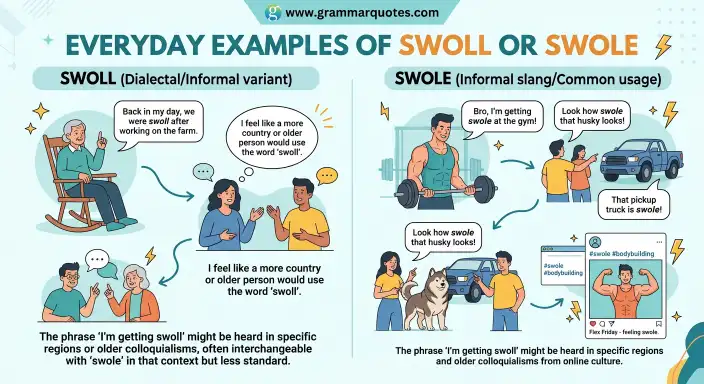
| Swole | Swoll |
| He looks swole in the gym photo. | The post uses swoll as a playful spelling. |
| My friend wants to get swole. | The commenter typed swoll in a joke. |
| The caption reads, “Stay swole.” | The unusual word swoll appeared in the meme. |
| He joked about getting swole. | The writer deliberately chose swoll for comic effect. |
| The fictional hero looked swole. | The caption used swoll as nonstandard slang. |
The examples show that swole is the more recognizable choice, while swoll is more likely to be understood as a spelling variation or deliberate stylistic choice.
Swoll vs Swole in Social Media and Fitness Culture
The word swole is frequently used in informal fitness content. It can appear in gym captions, workout jokes, memes, and discussions of muscle development.
Common phrases include:
- Getting swole
- Stay swole
- Swole goals
- Swole season
These phrases are informal and often humorous. They do not represent technical exercise or medical terminology.
Swoll may also appear in online posts, but it is less standard. If clarity matters, use swole for slang or muscular for a more neutral description.
What Is the Difference Between Swole, Swollen, and Muscular?
These words may be related in discussions about body size, but they do not mean the same thing.
| Word | Meaning | Typical Use | Example |
| Swole | Muscular or well developed, in slang | Casual conversation and fitness culture | He looks swole. |
| Swollen | Enlarged, often because of fluid or inflammation | Everyday, medical, and descriptive writing | Her ankle is swollen. |
| Muscular | Having developed muscles | Neutral, descriptive, or formal writing | The athlete has a muscular build. |
| Buff | Muscular, in informal slang | Casual conversation | The character looks buff. |
| Well built | Having a solid physical build | Neutral description | He is well built. |
Key takeaway: Use swole for informal slang, swollen for enlargement, and muscular for a neutral description of developed muscles.
Antonyms of Swole
Because swole is slang and its meaning depends on context, it does not have one exact antonym. However, several words can express contrasting ideas.
| Word | Meaning | Example |
| Slim | Having a slender build | The character has a slim build. |
| Lean | Having relatively little body fat, often with visible muscle definition | The athlete has a lean physique. |
| Slender | Having a narrow or delicate build | The character is tall and slender. |
| Unmuscular | Not having noticeably developed muscles | The description presents him as unmuscular. |
| Slight | Small or delicate in build | The fictional character has a slight frame. |
These words are not direct opposites in every situation. For example, someone can be both lean and muscular. The best contrasting word depends on if you mean muscle size, overall build, or strength.
Frequently Asked Questions
1. Is swoll or swole correct?
Swole is the more widely recognized informal spelling for someone who is muscular. Swoll is a less common variant and may be considered nonstandard.
2. What does swole mean in slang?
In slang, swole usually means muscular or physically well developed. It is particularly common in fitness culture and informal online conversations.
3. Is swoll a real word?
Swoll appears in informal writing as a spelling variant, but it is less established than swole. For clearer communication, swole is generally the better choice for this slang meaning.
4. Is swole the same as swollen?
No. Swole is commonly used as slang for muscular, while swollen is a standard adjective meaning enlarged. The words have different modern uses.
5. Can I use swole in formal writing?
It is better to avoid swole in formal writing. Use muscular, well developed, or another precise description that fits the context.
People Also Ask
1. How do you spell swole correctly?
The widely recognized spelling of the slang adjective is swole.
2. What is another word for swole?
Depending on the context, alternatives include muscular, buff, jacked, strong, and well built. Some are informal slang, while others are more neutral.
3. Does swole mean strong?
Not exactly. Swole usually refers to a muscular appearance, while strong refers to physical power or the ability to exert force. A muscular appearance does not automatically tell you how strong someone is.
4. What is the past tense of swell?
The standard past tense of swell is swelled. The past participle is commonly swollen, although swelled is also used in some contexts.
5. Is swole appropriate for an academic essay?
Usually not. Since swole is informal slang, words such as muscular or physically developed are generally more appropriate in academic writing.
Conclusion
The choice between swoll and swole depends on how you want to use the word. Swole is the more widely recognized informal spelling, especially in fitness culture, where it describes someone who looks muscular or physically well developed. Swoll is a less common variant that may appear in jokes, memes, or deliberately nonstandard writing. For casual captions and conversations, swole is generally the clearer choice.
For formal or academic writing, use a more standard word such as muscular, strong, or well built. Also, remember that swole and swollen have different modern meanings: the former is slang for muscular, while the latter means enlarged. Understanding these distinctions will help you choose words more accurately and communicate clearly.
Discover More Articles!
Pajamas or Pyjamas: Which Spelling Is Correct?(2026)
Wegovy or Mounjaro: Which Is Better?(2026)
Advisers vs Advisors: Meaning, Difference, and Correct Spelling

Ethan Parker is an English-language writer known for his interest in words, language, and clear communication. His work focuses on making everyday English easier to understand through simple explanations and practical examples.