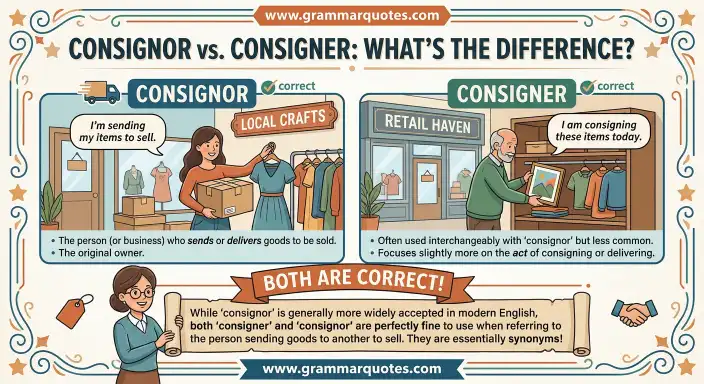
Have you ever wondered if to write consigner or consignor? Both spellings are used in English, but consignor is the standard and widely accepted term in shipping, business, and legal contexts. A consignor is a person or business that sends goods to another party for sale, delivery, or safekeeping.
In most situations, consignor is the correct choice when referring to someone who sends goods. Although consigner can also refer to a person who consigns something, it is much less common in modern business writing.
In this guide, you will learn the difference between consigner and consignor, their meanings, correct usage, examples, common mistakes, and answers to frequently asked questions.
Quick Answer: Consigner or Consignor?
Consignor is the preferred spelling in business, shipping, and commercial documents. It refers to the person or company that sends goods to another person or business.
- Consignor: The person or company that sends goods.
- Consigner: A less common alternative spelling for someone who consigns goods.
Example: The consignor shipped the furniture to the retailer for sale.
Remember: If you are writing an invoice, shipping label, delivery document, or business agreement, use consignor unless a specific organization requires different wording.
What Does Consignor Mean?
A consignor is an individual, company, or organization that delivers or sends goods to another party, usually called the consignee. The goods may be sent for transportation, storage, or sale under a consignment arrangement.
The consignor often retains ownership of the goods until they are sold or until the terms of the agreement transfer ownership.
Examples of Consignor in Sentences
- The consignor sent the products to the warehouse.
- The shipping document clearly identified the consignor.
- The consignor agreed to sell the paintings through an art gallery.
- The company listed its name and address as the consignor.
- The consignor received payment after the goods were sold.
Synonyms for Consignor
Depending on the context, related terms include:
- Sender: Someone who sends something.
- Shipper: A person or company arranging the shipment of goods.
- Supplier: A person or business providing products.
- Exporter: A business that sends goods to another country.
- Seller: A person or company selling goods.
These words are related but are not always interchangeable. For example, a consignor may not be the final seller or the person who physically ships the goods.
What Does Consigner Mean?
Consigner refers to someone who consigns goods or property to another party. It is a legitimate spelling, but it is less common than consignor, especially in formal commercial and shipping terminology.
The word comes from the verb consign, which means to hand over or send something to another person or organization.
Examples of Consigner in Sentences
- The consigner delivered the artwork to the gallery.
- The consigner provided a list of items for sale.
- The consigner contacted the shop about the unsold products.
- The agreement explained the consigner’s responsibilities.
- The consigner sent the package to the designated warehouse.
In these sentences, consigner communicates the intended meaning. However, consignor is generally the safer choice for formal business writing.
Consigner vs Consignor: Key Differences
The main difference between these words is their spelling and frequency of use, rather than their basic meaning.
| Feature | Consigner | Consignor |
| Meaning | Someone who consigns goods | Someone who consigns goods |
| Correct spelling | Acceptable | Standard and widely preferred |
| Common usage | Less common | Common in shipping and business |
| Formal documents | Less preferred | Recommended |
| Example | The consigner sent the items. | The consignor sent the items. |
The easiest rule to remember is this: use consignor for professional, commercial, and shipping documents.
Origin of Consignor and Consigner
Both words are connected to the verb consign, which comes through French from Latin roots associated with marking, signing, or entrusting something.
The suffix er commonly identifies a person who performs an action. The suffix or also appears in English words that describe people who perform particular roles.
This explains why both spellings can be understood as referring to someone who consigns goods. Over time, consignor became the established form in commercial and transportation terminology.
When Should You Use Consignor?
Use consignor when you need to identify the party sending goods, especially in formal or professional settings.
In Shipping and Transportation
Shipping documents often identify both the consignor and the consignee.
Example:
The consignor provided the shipment details before dispatch.
In Retail and Consignment Sales
A consignor may give products to a shop or gallery to sell on their behalf.
Example: The consignor delivered handmade jewellery to the boutique.
In Business Contracts
Contracts may specify the consignor’s responsibilities for product condition, delivery, insurance, and payment.
Example: The consignor signed the agreement before transferring the goods.
In Invoices and Delivery Notes
Using the standard term helps keep business records clear and consistent.
Example:
The invoice included the consignor’s company name and contact details.
Consignor vs Consignee
Do not confuse consignor with consignee. These words describe two different parties in a shipment.
| Term | Meaning | Example |
| Consignor | The party sending the goods | A manufacturer sends a shipment. |
| Consignee | The party receiving the goods | A retailer receives the shipment. |
Memory tip: The consignor sends; the consignee receives.
Example: The manufacturer was the consignor, while the retail store was the consignee.
Common Mistakes With Consigner and Consignor

1. Using Consigner in Every Business Document
Although consigner is understandable, consignor is the more established choice in professional shipping terminology.
Incorrect choice for standard terminology: The consignor field was labelled “consigner” without following the company’s required terminology.
Preferred: The consignor field identified the company sending the shipment.
2. Confusing Consignor With Consignee
These terms have different roles. The consignor sends the goods, while the consignee receives them.
Incorrect: The consignee sent the goods, when the intended meaning is the party that originally dispatched them.
Correct: The consignor sent the goods to the consignee.
3. Assuming the Consignor Always Owns the Goods
Ownership depends on the agreement and applicable law. In a consignment sale, the consignor commonly retains ownership until a sale takes place, but other arrangements may differ.
Correct approach: Check the contract before making claims about ownership.
4. Treating Consignor and Shipper as Exact Synonyms
A consignor is the party identified as consigning the goods. A shipper may be the party arranging or physically sending them. The roles can overlap, but they are not always identical.
Everyday Examples of Consigner and Consignor

Here are additional examples showing how to use consignor naturally.
- The consignor sent the shipment on Monday.
- The warehouse contacted the consignor about damaged packaging.
- The consignor supplied the retailer with ten boxes of products.
- The gallery paid the consignor after selling the painting.
- The consignor entered the shipment details into the system.
- The consignee confirmed receipt of the goods.
- The consignor was responsible for providing accurate product information.
- The shipping label displayed the consignor’s address.
- The consignor and consignee signed the delivery record.
- The consignor reviewed the terms of the sales agreement.
People Also Ask: Consigner or Consignor
1. Is consigner or consignor correct?
Both spellings can refer to someone who consigns goods. However, consignor is the standard and more widely preferred spelling, particularly in shipping and business documents.
2. What is the difference between a consigner and a consignor?
There is little difference in basic meaning. Consignor is the established commercial term, while consigner is a less common alternative.
3. Who is called a consignor?
A consignor is the person or company that sends or entrusts goods to another party for transportation, storage, or sale.
4. Is a consignor the sender or receiver?
A consignor is generally the sender or party consigning the goods. The receiver is called the consignee.
5. How do you spell consignor in a shipping document?
Use consignor when identifying the party sending or consigning the shipment, unless the relevant form or organization specifies another term.
FAQs About Consigner or Consignor
1. Is consignor an American or British spelling?
Consignor is used in both American and British English. It is the standard term in commercial and shipping contexts in both varieties.
2. Can I use consigner in a formal email?
You can, but consignor is usually preferable when discussing shipping, consignment sales, or commercial documents. Consistency with the terminology used by your organization is also important.
3. What is the plural of consignor?
The plural is consignors.
Example: The consignors delivered their products to the distribution centre.
4. What is the opposite of consignor?
In shipping and consignment contexts, the corresponding party is generally the consignee, who receives the goods.
5. What is the difference between a consignor and a seller?
A consignor sends or entrusts goods to another party. A seller is the party selling goods. One person or business may perform both roles, but the terms describe different functions.
Conclusion
When choosing between consigner or consignor, remember that both spellings can describe someone who consigns goods, but consignor is the more common and established form in modern commercial English.
Use consignor in shipping documents, invoices, contracts, and consignment agreements. Use consignee for the receiving party, and remember that a consignor’s ownership responsibilities depend on the terms of the arrangement.
Final tip: The consignor sends the goods, and the consignee receives them. Choosing the standard spelling helps make your business writing clear and professional.
Discover More Articles!
Appraise or Apprise: Meaning, Difference, and Examples
Palate or Palette: Meaning, Difference, and Examples
Untill or Until: Which Spelling Is Correct?(2026)

Ethan Parker is an English-language writer known for his interest in words, language, and clear communication. His work focuses on making everyday English easier to understand through simple explanations and practical examples.