Have you ever wondered if to write palate or palette? These two words sound exactly alike, but they have very different meanings. Choosing the wrong one can change the meaning of your sentence and create confusion for your readers.
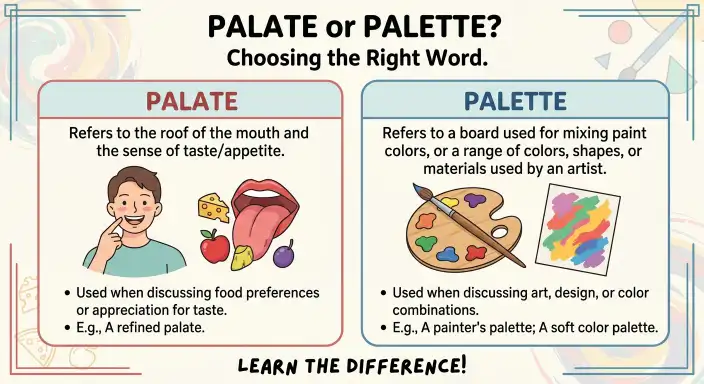
Palate refers to the roof of your mouth or your sense of taste. Palette refers to a board used by artists to hold and mix colors, or to a range of colors used in art and design. Both words are correct, but you must use them in the right context.
For example, a food critic might have a refined palate, while a painter might choose a bright color palette. Although the words sound the same, their meanings and uses are not interchangeable.
In this guide, you will learn the difference between palate and palette, discover their meanings and origins, and explore simple examples from food, art, fashion, and everyday writing. You will also learn common mistakes and easy memory tricks to help you remember which word to use.
Palate vs. Palette: Quick Answer
Palate and palette are both correct words, but they have different meanings.
- Palate: The roof of the mouth or a person’s ability to taste and appreciate flavors. Example: She has an excellent palate for spicy food.
- Palette: A board for mixing paint or a selection of colors. Example: The artist chose a warm color palette.
Memory tip: Palate is connected to food and taste, while palette is connected to paint and colors.
What Does Palate Mean?
The word palate has two main meanings. It can refer to a part of the human mouth or a person’s ability to recognize and enjoy different flavors.
1. Palate as a Part of the Mouth
In anatomy, the palate is the roof of the mouth. It separates the mouth from the nasal cavity.
There are two main parts:
- Hard palate: The firm, bony front part of the roof of the mouth.
- Soft palate: The softer back part of the roof of the mouth.
Examples:
- The dentist examined the roof of the child’s mouth and checked the palate.
- The doctor explained how the soft palate helps with swallowing and speech.
This meaning is common in medical, dental, and educational writing.
2. Palate as a Sense of Taste
In everyday English, palate often describes a person’s ability to taste, recognize, and appreciate flavors.
Examples:
- She has a sophisticated palate for fine food.
- This spicy dish may be too strong for a sensitive palate.
- Travelling helped him develop a taste for new cuisines.
A person’s palate can describe their taste preferences and their ability to appreciate flavors.
You may also see these expressions:
- A refined palate: An ability to notice and appreciate subtle flavors.
- A sweet palate: A preference for sweet foods.
- An adventurous palate: A willingness to try unfamiliar foods.
- A sensitive palate: An ability to notice small differences in taste.
Palate in Everyday Sentences
Here are more examples to help you understand the word:
- The chef created a dish that delighted every palate.
- My palate prefers mild flavors over spicy food.
- The wine expert has a well developed palate.
- The restaurant offers dishes for every palate.
- Fresh herbs can add new flavors to your palate.
Remember that palate is the correct word when you are discussing taste, food preferences, or the roof of the mouth.
What Does Palette Mean?
The word palette has two common uses. It can describe a physical tool used by artists or a selected range of colors used in creative work.
1. Palette as an Artist’s Tool
A traditional artist’s palette is a flat surface used to hold and mix paints before applying them to a canvas.
Examples:
- The painter mixed blue and yellow on her palette.
- He cleaned his palette after finishing the painting.
- The artist carried a wooden palette and several brushes.
Artists may use wooden, plastic, or other types of palettes. Some digital art programs also use the word palette for the on screen colors available to the user.
2. Palette as a Range of Colors
In design, photography, fashion, and digital art, a palette is a group of colors chosen to work together.
Examples:
- The designer selected a blue and white color palette.
- The website uses a simple palette of neutral colors.
- The autumn collection features a warm palette of brown, orange, and gold.
A color palette helps create a consistent visual style.
For example, a website might use dark blue for headings, white for backgrounds, and green for buttons. Together, these colors form the website’s color palette.
Palette in Everyday Sentences
- The artist chose a palette of bright colors.
- The interior designer created a calming color palette for the bedroom.
- The fashion collection uses a neutral palette.
- The graphic designer updated the palette for the new logo.
- The photographer prefers a soft, muted color palette.
Use palette whenever you mean a tool for mixing colors or a selection of colors in a creative project.
Palate vs Palette: Key Differences
The easiest way to distinguish these words is to focus on their meanings.
| Feature | Palate | Palette |
| Main meaning | Roof of the mouth or sense of taste | Tool for mixing paint or a selection of colors |
| Common field | Food, anatomy, cooking | Art, design, fashion, photography |
| Related words | Taste, flavor, mouth | Paint, color, design |
| Example | He has a sensitive palate. | She chose a bright palette. |
| Correct spelling | Palate | Palette |
Although the words sound the same, their spelling provides a useful clue.
- Palate: Think of eating and tasting.
- Palette: Think of painting and colors.
Palate vs Pallet vs Palette

There is a third word that sounds similar: pallet. Learning all three words together can help you avoid spelling mistakes.
| Word | Meaning | Example |
| Palate | Roof of the mouth or sense of taste | The chef has a refined palate. |
| Palette | An artist’s tool or a range of colors | The artist chose a green palette. |
| Pallet | A flat platform used to store or move goods | The boxes were stacked on a wooden pallet. |
Palate relates to taste, palette relates to color, and pallet relates to transporting or storing goods.
Examples in context:
- The food critic has a trained palate.
- The designer selected a colorful palette.
- The warehouse worker moved a pallet of boxes.
These words are not interchangeable. Using the wrong spelling can make your sentence confusing or incorrect.
How to Remember Palate and Palette
Spelling tricks can help you choose the correct word without checking a dictionary every time.
1. Connect Palate With Eating
The word palate contains the letters pal, which you can associate with a person enjoying a meal with a pal.
For example: My palate enjoys new flavors.
This is only a memory aid, not the actual origin of the word.
2. Connect Palette With Paint
The word palette contains an extra t compared with palate. You can associate that extra letter with tints, which are variations of colors.
For example: The artist mixed different tints on the palette.
3. Use Pallet for Packages
Remember that pallet is used to move or store goods. You might see pallets in warehouses, shops, and delivery centers.
4. Learn One Example for Each Word
- Palate: I enjoy trying foods that challenge my palate.
- Palette: The artist created a colorful palette.
- Pallet: The delivery arrived on a wooden pallet.
The best memory trick is to connect each word with a familiar object or activity: taste, paint, and packages.
Common Mistakes With Palate and Palette

Even experienced writers can confuse these words because they sound alike. Here are common mistakes and their corrections.
Mistake 1: Using Palette for Taste
Incorrect: The chef has an excellent palette for desserts.
Correct: The chef has an excellent palate for desserts.
Explanation: The sentence discusses the chef’s ability to appreciate flavors, so palate is correct.
Mistake 2: Using Palate for Colors
Incorrect: The designer chose a beautiful palate for the website.
Correct: The designer chose a beautiful palette for the website.
Explanation: The sentence refers to a group of colors, so palette is the correct word.
Mistake 3: Confusing Palette With Pallet
Incorrect: The delivery driver placed the boxes on a wooden palette.
Correct: The delivery driver placed the boxes on a wooden pallet.
Explanation: A pallet is a platform used for storing or transporting goods. A palette is associated with art and colors.
Mistake 4: Using Palette in Medical Writing
Incorrect: The dentist examined the patient’s palette.
Correct: The dentist examined the patient’s palate.
Explanation: The roof of the mouth is called the palate.
Mistake 5: Using Palate for a Design Choice
Incorrect: The photographer used a warm palate in the picture.
Correct: The photographer used a warm palette in the picture.
Explanation: A selection of colors in a photograph is a color palette.
Everyday Examples of Palate and Palette
Seeing these words in different situations will help you understand how to use them naturally.
1. Food and Cooking
- The chef prepared a meal that suited every palate.
- Her palate can detect even subtle spices.
- The restaurant offers flavors for adventurous palates.
- A squeeze of lemon can brighten the dish and please the palate.
2. Art and Painting
- The painter used a limited palette to create the portrait.
- Red and yellow were the main colors on her palette.
- The artist cleaned the palette before starting another painting.
- A soft palette gave the artwork a peaceful appearance.
3. Fashion and Interior Design
- The designer created a neutral palette for the clothing collection.
- The bedroom features a calming palette of blue and gray.
- The autumn palette includes shades of orange, brown, and gold.
- The stylist selected a bold palette for the fashion show.
4. Business and Branding
- The company updated its brand palette to reflect its new identity.
- The designer chose a consistent palette for the marketing materials.
- The restaurant developed a menu to appeal to a wide range of palates.
5. Academic and Professional Writing
- The anatomy lesson explained the structure of the hard palate.
- The art student compared the color palettes of two paintings.
- The food science report discussed how aroma influences the perception of flavor.
6. Daily Conversation
- “This curry is too spicy for my palate.”
- “I love the color palette in your drawing.”
- “Can you change the palette to include more green?”
- “The chef has a great palate for balancing flavors.”
These examples show why context matters. The surrounding words often tell you which spelling is correct.
People Also Ask: Palate or Palette
1. Is it palate or palette for food?
Use palate when talking about food, taste, or flavor preferences. For example, “She has an adventurous palate” means she enjoys trying different foods. Use palette when referring to paint or a selection of colors. Although the words sound alike, their meanings are different.
2. What is the difference between palate and palette?
A palate is the roof of the mouth or a person’s sense of taste. A palette is an artist’s tool for holding and mixing paint, or a set of colors used in design. The correct word depends on if you are discussing taste or color.
3. Is a color palette or color palate correct?
Color palette is correct. It refers to a group of colors selected for a painting, website, photograph, brand, or interior design project. Color palate is incorrect in this context because palate relates to the mouth and taste rather than a selection of colors.
4. What does refined palate mean?
A refined palate describes someone who can notice and appreciate subtle differences in flavors. The expression is often used for chefs, food critics, and people who enjoy exploring different foods and drinks. It does not mean that the person necessarily prefers expensive food.
5. What is the difference between palate, palette, and pallet?
Palate refers to taste or the roof of the mouth. Palette refers to an artist’s paint mixing tool or a group of colors. Pallet is a platform used to store or transport goods. All three words sound alike, but each has a distinct meaning.
Frequently Asked Questions
1. Is palate spelled with one T or two?
Palate is spelled with one T. The word has six letters: P A L A T E. It refers to the roof of the mouth or the ability to appreciate flavors. By contrast, palette contains two Ts and is used for art tools and color selections.
2. Can palate and palette be used interchangeably?
No. Although they sound the same, they have different meanings. Use palate for taste or anatomy and palette for paint or colors. For example, “a sensitive palate” is correct, while “a sensitive palette” would normally be incorrect if you mean a person’s sense of taste.
3. What does a limited palette mean in art?
A limited palette is a selection of only a few colors used to create an artwork. Artists may choose a limited palette to produce harmony, control the mood, or make the painting feel consistent. For example, an artist might use only blue, white, and gray.
4. Can someone have a sweet palate?
Yes. A sweet palate describes someone who enjoys sweet flavors or has a preference for sweet foods. For example, “He has a sweet palate and usually chooses chocolate desserts.” The word palate is correct because the sentence describes taste preferences, not colors.
5. Is pallet the same as palette?
No. A pallet is a flat structure used to store or move goods, often with a forklift. A palette is an artist’s tool or a selected group of colors. For example, a warehouse stores boxes on a pallet, while a painter mixes colors on a palette.
Conclusion
Understanding the difference between palate and palette is simple once you connect each word with its meaning. Palate relates to the mouth and taste, while palette relates to paint and color choices. Both are correct English words, but they cannot usually replace one another.
Use palate when describing someone’s taste, a food preference, or the roof of the mouth. Choose palette when discussing an artist’s tools, website colors, fashion collections, or interior design. If you are talking about a platform used to transport goods, remember the third word, pallet.
The key is to check the context before choosing your spelling. A few simple examples and memory tricks can help you remember the difference and avoid common writing mistakes.
Remember: palate is for taste, palette is for paint, and pallet is for packages. Keep practising these word differences to make your English clearer and more accurate.
Discover More Articles!
Gibberish or Jibberish: Which Spelling Is Correct?(2026)
Britain or England: What Is the Difference? Meaning, Geography, and Key Facts
Business or Buisness: Which Spelling Is Correct?(2026)

Ethan Parker is an English-language writer known for his interest in words, language, and clear communication. His work focuses on making everyday English easier to understand through simple explanations and practical examples.