Have you ever wondered if the correct spelling is business or buisness? This is a common English spelling mistake because both versions look similar, especially when typing quickly. However, only one spelling is correct in standard English.
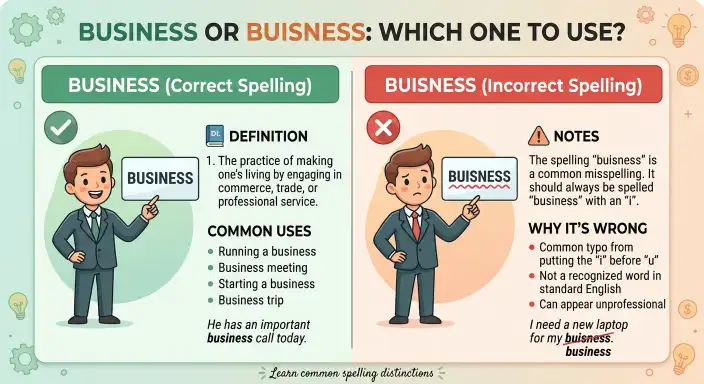
Business is the correct spelling. Buisness is a misspelling and should not be used in formal or informal writing.
The word business has several meanings. It can refer to a company, a commercial activity, or the work someone does to earn money. You may use it when talking about a small shop, a large company, or your daily work.
Knowing the correct spelling matters when writing emails, preparing school assignments, creating website content, or communicating with customers. A simple spelling mistake can make your writing look less professional.
In this guide, you will learn the difference between business and buisness, understand the word’s meaning and origin, and discover how to use it correctly in everyday English. You will also find practical examples, spelling tips, and answers to common questions.
Business or Buisness: Quick Answer
Business is the correct spelling, and buisness is incorrect. The word business refers to commercial activity, a company, or someone’s work. Although buisness is a common typing and spelling error, it is not an accepted alternative in standard English.
Examples:
- Correct: My father owns a small business.
- Incorrect: My father owns a small buisness.
- Correct: She wants to start her own business.
Remember to spell the word B U S I N E S S in schoolwork, emails, reports, and professional documents.
Business or Buisness: What’s the Difference?
The main difference between business and buisness is spelling. Business is the correct English word, while buisness is a misspelling.
| Word | Correct? | Meaning | Example |
| Business | Yes | A company, commercial activity, or work | They started a new business. |
| Buisness | No | Incorrect spelling of business | Avoid writing “buisness” in an email. |
There is no difference in meaning because buisness is not a standard alternative spelling.
If you are writing for school, work, a website, or social media, always choose business.
What Does Business Mean?
The word business is a noun. Its meaning depends on the context in which it appears.
1. Business as a Company
A business can be an organization that sells goods or provides services to customers.
Examples:
- My uncle runs a mobile accessories business.
- She opened a clothing business last year.
- Their family business has served local customers for many years.
In these sentences, business refers to a company or commercial activity.
2. Business as Commercial Activity
Business can also refer to buying, selling, and other activities carried out to earn money.
Examples:
- Online business has become popular around the world.
- The company does business with international customers.
- Good customer service can help a business grow.
3. Business as Work or Responsibility
Sometimes, business refers to a person’s work, duties, or matters that need attention.
Examples:
- I have some important business to discuss.
- She travels to London on business.
- Let’s get down to business and finish the meeting.
These examples show that the word has several uses beyond describing a company.
The Origin of Business
The word business developed from the older English word bisignes, which referred to anxiety, care, or a state of being occupied. It is related to the Old English word bisig, meaning busy or occupied.
Over time, its meaning expanded. It came to refer to someone’s occupation, duties, affairs, and eventually commercial activities.
This history helps explain why business can mean both a commercial organization and work that needs to be done.
Why Is Business Spelled This Way?
The spelling may seem unusual because the word does not sound exactly as some learners expect it to.
The word is related to busy, but its spelling is business, not buisness. English spelling often preserves forms that developed over many years, even when pronunciation changes.
A helpful way to remember it is to connect the words busy and business. Both begin with the letters B U S.
British English vs American English
British English and American English use the same spelling: business.
Unlike words such as colour and color, this word does not have separate British and American spellings.
| British English | American English | Example |
| Business | Business | She owns a successful business. |
| Colour | Color | The colour of the logo is blue. |
| Favourite | Favorite | This is my favourite shop. |
| Centre | Center | The business is in the town centre. |
| Organise | Organize | They organise business meetings. |
The table shows that some English words change across regions, but business remains the same.
What About Other English Speaking Countries?
The spelling business is also standard in Canada, Australia, and other English speaking countries.
You should not change the spelling based on your audience’s location. if you are writing an American business email or an Australian company profile, use business.
Which Version Should You Use?
The answer is simple: use business in every type of standard English writing.
- United States: Write business in professional documents and everyday communication.
- United Kingdom: Use business in British English.
- Canada: Use business regardless of other Canadian spelling preferences.
- Australia: Write business in schoolwork, reports, and company documents.
- International writing: Use business for websites, blogs, and global audiences.
- Academic writing: Spell the word correctly in essays, assignments, and research papers.
- Business communication: Use business in proposals, invoices, emails, and presentations.
For example, write “We are expanding our business” rather than “We are expanding our buisness.”
Correct spelling helps your writing look clear and professional.
Common Mistakes With Business and Buisness

Many people misspell business because they remember the sound of the word but forget the order of its letters.
Here are common errors and ways to avoid them.
Mistake 1: Writing Buisness
Incorrect: I want to start my own buisness.
Correct: I want to start my own business.
Explanation: The correct spelling places the letters S I after U, not I S.
Mistake 2: Using the Wrong Spelling in Emails
Incorrect: Please send me the buisness details.
Correct: Please send me the business details.
Explanation: Professional emails should use standard spelling to avoid distracting the reader.
Mistake 3: Misspelling Business Names
Incorrect: ABC Buisness Solutions
Correct: ABC Business Solutions
Explanation: When creating a company name, check every word carefully. If a registered brand deliberately uses a nonstandard spelling, reproduce its official name accurately. Otherwise, use business.
Mistake 4: Typing Too Quickly
Incorrect: Our buisness is growing every year.
Correct: Our business is growing every year.
Explanation: Typing quickly can cause letters to appear in the wrong order. Read your writing before publishing or sending it.
An Easy Memory Trick
Remember this spelling pattern:
BUS + I + NESS = BUSINESS
Think of the word busy. Someone who is busy may have a lot of business to take care of.
This association can help you remember the correct spelling whenever you write the word.
Everyday Examples of Buisness and Business

The word business appears in daily conversation, schoolwork, emails, advertising, and professional communication.
1. Emails
“Thank you for contacting us about our business services.”
This is a suitable sentence for a professional email.
2. Business Writing
“Our business aims to provide reliable products and excellent customer service.”
This example uses business to describe a commercial organization.
3. News Headlines
“Small Business Owners Prepare for a Busy Shopping Season”
Here, business refers to companies that sell products or services.
4. Blogs
“Starting an Online Business: A Beginner’s Guide”
This headline uses the word to describe a commercial activity conducted online.
5. Social Media
“Hard work and patience are important when building a business.”
This sentence is suitable for a motivational post about entrepreneurship.
6. Academic Writing
“Small businesses play an important role in many local economies.”
This example uses the word in a formal, educational context.
7. Daily Conversation
“My brother wants to start a business after finishing college.”
This is a natural way to talk about someone’s future plans.
8. Customer Communication
“We appreciate your business and look forward to serving you again.”
Companies often use this sentence to thank their customers.
Google Trends and Modern Usage
People search for business or buisness because they want to confirm the correct spelling before using it in their writing.
The confusion often comes from the order of the letters. Since the word contains several letters close together, writers may accidentally switch the positions of I and S.
Which Spelling Is More Common?
Business is the standard spelling used in dictionaries, published writing, and professional communication. Buisness appears as a misspelling in some online content.
Without current Google Trends data, it would be misleading to provide exact search volumes or claim specific regional popularity figures.
Why Do People Search for This Keyword?
Common reasons include:
- Checking the correct spelling of business.
- Writing a company profile or business plan.
- Preparing school assignments and exams.
- Creating professional emails.
- Publishing blog posts and website content.
- Learning English as a second language.
How Can You Avoid This Mistake?
Use a dictionary or spell checking tool when you are unsure. You can also remember the spelling pattern BUSINESS and check the order of the letters before submitting your work.
For website owners and content writers, correcting common spelling errors helps keep articles professional, readable, and trustworthy.
People Also Ask: Business or Buisness
1. Is it business or buisness?
Business is the correct spelling. Buisness is a common spelling mistake. Use business when referring to a company, commercial activity, or someone’s work. The correct spelling is the same in British and American English.
2. Why is business spelled with an I after the S?
The spelling developed through the history of the English language and is related to busy. Although the pronunciation can make the spelling tricky, the standard written form is business. Remember the letters B U S I N E S S to avoid switching the I and S.
3. How do you spell business correctly?
Spell it B U S I N E S S. One useful trick is to remember the first three letters, BUS, followed by I N E S S. Practising the word in sentences can also help you remember it, especially if you often type it incorrectly.
4. Is business the same in British and American English?
Yes. Both British and American English use business. Unlike colour and color, the word has no standard regional spelling variation. The same spelling is also used in Canadian and Australian English.
5. What is the meaning of business?
Business can mean a company, the activity of selling goods or services, or work that someone needs to do. For example, “She owns a business” refers to a company, while “He is travelling on business” means he is travelling for work.
Frequently Asked Questions
1. Is buisness a real word?
Buisness is not the standard spelling of the English word business. It may appear in online posts or other informal writing, but it should be treated as a spelling mistake in ordinary English. Use business in assignments, professional documents, emails, and published articles.
2. What is the plural of business?
The plural of business is businesses. For example, “Many businesses operate in the city.” The spelling changes by adding es to the singular form. Do not write buisnesses, because that repeats the original spelling error.
3. Is business a noun or a verb?
Business is a noun. It can refer to a company, commercial activity, or work. The related verb is do business, as in “We do business with international clients.” The word busy is an adjective, as in “She is busy today.”
4. How can I remember the spelling of business?
Remember the opening letters B U S and then add I N E S S. You can also connect business with busy, since the words are historically related. Writing the word in a few example sentences and checking it with a spell checking tool can reinforce the correct spelling.
5. Is business spelled differently in the UK and USA?
No. Business is spelled the same way in British and American English. The spelling also remains unchanged in Canada and Australia. You can use the word confidently in international writing without choosing a regional variation.
Conclusion
When deciding between business and buisness, always choose business. It is the correct spelling in standard English, while buisness is a common spelling error.
The word business can refer to a company, commercial activity, or work. You may use it when discussing a family shop, an online company, professional services, or important work matters. Its spelling stays the same in British, American, Canadian, and Australian English.
To avoid mistakes, remember the pattern BUS + I + NESS. Pay attention to the order of the I and S, especially when typing quickly. If you are writing an email, school assignment, company profile, or website article, check your spelling before publishing or sending it.
Correct spelling may seem like a small detail, but it helps readers understand your message and creates a more professional impression.
Final takeaway: A successful business starts with a good idea, but correct writing starts with the right spelling: business, not buisness.
Discover More Articles!
Overlaid or Overlayed: Which Spelling Is Correct? Meaning, Rules, and Examples
Advice vs Advise: Meaning, Differences, and Examples
Less vs Fewer: Meaning, Differences, and Examples

Ethan Parker is an English-language writer known for his interest in words, language, and clear communication. His work focuses on making everyday English easier to understand through simple explanations and practical examples.