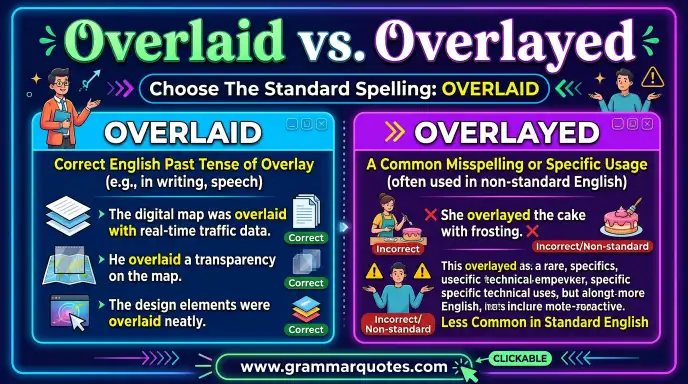
Overlaid is the standard and widely accepted past tense and past participle of overlay. Although overlayed sometimes appears in informal writing, technical discussions, or less common usage, overlaid is the preferred form in standard English. Both spellings may be encountered, but overlaid is the safest choice for schoolwork, professional writing, and formal communication.
The word overlay means to place something over another thing, cover a surface with a layer, or add one visual element on top of another. For example, “The designer overlaid text on the image” means that the designer placed text over the picture. Similarly, “The floor was overlaid with tiles” describes a surface covered with a new layer.
Understanding the difference between overlaid and overlayed can help you avoid spelling mistakes and use the correct form in everyday writing. In this guide, you will learn their meanings, grammatical rules, differences, pronunciation, and practical examples.
Quick Answer: Overlaid vs Overlayed
| Word | Usage | Example |
| Overlaid | Standard past tense and past participle | She overlaid the image with text. |
| Overlayed | Less common variant | The image was overlayed with text. |
Quick rule: Use overlaid in standard English. It is the conventional past tense and past participle of overlay.
What Does Overlaid Mean?
Overlaid is the past tense and past participle of the verb overlay. It means that something was placed, spread, or added over another surface, object, image, or layer.
The word appears in many contexts, including design, photography, construction, mapping, and everyday descriptions.
Definition and Meaning of Overlaid
According to its grammatical use, overlaid describes an action that happened in the past or a condition resulting from that action.
Examples:
- The designer overlaid text on the photograph.
- The old floor was overlaid with new tiles.
- A transparent pattern was overlaid on the background.
- The map was overlaid with traffic information.
In each example, one thing is placed over another.
Overlaid as a Past Tense
Use overlaid when describing an action completed in the past.
Examples:
- The artist overlaid several colours on the canvas.
- She overlaid the original picture with a new design.
- The builder overlaid the damaged surface with fresh material.
Overlaid as a Past Participle
Use overlaid with helping verbs such as has, have, had, or was.
Examples:
- The designer has overlaid the image with text.
- They had overlaid the wall with decorative panels.
- The photograph was overlaid with a watermark.
These constructions describe a completed action or the result of an action.
What Does Overlayed Mean?
Overlayed is an alternative form sometimes used as the past tense or past participle of overlay. However, it is much less common than overlaid and is generally not the preferred form in standard edited English.
Because overlay is an irregular verb, its traditional past tense and past participle are formed using overlaid, following the pattern of lay and laid.
Definition and Meaning of Overlayed
When writers use overlayed, they usually intend the same meaning as overlaid: something was placed over another object or surface.
Examples of this less common form include:
- The image was overlayed with a coloured filter.
- The designer overlayed the text on the photograph.
- The map was overlayed with additional information.
For standard English writing, these sentences are better written with overlaid instead.
Why Is Overlayed Less Preferred?
The verb overlay follows an established irregular pattern. Its main forms are:
- Present: overlay
- Past tense: overlaid
- Past participle: overlaid
Although English sometimes develops alternative regular forms, the established form overlaid remains the standard choice.
Overlaid vs Overlayed: Main Differences
The key difference is not usually the intended meaning. Both forms are used to express the idea of placing one thing over another, but they differ in how commonly they are accepted in standard English.
| Feature | Overlaid | Overlayed |
| Status | Standard form | Less common variant |
| Grammatical role | Past tense and past participle | Used as a past form by some writers |
| Meaning | Placed or added over something | Usually intended to mean the same thing |
| Formal writing | Recommended | Generally avoid |
| Academic writing | Preferred | Not recommended |
| Example | The photo was overlaid with text. | The photo was overlayed with text. |
Best choice: Choose overlaid for clarity, consistency, and standard grammatical usage.
British vs American English: Overlaid or Overlayed?
Unlike spelling pairs such as colour and color, the difference between overlaid and overlayed is not a standard British versus American spelling distinction.
Both British and American English generally use overlaid as the established past tense and past participle of overlay.
| English variety | Preferred form | Example |
| British English | Overlaid | The image was overlaid with text. |
| American English | Overlaid | The image was overlaid with text. |
| Formal international English | Overlaid | The design has been overlaid with a pattern. |
If you are writing for a British, American, or international audience, overlaid is the recommended form.
Common Mistakes When Using Overlaid or Overlayed
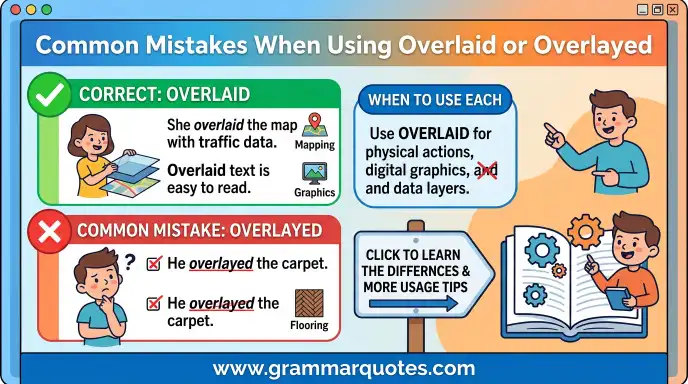
Writers sometimes use overlayed because they assume that every verb forms its past tense by adding ed. However, English contains many irregular verbs.
Mistake 1: Using Overlayed in Formal Writing
Incorrect or less preferred: The designer overlayed text on the image.
Correct: The designer overlaid text on the image.
Why? Overlaid is the established standard past tense of overlay.
Mistake 2: Using Overlay Instead of Overlaid in the Past
Incorrect: She overlay the map with road information yesterday.
Correct: She overlaid the map with road information yesterday.
Why? The sentence describes a completed past action, so the past tense is required.
Mistake 3: Using the Wrong Form After Has or Have
Incorrect: The designer has overlay the image with text.
Correct: The designer has overlaid the image with text.
Why? The present perfect tense requires the past participle overlaid.
Mistake 4: Confusing Overlay With Overlaid
Incorrect: The picture was overlay with a transparent pattern.
Correct: The picture was overlaid with a transparent pattern.
Why? In this passive construction, the past participle is needed.
Mistake 5: Treating Overlayed as a British or American Difference
Incorrect assumption: British writers must use overlaid, while American writers must use overlayed.
Correct understanding: Both varieties generally use overlaid as the standard form.
Why? This is primarily a verb form issue, not a regional spelling difference.
Everyday Examples of Overlayed and Overlaid

The following examples show the standard form and explain how the less common alternative may appear.
Examples Using Overlaid
- The designer overlaid text on the photograph.
- She overlaid a transparent filter on the image.
- The map was overlaid with road information.
- The artist overlaid blue paint on the background.
- The floor was overlaid with new tiles.
- The editor overlaid subtitles on the video.
- The researcher overlaid two maps to compare the results.
- A decorative pattern was overlaid on the fabric.
- The software has overlaid the data on the chart.
- They had overlaid the old surface with a protective layer.
- The photographer overlaid the logo on the picture.
- The building’s damaged roof was overlaid with new material.
- The graphic designer overlaid several shapes in the illustration.
- A layer of snow overlaid the ground.
- The presentation was overlaid with helpful labels.
Examples Showing Overlayed as a Less Common Variant
- The image was overlayed with a coloured filter.
- The designer overlayed text on the background.
- The map was overlayed with additional details.
- The photograph had been overlayed with a watermark.
- The chart was overlayed with a transparent graphic.
In examples 16–20, overlaid is the recommended replacement in standard English.
Word Origin and History of Overlay
The word overlay is formed from over and lay. The prefix over conveys the idea of being above, covering, or placing something on top of another thing. The verb lay means to put or place something down.
The past tense of lay is laid, so the traditional past tense of overlay is overlaid. This pattern explains why overlaid is preferred over the more regular looking overlayed.
English has many verbs whose past forms do not follow the simple ed pattern. For example:
| Base verb | Past tense | Past participle |
| Lay | Laid | Laid |
| Relay | Relaid | Relaid |
| Overlay | Overlaid | Overlaid |
| Underlay | Underlaid | Underlaid |
These related forms help explain the established grammatical pattern of overlay.
Word Formation and Grammar Rules
Understanding the main forms of overlay will help you use the word correctly.
Main Forms of Overlay
| Form | Word | Example |
| Base form | Overlay | Overlay the image with text. |
| Third person singular | Overlays | She overlays the image with text. |
| Present participle | Overlaying | He is overlaying the map with data. |
| Past tense | Overlaid | She overlaid the picture with text. |
| Past participle | Overlaid | The picture has been overlaid with text. |
How to Use Overlaid in a Sentence
Use overlaid in these common structures:
- Subject + overlaid + object: The designer overlaid the image with text.
- Subject + has/have + overlaid + object: She has overlaid the chart with labels.
- Object + was/were + overlaid: The photograph was overlaid with a logo.
- Object + had been + overlaid: The map had been overlaid with new information.
These patterns are useful in both everyday and professional writing.
Synonyms and Related Words for Overlaid
Depending on the context, several words can express a similar idea to overlaid. However, they are not exact substitutes in every sentence.
| Word | Meaning | Example |
| Covered | Had something placed over it | The table was covered with cloth. |
| Layered | Arranged in layers | The image was layered with colours. |
| Applied | Put onto a surface | A filter was applied to the photograph. |
| Superimposed | Placed over something else | Text was superimposed on the image. |
| Coated | Covered with a layer of material | The surface was coated with paint. |
| Added | Put something extra in place | Labels were added to the map. |
Superimposed is often especially suitable in photography, graphics, and technical descriptions when one image or visual element is placed over another.
Key Takeaways
- Overlaid is the standard past tense and past participle of overlay.
- Overlayed is a less common alternative and is generally avoided in formal writing.
- Both forms are usually intended to express the same basic meaning.
- British and American English generally prefer overlaid.
- The correct verb forms are overlay, overlays, overlaying, and overlaid.
- Use overlaid in school assignments, professional documents, articles, and academic writing.
People Also Ask
Is Overlaid or Overlayed Correct?
Overlaid is the standard and preferred spelling. Although overlayed appears in some writing, overlaid is the safer choice for formal and professional English.
Why Is Overlaid Correct?
Overlay follows the irregular verb pattern of lay. Since the past tense of lay is laid, the established past tense of overlay is overlaid.
Is Overlayed Ever Used?
Yes. Some writers use overlayed as a regularised past form, but it is less common and generally not preferred in standard edited English.
What Is the Past Tense of Overlay?
The past tense of overlay is overlaid. For example, “The designer overlaid the photograph with text.”
What Is the Past Participle of Overlay?
The past participle is also overlaid. For example, “The photograph has been overlaid with a logo.”
Is Overlaid British or American English?
Overlaid is standard in both British and American English. The difference between overlaid and overlayed is not a typical regional spelling distinction.
Frequently Asked Questions (FAQs)
1. Should I use overlaid or overlayed in an essay?
Use overlaid. It is the standard form and is the better choice for essays, academic assignments, and professional documents.
2. Does overlaid have the same meaning as overlayed?
Generally, yes. Both are used to convey the idea of placing something over another object or surface. However, overlaid is the established standard form.
3. Can I say “the image was overlaid with text”?
Yes. This sentence is grammatically correct. It means that text was placed on top of the image.
4. Is overlayed a spelling mistake?
It is better described as a less common alternative form rather than the standard spelling. In formal English, use overlaid to avoid questions about correctness.
5. What are the four main forms of overlay?
The main forms are overlay (base form), overlays (third person singular), overlaying (present participle), and overlaid (past tense and past participle).
6. Which form should content writers use?
Content writers should use overlaid for consistency with standard English grammar. This is especially important in articles, tutorials, product descriptions, and technical documentation.
Conclusion
Choosing between overlaid and overlayed is easier when you understand how the verb overlay works. Although both forms may appear in written English, overlaid is the standard and widely preferred past tense and past participle. It follows the established pattern of the verb lay, whose past forms are laid and laid.
Use overlaid when describing an image covered with text, a floor covered with tiles, a map combined with additional information, or a surface covered with another material. The same spelling is preferred in both British and American English, so you do not need to choose between regional variations.
For essays, professional writing, websites, and academic assignments, overlaid is the best choice. Remembering this simple rule will help you avoid common verb form mistakes and make your writing more accurate and natural.
Discover More Articles!
Separate or Seperate: Correct Spelling, Meaning, and Examples
Less vs Fewer: Meaning, Differences, and Examples
Advice vs Advise: Meaning, Differences, and Examples

Ethan Parker is an English-language writer known for his interest in words, language, and clear communication. His work focuses on making everyday English easier to understand through simple explanations and practical examples.