Do you know when to use advice and advise? These two words look and sound similar, but they have different grammatical roles. The main difference is simple: advice is a noun, while advise is a verb.
Advice means a suggestion or guidance that helps someone make a decision. Advise means to give someone a suggestion or recommend what they should do.
For example, you can give someone advice, but you advise someone when you offer that guidance. Understanding this difference can help you avoid common spelling and grammar mistakes.
In this guide, you will learn the meanings of advice and advise, their pronunciation, examples, common mistakes, and easy tips to remember which word to use in everyday English.
Quick Answer: Advice vs Advise
Advice is a noun that means a suggestion, recommendation, or guidance.
Advise is a verb that means to give someone advice or recommend a course of action.
Examples:
- My teacher gave me useful advice.
- My teacher advised me to study every day.
- I need your advice about my future.
- I advise you to read the instructions carefully.
Easy memory tip: You give advice, but you advise someone.
What Does Advice Mean?
Definition of Advice
Advice is a noun that refers to guidance, suggestions, or recommendations about what someone should do.
Advice can come from teachers, parents, friends, doctors, or other people with relevant knowledge and experience.
Examples of Advice in Sentences
- My father gave me useful advice about my studies.
- She asked her teacher for advice.
- His advice helped me solve the problem.
- I always appreciate your honest advice.
- The doctor gave her advice about staying healthy.
Common Uses of Advice
- Good advice: Helpful guidance.
- Useful advice: Guidance that can help someone.
- Expert advice: Recommendations from someone with relevant expertise.
- Financial advice: Guidance about money and financial decisions.
- A piece of advice: One suggestion or recommendation.
Remember that advice is usually uncountable in standard English. Say “some advice” or “a piece of advice,” not “an advice.”
Connotative Meaning of Advice
The word advice often suggests help, support, knowledge, or careful guidance. It can refer to a simple suggestion or an important recommendation.
For example, “My mother gave me good advice” suggests that her guidance was useful or valuable.
Advice does not always have to be followed. It gives someone an idea or recommendation to consider.
Origin and Short History of Advice
The word advice entered English through Anglo French and Old French forms related to the idea of consideration, judgment, or counsel. Over time, it developed its modern meaning of guidance or recommendations.
Today, advice is commonly used in education, healthcare, business, relationships, and everyday conversations.
What Does Advise Mean?
Definition of Advise
Advise is a verb that means to give someone advice, guidance, or a recommendation about what they should do.
It describes the action of helping someone make a decision or choose a course of action.
Examples of Advise in Sentences
- I advise you to practise English every day.
- The teacher advised the students to prepare for the exam.
- My doctor advised me to get enough sleep.
- Experts advise people to read contracts carefully.
- She will advise us on the best way to proceed.
Common Forms of Advise
| Word form | Example |
| Advise | I advise you to be careful. |
| Advises | He advises students about careers. |
| Advised | She advised me to wait. |
| Advising | They are advising the company. |
| Adviser | He is a financial adviser. |
| Advisory | The government issued an advisory notice. |
Connotative Meaning of Advise
The word advise often suggests an action involving guidance, recommendation, or professional knowledge.
For example, “The lawyer advised her to read the agreement carefully” means that the lawyer recommended a particular action.
The verb can be used in both formal and everyday situations.
Origin and Short History of Advise
The verb advise developed from French forms related to giving an opinion or considering a matter. It is closely related to the noun advice.
Although the two words share a historical connection, their modern grammatical roles differ: advice names the guidance, while advise describes giving it.
Advice vs Advise: Key Differences
The main difference is that advice is a noun and advise is a verb.
| Feature | Advice | Advise |
| Part of speech | Noun | Verb |
| Main meaning | Guidance or recommendation | To give guidance or recommend |
| Example | I need your advice. | Please advise me. |
| Common phrase | A piece of advice | Advise someone to do something |
| Pronunciation | Ends with an /s/ sound | Ends with a /z/ sound |
How to Choose the Correct Word
Ask yourself what you want to describe:
- If you mean the guidance itself, use advice.
- If you mean the action of giving guidance, use advise.
Compare:
- She gave me helpful advice.
- She advised me to apply for the course.
Both sentences are correct, but they use different parts of speech.
Advise vs Advice: Pronunciation
Although the words look similar, their final sounds are different.
- Advice — American IPA: /ədˈvaɪs/
- Advice — British IPA: /ədˈvaɪs/
- Advise — American IPA: /ədˈvaɪz/
- Advise — British IPA: /ədˈvaɪz/
Both words generally have two syllables.
The key difference is the final consonant sound: advice ends with an /s/ sound, while advise ends with a /z/ sound.
Common Mistakes With Advice and Advise

Mistake 1: Using Advice as a Verb
Incorrect: I advice you to study harder.
Correct: I advise you to study harder.
Why? The sentence describes the action of giving guidance, so it needs the verb advise.
Mistake 2: Using Advise as a Noun
Incorrect: Thank you for your helpful advise.
Correct: Thank you for your helpful advice.
Why? The sentence refers to guidance, so the noun advice is correct.
Mistake 3: Writing “An Advice”
Incorrect: She gave me an advice.
Correct: She gave me some advice.
Also correct: She gave me a piece of advice.
Why? Advice is normally uncountable in standard English.
Mistake 4: Confusing the Final Sounds
Incorrect: Choosing advice when the sentence requires the verb advise.
Correct: The manager will advise us on the next steps.
Why? Remember that advice names the guidance, while advise describes the action of giving it.
Everyday Examples of Advise vs Advice
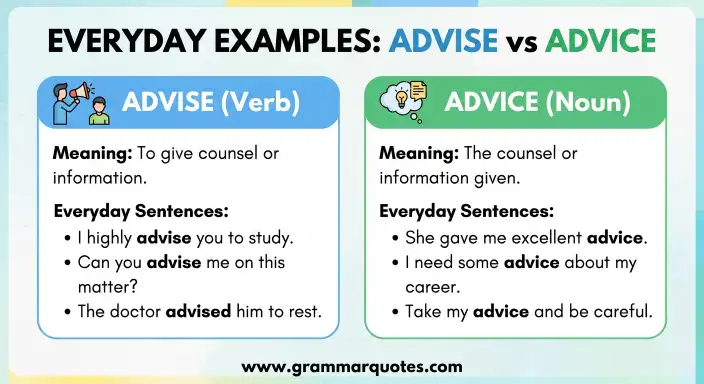
Examples Using Advice
- My teacher gave me valuable advice before the exam.
- I need some advice about choosing a university.
- Her advice helped me make a better decision.
- He ignored the advice of his parents.
- Can you give me a piece of advice about learning English?
- The website offers useful advice for students.
Examples Using Advise
- I advise you to practise speaking every day.
- The doctor advised him to rest.
- My teacher advises students to read regularly.
- The consultant will advise us about the application.
- I would advise you to check the spelling.
- They are advising the company on its plans.
Synonyms of Advice and Advise
The best alternative depends on the sentence. These words have related meanings but are not always interchangeable.
Synonyms of Advice
- Guidance: Help or direction.
- Recommendation: A suggestion about what may be best.
- Suggestion: An idea offered for consideration.
- Counsel: Advice or professional guidance.
- Tip: A short, useful piece of information.
- Direction: Instructions about what to do.
Example: My teacher gave me helpful guidance.
Synonyms of Advise
- Recommend: To suggest something as a good choice.
- Suggest: To offer an idea for consideration.
- Counsel: To give guidance.
- Guide: To help someone choose a direction or course of action.
- Urge: To strongly encourage someone to do something.
Example: I recommend reading the instructions before starting.
Frequently Asked Questions
1. What Is the Difference Between Advice and Advise?
Advice is a noun meaning guidance or a recommendation. Advise is a verb meaning to give guidance or recommend an action.
2. Is Advice a Noun or a Verb?
Advice is a noun. It refers to guidance or recommendations.
Example: Thank you for your advice.
3. Is Advise a Noun or a Verb?
Advise is a verb. It means to give someone advice.
Example: I advise you to be careful.
4. Is It Advice or Advise Me?
The correct expression is advise me when asking someone to give guidance.
Example: Please advise me about my university options.
You can also say, “Please give me advice.”
5. Is It a Piece of Advice or a Piece of Advise?
The correct expression is a piece of advice because advice is the noun.
6. How Do You Pronounce Advice and Advise?
Advice ends with an /s/ sound, while advise ends with a /z/ sound.
7. What Is the Past Tense of Advise?
The past tense is advised.
Example: My teacher advised me to revise my notes.
Conclusion
Understanding advice vs advise is easy when you remember their grammatical roles. Advice is a noun that means guidance, a suggestion, or a recommendation. Advise is a verb that means to give someone guidance or recommend an action.
For example, you can receive advice from a teacher, and your teacher can advise you to study regularly. Also, remember that advice is usually uncountable, so say “some advice” or “a piece of advice.”
Pay attention to the final sound, too: advice ends with an /s/ sound, while advise ends with a /z/ sound. With regular practice, you can use both words correctly in everyday conversations, school assignments, and professional writing.
Discover More Articles!
Few vs A Few: Meaning, Differences, Grammar Rules, and Examples
Narcissist or Autistic: What Is the Difference?
Shinning or Shining: Correct Spelling, Meaning, Differences, and Examples

Ethan Parker is an English-language writer known for his interest in words, language, and clear communication. His work focuses on making everyday English easier to understand through simple explanations and practical examples.