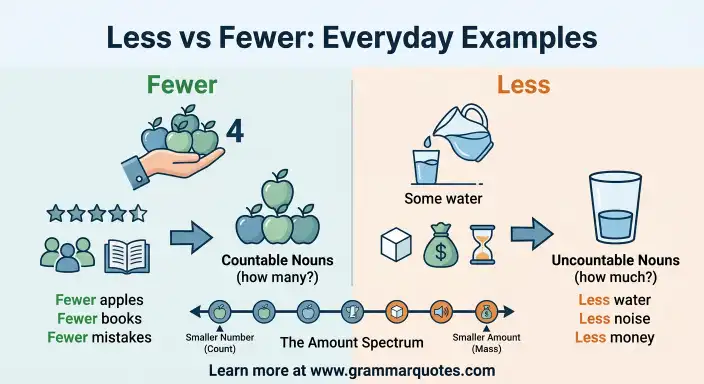
Do you know when to use less and fewer? These two words both describe a smaller amount, but they are not always used in the same way. The main difference is simple: use less with uncountable nouns and fewer with plural countable nouns.
For example, you should say “less water” but “fewer bottles.” Water is usually measured as an amount, while bottles can be counted individually.
Understanding less vs fewer can improve your grammar and help you write clearer English. These words appear in everyday conversations, school assignments, business writing, and professional communication.
In this guide, you will learn their meanings, differences, pronunciation, examples, common mistakes, and simple tips to remember which word to use.
Quick Answer: Less vs Fewer
Less is generally used with uncountable nouns, while fewer is generally used with plural countable nouns.
- Less sugar: Sugar is uncountable in this context.
- Fewer cookies: Cookies can be counted individually.
- Less time: Time is treated as an amount.
- Fewer students: Students can be counted.
Easy memory tip: If you can count the items one by one, use fewer. If you are talking about an amount, use less.
What Does Less Mean?
Definition of Less
Less is used to describe a smaller amount, degree, or quantity. It commonly appears with uncountable nouns, such as water, money, time, and sugar.
It can also be used with adjectives and adverbs to show a lower degree.
Examples of Less in Sentences
- I need less sugar in my tea.
- We have less time to finish the project.
- She spends less money on clothes now.
- This task is less difficult than the previous one.
- He drives less carefully when he is tired.
Common Uses of Less
- Less water: A smaller amount of water.
- Less money: A smaller amount of money.
- Less stress: A lower amount of stress.
- Less expensive: Not as expensive.
- Less often: With lower frequency.
Connotative Meaning of Less
The word less often suggests reduction, a lower level, or a smaller amount.
For example, “I need less stress in my life” means that the speaker wants to experience a lower level of stress.
The word does not always have a negative meaning. “Less expensive” can describe something that costs less money and may be a positive benefit.
What Does Fewer Mean?
Definition of Fewer
Fewer refers to a smaller number of people, animals, objects, or other things that can be counted individually.
It is usually used with plural countable nouns.
Examples of Fewer in Sentences
- There are fewer students in the classroom today.
- We bought fewer apples this week.
- The company hired fewer employees this year.
- She made fewer mistakes on her latest test.
- Fewer cars were on the road early this morning.
Common Uses of Fewer
- Fewer books: A smaller number of books.
- Fewer people: A smaller number of people.
- Fewer mistakes: A smaller number of mistakes.
- Fewer questions: A smaller number of questions.
- Fewer visitors: A smaller number of visitors.
Connotative Meaning of Fewer
The word fewer emphasizes the number of individual items or people.
For example, “Fewer students attended the event” means that the number of students who attended was lower than expected or lower than on another occasion.
It does not automatically mean that the change is good or bad. The context determines the meaning.
Less vs Fewer: Key Differences
The main difference is the type of noun each word describes.
| Feature | Less | Fewer |
| Main use | Smaller amount | Smaller number |
| Common noun type | Uncountable nouns | Plural countable nouns |
| Example | Less milk | Fewer bottles |
| Another example | Less work | Fewer tasks |
| Example in a sentence | We need less space. | We need fewer chairs. |
Countable and Uncountable Nouns
A countable noun is something you can count individually.
Examples: books, chairs, students, apples, and cars.
An uncountable noun is generally treated as a whole amount rather than individual units.
Examples: water, information, advice, furniture, and traffic.
Compare these sentences:
- We need less furniture.
- We need fewer chairs.
Both sentences can be correct because furniture is uncountable, while chairs are countable.
Less vs Fewer: Pronunciation
Both words have one syllable, but their vowel sounds differ.
- Less — American IPA: /lɛs/
- Less — British IPA: /les/
- Fewer — American IPA: /ˈfjuːər/
- Fewer — British IPA: /ˈfjuːə/
Pronunciation can vary slightly by accent. The spelling and basic grammatical difference remain the same.
When Can You Use Less With Countable Nouns?
Although the general rule is to use fewer with plural countable nouns, less is also common in certain situations.
Less Than Five Minutes
When discussing measurements, time, distance, money, or numerical values, less than is often appropriate.
Examples:
- The journey took less than five minutes.
- The bag weighs less than ten kilograms.
- The temperature fell to less than five degrees.
- You can complete the task in less than an hour.
In these examples, the focus is on a measurement or total amount.
Less Than 100 Dollars
The word less is commonly used with prices and amounts of money.
Example: The book costs less than 100 dollars.
This is natural because the sentence focuses on the monetary amount.
Less Than 50 Miles
When talking about distance as a measurement, less than is also common.
Example: The village is less than 50 miles away.
The important point is that less is not limited to uncountable nouns in every possible context. The traditional rule is a useful guide, but context also matters.
Common Mistakes With Less and Fewer
Mistake 1: Using Less With Countable Items
Incorrect: There are less students in the class.
Correct: There are fewer students in the class.
Why? Students are individual people who can be counted.
Mistake 2: Using Fewer With Uncountable Nouns
Incorrect: I need fewer water.
Correct: I need less water.
Why? Water is uncountable in this context.
Mistake 3: Confusing Less Money With Fewer Coins
Both of these can be correct:
- I have less money.
- I have fewer coins.
Why? Money refers to an amount, while coins are individual items.
Mistake 4: Forgetting That Some Nouns Can Be Counted in Different Ways
Compare:
- We have less chicken left for dinner.
- We have fewer chickens on the farm.
Why? Chicken can refer to meat as an uncountable noun or to individual birds as a countable noun.
The meaning of the noun helps determine if less or fewer is appropriate.
Everyday Examples of Less vs Fewer
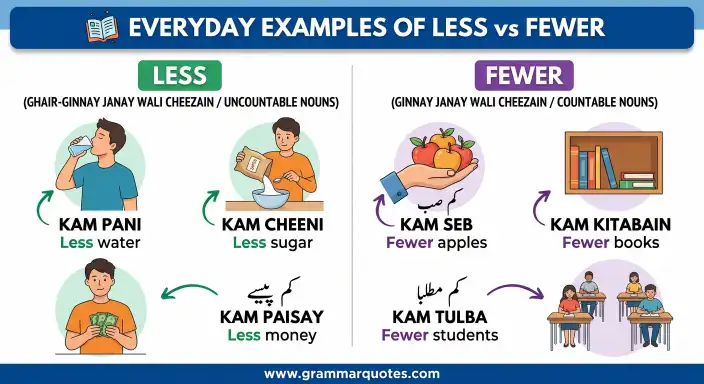
Examples Using Less
- I drink less coffee than I used to.
- We need less information to complete this form.
- He has less free time during exams.
- This road has less traffic at night.
- Try to use less salt when cooking.
- She feels less nervous before presentations.
Examples Using Fewer
- I read fewer books during the holidays.
- Our team made fewer errors this time.
- There are fewer shops in this area.
- We received fewer applications this year.
- The new system requires fewer steps.
- Fewer passengers used the train yesterday.
Synonyms of Less and Fewer
These alternatives may work in certain contexts, but they are not always interchangeable.
Synonyms and Alternatives for Less
- Smaller amount: A reduced quantity.
- Lower: A reduced level or value.
- Reduced: Made smaller or decreased.
- Decreased: Became smaller in amount or degree.
- Not as much: A phrase expressing a smaller amount.
Example: We need a smaller amount of sugar.
Synonyms and Alternatives for Fewer
- A smaller number: A lower count of individual items.
- Not as many: A phrase expressing a lower number.
- A reduced number: A smaller count.
- A lower number: A count that is not as high.
Example: We invited a smaller number of guests this year.
Frequently Asked Questions
1. What Is the Main Difference Between Less and Fewer?
Less usually describes an amount, while fewer usually describes a number of countable items or people.
2. Is It Less People or Fewer People?
In standard formal English, fewer people is generally preferred because people can be counted.
3. Is It Less Money or Fewer Money?
The correct expression is less money because money is treated as an amount.
4. Is It Less Time or Fewer Time?
The correct expression is less time because time is generally treated as an amount.
5. Is It Less Problems or Fewer Problems?
Fewer problems is preferred in standard English because problems are countable.
6. Is It Less Water or Fewer Water?
The correct expression is less water because water is uncountable in this context.
7. Can Less Be Used With Numbers?
Yes. Expressions such as less than ten minutes, less than five miles, and less than 100 dollars are common when referring to measurements or amounts.
Conclusion
Understanding less vs fewer is easier when you focus on if you are talking about an amount or a number. Use less with uncountable nouns such as water, money, time, and information. Use fewer with plural countable nouns such as books, students, cars, and mistakes.
For example, say “less milk” but “fewer bottles.” Remember that expressions involving measurements, time, distance, and money often use less than, even when a number follows.
Although everyday speech sometimes uses less with countable nouns, fewer is generally the better choice in formal writing when referring to countable items. Practising these examples will help you choose the right word and make your English clearer and more accurate.
Discover More Articles!
Army or Marines: Meaning, Differences, Roles, and Examples
Bait or Retardation: Meaning, Differences, and Correct Usage
Love or Hate: Meaning, Differences and Examples

Ethan Parker is an English-language writer known for his interest in words, language, and clear communication. His work focuses on making everyday English easier to understand through simple explanations and practical examples.