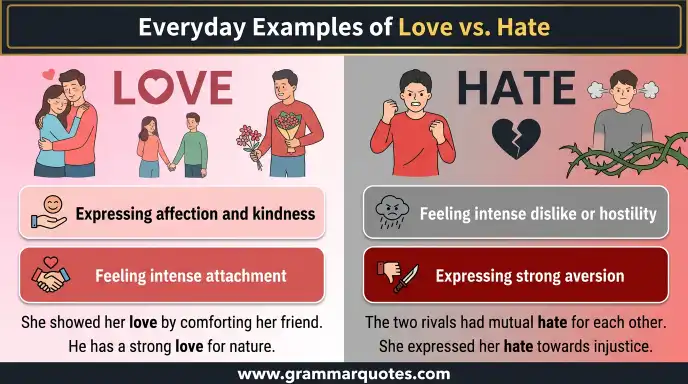
Love vs hate describes two opposite emotions that influence how people feel about others, experiences, and things.
Love is a feeling of deep affection, care, or attachment, while hate is an intense feeling of dislike, hostility, or rejection. Both emotions can affect people’s thoughts, decisions, relationships, and behaviour.
For example, someone may love spending time with their family because they feel safe and supported. On the other hand, someone may hate dishonesty because it goes against their values. These words are often used to describe strong feelings, but their meanings are very different.
Understanding the difference between love and hate can help you express emotions more clearly in everyday conversations, essays, stories, and personal writing. In this guide, you will learn their meanings, differences, synonyms, examples, common mistakes, and answers to frequently asked questions.
Quick Answer: Love or Hate?
Love and hate are opposite emotions, but both describe strong feelings.
- Love: A deep feeling of affection, care, attachment, or appreciation.
- Hate: An intense feeling of dislike, hostility, or strong opposition.
Examples:
- I love spending time with my family.
- I hate being treated unfairly.
Easy way to remember: Love expresses affection and care, while hate expresses strong dislike or hostility.
Love: Definition and Meaning
Love is a strong feeling of affection, care, respect, or emotional attachment toward someone or something. It can exist between family members, friends, partners, and even people who share common interests.
Love is not limited to romantic relationships. It can also describe kindness, loyalty, compassion, and appreciation.
Different Types of Love
1. Family Love
Family love is the affection and care people feel toward parents, children, siblings, and other relatives.
Example: She loves her family and always supports them.
2. Friendship Love
This type of love involves trust, respect, loyalty, and care between friends.
Example: True friendship is built on love and mutual respect.
3. Romantic Love
Romantic love involves emotional affection and a special connection between people in a romantic relationship.
Example: Their relationship is based on trust, respect, and love.
4. Self Love
Self love means treating yourself with respect, accepting your individuality, and caring about your well being.
Example: Self love includes recognizing your strengths and respecting your personal boundaries.
5. Compassionate Love
Compassionate love involves caring about other people’s feelings and wanting them to be treated with kindness.
Example: Her love for helping others inspired her community work.
Hate: Definition and Meaning
Hate is an intense feeling of dislike, hostility, or strong opposition toward someone or something. It can be directed at actions, ideas, behaviour, or situations.
Hate is generally stronger than ordinary dislike.
Examples:
- He hates dishonesty.
- She expressed her hatred of unfair treatment.
- I hate wasting time.
Different Ways Hate Is Used
1. Personal Dislike
Hate can express a strong negative feeling about a particular thing or activity.
Example: I hate getting stuck in traffic.
2. Disapproval of Behaviour
People may use hate to express strong opposition to actions they consider wrong.
Example: She hates bullying and discrimination.
3. Hostility Toward Someone
Hate can describe intense hostility toward another person or group. This is a serious emotion and should not be confused with ordinary disagreement.
Example: Hatred can damage relationships and communities.
4. Strong Negative Reaction
Sometimes people use hate informally to emphasize that they strongly dislike an experience.
Example: I hate waking up late for important meetings.
Love vs Hate: Key Differences
The main difference between love and hate is the type of emotion they express. Love is associated with affection and care, while hate is associated with intense dislike and hostility.
| Feature | Love | Hate |
| Meaning | Deep affection or care | Intense dislike or hostility |
| Emotion | Positive | Negative |
| Main feeling | Affection | Dislike |
| Related actions | Supporting, caring, appreciating | Rejecting, opposing, disapproving |
| Common use | Relationships and interests | Conflict and strong disagreement |
| Related noun | Love | Hatred |
| Related adjective | Loving | Hateful |
| Example | I love honesty. | I hate dishonesty. |
Love vs Hate: Examples in Everyday Sentences
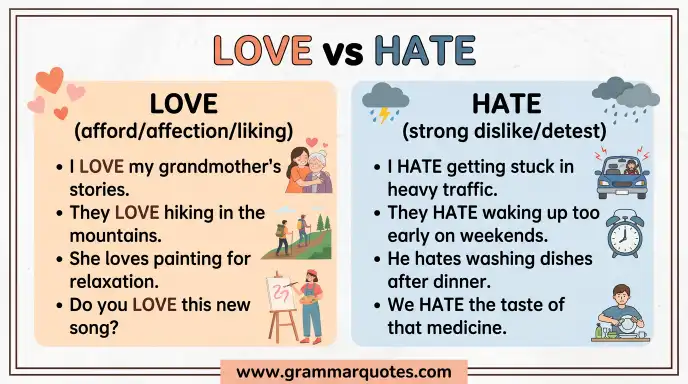
Understanding these words becomes easier when you see how they are used in everyday situations.
Examples of Love
- I love spending time with my family.
- She loves reading interesting books.
- They love helping people in need.
- He has a deep love for nature.
- We love learning new things.
- My parents love and support me.
- She loves listening to music.
- I love the peaceful atmosphere of this place.
- Their friendship is full of love and respect.
- He loves working with children.
Examples of Hate
- I hate dishonesty.
- She hates waiting for a long time.
- They hate unnecessary arguments.
- He expressed his hatred of injustice.
- I hate waking up late.
- She hates being treated unfairly.
- We hate wasting valuable resources.
- He hates negative behaviour.
- They strongly oppose hatred and discrimination.
- I hate losing important documents.
These examples show that love and hate can describe feelings about people, activities, situations, and personal values.
Love vs Hate: Synonyms and Opposite Words
Learning synonyms can help you express emotions more precisely.
Synonyms of Love
| Synonym | Meaning | Example |
| Affection | A feeling of care and fondness | She showed affection toward her family. |
| Adoration | Deep love or admiration | The child looked at his parents with adoration. |
| Fondness | A warm liking for someone or something | He has a fondness for old books. |
| Devotion | Strong loyalty and commitment | Her devotion to her family is clear. |
| Attachment | An emotional connection | He developed an attachment to his hometown. |
| Passion | A strong feeling or enthusiasm | She has a passion for teaching. |
| Admiration | Respect and approval | I have great admiration for my teacher. |
| Tenderness | Gentle care and affection | The mother treated her child with tenderness. |
Synonyms of Hate
| Synonym | Meaning | Example |
| Hatred | An intense feeling of dislike | Hatred can create serious conflicts. |
| Hostility | Unfriendly or aggressive feelings | There was hostility between the groups. |
| Detestation | Very strong dislike | He expressed his detestation of corruption. |
| Loathing | An intense feeling of disgust or dislike | She felt loathing toward cruelty. |
| Dislike | A feeling of not liking something | I dislike unnecessary noise. |
| Antipathy | A strong feeling of opposition or dislike | He had an antipathy toward dishonesty. |
| Resentment | Bitter feelings about unfair treatment | She felt resentment after the unfair decision. |
| Aversion | A strong feeling of wanting to avoid something | He has an aversion to loud music. |
Remember: These synonyms have different levels of intensity. For example, dislike is usually milder than hatred, while adoration expresses especially strong affection.
Hate vs Love in Different Situations
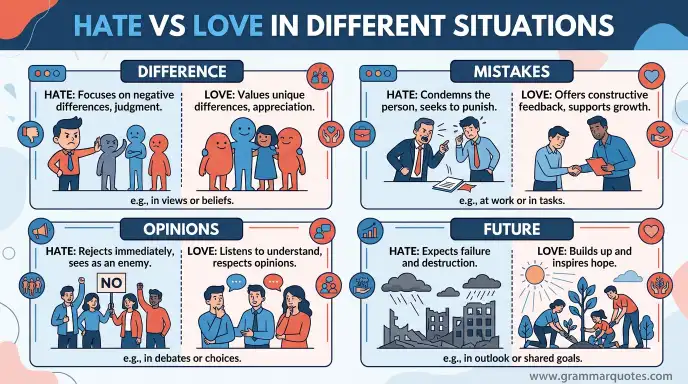
The meanings of these words can become clearer when you consider their use in different contexts.
1. Family Relationships
Love is commonly used to describe affection, care, and support between family members.
Example: Parents often show love through care, encouragement, and support.
The word hate may describe strong disapproval of harmful behaviour, but disagreement does not necessarily mean hatred.
2. Friendships
Love in friendship involves trust, loyalty, and mutual respect.
Example: I love having friends who support me during difficult times.
Hate can describe strong negative feelings after dishonesty or betrayal, although people can also resolve disagreements through communication.
3. Education and Learning
Students may love subjects they find interesting and hate activities they find difficult or frustrating.
Examples:
- I love learning English grammar.
- He hates doing unnecessary homework.
In these sentences, the words describe personal preferences rather than deep emotional relationships.
4. Workplace and Professional Life
Love may describe enthusiasm for a profession, while hate may express strong dissatisfaction with a particular practice.
Examples:
- She loves working with a creative team.
- Employees hate unfair treatment.
5. Society and Human Behaviour
Love can encourage kindness, cooperation, and understanding. Hate can contribute to discrimination, hostility, and conflict.
Example: Communities become stronger when people promote respect instead of hatred.
Common Mistakes When Using Love and Hate
Although these words are simple, some mistakes can occur when using them in sentences.
1. Confusing Love With Like
Love usually expresses stronger affection or enjoyment than like.
- I like this song. (I enjoy it.)
- I love this song. (I enjoy it very much.)
Both sentences are correct, but the strength of the feeling is different.
2. Confusing Hate With Dislike
Hate expresses a much stronger negative feeling than dislike.
- I dislike loud music.
- I hate loud music.
The second sentence communicates stronger dissatisfaction.
3. Using Hateful Instead of Hated
Hateful means expressing or showing hate. Hated means strongly disliked by someone.
- Correct: He made a hateful comment.
- Correct: The unfair rule was hated by many people.
4. Confusing Love and Loving
Love can be a noun or a verb, while loving is often used as an adjective or as a verb form.
- Noun: Love is important in a family.
- Verb: I love my family.
- Adjective: She is a loving person.
5. Using Hate and Hatred Interchangeably in Every Sentence
Hate can be a noun or a verb, while hatred is a noun.
- Verb: I hate dishonesty.
- Noun: His hatred of dishonesty was well known.
Easy Ways to Remember Love vs Hate
Here are some simple ways to remember the difference.
Trick 1: Think About Positive and Negative Feelings
- Love = Affection, care, and appreciation.
- Hate = Strong dislike, hostility, and opposition.
Trick 2: Remember Their Related Words
- Love → Loving → Lovable
- Hate → Hateful → Hatred
These related forms can help you understand how the words change in different sentences.
Trick 3: Use Simple Examples
Remember these two sentences:
- I love helping people.
- I hate unfair treatment.
The first expresses affection or enjoyment, while the second expresses strong disapproval.
Love or Hate: Frequently Asked Questions
1. What is the main difference between love and hate?
Love is a feeling of deep affection, care, or attachment. Hate is an intense feeling of dislike, hostility, or opposition. They express very different emotional experiences.
2. Are love and hate opposites?
Yes. Love and hate are commonly considered opposite emotions. Love expresses affection and care, while hate expresses strong negative feelings.
3. What is the meaning of love?
Love means a deep feeling of affection, care, respect, or emotional attachment toward someone or something.
4. What is the meaning of hate?
Hate means an intense feeling of dislike, hostility, or strong opposition toward someone or something.
5. What are the synonyms of love?
Common synonyms include affection, adoration, fondness, devotion, attachment, passion, and admiration. The best word depends on the type and strength of the feeling.
6. What are the synonyms of hate?
Common synonyms include hatred, hostility, loathing, detestation, antipathy, and aversion. Some are stronger or more formal than others.
7. Can love and hate exist at the same time?
People can experience mixed emotions toward the same person or situation. For example, someone may care about a family member while feeling angry or disappointed about their behaviour.
8. Is hate stronger than dislike?
Yes. Hate generally expresses a much stronger negative feeling than dislike. Dislike can describe a mild preference, while hate communicates intense opposition or rejection.
9. What is the opposite of hatred?
Depending on the context, opposites of hatred include love, affection, kindness, compassion, and goodwill.
10. How can I use love and hate in a sentence?
You can use love to express affection or enjoyment and hate to express strong dislike.
Examples:
- I love spending time with my family.
- I hate unnecessary arguments.
Conclusion
Understanding love vs hate helps you express emotions more clearly and accurately. Love represents affection, care, respect, and emotional attachment, while hate represents intense dislike, hostility, or opposition.
Both words can describe feelings toward people, activities, ideas, and situations. Their meanings also change slightly depending on the context. Learning their synonyms, related forms, and everyday uses can improve your vocabulary and make your English writing more effective.
The easiest way to remember the difference is simple: love is associated with affection and care, while hate is associated with strong dislike and hostility.
Discover More Articles!
Ascent vs Assent: Meaning, Differences, Examples, and Mistakes
AWD or RWD: What Is the Difference?(2026)
Finaly or Finally: Spelling, Meaning, Examples, and Mistakes

Ethan Parker is an English-language writer known for his interest in words, language, and clear communication. His work focuses on making everyday English easier to understand through simple explanations and practical examples.