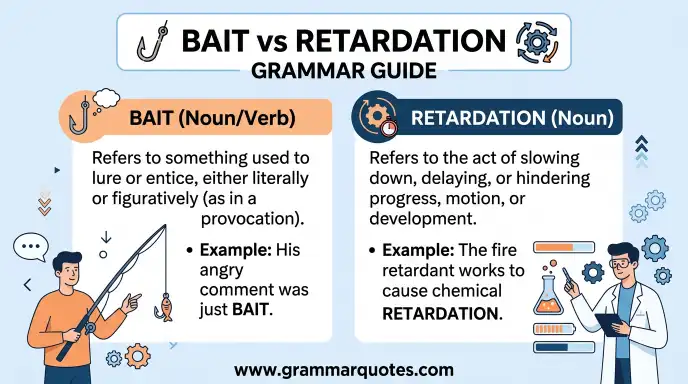
Bait and retardation are completely different English words: bait refers to something used to attract or catch an animal or person, while retardation is a formal term historically used to describe slowing or delay in development or progress. Because the two words have different meanings, they cannot normally be used interchangeably.
The word “bait” is common in everyday English. You may see it when people talk about fishing, traps, online content, or attempts to provoke a reaction.
“Retardation,” on the other hand, has several historical and technical uses, but its use in discussions about intellectual or developmental disabilities has changed over time.
Today, modern medical and educational writing generally avoids older terminology that can be stigmatizing. Terms such as intellectual disability and developmental delay are preferred when they accurately describe the situation.
This guide explains the meanings, origins, differences, examples, common mistakes, and appropriate usage of both terms.
Bait or Retardation : Quick Answer
Bait means something used to attract or lure someone or something, especially an animal.
Retardation means a slowing, delay, or reduction in the rate of something. In older medical terminology, it was also used in descriptions of developmental or intellectual disabilities, but that usage is now generally outdated and can be offensive.
Definition and Meaning of Bait
Bait is something used to attract an animal, fish, or sometimes a person into a particular situation.
For example:
- A worm can be used as bait for fishing.
- The trap was set with bait.
- The advertisement was designed as clickbait.
The word can also be used figuratively when something is intended to tempt or provoke a reaction.
Definition and Meaning of Retardation
Retardation comes from the idea of making something slower or delaying its progress.
In technical contexts, the word can still describe a reduction in speed or rate. For example, scientific writing may discuss the retardation of a process.
However, the term was historically used in medical and educational language in connection with intellectual disability. That usage is now widely considered outdated. “Intellectual disability” is the preferred modern term.
What Does Bait Mean?
Bait can have several related meanings.
Bait for Fishing
The most familiar meaning is something placed on a hook to attract fish.
Example:
“The fisherman put bait on the hook.”
Bait for Traps
Bait can also be food or another attractive item placed inside or near a trap.
Example:
“The trap was placed with suitable bait.”
Bait as a Figurative Term
In everyday language, bait can describe something designed to attract attention or encourage a response.
Example:
“The post was obvious bait for an argument.”
Online, the word appears in terms such as clickbait and engagement bait.
What Does Retardation Mean?
Retardation generally describes slowing, delay, or a reduction in the rate of progress.
The word can occur in technical contexts.
For example:
- “The material causes retardation of the chemical reaction.”
- “The process showed some retardation.”
However, context matters greatly.
When discussing a person’s intellectual or developmental condition, modern writing should use terms such as intellectual disability or developmental delay, depending on what is actually being described.
Is “retardation” still a medical term?
The term can appear in older medical literature or in specific technical contexts, but it is no longer the preferred terminology for intellectual disability.
Modern professional language aims to use accurate and respectful terms that describe a condition without using outdated labels.
Bait vs Retardation: Main Difference
The two words differ in both meaning and usage.
| Feature | Bait | Retardation |
| Basic meaning | Something used to attract or lure | Slowing or delay |
| Common context | Fishing, traps, online content | Technical or historical contexts |
| Part of speech | Noun / verb | Noun |
| Related word | Baiting | Retard |
| Modern everyday use | Very common | More limited |
| Medical usage | No | Historical/outdated in some contexts |
| Can they replace each other? | No | No |
Origin of Bait and Retardation
Origin of Bait
The word bait has been used in English for centuries. It developed from older Germanic language forms associated with food given to animals or something used to attract them.
Its meaning later expanded beyond fishing and hunting. Today, people also use it metaphorically for anything intended to attract attention or provoke a reaction.
Origin of Retardation
Retardation comes through Latin roots related to making something slower or delaying it.
The English verb retard historically meant to slow, delay, or hold back something. The noun retardation developed from this meaning.
Over time, the word entered older medical terminology. However, some of those uses are now considered outdated, especially when referring to people with intellectual or developmental disabilities.
Common Uses of Bait
The word “bait” appears in several modern expressions.
Fishing Bait
Something used to attract fish.
Example:
“We need fresh bait for the fishing trip.”
Clickbait
Online material designed to attract clicks, often through an attention grabbing headline.
Example:
“That headline looks like clickbait.”
Baiting Someone
Trying to provoke someone into reacting.
Example:
“He was baiting his friend to start an argument.”
Bait and Switch
A deceptive practice in which someone is attracted by one offer but encouraged to accept another.
Example:
“The advertisement was criticized as a bait and switch tactic.”
Common Mistakes With Retardation or Bait
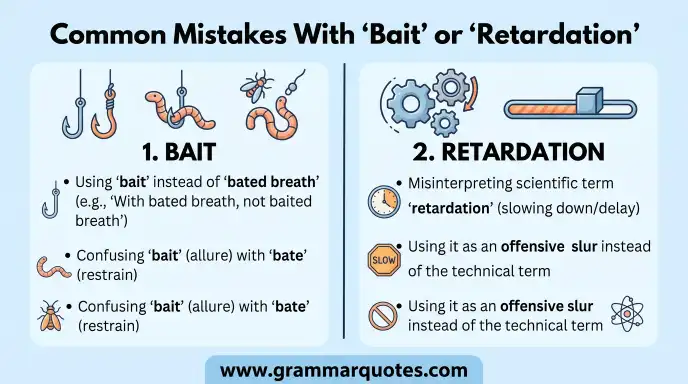
Mistake 1: Treating Them as Synonyms
Bait and retardation have unrelated meanings.
Incorrect:
“The fisherman used retardation to catch fish.”
Correct:
“The fisherman used bait to catch fish.”
Mistake 2: Using Historical Medical Language as Modern Terminology
Older texts may contain terminology that is no longer appropriate.
Modern writing should generally use intellectual disability when that is the intended meaning.
Mistake 3: Confusing “Bait” With “Bate”
“Bait” and “bate” sound similar but have different meanings.
Bait means something used to attract.
Bate is a much less common word that can mean to restrain, reduce, or moderate.
Mistake 4: Using Outdated Labels for People
When discussing disabilities, avoid using outdated terminology as a label for a person. Modern respectful language focuses on the condition rather than defining the individual by it.
Bait or Retardation in Everyday Examples
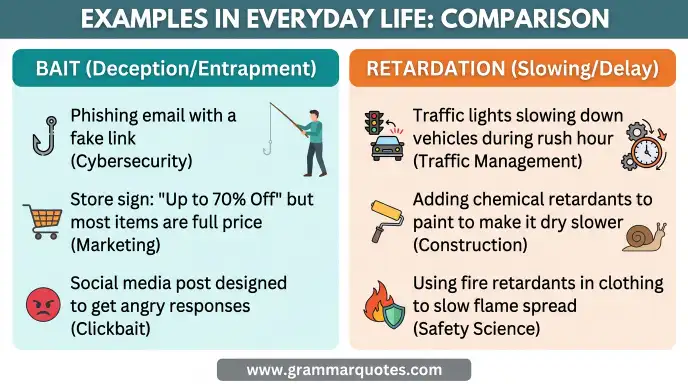
Example 1: Fishing
“The fisherman bought some bait before going to the lake.”
Example 2: Social Media
“That comment seems designed as bait to provoke people.”
Example 3: Online Articles
“The website used a sensational headline as clickbait.”
Example 4: Technical Writing
“The treatment produced retardation of the process.”
Example 5: Modern Disability Language
Preferred:
“The student has an intellectual disability.”
Rather than using an outdated historical term as a label for the person.
British English vs American English
There is generally no major spelling difference between bait and retardation in British and American English.
| Word | British English | American English |
| Bait | Bait | Bait |
| Retardation | Retardation | Retardation |
| Baiting | Baiting | Baiting |
| Intellectual disability | Intellectual disability | Intellectual disability |
The main difference is not spelling but context and preferred terminology, particularly when discussing disability.
Which Word Should You Use?
Use bait when you mean something intended to attract or lure.
Use retardation only when the context genuinely means slowing or delaying a process, especially in a technical or historical context.
When discussing intellectual or developmental disabilities, use modern terms such as:
- Intellectual disability
- Developmental delay
- Developmental disability
The exact term should match the situation. For formal writing, respectful and current terminology is usually the best choice.
Is “Retardation” an Offensive Word?
The answer depends on context.
In technical writing, “retardation” can still have a neutral meaning related to slowing or delaying a process.
However, using it as a label for a person with an intellectual or developmental disability is outdated and can be hurtful. Modern professional language generally uses intellectual disability instead.
This distinction is important because the same word can have different meanings in different fields.
10 People Also Ask Questions
1. What is the difference between bait and retardation?
Bait is something used to attract or lure, while retardation generally refers to slowing or delay.
2. Is bait the same as clickbait?
Not exactly. Clickbait is a specific type of bait used online to attract clicks or attention.
3. What does bait mean in slang?
In informal online language, “bait” can describe content designed to provoke a reaction or argument.
4. What does retardation mean in technical writing?
It can mean slowing or delaying a process or rate.
5. Is retardation still used as a medical term?
Some older medical literature contains the term, but it is generally outdated when referring to intellectual disability.
6. What is the modern term for mental retardation?
The modern term is intellectual disability.
7. Is “intellectual disability” the preferred term?
Yes. It is the widely preferred modern term in professional and educational contexts.
8. Can bait be used as a verb?
Yes. “To bait” can mean to put bait somewhere or to deliberately provoke someone.
9. What is another word for bait?
Depending on context, alternatives include lure, temptation, attraction, decoy, and enticement.
10. Why has medical terminology changed?
Medical and educational terminology changes as professionals develop more accurate, respectful, and less stigmatizing ways to describe conditions.
FAQs
What is the simplest meaning of bait?
Bait is something used to attract or lure a person, animal, or fish.
What is the simplest meaning of retardation?
In its general technical sense, retardation means slowing or delaying something.
Can bait and retardation be used in the same sentence?
Yes, but they do not have the same meaning.
Example:
“The bait attracted the fish, while the cold water caused retardation of the chemical process.”
What should I say instead of an outdated term for intellectual disability?
Use intellectual disability or another accurate modern term that matches the situation.
Is “retardation” always offensive?
No. Its technical meaning of slowing or delay is different from its outdated use as a label for people with intellectual disabilities. Context is important.
Is bait a negative word?
Not necessarily. Bait can be completely neutral, such as fishing bait. In online contexts, “bait” can sometimes describe deliberately provocative content.
Final Guide: Bait or Retardation
Bait and retardation have completely different meanings. Bait is something used to attract or lure, while retardation generally refers to slowing, delaying, or reducing the rate of a process.
The word bait is common in everyday English and appears in phrases such as fishing bait, clickbait, and baiting. Retardation is less common in everyday speech and is more likely to appear in technical, scientific, or older texts.
When discussing intellectual or developmental disabilities, terminology deserves special care. Intellectual disability is the modern preferred term, while older terminology can be outdated or stigmatizing.
Understanding the context of each word helps you choose language that is both accurate and appropriate. If you are writing for school, work, a website, or a professional audience, current and respectful terminology is usually the best choice.
Conclusion
Bait and retardation are not interchangeable words. Bait refers to something used to attract or lure, while retardation can describe slowing or delay.
The word also has a history in older medical terminology related to intellectual disabilities. That terminology is now generally outdated. Intellectual disability is the preferred modern term in professional and educational contexts.
Learning the difference is useful not only for vocabulary but also for choosing respectful language. Always consider the context, audience, and current terminology when writing about people or disabilities.
Discover More Articles!
Volume or Volumn: Which Spelling Is Correct?(2026)
Preventative or Preventive: Which One Is Correct?(2026)
Divorce or Annulment: What Is the Difference?

Ethan Parker is an English-language writer known for his interest in words, language, and clear communication. His work focuses on making everyday English easier to understand through simple explanations and practical examples.