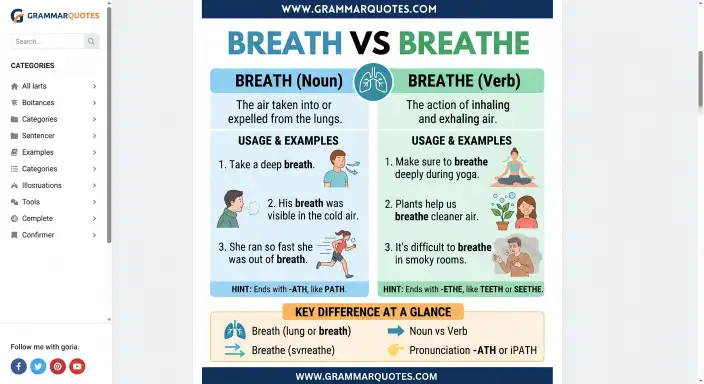
Breath vs breathe is a common English grammar question. Both words are correct, but they have different meanings and uses. Breath is a noun that means the air you take into or release from your lungs. Breathe is a verb that means to take air into your lungs and release it. For example, you take a deep breath before a speech, but you breathe slowly to help yourself relax.
These words often confuse English learners because they look almost the same. The main difference is the final sound and their grammatical roles. Learning how to use them correctly can improve your spelling, grammar, speaking, and writing. It can also help content writers avoid common mistakes and create clear sentences.
In this guide, you will learn the meanings, pronunciation, history, and word forms of breath and breathe. You will also explore their differences, common mistakes, everyday examples, and useful grammar tips.
Quick Answer: Breath vs Breathe
Breath is a noun, while breathe is a verb. Use breath when talking about the air you take in or release. Use breathe when describing the action of taking air into your lungs and releasing it.
| Feature | Breath | Breathe |
| Part of speech | Noun | Verb |
| Meaning | Air taken into or released from the lungs | To take air in and release it |
| Pronunciation | /breθ/ | /briːð/ |
| Final sound | Unvoiced /θ/, as in think | Voiced /ð/, as in this |
| Example | Take a deep breath. | Breathe slowly. |
| Common phrase | Out of breath | Breathe deeply |
Meaning of Breath and Breathe
Definition of Breath
Breath (noun): The air that enters or leaves your lungs when you breathe.
The word can also describe a small amount of air, a short pause, or a slight sign of something.
Examples:
- She took a deep breath before speaking.
- He was out of breath after running.
- A breath of fresh air entered the room.
Definition of Breathe
Breathe (verb): To take air into your lungs and release it.
It can also describe living, resting, or having enough space and freedom to act.
Examples:
- Remember to breathe slowly during the exercise.
- Plants and animals need suitable conditions to survive and breathe.
- The team needs time to breathe after a busy week.
Connotative Meaning
Connotation (the feelings or ideas a word suggests beyond its basic meaning) helps explain the impressions these words can create.
- Positive tone: A breath of fresh air can suggest something new, pleasant, or refreshing. Breathe easily may suggest relief.
- Negative tone: Out of breath can suggest tiredness or physical effort. Breathe down someone’s neck suggests unwanted pressure or close watching.
- Neutral tone: Breath and breathe are neutral when used to describe normal breathing.
Their tone depends on the sentence and the context.
Etymology of Breathe and Breath
Origin of the Words
- Source language: Both words developed from Old English.
- Old English roots: Breath is related to Old English brǣþ, which referred to breath or an exhalation.
- Verb history: Breathe developed from an Old English verb related to breathing or exhaling.
- Spelling difference: The final e in breathe helps distinguish the verb from the noun in modern English spelling.
- Shared origin: Both words belong to the same historical word family.
Short History of Breath and Breathe
Old English (450–1100): Early English had related forms for the noun and verb. These words described breathing, air, and the act of taking air into or out of the body.
Middle English (1100–1500): The forms changed as English spelling and pronunciation developed. Writers used different spellings before modern conventions became more stable.
Modern English (1500–Present): Breath became the standard noun spelling, while breathe became the standard verb spelling. Today, the distinction is important in both written and spoken English.
Pronunciation of Breath and Breathe
US and UK Pronunciation
Breath
- US: /brɛθ/
- UK: /breθ/
Breathe
- US: /briːð/
- UK: /briːð/
The noun breath has a short vowel sound and ends with the unvoiced /θ/ sound. The verb breathe has a long vowel sound and ends with the voiced /ð/ sound.
Syllables
- Breath: breath (one syllable)
- Breathe: breathe (one syllable)
How to Say Them Correctly
To pronounce breath, use the short vowel sound in red and the final sound in think.
To pronounce breathe, use the long vowel sound in see and the final sound in this.
Practising these sounds can help you distinguish the words when speaking.
Affixation Pattern of Breath and Breathe
Root
- Breath: The base noun.
- Breathe: The related verb form.
Both words belong to the same word family, but they have different grammatical roles.
Prefix
Neither breath nor breathe has a prefix in its basic form.
Suffix
The final e in breathe is part of its spelling. It is not a separate grammatical suffix that changes a noun into a verb.
Word Formation
- Breath (noun): Air taken into or released from the lungs.
- Breathe (verb): To take air in and release it.
- Breathing (noun or verb form): The process or action of breathing.
- Breathed (verb form): The past tense and past participle of breathe.
- Breathless (adjective): Unable to breathe normally or very excited.
- Breathlessly (adverb): In a breathless manner.
- Breathlessness (noun): The state of being breathless.
- Breathable (adjective): Allowing air to pass through.
- Breather (noun): A short rest or a person or device that breathes.
- Breathily (adverb): In a way that sounds soft or airy.
These words are related, but they do not all have the same meaning. Their grammatical role depends on how each word is used in a sentence.
Breath vs Breathe: Main Differences
1. Breath Is a Noun
Use breath when naming the air you take in or release.
Examples:
- Take a deep breath before you begin.
- His breath was visible in the cold air.
- She held her breath for a moment.
In these sentences, breath names something rather than describing an action.
2. Breathe Is a Verb
Use breathe when describing the action of taking air into your lungs and releasing it.
Examples:
- Try to breathe slowly.
- The doctor asked him to breathe deeply.
- It was difficult to breathe in the smoky room.
In these sentences, breathe describes an action.
3. The Final Sound Is Different
The noun breath ends with /θ/, as in think. The verb breathe ends with /ð/, as in this.
This sound difference is useful when learning to pronounce the words correctly.
4. The Vowel Sound Is Different
Breath has a short vowel sound, while breathe has a long vowel sound.
- Breath: /brɛθ/
- Breathe: /briːð/
The spelling and pronunciation both help distinguish the words.
Grammar Rules for Breath and Breathe
Use Breath After an Article or Adjective
Because breath is a noun, it can follow words such as a, the, deep, and short.
Examples:
- Take a breath.
- She took a deep breath.
- He held his breath.
Use Breathe After To
The word breathe often follows to when expressing an action.
Examples:
- It is important to breathe calmly.
- She tried to breathe slowly.
- He needed space to breathe.
Use Breathe After Modal Verbs
After modal verbs such as can, could, should, and must, use the base verb breathe.
Examples:
- You should breathe slowly.
- We must breathe clean air.
- She can breathe more easily now.
Use Breathing for an Ongoing Action
The word breathing can describe an action that is happening or a process.
Examples:
- He is breathing normally.
- Deep breathing can help some people feel calmer.
Use Breathed for the Past
The past tense of breathe is breathed.
Examples:
- She breathed a sigh of relief.
- He breathed slowly and continued.
Remember that breath is not the past tense of breathe. The correct past tense is breathed.
Common Mistakes with Breath and Breathe
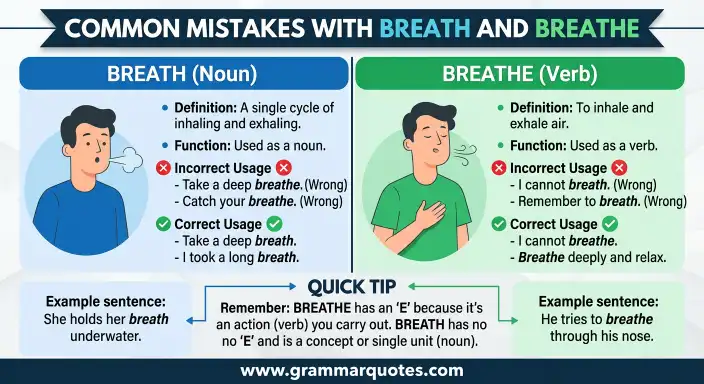
1. Using Breath Instead of Breathe
Incorrect: I need to breath slowly.
Correct: I need to breathe slowly.
Why? The word after to is a verb, so breathe is correct.
2. Using Breathe Instead of Breath
Incorrect: Take a deep breathe.
Correct: Take a deep breath.
Why? The phrase needs a noun after a deep.
3. Confusing Breathless and Breathe
Incorrect: I was breathe after running.
Correct: I was breathless after running.
Why? Breathless is an adjective that describes someone who is short of breath or very excited.
4. Using the Wrong Past Tense
Incorrect: She breath slowly yesterday.
Correct: She breathed slowly yesterday.
Why? The past tense of breathe is breathed.
5. Forgetting the Difference in Pronunciation
Some learners pronounce both words in the same way. Practise the short vowel and /θ/ sound in breath, then the long vowel and /ð/ sound in breathe.
Everyday Examples of Breathe and Breath

In Daily Life
- Breath: I took a deep breath before answering.
- Breathe: I tried to breathe slowly.
In Sports
- Breath: The runner was out of breath after the race.
- Breathe: Athletes learn to breathe in a steady rhythm.
For School
- Breath: She took a breath before giving her speech.
- Breathe: The teacher told the class to breathe calmly before the test.
In Nature
- Breath: A breath of fresh air came through the window.
- Breathe: Many animals breathe through lungs.
For Writing
- Breath: The character held his breath in surprise.
- Breathe: The character paused to breathe before speaking again.
In Common Expressions
- A breath of fresh air: Something new, refreshing, or welcome.
- Out of breath: Breathing quickly after physical effort.
- Hold your breath: Stop breathing briefly or wait with great anticipation.
- Breathe a sigh of relief: Feel relief after worry or tension.
- Breathe down someone’s neck: Watch or pressure someone very closely.
- Not have a breath to spare: Have no time or energy to spare.
Quick Comparison Table
| Feature | Breath | Breathe |
| Part of speech | Noun | Verb |
| Basic meaning | Air taken in or released | The action of taking air in and releasing it |
| Pronunciation | /brɛθ/ in US English | /briːð/ |
| Syllables | One | One |
| Example | Take a breath. | Breathe slowly. |
| Past tense | Not applicable | Breathed |
| Related form | Breathless | Breathing |
Key Takeaways
- Breath is a noun.
- Breathe is a verb.
- Take a breath is correct.
- Try to breathe is correct.
- The past tense of breathe is breathed.
- Breath ends with /θ/, while breathe ends with /ð/.
- Check if your sentence needs a noun or a verb before choosing the word.
People Also Ask
1. What is the main difference between breath and breathe?
Breath is a noun that means air taken into or released from the lungs. Breathe is a verb that means to take air in and release it.
2. Is it take a breath or take a breathe?
The correct phrase is take a breath because the word after a is a noun.
3. Is it hard to breath or hard to breathe?
The correct phrase is hard to breathe because to is followed by the base form of a verb.
4. What is the past tense of breathe?
The past tense of breathe is breathed. For example, “She breathed slowly.”
5. How can I remember breath vs breathe?
Remember that breath is the thing, while breathe is the action. You take a breath, and you breathe.
Frequently Asked Questions
1. Is breath a noun or a verb?
Breath is mainly a noun. It names the air you take in or release from your lungs.
2. Is breathe a noun or a verb?
Breathe is a verb. It describes the action of taking air into the lungs and releasing it.
3. Why does breathe have an e at the end?
The final e is part of the standard spelling of the verb. It helps distinguish breathe from the noun breath.
4. What are some words related to breath?
Related words include breathe, breathing, breathed, breathless, breathlessness, and breathable.
5. Which sentence is correct: “I cannot breath” or “I cannot breathe”?
“I cannot breathe” is correct because cannot is followed by the base form of the verb.
Conclusion
Understanding breath vs breathe can help you improve your English grammar, spelling, and pronunciation. Although the words look similar, they have different grammatical roles. Breath is a noun that refers to the air you take in or release, while breathe is a verb that describes the action itself. The easiest way to remember the difference is to say, “Take a breath, then breathe slowly.”
Practising these words in everyday sentences can help you avoid common spelling mistakes. Pay attention to phrases such as take a deep breath, out of breath, and try to breathe. Also remember that the past tense is breathed. By learning these simple rules and reviewing examples regularly, you can build a stronger vocabulary and communicate more confidently in English.
Discover More Articles!
Color or Colour: Correct Spelling, Meaning, and Examples
Motorhome or RV: What Is the Difference?(2026)
Definitely or Definately: Correct Spelling, Meaning, and Examples

Ethan Parker is an English-language writer known for his interest in words, language, and clear communication. His work focuses on making everyday English easier to understand through simple explanations and practical examples.