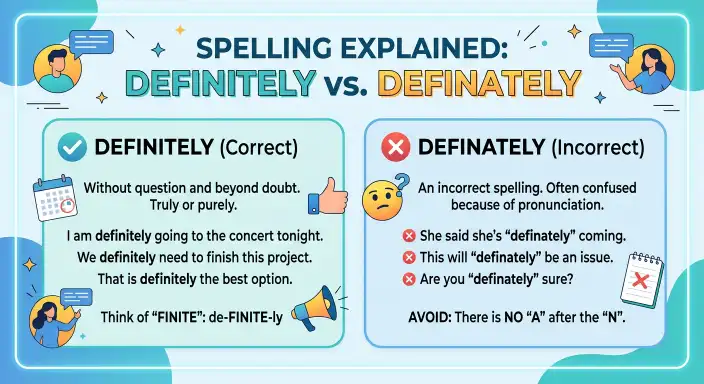
Definitely is the correct spelling, while definately is a common spelling mistake. The word definitely means certainly, without doubt, or in a clear and sure way. Many people misspell it because they confuse the vowels in the middle of the word. Learning the correct spelling can help you improve your English writing and avoid common mistakes in school, emails, and everyday communication.
In this guide, you will learn the difference between definitely and definately, their meanings, pronunciation, common mistakes, synonyms, and simple examples.
Quick Answer: Definitely or Definately?
Definitely is the correct spelling in standard English. Definately is incorrect and should not be used in formal or informal writing.
| Word | Correct or Incorrect? | Explanation |
| Definitely | Correct | The standard English spelling |
| Definately | Incorrect | A common spelling mistake |
Examples:
- Correct: I will definitely call you tomorrow.
- Incorrect: I will definately call you tomorrow.
Remember this simple rule: Definitely contains “finite” in its spelling. Think of the word definite to help you remember the correct letters.
What Does Definitely Mean?
The word definitely is an adverb. It means certainly, without doubt, or in a way that shows you are sure about something.
People use it to express confidence, agreement, or certainty.
Definitely as an Adverb
An adverb can describe a verb, an adjective, or another adverb. Definitely often adds certainty to a statement.
Examples:
- I will definitely attend the meeting.
- She is definitely a talented student.
- We should definitely visit that place.
- He will definitely help you with your work.
- This is definitely the right answer.
In each sentence, definitely shows that the speaker feels sure about what they are saying.
Definitely to Show Agreement
People also use definitely in everyday conversations to show strong agreement.
Examples:
- “Do you want to join us?” “Definitely!”
- “Is this a good idea?” “Definitely.”
- “Should we study together?” “Yes, definitely.”
- “Will you come to the party?” “I will definitely be there.”
This use is common in both spoken and written English.
Why Do People Spell Definitely Incorrectly?
Many people write definately because they remember the sound of the word but not its exact spelling. The letters in the middle can be confusing, especially because the pronunciation does not make every letter obvious.
The correct spelling is:
D E F I N I T E L Y
The incorrect spelling is:
D E F I N A T E L Y
Notice the important difference: the correct word has “ite” near the end, not “ate.”
A helpful trick is to remember the word definite inside definitely:
Definite + ly = Definitely
This simple connection can help you remember the correct spelling.
Definitely vs Definately: Key Differences
The main difference is spelling. These words do not have different meanings because definately is not a standard English spelling.
| Feature | Definitely | Definately |
| Spelling | Correct | Incorrect |
| Meaning | Certainly; without doubt | No standard meaning |
| Part of speech | Adverb | Not a standard word |
| Formal writing | Accepted | Avoid |
| Example | I will definitely come. | I will definately come. |
Always use definitely in school assignments, professional emails, essays, reports, and other forms of writing.
How to Pronounce Definitely
The word definitely is commonly pronounced:
- IPA: /ˈdefɪnətli/
- Syllables: def i nite ly
In natural speech, the middle sounds may be reduced, so the word may sound shorter than its spelling suggests.
Pronunciation Examples
- I will definitely help you.
- She will definitely pass the test.
- This is definitely worth trying.
Practising the word aloud while looking at its correct spelling can help you remember both its pronunciation and spelling.
Common Mistakes with Definitely and Definately
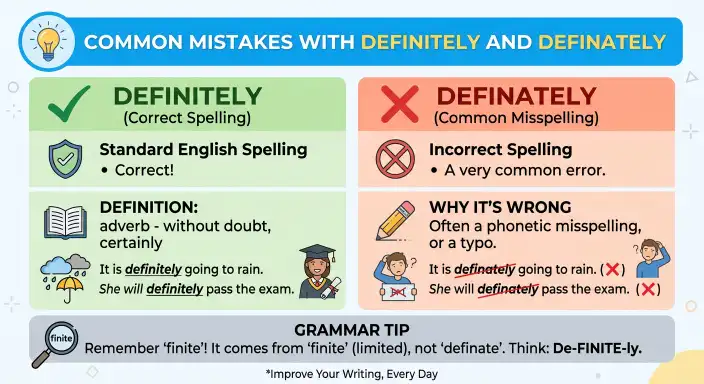
Here are some common mistakes and their corrections.
Mistake 1: Writing Definately
Incorrect: I will definately visit you next week.
Correct: I will definitely visit you next week.
Why? The correct spelling is definitely, with “ite” near the end.
Mistake 2: Confusing Definitely with Definite
Incorrect: I am definite going to the market.
Correct: I am definitely going to the market.
Why? Definite is an adjective, while definitely is an adverb. In this sentence, the adverb is needed to describe the action.
Mistake 3: Using Definitely When You Are Unsure
Example: I will definitely come, but I am not sure yet.
This sentence may sound confusing because definitely expresses certainty.
Better: I will probably come, but I am not sure yet.
Why? Use definitely when you want to show certainty. Use probably when something is likely but not certain.
Mistake 4: Forgetting the Correct Spelling in Formal Writing
Incorrect: We definately recommend this book.
Correct: We definitely recommend this book.
Why? Always check the spelling of commonly misspelled words before submitting important writing.
Everyday Examples of Definitely
Here are 12 simple sentences that show how to use definitely correctly.
- I will definitely finish my homework today.
- She is definitely a good friend.
- We should definitely visit the museum.
- He will definitely enjoy this movie.
- This is definitely the best option for us.
- I will definitely call you tonight.
- They are definitely ready for the competition.
- You should definitely try this new restaurant.
- I will definitely remember your advice.
- That was definitely an interesting lesson.
- We will definitely meet again soon.
- She has definitely improved her English.
These examples show how definitely can express certainty in different situations.
Synonyms of Definitely
Synonyms are words with the same or similar meanings. The best synonym depends on the sentence.
| Synonym | Meaning | Example |
| Certainly | Without doubt | I will certainly attend. |
| Surely | With confidence or expectation | Surely, we can find a solution. |
| Absolutely | Completely or without doubt | I absolutely agree with you. |
| Undoubtedly | Without any doubt | She is undoubtedly talented. |
| Clearly | In an obvious way | He clearly understands the task. |
| Unquestionably | Beyond reasonable doubt | It was unquestionably a success. |
| Positively | With certainty | I can positively identify the place. |
| Without a doubt | With complete certainty | Without a doubt, she did her best. |
These synonyms are similar to definitely, but they may differ in tone and context. Choose the word that best fits your sentence.
Definitely vs Definitely Not

Definitely not is used to express strong disagreement or certainty that something will not happen or is not true.
Examples:
- I will definitely not miss the exam.
- That is definitely not the correct answer.
- She will definitely not forget your birthday.
- “Do you want to give up?” “Definitely not!”
The word definitely expresses certainty, while not reverses the meaning of the statement.
Frequently Asked Questions
Is Definitely or Definately Correct?
Definitely is correct. Definately is a common misspelling and is not accepted as standard English.
Why Is Definitely So Often Misspelled?
People often confuse the vowel sounds and write definately instead of definitely. Remembering the word definite can help you spell it correctly.
What Does Definitely Mean?
Definitely means certainly, without doubt, or in a way that expresses confidence.
Is Definitely an Adjective or an Adverb?
Definitely is an adverb. The related adjective is definite.
Example: We have a definite plan, and we will definitely follow it.
What Is Another Word for Definitely?
Common synonyms include certainly, absolutely, surely, undoubtedly, and without a doubt. The best choice depends on the sentence.
How Can I Remember the Spelling of Definitely?
Remember this connection: definite + ly = definitely. The word contains “nite” in its spelling, not “nate.”
Can I Use Definitely in Formal Writing?
Yes. Definitely is suitable for formal and informal English. However, in highly technical writing, a more precise expression may sometimes be better.
What Is the Difference Between Definitely and Probably?
Definitely expresses certainty, while probably means that something is likely but not certain.
Examples:
- I will definitely attend. — I am sure.
- I will probably attend. — I expect to attend, but I am not completely sure.
Conclusion
Definitely is the correct spelling, while definately is a common spelling error. The word definitely is an adverb that means certainly or without doubt. It is useful when expressing confidence, agreement, or certainty in everyday conversations and formal writing.
To remember the spelling, connect definitely with the word definite. This can help you avoid replacing the correct letters with the incorrect spelling definately. Practise writing simple sentences, such as “I will definitely come” and “She is definitely right.”
Whenever you are unsure, remember: Definitely is correct; definately is incorrect.
Discover More Articles!
Narcissist or Autistic: What Is the Difference?
Shinning or Shining: Correct Spelling, Meaning, Differences, and Examples
Few vs A Few: Meaning, Differences, Grammar Rules, and Examples

Ethan Parker is an English-language writer known for his interest in words, language, and clear communication. His work focuses on making everyday English easier to understand through simple explanations and practical examples.