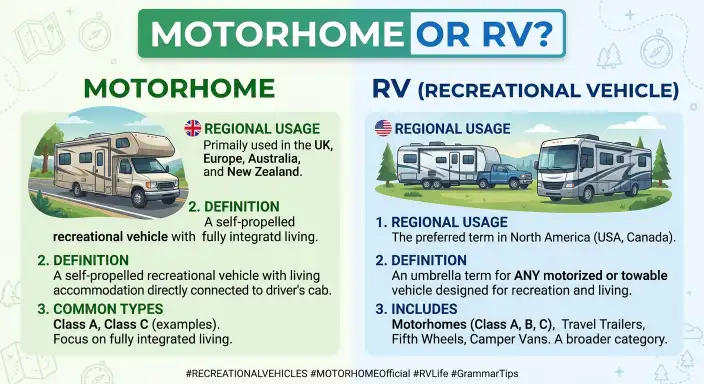
Motorhome and RV are closely related terms, but they do not mean exactly the same thing. A motorhome is a recreational vehicle that has its own engine and can be driven without a separate towing vehicle.
RV stands for recreational vehicle and is a broad term for vehicles or trailers designed for travel, camping, and temporary living. A motorhome is one type of RV, but not every RV is a motorhome.
The difference is simple once you understand how each term works. In the United States, people often use RV when talking about motorhomes, travel trailers, and other recreational vehicles. In the United Kingdom and some other countries, people may use terms such as motorhome, campervan, or caravan depending on the vehicle. These names can vary by region.
If you are writing a blog post, planning a road trip, or researching camping vehicles, choosing the right term helps you explain what you mean. This guide covers the definitions, key differences, regional usage, common mistakes, and everyday examples of motorhome or RV.
Motorhome or RV: Quick Answer
A motorhome is a motorized recreational vehicle with its driving area and living space built into one vehicle. An RV, or recreational vehicle, is a broader category that includes motorhomes and towable options such as travel trailers and fifth wheel trailers.
| Term | Meaning | Example |
| Motorhome | A recreational vehicle with its own engine | We rented a motorhome for our road trip. |
| RV | A vehicle or trailer designed for recreation and travel | They bought an RV for family camping trips. |
Quick rule: Every motorhome is an RV, but not every RV is a motorhome.
What Do Motorhome and RV Mean?
Although these terms are often used together, they describe different levels of the same category.
What Is a Motorhome?
A motorhome is a motorized vehicle designed for travel, camping, and living on the road. It combines a driving area with a living space. Depending on its size and design, it may include beds, a kitchen, a bathroom, storage, and seating.
Motorhomes come in different sizes. Some are compact and easy to drive, while others are large vehicles with extensive living facilities.
Examples:
- We rented a motorhome for our summer holiday.
- The family travelled across the country in a motorhome.
- Their motorhome has a kitchen, a bed, and a small bathroom.
The key feature is that a motorhome has its own engine and does not need another vehicle to tow it during normal driving.
What Is an RV?
RV stands for recreational vehicle. It is a general term for vehicles and trailers designed to provide transport, accommodation, or both during leisure travel.
In American English, the term can refer to several types of recreational vehicles, including motorhomes and towable trailers.
Examples:
- We parked our RV at the campsite.
- My uncle wants to buy an RV for weekend trips.
- The campground has spaces for RVs and tents.
An RV may be motorized or towable. A motorhome is driven independently, while a travel trailer generally needs a suitable towing vehicle.
Origin of Motorhome and RV
The term motorhome combines the words motor and home. It describes a vehicle that provides both transportation and living accommodation. The term became more familiar as recreational vehicles developed into practical options for road trips, holidays, and extended travel.
The abbreviation RV comes from recreational vehicle. It became especially common in the United States, where motorhomes and travel trailers are popular choices for camping and road travel.
Both terms reflect the idea of combining travel with temporary accommodation. However, their meanings are different in scope. Motorhome refers to a particular kind of vehicle, while RV refers to a wider group of recreational vehicles.
Today, manufacturers, rental companies, travel websites, and camping parks use these terms to describe vehicles with different designs and features.
Motorhome vs RV: Key Differences
The most important difference is that motorhome names a specific type of recreational vehicle, while RV is the broader category.
| Feature | Motorhome | RV |
| Full meaning | Motorized home vehicle | Recreational vehicle |
| Has its own engine? | Yes | Sometimes |
| Can include towable trailers? | No, not as a motorhome | Yes |
| Living space | Built into the motorized vehicle | Built into a motorhome or trailer |
| Needs a separate towing vehicle? | No, for normal driving | Depends on the type |
| Common use | Road trips and mobile accommodation | Camping, road trips, and recreational travel |
| Example | Class A, B, or C motorhome | Motorhome, travel trailer, or fifth wheel trailer |
Types of Motorhomes
Motorhomes are often grouped into three common classes in the United States.
- Class A: Large motorhomes built on a heavy vehicle chassis. They often provide spacious living areas.
- Class B: Compact motorhomes, often built using van style bodies. They are sometimes called campervans.
- Class C: Motorhomes commonly built on a truck or van chassis, often with an additional sleeping area over the cab.
The exact design and features vary by model.
Types of RVs
The wider RV category includes motorhomes and several types of towable recreational vehicles.
- Travel trailer: A towable living space pulled by a suitable vehicle.
- Fifth wheel trailer: A larger trailer connected to a compatible towing vehicle through a special hitch.
- Pop up camper: A compact camping trailer that expands when set up.
- Motorhome: A self powered recreational vehicle with integrated living space.
This is why the word RV is useful when discussing recreational vehicles as a whole.
Which Term Should You Use?
Choosing between motorhome and RV depends on what you are describing and who will read your content.
1. Use Motorhome for a Self Driving Vehicle
Choose motorhome when you specifically mean a recreational vehicle with its own engine and integrated living space.
Example: We hired a motorhome for a two week journey.
This tells readers that the accommodation is part of a motorized vehicle rather than a separate trailer.
2. Use RV for the Wider Category
Use RV when discussing recreational vehicles in general or when you do not need to identify a specific type.
Example: The campsite offers several facilities for RV travellers.
The word works well when the information applies to motorhomes and towable recreational vehicles.
3. Use the Right Term for Your Audience
Regional terminology matters. In the United States, RV is widely used as an umbrella term. In the United Kingdom, motorhome and campervan are common for motorized vehicles, while caravan often refers to a towable recreational unit.
For Australia and other English speaking countries, usage can vary by vehicle type and local convention.
4. Use Specific Terms in Product Descriptions
If you are writing a rental listing or buying guide, name the exact vehicle type whenever possible.
For example, Class B motorhome is more precise than simply RV. Likewise, travel trailer tells a reader that the unit needs to be towed.
5. Keep Your Writing Consistent
Use motorhome when discussing motorized accommodation and RV when discussing the broader category. If you introduce both terms in an article, explain the difference early so readers understand your meaning.
Common Mistakes With Motorhome and RV

Writers sometimes treat motorhome and RV as exact synonyms. Although people may use them loosely in conversation, the terms have different meanings.
| Common mistake | Correct understanding | Why it matters |
| Saying every RV is a motorhome | An RV may be motorized or towable | RV is the broader category |
| Saying a motorhome needs a towing vehicle | A motorhome has its own engine | It can be driven independently |
| Using RV only for motorhomes | RV also includes many trailers | The term covers more vehicle types |
| Assuming every country uses the same terms | Regional vocabulary varies | Readers may understand different meanings |
| Using motorhome for every camping trailer | A trailer is not a motorhome | The vehicle type should be clear |
Mistake 1: Treating Both Terms as Identical
Incorrect: A motorhome and an RV always mean exactly the same thing.
Correct: A motorhome is one type of RV, but RV can also refer to towable vehicles.
Mistake 2: Calling a Travel Trailer a Motorhome
Incorrect: We drove our motorhome behind the pickup truck.
Better: We towed our travel trailer behind the pickup truck.
A travel trailer is generally towed, while a motorhome has its own engine.
Mistake 3: Ignoring Regional Vocabulary
Incorrect assumption: Everyone uses RV in the same way.
Correct understanding: RV is particularly common in American English, while motorhome, campervan, and caravan may be preferred for particular vehicles in other regions.
Memory tip: A motorhome moves under its own power. RV is the larger category that includes motorhomes and towable recreational vehicles.
Everyday Examples of RV and Motorhome

These examples show how the terms work in everyday conversation, business, travel writing, and online content.
1. In Daily Conversation
- We rented a motorhome for our family holiday.
- My neighbours bought an RV for their camping trips.
- The motorhome has enough space for four people.
- They are comparing different types of RVs before buying one.
2. In Travel Blogs
- A motorhome can make a long road trip more convenient.
- Our RV journey took us through several national parks.
- Before renting a motorhome, check its size and driving requirements.
- Some RVs provide sleeping space without needing a hotel.
3. In Business and Rental Listings
- This motorhome includes a kitchen and sleeping area.
- We offer several RV rental options for weekend trips.
- The company rents Class C motorhomes to eligible drivers.
- Contact us to compare available RV models.
Businesses should identify the exact type of vehicle and clearly explain the features included in the rental.
4. In News Headlines
- Family Plans a Cross Country Motorhome Trip
- New RV Models Offer Flexible Camping Options
- Motorhome Travel Gains Attention Among Holidaymakers
Headlines can use either term, depending on the subject of the story.
5. In Social Media Posts
- Ready for a weekend motorhome adventure?
- Our first RV trip was full of beautiful views.
- Which would you choose: a motorhome or a travel trailer?
- Exploring the outdoors one RV stop at a time.
6. In Academic or Informative Writing
- A motorhome combines transportation and accommodation.
- Recreational vehicles include both motorized and towable designs.
- The size of an RV can affect parking and campsite requirements.
- Motorhomes and travel trailers serve different travel needs.
For informative writing, use recreational vehicle the first time if your audience may not know what RV means.
Motorhome or RV: Search Trends and Modern Usage
Both motorhome and RV are used online, but the preferred term often depends on the audience and location.
In the United States, RV is a widely recognized term for recreational vehicles. Searchers may use it when researching rentals, camping equipment, vehicle comparisons, or travel destinations. Motorhome is useful when the search specifically concerns a self powered recreational vehicle.
In the United Kingdom, searches may use motorhome or campervan for motorized vehicles and caravan for a towable unit. These distinctions matter when creating content for different countries.
Google Trends can help compare interest in motorhome and RV across regions and time periods. However, search interest does not prove that one term is more correct, and results can change depending on the selected location and date range.
For , choose the term that best matches the subject of your page. If your article explains all types of recreational vehicles, RV may be appropriate for an American audience. If it focuses on a self contained motorized vehicle, motorhome is more precise.
The best approach is to match search intent and use the terms accurately, rather than repeating both keywords unnaturally.
Motorhome vs RV: Quick Comparison
Use this table for a final review of the main differences.
| Question | Motorhome | RV |
| What does it mean? | A motorized recreational vehicle | Recreational vehicle |
| Is it a specific type? | Yes | It is a broad category |
| Does it have an engine? | Yes | Not always |
| Can it be towed as a trailer? | No, not as a motorhome | Yes, some RV types can |
| Is it used for camping? | Yes | Yes |
| Is it suitable for road trips? | Yes | Yes, depending on the type |
| Which term is more general? | Less general | More general |
In short, a motorhome is an RV, but an RV is not always a motorhome.
Key Takeaways
- Motorhome refers to a recreational vehicle with its own engine and integrated living space.
- RV stands for recreational vehicle.
- The term RV includes motorhomes and towable options such as travel trailers.
- A motorhome does not normally need a separate vehicle to tow it.
- Regional vocabulary varies, especially between American and British English.
- Use motorhome when you mean a specific motorized vehicle.
- Use RV when discussing recreational vehicles as a general category.
- For , select the term that best matches the reader’s search and the vehicle being described.
Remember the simplest rule: motorhome is a type of RV, while RV is the broader term. Knowing this difference helps you write more clearly about travel, camping, vehicle rentals, and outdoor adventures.
People Also Ask About Motorhome or RV
1. Is a motorhome the same as an RV?
Not exactly. A motorhome is one type of RV. The term RV also includes towable recreational vehicles, such as travel trailers.
2. What does RV stand for?
RV stands for recreational vehicle. It describes vehicles or trailers designed for travel, camping, and temporary accommodation.
3. Is a motorhome better than an RV?
A motorhome is an RV, so the comparison depends on the specific vehicle. Motorhomes can be convenient for people who want driving and living space in one unit, while trailers may suit people who prefer a separate towing vehicle.
4. Is a campervan a motorhome or an RV?
A campervan is generally a compact motorized recreational vehicle. It can be described as a type of motorhome and, in the United States, a type of RV.
5. What is the difference between an RV and a travel trailer?
RV is the broad category. A travel trailer is one type of RV that is towed by a suitable vehicle rather than driven independently.
Frequently Asked Questions (FAQs)
1. Can I use motorhome and RV interchangeably?
Sometimes, especially in casual conversation, but the terms are not exact synonyms. Use motorhome for a motorized vehicle and RV for the broader category.
2. Is RV an American term?
The abbreviation RV is especially common in American English. Other countries may use terms such as motorhome, campervan, or caravan, depending on the vehicle.
3. Does a motorhome have a bathroom and kitchen?
Some motorhomes have a bathroom, kitchen, beds, and other living facilities. Features vary by model, size, and design.
4. Can an RV be a trailer?
Yes. An RV can be a towable trailer, such as a travel trailer or fifth wheel trailer. These vehicles need a suitable towing vehicle.
5. Which keyword should I use in an article?
Use the keyword that matches your topic and audience. Choose motorhome for a specific motorized vehicle and RV when discussing recreational vehicles generally.
Conclusion
Understanding motorhome or RV is easier when you remember that one term describes a specific vehicle and the other describes a broader category. A motorhome has its own engine and combines transportation with living space. An RV, short for recreational vehicle, can be a motorhome or a towable unit such as a travel trailer.
The terms are related, but they should not always replace each other. If you are discussing a vehicle that can be driven independently, motorhome is usually the more precise word. If you are talking about recreational vehicles as a group, RV is the better general term.
Regional vocabulary also matters, as American English commonly uses RV, while British English often uses terms such as motorhome, campervan, and caravan for different vehicle types.
For blog posts, travel guides, rental listings, and informational articles, the best choice is the one that accurately describes the vehicle and makes sense to your readers. A motorhome is an RV, but not every RV is a motorhome. Keep this simple rule in mind, and you can use both terms correctly and confidently.
Discover More Articles!
Army or Marines: Meaning, Differences, Roles, and Examples
Love or Hate: Meaning, Differences and Examples
Bait or Retardation: Meaning, Differences, and Correct Usage

Ethan Parker is an English-language writer known for his interest in words, language, and clear communication. His work focuses on making everyday English easier to understand through simple explanations and practical examples.