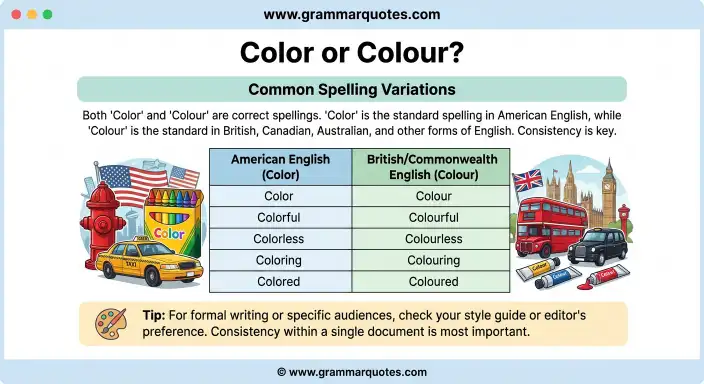
Color or colour is a common spelling question in English. Both spellings are correct, but they are used in different forms of English. Color is the standard spelling in American English, while colour is the standard spelling in British English.
For example, an American writer may describe a beautiful blue color, while a British writer may use the phrase blue colour. Both sentences are correct.
This difference often confuses English learners because the words have the same meaning and pronunciation. Learning when to use each spelling helps students improve their grammar, write clearly, and avoid mistakes in schoolwork or professional documents. It also helps content writers create articles for readers in different countries.
In this guide, you will learn the meanings, pronunciation, history, and grammar of color and colour. You will also explore their differences, common mistakes, everyday examples, and related words so you can choose the correct spelling with confidence.
Quick Answer: Color or Colour?
Color is correct in American English, while colour is correct in British English. Both words refer to the appearance of something, such as red, blue, green, or yellow. They have the same meaning and pronunciation. The main difference is regional spelling, not grammar or meaning.
| Feature | Color | Colour |
| English variety | American English | British English |
| Correct spelling | Yes | Yes |
| Meaning | The appearance of an object, such as red or blue | The same |
| Pronunciation | /ˈkʌl.ɚ/ | /ˈkʌl.ə/ |
| Common use | US publications and websites | UK publications and websites |
| Example | My favorite color is blue. | My favourite colour is blue. |
Meaning of Color and Colour
Definition
Color or colour (noun): The visual appearance of something based on the light it reflects or emits. Examples include red, blue, green, yellow, and purple.
The word can also describe a person’s complexion, a distinctive quality, or something that makes a story more interesting or lively.
Examples
- The color of the sky changed at sunset.
- Her favourite colour is purple.
- The artist used bright colors to make the painting more lively.
- The writer added colour to the story with vivid details.
Color or Colour as a Verb
Both spellings can also be used as verbs. They mean to add color to something or to change its appearance.
American English:
- The children will color the picture.
- She colored the drawing with blue pencils.
British English:
- The children will colour the picture.
- She coloured the drawing with blue pencils.
Connotative Meaning
Connotation (the feelings or ideas a word suggests beyond its basic meaning) explains how a word can create different impressions.
- Positive tone: Color can suggest beauty, happiness, creativity, and energy. For example, bright colors may create a cheerful feeling.
- Negative tone: The word can suggest warning, danger, or strong emotion in phrases such as a red warning light or a colorful argument.
- Neutral tone: Color or colour can simply identify the visual appearance of an object, such as the color of the wall.
The spelling itself does not change the tone or meaning.
Etymology of Color and Colour
Origin of the Words
- Source language: Both spellings come from the same historical word.
- Latin origin: The word comes from Latin color, meaning color, appearance, or complexion.
- French influence: Old French colour helped shape the spelling used in British English.
- American spelling: American English later adopted the shorter form color as part of a broader spelling tradition associated with Noah Webster.
Short History of Color and Colour
Old English (450–1100): The modern forms color and colour were not standard English spellings during most of this period. English speakers used older words to describe appearance and visual qualities.
Middle English (1100–1500): French and Latin influenced English vocabulary and spelling. Forms related to colour became established through French influence.
Modern English (1500–Present): Both spellings developed into standard forms. British English generally retained colour, while American English increasingly used color. Today, both are correct within their respective spelling systems.
Pronunciation of Color and Colour
US and UK Pronunciation
- Color, US: /ˈkʌl.ɚ/
- Colour, UK: /ˈkʌl.ə/
The exact pronunciation can vary slightly by accent. In both varieties, the word has two syllables and begins with a sound similar to “kuhl.”
Syllables
col or (two syllables)
Both spellings have the same syllable pattern.
Affixation Pattern of Color and Colour
Root
Color/colour is the base word.
Prefix
Neither spelling has a prefix in its basic form.
Suffix
The words can take common English suffixes to create related forms. The regional spelling difference usually remains.
Word Formation
- Color/colour (noun): The visual appearance of something.
- Colorful/colourful (adjective): Full of color or visually interesting.
- Colorless/colourless (adjective): Without color or lacking liveliness.
- Colorfully/colourfully (adverb): In a colorful way.
- Coloring/colouring (noun or verb form): The process of adding color.
- Colored/coloured (adjective or verb form): Having color or having had color added.
- Discolor/discolour (verb): To change the color of something, often in an unwanted way.
- Discoloration/discolouration (noun): A change in the normal color of something.
- Multicolor/multicolour (adjective or noun): Having several colors.
- Recolor/recolour (verb): To give something a new color.
American English generally uses the shorter color spelling in these word forms, while British English generally retains the u in colour.
Color vs Colour: Main Differences
1. American English Uses Color
In the United States, color is the standard spelling in schools, books, newspapers, and websites.
Examples:
- What is your favorite color?
- The artist used color to express emotion.
- Please color the picture carefully.
2. British English Uses Colour
In the United Kingdom, colour is the standard spelling. It is also common in several other English varieties, including Australian and New Zealand English.
Examples:
- What is your favourite colour?
- The artist used colour to express emotion.
- Please colour the picture carefully.
3. The Meaning Is the Same
There is no difference in meaning between the two spellings. Both describe visual appearance and can be used as nouns or verbs.
4. Consistency Matters
Choose the spelling system that matches your audience. If you are writing for an American audience, use color, favorite, and organize. If you are writing for a British audience, use colour, favourite, and organise where appropriate.
British vs American English
Spelling Comparison Table
| American English | British English |
| Color | Colour |
| Colors | Colours |
| Colored | Coloured |
| Coloring | Colouring |
| Colorful | Colourful |
| Colorless | Colourless |
| Discolor | Discolour |
| Discoloration | Discolouration |
| Multicolor | Multicolour |
| Recolor | Recolour |
The spelling patterns are similar across these word families. However, some related words have additional regional differences, so check a dictionary when you are unsure.
Which Spelling Should You Use?
Use Color for American Readers
Choose color when writing for an American audience or following an American style guide. It is suitable for school assignments, business documents, websites, and creative writing intended for US readers.
Examples:
- The color of the car is black.
- The website uses color to highlight important information.
Use Colour for British Readers
Choose colour when writing for a British audience or following British spelling conventions.
Examples:
- The colour of the car is black.
- The website uses colour to highlight important information.
What About International English?
For international websites, either spelling can work. The important thing is to follow one spelling system consistently. If most of your readers are in the United States, color may be the better choice. If your readers mainly live in the UK, colour is more suitable.
Common Mistakes with Colour and Color
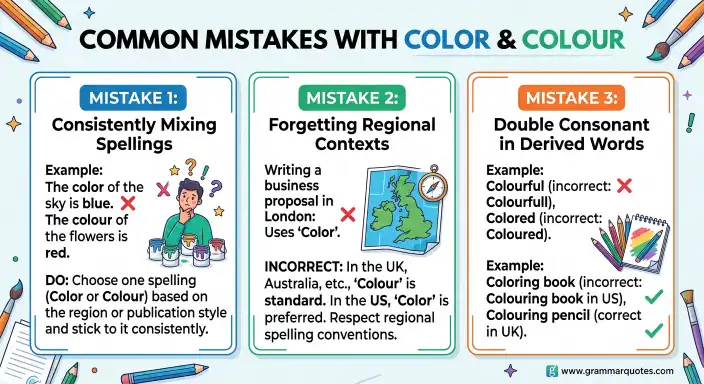
1. Mixing American and British Spellings
A common mistake is using color in one paragraph and colour in another without a reason.
Incorrect for consistent American English:
- My favorite colour is blue.
Correct American English:
- My favorite color is blue.
Correct British English:
- My favourite colour is blue.
2. Thinking One Spelling Is Always Wrong
Neither spelling is universally wrong. The correct choice depends on the type of English you are using.
- American English: color
- British English: colour
3. Forgetting Related Word Forms
The same regional spelling pattern often appears in related words.
- American: colorful, colored, coloring.
- British: colourful, coloured, colouring.
4. Changing Spelling in Formal Writing
When writing an essay, report, or article, follow the spelling conventions required by your school, employer, publisher, or target audience.
5. Confusing Spelling with Pronunciation
The letter u in colour does not create a different meaning. The words are pronounced similarly, with minor differences depending on accent.
Everyday Examples of Color and Colour
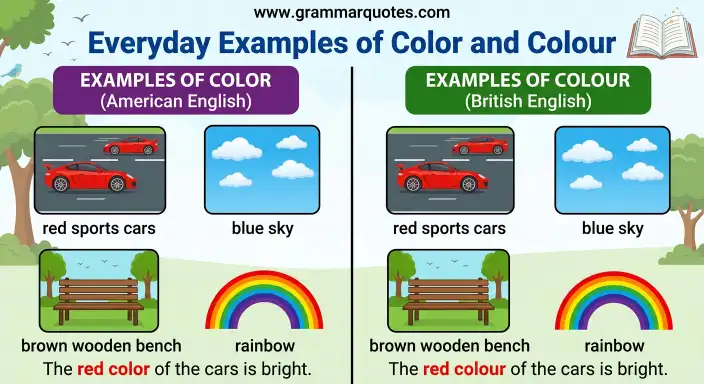
In Daily Conversation
- American: I love the color of your shirt.
- British: I love the colour of your shirt.
In School
- American: Write the name of each color under the picture.
- British: Write the name of each colour under the picture.
For Art
- American: The painter used warm colors in the landscape.
- British: The painter used warm colours in the landscape.
For Business
- American: The company changed the color of its logo.
- British: The company changed the colour of its logo.
In Science
- American: Light can separate into different colors.
- British: Light can separate into different colours.
In Creative Writing
- American: The garden was full of color in spring.
- British: The garden was full of colour in spring.
Digital Design
- American: Choose a background color for your website.
- British: Choose a background colour for your website.
Quick Comparison: Color or Colour?
| Question | Answer |
| Is color correct? | Yes, in American English. |
| Is colour correct? | Yes, in British English. |
| Do they mean different things? | No, their meaning is the same. |
| Are they pronounced differently? | Usually very similarly, with some accent variation. |
| Which spelling should students learn? | Follow the spelling system required by their school or exam. |
| Which spelling is better for a website? | Use the spelling that matches your main audience. |
Key Takeaways
- Color is standard in American English.
- Colour is standard in British English.
- Both spellings have the same meaning.
- Both can function as nouns and verbs.
- Related words follow similar regional patterns, such as colorful/colourful.
- Consistency matters more than choosing one spelling for every country.
- Always consider your audience, style guide, or school requirements.
People Also Ask
1. Is color or colour correct?
Both are correct. American English uses color, while British English uses colour.
2. Why do Americans spell colour without a u?
American spelling conventions favored shorter forms in many words. The spelling color became standard in the United States.
3. Do color and colour sound the same?
They usually sound the same or very similar. Accent can affect the final vowel sound.
4. Is colour British English?
Yes. Colour is the standard spelling in British English and is also used in several other varieties, including Australian English.
5. Which spelling should I use in an IELTS essay?
Follow the spelling system you can use accurately and consistently. Both British and American spellings are accepted, but avoid mixing them unnecessarily.
Frequently Asked Questions
1. Is color a noun or a verb?
It can be both. As a noun, it describes visual appearance. As a verb, it means to add color or change something’s appearance.
2. Is colourful or colorful correct?
Both are correct. Colorful is American English, while colourful is British English.
3. Does Canada use color or colour?
Canadian English generally uses colour, although some American spellings appear in certain contexts. Follow the relevant Canadian style guide when needed.
4. Is color used in Australia?
Australian English generally uses colour, following British spelling conventions.
5. Is it colorize or colourise?
Both forms exist. Colorize is common in American English, while colourise may be used in British style spelling. Usage can vary by context.
6. Should I use color or colour on my website?
Choose the spelling that best matches your main audience. For a US audience, use color. For a UK audience, use colour. Keep the choice consistent across your website.
Conclusion
Understanding color or colour is a simple way to improve your English spelling and writing skills. Both words are correct, but they belong to different spelling systems. American English uses color, while British English uses colour. The meaning, basic grammar, and use of the word remain the same.
Learning regional spelling differences helps English learners avoid mistakes and write with greater confidence. It also helps content writers create a consistent style for their target audience. Remember that related forms follow similar patterns, such as colorful and colourful, or colored and coloured.
To improve your vocabulary, practise reading both American and British English. Notice the spelling patterns and choose the one that suits your purpose. With regular practice, you will become more confident in choosing the right spelling for essays, websites, emails, and everyday communication.
Discover More Articles!
License or Licence: Correct Spelling, Meaning, and Examples
Catalog or Catalogue: Which Spelling Is Correct?(2026)
Theater or Theatre: Which Spelling Is Correct?(2026)

Ethan Parker is an English-language writer known for his interest in words, language, and clear communication. His work focuses on making everyday English easier to understand through simple explanations and practical examples.