License and licence are both correct spellings, but their use depends on the variety of English and the part of speech.
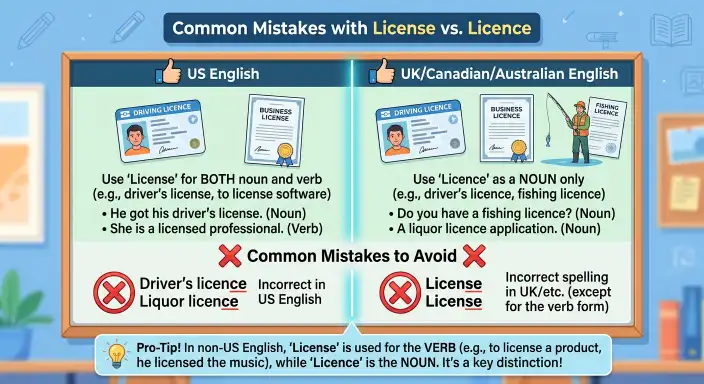
In American English, license is used as both a noun and a verb. In British English, licence is the noun, while license is the verb.
For example, an American writer may say, “I renewed my driver’s license,” while a British writer may write, “I renewed my driving licence.” Both forms are correct in their respective spelling systems.
The difference can be confusing because the two words have the same meaning and almost the same pronunciation.
They refer to official permission to do something, such as driving a car, running a business, or using certain materials. The spelling changes according to regional rules, not the meaning.
If you are writing an essay, website article, business document, or official application, it is important to choose the form that matches your audience.
This guide explains the meaning, spelling rules, British and American usage, common mistakes, and practical examples of license or licence so you can use each form confidently.
License or Licence: Quick Answer
License is the standard spelling for both the noun and verb in American English. In British English, licence is used as a noun, while license is used as a verb.
| English variety | Noun | Verb |
| American English | License | License |
| British English | Licence | License |
| Canadian English | Often licence as a noun and license as a verb | License |
Quick rule: In American English, use license for everything. In British English, use licence for a thing or document and license for the action of granting permission.
Canadian usage can follow the British noun and verb distinction, although official terminology and style guides should be checked for specific contexts.
What Do License and Licence Mean?
Both spellings refer to permission granted by an authority or organization. The spelling depends on regional conventions and, in British English, if the word functions as a noun or a verb.
What Does License Mean?
In American English, license can be a noun or a verb.
As a noun, it means official permission or a document that proves someone has permission to do something.
Examples:
- I renewed my driver’s license.
- She has a business license.
- The restaurant needs a special license to operate.
As a verb, license means to grant official permission.
Examples:
- The state will license the new business.
- The agency can license qualified professionals.
- The company is authorized to license its software.
What Does Licence Mean?
In British English, licence is the noun form. It refers to permission or a document that grants permission.
Examples:
- He applied for a driving licence.
- The shop has a valid business licence.
- She showed her licence to the official.
In British English, the verb is spelled license, not licence.
Example:
- The authority will license the new company.
Do License and Licence Have Different Meanings?
No. When used as nouns, license and licence have the same basic meaning. The difference is mainly regional spelling.
However, the grammatical role matters in British English:
- Licence is the noun.
- License is the verb.
In American English, license is used for both.
Origin of License and Licence
The word license comes through French from Latin roots associated with permission and freedom to do something. Over time, it became a common English word for official authorization.
The spelling difference developed through regional English conventions. American English generally standardized license for both noun and verb uses. British English developed a distinction between licence as a noun and license as a verb.
This spelling pattern is similar to other British English noun and verb pairs, such as advice and advise. In these pairs, the endings help distinguish the grammatical role of the word.
Today, both license and licence are established forms. Neither is universally wrong. The correct choice depends on the English variety, the word’s function, and the style guide used by a publication or organization.
British English vs American English
The main difference is how the two English varieties spell the noun form.
| Feature | American English | British English |
| Noun spelling | License | Licence |
| Verb spelling | License | License |
| Driver’s document | Driver’s license | Driving licence |
| Business permission | Business license | Business licence |
| Action of granting permission | License | License |
| Meaning | Official permission | Official permission |
Which Spelling Is Used in Other Countries?
English spelling conventions can vary by country and by official organization.
- United States: License is used as both a noun and a verb.
- United Kingdom: Licence is the noun, while license is the verb.
- Canada: Licence is commonly used as a noun and license as a verb, but official terminology may vary.
- Australia: British style spelling conventions commonly use licence as a noun and license as a verb.
- International English: Follow the spelling system required by your audience, publisher, institution, or official authority.
For legal or government documents, always follow the terminology used by the relevant agency. Official names and forms may have their own conventions.
Which Spelling Should You Use?
Choosing between license and licence becomes easy when you know your audience and how the word is used in the sentence.
1. Use License for American English
If your readers are mainly in the United States, use license as both a noun and a verb.
Examples:
- I need to renew my driver’s license.
- The company will license its new software.
- She applied for a business license.
This spelling follows standard American English usage.
2. Use Licence as a Noun in British English
For British English writing, use licence when referring to a document or permission.
Examples:
- He has a valid driving licence.
- The restaurant needs a special licence.
- Her television licence must be renewed.
3. Use License as a Verb in British English
When describing the action of granting official permission, British English uses license.
Examples:
- The council will license the business.
- The organization is authorized to license the product.
- The authority can license qualified applicants.
Remember that the noun and verb have different spellings in British English.
4. Follow Your School or Workplace Style Guide
Teachers, universities, businesses, and publishers may require a specific English variety. Follow their rules even if you normally use a different spelling.
For example, an American style essay should normally use license as a noun. A British style essay should use licence as a noun and license as a verb.
5. Keep Your Spelling Consistent
Avoid mixing American and British spelling conventions without a reason. If your article follows British English, use licence for the noun throughout the article. If it follows American English, use license for both forms.
Consistency makes your writing clearer and more professional.
Common Mistakes With Licence and License
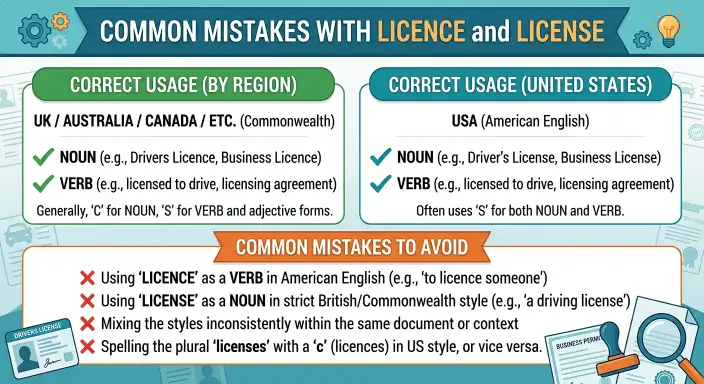
Writers often assume that one spelling is always wrong. Others forget that British English distinguishes between noun and verb forms.
| Common mistake | Correct form | Explanation |
| Writing licence as a noun in standard American English | License | American English uses license for the noun. |
| Writing license as a British noun | Licence | British English uses licence for the noun. |
| Writing licence as a British verb | License | The British verb is license. |
| Assuming the words have different meanings | Same basic meaning | The spelling difference depends on regional usage. |
| Switching spelling styles in one article | Follow one style consistently | Consistency improves readability. |
Mistake 1: Using Licence as an American Noun
Less suitable for standard American English: I renewed my driver’s licence.
Preferred American form: I renewed my driver’s license.
The American spelling uses license for both the document and the action of granting permission.
Mistake 2: Using License as a British Noun
Less suitable for standard British English: She has a driving license.
Preferred British form: She has a driving licence.
In British English, the noun is usually licence. However, always check the terminology used by the relevant organization.
Mistake 3: Spelling the British Verb as Licence
Incorrect in standard British usage: The council will licence the business.
Correct: The council will license the business.
The verb takes an s in both American and British English.
Memory tip: In British English, the noun ends in ce and the verb ends in se. In American English, both use license.
Everyday Examples of License and Licence
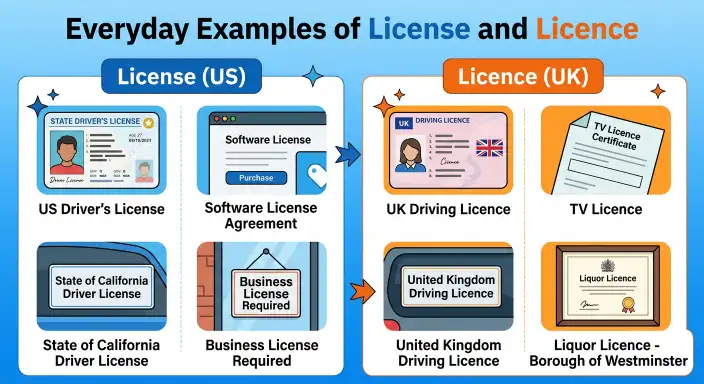
These examples show how the spellings work in daily conversation, business, official documents, and online content.
1. In Daily Conversation
American English:
- I forgot my driver’s license at home.
- My brother needs to renew his license.
- She finally received her driving license.
British English:
- I forgot my driving licence at home.
- My brother needs to renew his licence.
- She finally received her driving licence.
2. In Business Writing
American English:
- The company needs a business license.
- The developer will license the software to another firm.
British English:
- The company needs a business licence.
- The developer will license the software to another firm.
Notice that the verb remains license in both varieties.
3. In Academic Writing
- Students should understand the rules for using a software license.
- The university may license certain educational materials.
- Researchers must follow the terms of the relevant licence when using protected resources.
The spelling should match the variety of English used in the rest of the paper.
4. In News Headlines
- Driver’s License Rules Change in the State
- New Driving Licence Requirements Announced
- Council to License More Local Businesses
Headlines should follow the publication’s regional spelling conventions.
5. In Emails and Professional Messages
American English:
- Please send a copy of your business license.
- We are waiting for the authority to license the new service.
British English:
- Please send a copy of your business licence.
- We are waiting for the authority to license the new service.
6. In Blogs and Social Media
- Do you need a license to start this business?
- Check if your driving licence is still valid.
- The company plans to license its technology to other businesses.
- License or licence? The answer depends on your English variety.
These examples are useful for grammar lessons, educational websites, and spelling comparison articles.
License or Licence: Google Trends and Modern Usage
Both spellings appear in online searches, but their usage depends on location and grammatical function. License is the standard form in American English for both nouns and verbs. Licence is commonly used as a noun in British English and in other varieties that follow the same distinction.
Google Trends can help writers compare interest in license and licence across countries and over selected periods. However, search interest does not prove that one spelling is universally correct. Search results may reflect local spelling conventions, official documents, or the type of information people are seeking.
For content, choose the spelling that best matches your audience. An article aimed at American readers should generally use license. An article aimed at British readers should use licence for the noun and license for the verb.
You can also include both spellings naturally when the article explains their differences. This helps readers understand regional usage without making the content repetitive.
Avoid adding unsupported search volume figures or claiming that one form is more popular everywhere. The most reliable approach is to use the correct spelling for the intended audience and follow an established style guide.
Licence vs License: Quick Comparison Table
Use this table to review the main rules at a glance.
| Question | License | Licence |
| Correct in American English? | Yes | Generally not the standard noun spelling |
| Correct in British English? | Yes, as a verb | Yes, as a noun |
| Can it be a noun? | Yes, in American English | Yes, in British English |
| Can it be a verb? | Yes | Not in standard British usage |
| Refers to permission? | Yes | Yes |
| Example | I have a license. | I have a licence. |
| Example as a verb | They license the product. | They license the product. |
The key difference is grammatical role in British English and regional spelling in American English.
Key Takeaways
- License is the standard spelling for both noun and verb in American English.
- Licence is the noun spelling in British English.
- License is the verb spelling in both American and British English.
- Both words relate to official permission or authorization.
- Canadian and Australian usage commonly follows the noun and verb distinction, but official conventions can vary.
- Follow your institution, employer, publisher, or government agency’s style guide.
- Keep spelling consistent throughout your writing.
The easiest rule to remember is this: American English uses license for everything, while British English uses licence as a noun and license as a verb.
People Also Ask About License or Licence
1. Is it license or licence?
Both spellings are correct. American English uses license for both noun and verb, while British English uses licence as a noun and license as a verb.
2. Is licence British or American English?
Licence is commonly used as a noun in British English. American English normally uses license for the noun.
3. Is license a noun or a verb?
In American English, license can be both a noun and a verb. In British English, it is normally the verb, while licence is the noun.
4. Does Canada use license or licence?
Canadian English commonly uses licence as a noun and license as a verb. For official documents, follow the relevant Canadian authority’s terminology.
5. Why does British English use licence and license?
British English uses different spellings to distinguish the noun from the verb. The noun is licence, while the verb is license.
Frequently Asked Questions (FAQs)
1. Which spelling should I use in an American essay?
Use license for both noun and verb forms. This is the standard American English spelling.
2. Which spelling should I use in a British essay?
Use licence as a noun and license as a verb. Follow any specific style rules provided by your school or publisher.
3. Is driving licence correct?
Yes. Driving licence is standard British English. In American English, the usual phrase is driver’s license.
4. Do license and licence sound different?
They are generally pronounced the same way. The difference is in spelling and, in British English, grammatical function.
5. Can I use both spellings in the same article?
Yes, when you are comparing the two forms or quoting official names. Otherwise, choose the spelling system that matches your audience and use it consistently.
Conclusion
Choosing between license or licence depends on the variety of English you are using and the role the word plays in your sentence. In American English, license is used for both a noun and a verb. In British English, licence is the noun, while license is the verb. Both forms refer to permission or official authorization, so the main difference is spelling rather than meaning.
If you are writing an article, school assignment, business email, or official document, first identify your audience. American readers generally expect license, while British readers generally expect licence when the word refers to a document or permission. For the action of granting permission, use license in both varieties.
Remember the simple rule: American English uses license for both forms; British English uses licence for the noun and license for the verb. Following this rule will help you write more accurately, avoid common spelling mistakes, and keep your content consistent. When dealing with legal or government documents, always check the terminology used by the relevant authority.
Discover More Articles!
Army or Marines: Meaning, Differences, Roles, and Examples
Love or Hate: Meaning, Differences and Examples
Bait or Retardation: Meaning, Differences, and Correct Usage

Ethan Parker is an English-language writer known for his interest in words, language, and clear communication. His work focuses on making everyday English easier to understand through simple explanations and practical examples.