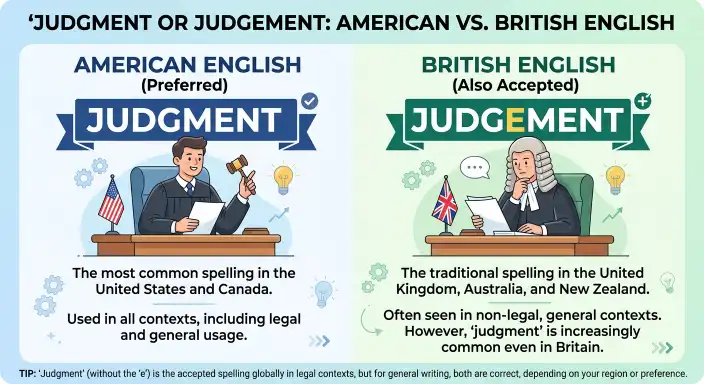
Judgment and judgement are both correct spellings, but their use depends on the variety of English and the context. Judgment is the preferred spelling in American English and is also widely used in legal writing. Judgement is common in British English, especially in general writing. Both words have the same meaning: an opinion, decision, or ability to make sensible choices.
If you are writing for an American audience, choose judgment. If you are following British English, judgement is often suitable for everyday writing. However, British legal writing commonly uses judgment for a court’s decision. The most important rule is to follow your audience’s spelling conventions and remain consistent throughout your writing.
Although the difference is only one letter, choosing the right spelling can make your writing look more professional. Students, bloggers, editors, and business writers may come across both forms in books, articles, legal documents, and online content. Understanding the difference helps you avoid spelling mistakes and use the word with confidence.
Judgment or Judgement: Quick Answer
Judgment is the standard spelling in American English, while judgement is commonly used in British English for general meanings. Both spellings refer to a decision, an opinion, or the ability to make sensible choices.
| Spelling | Common usage | Example |
| Judgment | American English; widely used in legal writing | The judge delivered the final judgment. |
| Judgement | Common in British English general writing | Good judgement comes with experience. |
Quick rule: Use judgment for American English and formal legal writing unless a specific style guide requires otherwise. Use judgement for general British English writing when it matches your chosen style.
What Do Judgment and Judgement Mean?
The words judgment and judgement have the same meaning. The difference is spelling, not definition.
Definition of Judgment
Judgment is a noun that describes the process of making a decision, forming an opinion, or evaluating a situation. It can also refer to an official decision made by a court.
Examples:
- Her judgment helped the team avoid a costly mistake.
- The court announced its judgment on Monday.
- You should use good judgment when making important decisions.
Definition of Judgement
Judgement has the same meanings as judgment. It is a common spelling in British English, particularly in everyday writing.
Examples:
- His judgement was based on years of experience.
- She showed excellent judgement during the meeting.
- The final judgement changed everyone’s plans.
In both forms, the word can describe a person’s decision making ability, an opinion about someone or something, or a formal legal decision.
Remember: Neither spelling is automatically wrong. The right choice depends on the English variety, context, and style guide you are following.
Origin of Judgment and Judgement
The word judgment comes through Old French from Latin roots associated with judging and making decisions. It developed as a term for the act of forming an opinion, reaching a decision, or deciding a legal case.
The spelling difference developed through variations in English usage. American English generally settled on judgment, without the extra e. British English retained or adopted judgement in many general contexts, although judgment also remains established, especially in legal language.
Over time, both spellings became accepted. Today, readers can understand either form, but the preferred spelling may change according to the country, publication, or type of document.
For example, an American newspaper will usually write good judgment, while a British writer may prefer good judgement. A British court document may still use judgment when referring to the court’s formal decision.
British English vs American English
The main difference between these spellings is regional preference. American English strongly favors judgment, while British English often uses judgement in general writing.
| Feature | American English | British English |
| Preferred general spelling | Judgment | Judgement is common |
| Alternative spelling | Judgement may appear | Judgment is also accepted |
| Legal decisions | Judgment | Judgment is widely used |
| Everyday writing | Good judgment | Good judgement |
| Meaning | Decision or opinion | Decision or opinion |
| Pronunciation | Generally the same | Generally the same |
Which Spelling Is Used in Other Countries?
English speaking countries do not always follow one identical spelling rule.
- United States: Judgment is the standard choice.
- United Kingdom: Judgement is common in general writing, while judgment is frequent in legal contexts.
- Canada: Judgment is widely used, including in formal and legal writing. Usage can vary by publication.
- Australia: Judgement is common in general writing, but judgment is also used, particularly in legal contexts.
- International English: Either spelling may appear. Follow the relevant organization’s preferred style.
These are general patterns, not absolute rules for every writer or publication.
Which Spelling Should You Use?
Choosing between judgment and judgement is simple when you know your audience and purpose.
1. Use Judgment for American English
If your readers are mainly in the United States, judgment is the best choice. It is the standard spelling in American English and is widely recognized in schools, businesses, newspapers, and professional documents.
Example: The manager used good judgment when selecting the right candidate.
2. Use Judgement for General British English Writing
If you are writing for a British audience, judgement is a common choice in general writing. It appears in books, articles, educational materials, and everyday communication.
Example: Making the right decision requires patience and sound judgement.
However, remember that British English also uses judgment, especially for formal legal decisions.
3. Follow the Required Style Guide
Academic institutions, newspapers, publishers, and businesses may have their own spelling rules. If a style guide specifies one form, use that spelling throughout your work.
For example, a university assignment following American English should normally use judgment. A British publication may prefer judgement in general prose.
4. Be Careful With Legal Writing
Legal writing deserves special attention because judgment is widely established as the spelling for a court’s decision in both American and British legal contexts.
Example: The court issued its judgment after reviewing the evidence.
If you are preparing a legal document, check the terminology used by the relevant court or legal authority.
5. Keep Your Writing Consistent
Do not switch between judgment and judgement without a clear reason. Consistency makes an article, essay, report, or website look polished.
For instance, if you choose judgement for a British English article, use that form consistently in ordinary prose unless you are quoting a source or following a specific legal convention.
Common Mistakes With Judgement and Judgment
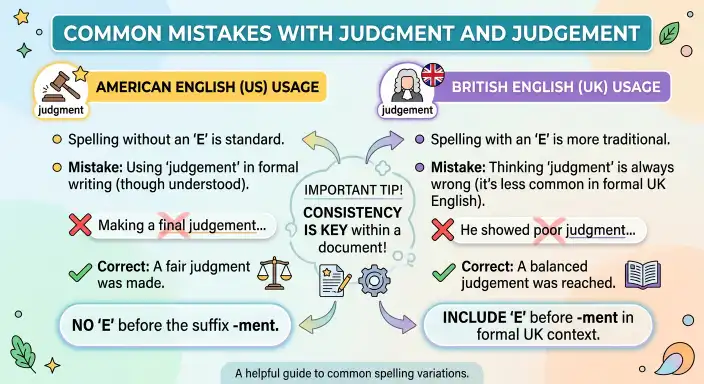
Writers sometimes assume that one spelling is always incorrect. Others use the two forms interchangeably in the same document. Understanding the difference prevents these common errors.
| Incorrect approach | Better approach | Explanation |
| Calling judgement incorrect in every context | Recognize both accepted forms | Both spellings are used in English. |
| Using judgement in American writing without a reason | Use judgment | It is the standard American form. |
| Assuming British legal writing always uses judgement | Check the legal context | Judgment is widely used for court decisions. |
| Switching spellings throughout one article | Choose one consistent form | Consistency improves readability. |
| Thinking the words have different meanings | Treat them as spelling variants | Their meanings are the same. |
Mistake 1: Believing Judgement Is Always Wrong
This is a common misconception. Judgement is an accepted spelling, especially in British English general writing.
Incorrect claim: Judgement is never correct.
Correct explanation: Both judgment and judgement are accepted spellings, although their preferred uses differ.
Mistake 2: Using the British Form in American Content
If your audience is American, judgement may look inconsistent with the spelling conventions they expect.
Less suitable for standard American writing: She showed excellent judgement.
Preferred American form: She showed excellent judgment.
Mistake 3: Ignoring Legal Conventions
The spelling used for a court decision may follow a legal authority’s established terminology rather than the general regional preference.
For example: The judge delivered the final judgment.
Memory tip: American English usually uses judgment. British English often uses judgement in general writing, but judgment remains common in legal writing.
Everyday Examples of Judgment and Judgement
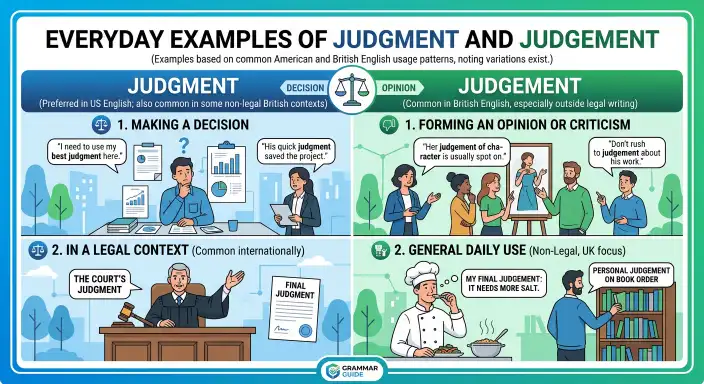
Seeing both spellings in real sentences makes the difference easier to remember. The examples below show how each form can fit naturally into everyday communication.
1. In Daily Conversation
- You showed excellent judgment by waiting before making a decision.
- Her judgement of the situation was accurate.
- Good judgment can help you solve difficult problems.
2. In Business Writing
- The manager’s judgment helped the company choose a suitable strategy.
- We trust your judgement when evaluating new opportunities.
- Careful judgment is essential when managing a team.
Choose the spelling that matches the English variety used by your company or clients.
3. In Academic Writing
- Critical thinking requires careful judgment.
- The student’s judgement was influenced by the available evidence.
- Researchers must use sound judgment when interpreting results.
For academic work, follow your institution’s preferred English style and apply it consistently.
4. In Legal Writing
- The court delivered its judgment after considering the case.
- The lawyer reviewed the written judgment before advising the client.
- The final judgment explained the court’s decision.
In legal contexts, judgment is widely established. Always follow the terminology used by the relevant court or authority.
5. In Emails and Professional Messages
- Thank you for your judgment and guidance during the project.
- We appreciate your judgement in handling this matter.
- Your sound judgment helped us reach a practical solution.
Both examples can be correct. The preferred spelling depends on the style used in the message.
6. In News Headlines
- Court Delivers Judgment in Major Case
- Leaders Question the Judgement Behind the Decision
- Good Judgment Remains Essential in Public Life
Headlines usually follow the publication’s own style guide.
7. In Blogs and Social Media
- Good judgment comes from learning and experience.
- Trust your judgement, but consider the facts.
- One decision does not define your entire judgment.
For blog posts and social media, choose a spelling that matches your target audience and use it consistently.
Judgment or Judgement: Google Trends and Modern Usage
Both spellings appear in modern English, but their popularity varies by region and context. Judgment is the dominant form in American English, while judgement remains common in British English general writing.
Google Trends can help writers explore search interest for the two terms across countries and over selected periods. However, search interest is not the same as a spelling’s correctness, and it does not directly measure how often a word appears in published writing.
When researching the terms, compare the same time period and geographic region. You can also review dictionaries, newspaper style guides, and official legal documents to understand which form is preferred for your audience.
For content, consider the spelling your readers are most likely to search for. An American focused article will generally benefit from using judgment, while a British focused article may naturally use judgement in general prose.
Do not add unsupported search volume figures or claim that one spelling is universally more popular. The useful lesson is that regional preference and context matter more than declaring one form universally correct.
Judgment vs Judgement: Quick Comparison Table
Use this table as a quick reference whenever you are unsure which spelling belongs in your writing.
| Comparison point | Judgment | Judgement |
| Correct spelling? | Yes | Yes |
| American English | Preferred | Less common |
| British English | Accepted; common in legal contexts | Common in general writing |
| Meaning | Decision, opinion, or ability to decide wisely | Same meaning |
| Pronunciation | Generally the same | Generally the same |
| Court decision | Widely used | Less typical in many legal contexts |
| Best use | American content and many legal contexts | General British English prose |
| Main rule | Follow your style guide | Follow your style guide |
The key difference is regional spelling preference, not meaning. Neither spelling should be treated as universally wrong.
Key Takeaways
- Judgment is the standard spelling in American English.
- Judgement is common in British English general writing.
- Both words have the same meaning.
- Judgment is widely used for court decisions in both American and British legal contexts.
- Canadian and Australian usage may vary according to the publication or legal setting.
- Always follow the relevant dictionary, style guide, or institutional requirements.
- Keep your spelling consistent throughout an article, essay, or report.
The easiest way to remember the difference is to associate judgment with American English and judgement with general British English. This is a useful guideline, although legal writing may follow a different convention.
People Also Ask About Judgment or Judgement
1. Is it judgment or judgement?
Both are correct. Judgment is the standard American spelling, while judgement is common in British English general writing.
2. Is judgement British or American English?
Judgement is especially common in British English. American English generally prefers judgment.
3. Why does judgment have no E?
The spelling judgment follows the standard American form, which omits the extra e found in judgement. Both spellings have the same meaning.
4. Is judgment the correct spelling in legal writing?
Yes. Judgment is widely used for a court’s decision in American and British legal writing. Always check the relevant court’s terminology or style guide.
5. Does Canada use judgment or judgement?
Judgment is widely used in Canada, particularly in formal and legal writing. The spelling may vary depending on the publication and context.
Frequently Asked Questions (FAQs)
1. What is the difference between judgment and judgement?
There is no difference in meaning. The main difference is spelling preference: judgment is standard in American English, while judgement is common in British English general writing.
2. Is judgement a spelling mistake?
No. Judgement is an accepted English spelling. It is particularly common in British English, although judgment is also correct.
3. Which spelling should I use in an essay?
Use the spelling required by your teacher, university, or style guide. If no preference is given, choose the form that matches your variety of English and remain consistent.
4. Is it good judgment or good judgement?
Both phrases are correct. Good judgment is standard in American English, while good judgement is common in British English general writing.
5. Do judgment and judgement sound different?
Generally, no. Both spellings are pronounced the same way in ordinary English. The difference is mainly written, not spoken.
Conclusion
Choosing between judgment or judgement depends mainly on your audience and the type of writing you are producing. Both spellings are correct, and both refer to a decision, an opinion, or the ability to make sensible choices.
American English generally prefers judgment, while judgement is common in British English general writing. However, the spelling judgment is also widely used in British legal contexts, particularly when referring to a court’s decision.
If you are writing a school assignment, blog post, business email, or professional report, start by checking the spelling conventions required for your audience. When a style guide is available, follow it. If there is no specific requirement, choose the form that best matches your English variety and use it consistently throughout your work.
Remember this simple rule: judgment for American English, judgement for general British English, and judgment as a widely used legal term. With this distinction in mind, you can choose the appropriate spelling confidently and avoid unnecessary spelling mistakes.
Discover More Articles!
Bait or Retardation: Meaning, Differences, and Correct Usage
Love or Hate: Meaning, Differences and Examples
Army or Marines: Meaning, Differences, Roles, and Examples

Ethan Parker is an English-language writer known for his interest in words, language, and clear communication. His work focuses on making everyday English easier to understand through simple explanations and practical examples.