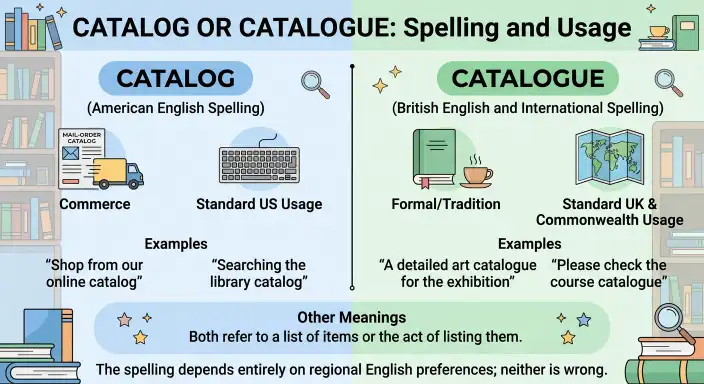
Have you ever wondered if to write catalog or catalogue? Both spellings are correct, and they have the same meaning. The main difference is regional preference. American English usually uses catalog, while British English generally prefers catalogue.
This spelling difference can confuse students, writers, editors, and English learners. You may see catalog on an American shopping website and catalogue in a British university brochure. Both words refer to an organized list of items, products, books, or other information.
Knowing which spelling to use can help you write more clearly and professionally. It is especially useful when preparing academic papers, business documents, product descriptions, and website content for readers in different countries.
In this guide, you will learn the meaning of catalog and catalogue, their origins, the differences between British and American English, and how to choose the right spelling for your audience.
You will also find practical examples, common mistakes, a comparison table, and answers to frequently asked questions.
Catalog or Catalogue: Quick Answer
The choice between catalog and catalogue depends mainly on the variety of English you use.
- Catalog: Preferred in American English.
- Catalogue: Preferred in British English and commonly used in several other English speaking regions.
Both words have the same meaning. Neither spelling is universally incorrect.
Examples:
- American English: I ordered a new sofa from the furniture catalog.
- British English: The university published its course catalogue.
- International business: Please check our online product catalog for the latest prices.
The third example uses the American spelling. A British company might use product catalogue instead.
Easy rule to remember: Use catalog for American readers and catalogue for British readers. If your organization follows a specific style guide, follow that guide.
What Does Catalog or Catalogue Mean?
A catalog or catalogue is an organized list of items, products, services, books, or other information. It often includes details that help people find, identify, compare, or select something.
Both spellings can be used as nouns and verbs.
Catalog or Catalogue as a Noun
As a noun, the word describes a collection or list of items arranged in an organized way.
Examples:
- The library has a digital catalog of its books.
- The museum printed a catalogue of its latest exhibition.
- The company sent customers a product catalog.
- Students can view the course catalogue online.
In each example, the word refers to an organized collection of information.
Catalog or Catalogue as a Verb
The word can also describe the act of making a list, recording information, or organizing items.
Examples:
- The librarian will catalog the new books.
- The museum plans to catalogue its historical objects.
- Researchers cataloged the documents for future study.
- The team has catalogued every item in the collection.
The spelling of the verb usually follows the same regional pattern as the noun.
Common Types of Catalogs and Catalogues
You may encounter this word in many areas of daily life.
- Product catalog: A list of products sold by a business.
- Library catalog: A searchable record of books and other library materials.
- Course catalogue: A list of university courses and their descriptions.
- Museum catalogue: A record of artworks, artifacts, or historical objects.
- Online catalog: A digital list that users can search through a website.
- Sales catalog: A collection of products and prices used for marketing.
These terms all refer to the same general concept. Only the preferred spelling may change by region.
The Origin of Catalog or Catalogue
The history of catalog and catalogue helps explain why English has two accepted spellings.
Both words ultimately come from the Greek word katalogos, meaning a list or register. The word passed through Latin and French before becoming established in English.
Over time, English developed different spelling conventions on either side of the Atlantic.
British English generally retained the ending logue or logue like forms in words such as catalogue and dialogue. American English often adopted shorter forms, including catalog and dialog, in everyday usage.
This pattern is not limited to one word. Similar differences appear in analog and analogue, although preferences vary by word and context.
Why Does American English Use Catalog?
American English often favors shorter spellings in certain word groups. The shorter form catalog became widely established in American publishing, commerce, education, and everyday writing.
This does not mean that the longer spelling is automatically wrong in the United States. Catalogue is still understood and may appear in particular publications or organizations.
Why Does British English Prefer Catalogue?
British English generally retains the longer spelling catalogue. It is common in British university materials, museum publications, business documents, and general writing.
The difference reflects established regional spelling habits rather than a difference in meaning or pronunciation.
British English vs American English
The key distinction between catalog and catalogue is the spelling convention used by the writer’s intended audience.
| British English | American English | Example |
| Catalogue | Catalog | Please check the product catalogue/catalog. |
| Dialog (less common in general British prose) / Dialogue | Dialog / Dialogue | We discussed the dialogue/dialog in the film. |
| Analogue | Analog | The device uses an analogue/analog signal. |
| Colour | Color | The colour/color is bright blue. |
| Centre | Center | The centre/center is near the station. |
| Organise | Organize | We organise/organize the files. |
The examples in this table show broader regional patterns. Some words have additional accepted forms, and not every spelling difference follows exactly the same rule.
Spelling Preferences in Different Regions
United States: Catalog is the usual choice in American English. You will commonly see it in retail websites, library systems, and business documents.
United Kingdom: Catalogue is the standard preference in most British English contexts.
Canada: Canadian English uses conventions influenced by both British and American English. Catalogue is common, but the preferred form can depend on the organization and publication.
Australia: Australian English generally favors catalogue, although individual businesses and digital platforms may use other forms.
International writing: The best choice depends on your target readers, publisher, or organization’s style guide.
Which Version Should You Use?
Choosing the right spelling is simple when you know who will read your work.
For Readers in the United States
Use catalog in most American English writing.
Example: Our online catalog includes more than 500 products.
This form is suitable for American product pages, sales materials, educational content, and general business communication.
For Readers in the United Kingdom
Use catalogue in British English writing.
Example: Please download the university course catalogue before applying.
This spelling is a natural choice for British academic and professional documents.
For Canadian and Australian Readers
Check the spelling conventions used by your institution, employer, or publisher. Catalogue is a common choice in both countries, but consistency with local editorial practice is more important than following a broad rule without checking.
For International Writing
If your website serves readers around the world, select one spelling convention and apply it consistently.
For example, an American e commerce website may use product catalog throughout its pages. A British retailer may use product catalogue.
You do not need to alternate between the spellings to make your content more international.
For Academic Writing
Follow the style guide required by your school, college, university, or journal. A publication may require American English, British English, or a specific institutional style.
The most important rule is consistency.
For Business Writing and
Match the language used by your intended market.
If you are writing a product page for American customers, catalog is a sensible choice. If your audience is primarily British, catalogue is usually more appropriate.
For , both spellings can be relevant search terms. However, do not insert both forms repeatedly into the same article simply to target more keywords. Use the natural spelling for your audience and mention the alternative once where it helps readers.
Common Mistakes With Catalog and Catalogue
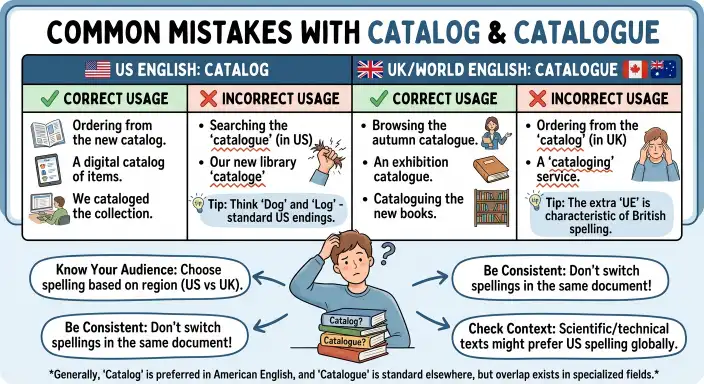
Although both forms are correct, writers can still make mistakes when using them.
Mistake 1: Treating Catalogue as Incorrect American English
Incorrect claim: Catalogue is always wrong in the United States.
Correct explanation: Catalog is the usual American spelling, but catalogue is also a recognized English spelling.
Memory tip: A regional preference is not the same as a universal grammar rule.
Mistake 2: Mixing Both Spellings in One Document
Inconsistent example: Our product catalog contains the latest items. Download the complete catalogue today.
Improved example: Our product catalog contains the latest items. Download the complete catalog today.
The second version uses American English consistently. A British version could use catalogue in both sentences.
Memory tip: Choose one spelling before you start writing.
Mistake 3: Assuming the Words Have Different Meanings
Incorrect claim: A catalog is a list of products, but a catalogue is a list of books.
Correct explanation: Both spellings can describe products, books, courses, museum objects, and other organized collections.
Memory tip: The ending changes, but the meaning stays the same.
Mistake 4: Forgetting the Verb Forms
The regional spelling difference can also appear in past tense forms.
| American English | British English |
| Catalog | Catalogue |
| Cataloged | Catalogued |
| Cataloging | Cataloguing |
Examples:
- American: The staff cataloged the books.
- British: The staff catalogued the books.
Follow the spelling convention used in the rest of your document.
Everyday Examples of Catalogue or Catalog

Here are practical examples showing how the word appears in different situations.
In Emails
American English: Please review the updated product catalog before Friday.
British English: Please review the updated product catalogue before Friday.
Both sentences are correct. Choose the version that matches your workplace’s style.
In Business Writing
American English: Our new catalog includes prices, descriptions, and product images.
British English: Our new catalogue includes prices, descriptions, and product images.
The word is useful in retail, manufacturing, wholesale, and other industries that organize products for customers.
In News Headlines
American English: Local Library Launches New Digital Catalog
British English: Local Library Launches New Digital Catalogue
News organizations generally follow their own editorial style, so spelling may vary between publications.
In Blog Posts
American English: How to Create a Product Catalog for Your Online Store
British English: How to Create a Product Catalogue for Your Online Store
If your blog targets a specific country, keep its spelling conventions consistent across related articles.
On Social Media
American English: Our latest catalog is now available online!
British English: Our latest catalogue is now available online!
Both versions work well for social media posts. The preferred form depends on your brand’s target market.
In Academic Writing
American English: Students can access the course catalog through the university website.
British English: Students can access the course catalogue through the university website.
Always check your institution’s preferred spelling conventions before submitting formal work.
In Daily Conversation
American English: Did you see the new furniture catalog?
British English: Have you seen the new furniture catalogue?
The word is common in shopping, education, libraries, and discussions about organized collections.
Google Trends and Modern Usage
People search for catalog or catalogue because they want to know which spelling is correct, if the words have different meanings, and which form they should use in professional writing.
The question is especially relevant to English learners, content writers, editors, online retailers, and students preparing academic documents.
Regional Popularity
General English usage shows a clear regional preference:
- Catalog is more strongly associated with American English.
- Catalogue is more strongly associated with British English and is also used in other English speaking countries.
These are general language patterns, not a claim about a measured search volume difference.
Modern Digital Usage
Online shopping, university websites, library databases, and digital publishing have made both forms easy to encounter. A reader may see one spelling on an American website and the other on a British website within minutes.
Both remain useful in modern English.
Why Do People Search for Both Spellings?
There are three main reasons:
- Spelling uncertainty: Readers want to know if the shorter form is correct.
- Regional differences: Writers need to match American or British English.
- Professional consistency: Businesses and publishers want a consistent spelling across websites and documents.
Google Trends can be used to compare search interest for the two terms over a selected period and region. However, without checking current, region specific data, it would be misleading to claim that one spelling has a particular search volume advantage.
For practical writing, the most reliable approach is to choose the form that suits your readers and use it consistently.
Catalog vs Catalogue: Quick Comparison Table
| Version | Meaning | Correct? | Region | Example |
| Catalog | An organized list of items | Yes | Mainly US | View our online catalog. |
| Catalogue | An organized list of items | Yes | Mainly UK | View our online catalogue. |
| Cataloged | Recorded or listed items | Yes | Mainly US | The books were cataloged. |
| Catalogued | Recorded or listed items | Yes | Mainly UK | The books were catalogued. |
| Cataloging | The process of organizing records | Yes | Mainly US | Cataloging takes time. |
| Cataloguing | The process of organizing records | Yes | Mainly UK | Cataloguing takes time. |
The table shows that both spellings are accepted. The regional distinction also appears in common verb forms.
Key Takeaways
- Catalog is the preferred spelling in American English.
- Catalogue is the preferred spelling in British English.
- Both words have the same meaning.
- Both forms can refer to products, books, courses, services, and collections.
- The spelling difference can also affect forms such as cataloged and catalogued.
- Canadian and Australian usage may depend on the publisher or organization’s style guide.
- Use one spelling consistently throughout an article, website, or academic paper.
- For , focus on your audience and natural language instead of repeating both spellings unnecessarily.
Frequently Asked Questions
Is catalog or catalogue correct?
Both catalog and catalogue are correct. The shorter form is preferred in American English, while the longer form is generally preferred in British English. They have the same meaning and can be used for lists of products, books, courses, and other items. Your choice should depend on your intended audience or the style guide you follow.
What is the difference between catalog and catalogue?
The main difference is regional spelling. American English usually uses catalog, while British English generally uses catalogue. Neither word has a different meaning because of its spelling. Both describe an organized list or record of items, such as products in a store or books in a library.
Is catalogue British or American English?
Catalogue is most closely associated with British English. It is widely used in British writing and is also common in other English speaking regions, including Australia. American English generally prefers catalog, although the longer spelling is still understood and accepted.
Is catalog American English?
Yes. Catalog is the standard preferred spelling in American English. It is common in product listings, library systems, retail websites, and business documents. Writers preparing content for an American audience will usually choose catalog rather than catalogue.
Is catalogue wrong in American English?
No. Catalogue is a recognized English spelling and is not automatically incorrect in the United States. However, catalog is the more typical American choice. In formal writing, follow the spelling conventions of your publisher, school, or organization.
What is the plural of catalog and catalogue?
The plural forms are catalogs and catalogues, respectively. For example, an American retailer might publish several product catalogs, while a British retailer might publish several product catalogues. Both plurals are correct when used according to their respective spelling conventions.
Should I use catalog or catalogue for ?
Choose the spelling that matches your target audience. Use catalog when writing primarily for American readers and catalogue for British readers. You can mention the alternative spelling naturally if it helps explain the regional difference. Avoid keyword stuffing, and keep your spelling consistent throughout the page.
Is it cataloged or catalogued?
Both forms are correct. Cataloged is the preferred American spelling, while catalogued is more common in British English. Both describe the act of recording or organizing items in a list. For example, an American librarian may have cataloged the books, while a British librarian may have catalogued them.
Do Canada and Australia use catalog or catalogue?
Catalogue is a common spelling in both Canadian and Australian English. However, spelling preferences can vary by organization, publisher, or industry. When preparing formal content, check the relevant style guide rather than assuming that every writer in either country uses the same form.
Conclusion
The choice between catalog or catalogue is simple once you understand the difference between American and British English. Both spellings are correct, and both refer to an organized list of items, products, books, services, or other information.
For students, writers, bloggers, and business owners, the best approach is to identify your audience before choosing a spelling. If you write for American readers, use catalog. If you write for British readers, use catalogue. For academic or professional documents, follow the required style guide.
Consistency matters more than choosing one form over the other. Using the same spelling throughout your content makes your writing look clear, polished, and professional.
Remember: Catalog is American English, catalogue is British English, and both are correct.
Did this guide clear up the difference? Explore more spelling comparisons on GrammarQuotes.com to improve your English one word at a time.
Discover More Articles!
Army or Marines: Meaning, Differences, Roles, and Examples
Bait or Retardation: Meaning, Differences, and Correct Usage
Few vs A Few: Meaning, Differences, Grammar Rules, and Examples

Ethan Parker is an English-language writer known for his interest in words, language, and clear communication. His work focuses on making everyday English easier to understand through simple explanations and practical examples.