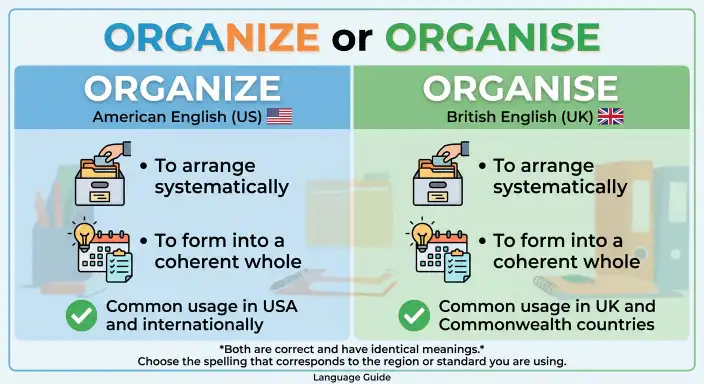
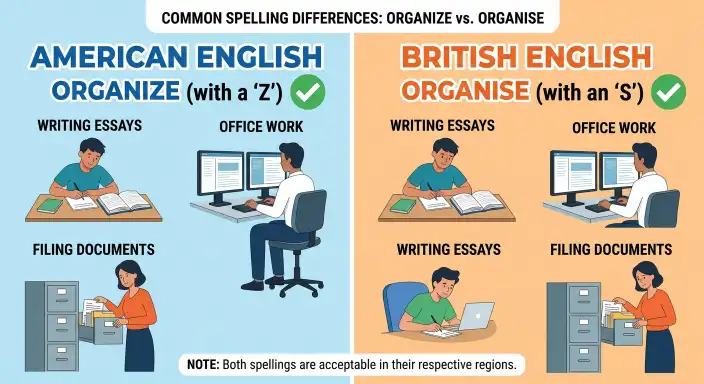
Organize and organise are both correct spellings of the same verb. The main difference is that organize is preferred in American English, while organise is commonly used in British English. Both words mean to arrange things, plan an event, or put something in order.
In this guide, you will learn the difference between organize and organise, their meanings, pronunciation, synonyms, and examples. You will also discover which spelling to use in schoolwork, professional writing, and everyday communication.
Quick Answer: Organize or Organise?
Both spellings are correct, but they are used in different forms of English.
- Organize: The preferred spelling in American English.
- Organise: A common spelling in British English.
- Meaning: To arrange, plan, or put things in order.
- Past tense: Organized or organised.
- Noun form: Organization or organisation.
Example: I need to organize my books before school.
British English example: We will organise a meeting next week.
Remember that the spelling depends on the English style you follow. Choose one form and use it consistently throughout your writing.
What Does Organize Mean?
Organize means to arrange things in a clear and useful order. It can also mean planning an event, managing a group, or preparing something carefully.
The word is widely used in American English.
Examples of Organize in Sentences
- I organize my school notes every Sunday.
- She wants to organize a birthday party.
- We need to organize our work before the deadline.
- The teacher asked us to organize the classroom.
- He organized all the files on his computer.
In each sentence, organize describes arranging, planning, or managing something.
What Does Organise Mean?
Organise has the same meaning as organize. The only difference is the spelling. It is commonly used in British English and other varieties that follow British spelling conventions.
Examples of Organise in Sentences
- I organise my books by subject.
- They will organise a school event tomorrow.
- She organised her notes before the exam.
- We must organise our time carefully.
- The students organised a charity event.
In these examples, organise means to arrange or plan something.
Organise vs Organize: Key Differences
| Feature | Organize | Organise |
| English style | American English | British English |
| Meaning | To arrange or plan | To arrange or plan |
| Present tense | Organize | Organise |
| Past tense | Organized | Organised |
| ing form | Organizing | Organising |
| Noun form | Organization | Organisation |
| Adjective form | Organizational | Organisational |
The meanings and grammatical uses are the same. The main difference is the spelling convention.
American English vs British English
American and British English use different spelling patterns for many words. The ize and ise endings are a common example.
American English
American English generally prefers ize spellings.
Examples:
- Organize
- Realize
- Recognize
- Apologize
- Modernize
British English
British English commonly uses ise spellings, although some British dictionaries and publications also accept or prefer certain ize forms.
Examples:
- Organise
- Realise
- Recognise
- Apologise
- Modernise
Important: British English does not always require ise. Some British style guides, including Oxford based conventions, use ize for many words. Follow the spelling rules required by your school, workplace, publisher, or chosen style guide.
How to Pronounce Organize and Organise
Both spellings have the same pronunciation.
- Organize: /ˈɔːrɡənaɪz/
- Organise: /ˈɔːɡənaɪz/ (a common British style transcription)
Pronunciation can vary slightly by accent. The word has three syllables: OR guh nize.
The main stress falls on the first syllable. The final sound is like the word “eyes,” but it ends with a /z/ sound.
When Should You Use Organize or Organise?
Choose the spelling that matches your audience and writing style.
Use Organize When:
- You are writing in American English.
- Your school or workplace follows American spelling.
- You are preparing content for a US audience.
- You have already used other American spellings, such as “color” and “organize.”
Use Organise When:
- You are writing in British English.
- Your school or workplace follows British spelling.
- You are preparing content for a UK audience.
- You have already used other British spellings, such as “colour” and “organise.”
For international writing, either form may be suitable. The most important rule is to remain consistent.
Common Mistakes with Organize and Organise
Writers sometimes become confused about which spelling is correct. Here are a few common mistakes to avoid.
1. Thinking One Spelling Is Always Wrong
Incorrect assumption: “Organise” is always wrong.
Correct understanding: Organize and organise are both accepted spellings in different English conventions.
2. Mixing American and British Spellings
Example of mixed spelling:
“Our company will organize the event and use British colours in its promotional materials.”
This is not automatically grammatically wrong, but it mixes spelling conventions. If the text follows British English, “organise” and “colours” would usually be more consistent.
3. Using the Wrong Verb Form
The past tense should match the spelling style.
- American English: organize, organized, organizing.
- British English: organise, organised, organising.
Avoid mixing forms in the same piece of writing unless you are quoting a source.
4. Confusing Organize with Organization
Organize is a verb. Organization is a noun.
- Verb: I organize my schedule.
- Noun: Good organization saves time.
The same distinction applies to organise and organisation.
Everyday Examples of Organise and Organize

Here are more examples to help you understand how to use both spellings.
| American English | British English |
| I organize my desk every week. | I organise my desk every week. |
| She organized the meeting. | She organised the meeting. |
| We are organizing a school trip. | We are organising a school trip. |
| They organize community events. | They organise community events. |
| He organized his files yesterday. | He organised his files yesterday. |
| We need to organize our plans. | We need to organise our plans. |
Each pair has the same meaning. Only the spelling changes.
Synonyms of Organize and Organise
If you want to avoid repeating the same word, you can use synonyms based on the sentence’s meaning.
Synonyms for Arranging Things
- Arrange
- Sort
- Order
- Systematize
- Classify
Synonyms for Planning Events
- Plan
- Coordinate
- Prepare
- Schedule
- Arrange
Example: Instead of saying, “I will organize the meeting,” you could say, “I will arrange the meeting” or “I will coordinate the meeting.”
Choose a synonym that fits the context because not every alternative has exactly the same meaning.
Frequently Asked Questions
1. Is Organize or Organise Correct?
Both are correct. Organize is preferred in American English, while organise is common in British English.
2. Is Organize American or British English?
Organize is the standard preferred spelling in American English. However, it is also accepted by some British English dictionaries and style guides.
3. Is Organise British English?
Yes. Organise is a common British English spelling and is also used in several other English speaking countries that follow British conventions.
4. What Is the Past Tense of Organize?
The American English past tense is organized. In British English, the common spelling is organised.
5. Is It Organization or Organisation?
Both forms are correct. Organization is preferred in American English, while organisation is common in British English.
6. Is Organizing or Organising Correct?
Both are correct. Use organizing in American English and organising in British English when following the corresponding spelling style.
7. Which Spelling Should I Use in an Essay?
Follow your teacher’s instructions or the required style guide. If no preference is given, choose one English convention and use it consistently.
8. Do Organize and Organise Have Different Meanings?
No. Both words mean to arrange, plan, or manage something. Their difference is spelling, not meaning.
Conclusion
The choice between organize or organise depends on the type of English you use. Organize is preferred in American English, while organise is common in British English. Both spellings are correct and share the same meaning.
If you are writing for an American audience, use “organize.” If you are following British spelling conventions, “organise” is a suitable choice. Most importantly, keep your spelling consistent throughout your writing.
Discover More Articles!
Narcissist or Autistic: What Is the Difference?
Shinning or Shining: Correct Spelling, Meaning, Differences, and Examples
Goods or Services: What’s the Difference?(2026)

Ethan Parker is an English-language writer known for his interest in words, language, and clear communication. His work focuses on making everyday English easier to understand through simple explanations and practical examples.