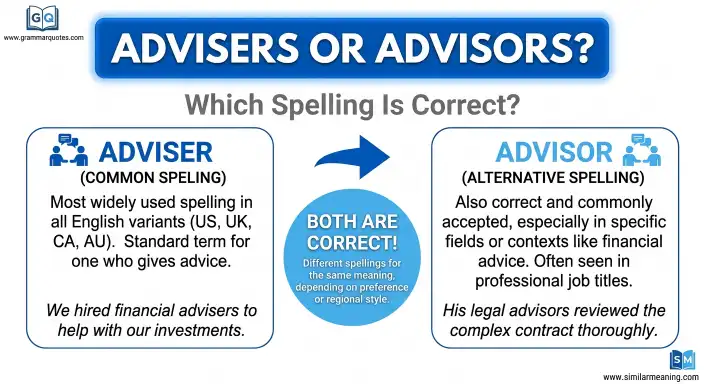
Both advisers and advisors are correct spellings, and both refer to people who give advice or guidance. The main difference is spelling, not meaning. Advisers is often associated with British English and is widely used in formal writing, while advisors is common in American English, business, finance, and professional titles.
For example, a British university might refer to academic advisers, while an American company might call its team financial advisors. However, these are general preferences, not strict rules. Both spellings are accepted in many English speaking countries, and some organizations have their own preferred form.
If you are writing an essay, business email, website article, or professional report, the best choice is to follow your audience’s spelling conventions and remain consistent. In this guide, you will learn the meanings of advisers and advisors, their origins, the differences between British and American usage, and how to use each spelling correctly in everyday and professional writing.
Advisers or Advisors: Quick Answer
There is no major difference in meaning between advisers and advisors. Both are plural nouns formed from adviser and advisor, meaning someone who gives advice.
- Advisers: Often used in British English and formal writing.
- Advisors: Common in American English, financial services, and official professional titles.
Examples:
- The school hired two experienced advisers.
- The company works with financial advisors.
- Students can contact their academic advisers for help.
Quick rule: Both spellings are correct. Choose the form that matches your preferred English style or the official spelling used by an organization.
What Do Advisers and Advisors Mean?
Advisers and advisors are plural nouns. They refer to people who help others make decisions by sharing knowledge, recommendations, or professional guidance.
The singular forms are adviser and advisor. Both come from the verb advise, which means to offer guidance or recommend a course of action.
1. Meaning of Advisers
An adviser is someone who provides advice or guidance to another person, group, business, or organization.
Examples:
- The students met their academic advisers.
- The government consulted its legal advisers.
- Our advisers helped us plan the project.
The spelling adviser is widely accepted and often appears in formal documents, educational settings, and British English publications.
2. Meaning of Advisors
An advisor has the same basic meaning as an adviser. It describes someone who provides recommendations, information, or professional support.
Examples:
- The company hired experienced financial advisors.
- The president met with his senior advisors.
- Our business advisors helped us develop a new plan.
The spelling advisor is especially familiar in American English and in many professional titles.
3. Are Advisers and Advisors the Same?
Yes. In ordinary usage, the two words have the same meaning. Both refer to people who offer advice.
For example:
- The adviser helped the student choose a course.
- The advisor helped the student choose a course.
Both sentences are correct. The difference is the spelling convention, not the person’s role.
4. Where Are These Words Used?
Both spellings appear in many fields, including:
- Education: academic advisers or academic advisors
- Finance: financial advisers or financial advisors
- Business: business advisers or business advisors
- Law: legal advisers or legal advisors
- Government: policy advisers or policy advisors
- Careers: career advisers or career advisors
In specialized settings, an institution or professional organization may use one spelling in its official job titles.
The Origin of Advisers and Advisors
Both words developed from the verb advise, which has roots in Old French and ultimately Latin. The verb means to give counsel, guidance, or a recommendation.
The noun adviser follows a familiar English pattern by adding the ending er to the verb stem. The alternative advisor uses the ending or, which appears in many English words describing people who perform a role.
Examples of similar spelling patterns include:
- Adviser and advisor
- Adviser and teacher
- Creator and instructor
- Operator and supervisor
The forms adviser and advisor developed into accepted alternatives over time. Neither spelling is simply a modern typo or an incorrect version of the other.
Why Are There Two Spellings?
English has several words with alternative endings, and usage can vary by region, profession, or organization.
The spelling adviser is common in British English and many formal publications. The spelling advisor is common in American English and frequently appears in job titles, financial services, and institutional names.
However, there is no absolute rule that all British writers must use adviser or that all American writers must use advisor.
Is One Spelling More Professional?
Neither spelling is automatically more professional. Both are standard English words.
A university may officially use academic adviser, while a financial company may use financial advisor. In these situations, follow the institution’s preferred wording rather than changing its title to match a general spelling preference.
British English vs American English
The spelling preference can differ between British and American English, but both forms are widely understood.
| British English | American English | Example |
| Adviser | Advisor | The adviser helped the student. |
| Advisers | Advisors | The advisers attended the meeting. |
| Financial adviser | Financial advisor | She spoke with a financial adviser. |
| Academic adviser | Academic advisor | The academic advisor reviewed the course plan. |
The table shows common preferences rather than fixed rules. Both forms may appear in either variety of English.
Is Adviser British or American?
Adviser is commonly associated with British English and is widely used in formal writing. It also appears in American English.
Example: The student met with an academic adviser to discuss university courses.
Is Advisor British or American?
Advisor is especially common in American English, particularly in professional titles and business settings. However, British organizations can also use it.
Example: The company hired two experienced financial advisors.
Do Advisers and Advisors Have Different Pronunciations?
The two spellings are generally pronounced the same or very similarly in English. The difference is mainly written, not spoken.
Which Spelling Do Dictionaries Accept?
Major English dictionaries recognize both adviser and advisor. The exact guidance and examples may vary by dictionary, but neither word is universally incorrect.
Which Version Should You Use?
The best spelling depends on your audience, publication, or organization’s preferred style.
United States
Both forms are correct in American English. Advisor is common in business, finance, and official job titles, while adviser also appears in formal writing.
Example: The financial advisor explained the available options.
United Kingdom
Adviser is a common choice in British English, particularly in formal and educational writing. However, advisor may appear in established titles.
Example: The student contacted an academic adviser.
Canada
Both spellings are used in Canadian English. Choose the form preferred by your organization, university, or publication.
Example: The school assigned each student an academic advisor.
Australia
Both forms can appear in Australian English. Follow your institution’s style guide or the spelling used in an official title.
Example:
The career adviser helped students prepare for interviews.
International Writing
For an international audience, either spelling is suitable. The most important thing is to choose one form and use it consistently.
If you are writing for a specific company, university, or professional service, check its official terminology first.
Academic Writing
Follow the spelling conventions required by your school, university, journal, or instructor.
For example, if your institution uses academic advisers, maintain that spelling throughout your essay or report.
Business Writing
Use the spelling found in your organization’s official documents and job titles. A financial firm that calls its staff financial advisors should generally retain that wording on its website, brochures, and business emails.
Common Mistakes With Advisers and Advisors

The most common mistake is assuming that one spelling is always correct and the other is always wrong. In reality, both forms are accepted.
| Incorrect or Inconsistent Usage | Better Usage | Explanation |
| The adviser and the advisors attended the meeting. | The advisers attended the meeting. | Use consistent wording when referring to the same group. |
| The company changed its official title from advisor to adviser without checking. | Follow the company’s official title. | Professional titles may use a preferred spelling. |
| All American writers must use advisor. | American writers can use either form. | The difference is a preference, not an absolute rule. |
| Advisers is always wrong in business writing. | Both forms are correct. | Business writing can use either spelling. |
Mistake 1: Thinking Advisers Is Incorrect
Incorrect claim: You must always write advisors.
Correct explanation: Both advisers and advisors are correct. Choose the one that matches your style guide or audience.
Mistake 2: Thinking Advisors Is Only American
Incorrect claim: British writers must never use advisor.
Correct explanation: Adviser is common in British English, but advisor can also appear in British publications and official titles.
Mistake 3: Mixing Both Spellings Without a Reason
Using both forms in the same document can make the writing look inconsistent if they refer to the same type of role.
Better approach: Choose one spelling for general use unless you are reproducing an official title that uses the other form.
Memory Tip
Remember this simple guide:
- Adviser: Often preferred in British English and formal writing.
- Advisor: Common in American business and professional titles.
Both words come from advise, and both mean someone who gives advice.
Everyday Examples of Advisors and Advisers

1. Emails
- Please contact your academic adviser before selecting your courses.
- Our financial advisors will review your application.
- The project advisers will share their recommendations tomorrow.
2. Business Writing
- The company consulted its legal advisers before signing the agreement.
- Our business advisors helped us improve the marketing plan.
- The senior advisers reviewed the proposed strategy.
3. News Headlines
- Government Advisers Discuss New Education Policy
- Financial Advisors Share Tips for Long Term Planning
- Academic Advisers Help Students Prepare for Graduation
4. Blogs
- How Academic Advisers Help Students Choose Courses
- Five Questions to Ask Your Financial Advisor
- What Business Advisers Can Teach New Entrepreneurs
5. Social Media
- Thank you to our advisers for their valuable guidance.
- Our financial advisors helped us understand our options.
- Students should speak with academic advisers before choosing a major.
6. Academic Writing
- Academic advisers support students throughout their studies.
- The research team consulted several policy advisors.
- Career advisers helped participants explore employment options.
7. Daily Conversation
- I need to speak with my adviser.
- Our business advisor gave us helpful suggestions.
- The school assigned new advisers to the students.
These examples show that both spellings fit naturally into everyday, academic, and professional communication.
Google Trends and Modern Usage
People search for “advisers or advisors” because both spellings appear in dictionaries, job titles, websites, educational institutions, and business documents.
The confusion often arises when readers encounter one form in a textbook and another on a company’s website.
Which Spelling Is More Popular?
Usage varies by region and profession. Advisor is common in American business and financial services, while adviser remains widely used in British English and formal writing.
Without checking a specific Google Trends report, it would be inaccurate to give exact search volumes or claim that one spelling is more popular worldwide.
Why Do People Search for This Keyword?
Common reasons include:
- Checking British and American spelling differences.
- Writing school assignments or university essays.
- Preparing business reports and emails.
- Choosing a title for a professional role.
- Editing website content for a specific audience.
Which Spelling Is Best for Modern Writing?
Both forms are suitable for modern English. Choose the version that matches your readers, publication, or organization’s established wording.
For content, use natural wording and consider the spelling most familiar to your target audience. Do not force both versions into every paragraph.
Advisers vs Advisors: Quick Comparison Table
| Version | Meaning | Correct? | Common Usage | Example |
| Adviser | A person who gives advice | Yes | British English and formal writing | The adviser reviewed the plan. |
| Advisers | More than one person who gives advice | Yes | British English and formal writing | The advisers attended the meeting. |
| Advisor | A person who gives advice | Yes | American English and professional titles | The advisor reviewed the plan. |
| Advisors | More than one person who gives advice | Yes | American English and professional titles | The advisors attended the meeting. |
Key Takeaways
- Advisers and advisors are both correct spellings.
- Both words mean people who provide advice or guidance.
- Adviser is often associated with British English and formal writing.
- Advisor is common in American English, finance, and professional titles.
- Neither spelling is universally wrong.
- Follow your organization’s official spelling when writing job titles.
- Choose one form and use it consistently throughout your document.
- Both words are suitable for academic, business, and everyday writing.
People Also Ask
1. Which is correct, advisers or advisors?
Both are correct. Advisers and advisors have the same meaning and refer to people who give advice. The choice depends on regional preferences, professional terminology, or a style guide. Use one form consistently unless you are following an official title.
2. Is adviser British or American English?
Adviser is commonly associated with British English and formal writing, but it is also used in American English. It is an accepted spelling in both varieties, so it is not limited to one country.
3. Is advisor more professional than adviser?
No. Neither spelling is automatically more professional. Both are standard English words. The best choice is the one used by your organization, employer, university, or target publication.
4. Why do financial companies use advisors?
Many financial companies use advisor in job titles such as financial advisor or investment advisor. These titles often follow the organization’s established terminology. Other companies use financial adviser. Both spellings are widely recognized, although specific professional or legal titles may have their own requirements.
5. What is the plural of adviser?
The plural of adviser is advisers. The plural of advisor is advisors. Both forms are correct, but the spelling of the plural should match the singular form you have chosen.
FAQs
1. Do advisers and advisors mean the same thing?
Yes. Both words refer to people who provide guidance, recommendations, or professional advice. For example, an academic adviser and an academic advisor can perform the same role. The spelling may reflect a regional preference or an institution’s official terminology, but it does not normally change the meaning.
2. Should I use adviser or advisor in an essay?
Use the form required by your school, instructor, or style guide. If no specific rule is given, either spelling is acceptable. Adviser is often preferred in British style formal writing, while advisor is common in American English. Consistency matters more than choosing one form as universally correct.
3. Is financial adviser or financial advisor correct?
Both expressions are correct. Financial adviser and financial advisor describe a person who provides financial guidance. Financial institutions may prefer one form for their official titles. When writing about a particular professional or company, use the title that the organization itself uses.
4. Can I use both advisers and advisors in one article?
You can, particularly when referring to official titles that use different spellings. However, if both words refer to the same general role, using one form throughout the article usually makes the writing more consistent. Follow a publication’s style guide when one is available.
5. Which spelling is better for content?
Neither spelling is inherently better for . Choose the form that fits your target audience and the language used by relevant organizations or readers. You can mention the alternative spelling naturally when explaining the difference, but avoid repeating both forms unnecessarily or stuffing them into headings.
Conclusion
When choosing between advisers and advisors, remember that both spellings are correct. They refer to people who provide advice, guidance, or recommendations. The difference mainly reflects regional preferences, professional terminology, and editorial style.
Advisers is often associated with British English and formal writing. Advisors is common in American English, financial services, and professional job titles. However, these preferences are not strict rules, and both forms appear across different English speaking countries.
For school assignments, follow your teacher’s or university’s spelling requirements. For business writing, use the spelling preferred by your organization. If you are writing for an international audience, choose one form and keep it consistent throughout the article.
Neither word is automatically more accurate, modern, or professional than the other. What matters most is clear writing and correct usage.
Final takeaway: Advisers and advisors both mean people who give advice. Choose the spelling that suits your audience, and use it consistently.
Discover More Articles!
Gibberish or Jibberish: Which Spelling Is Correct?(2026)
Appraise or Apprise: Meaning, Difference, and Examples
Palate or Palette: Meaning, Difference, and Examples

Ethan Parker is an English-language writer known for his interest in words, language, and clear communication. His work focuses on making everyday English easier to understand through simple explanations and practical examples.